

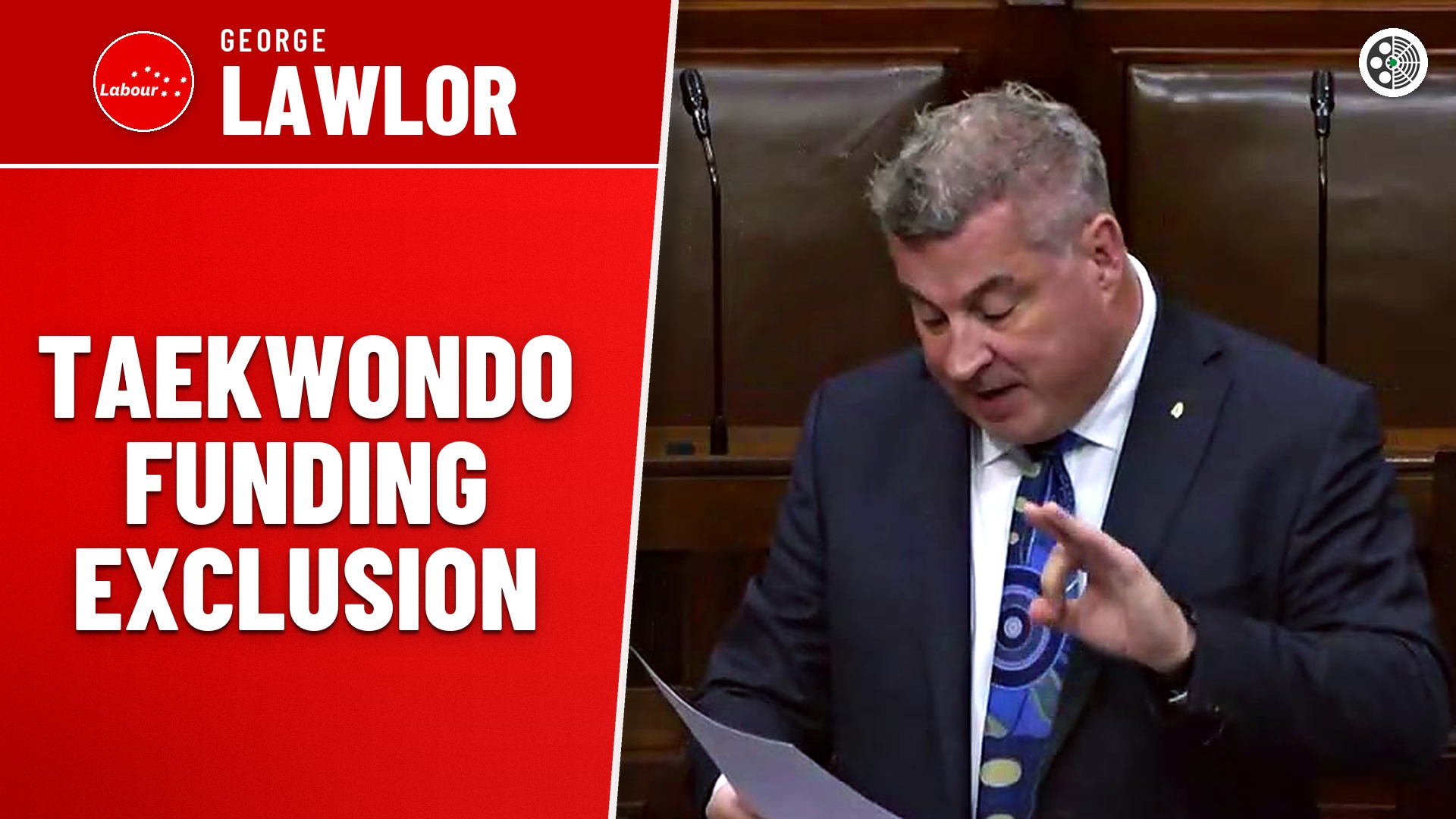


George Lawlor: 20,000 Taekwondo practitioners shut out of funding
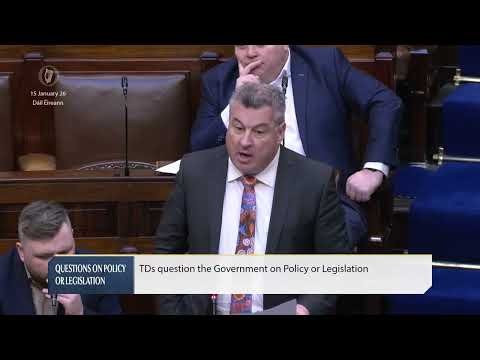
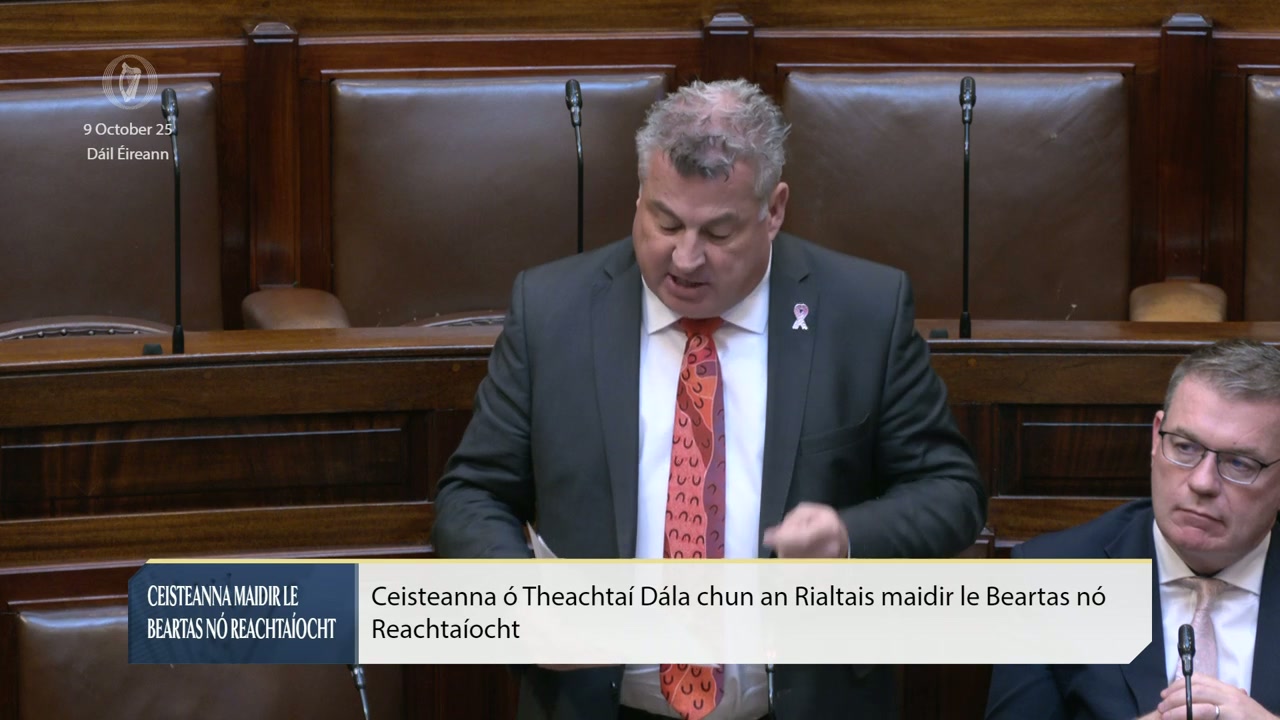
George Lawlor asked for Sports Ireland to review how Taekwondo clubs are represented and access public funding during an Oireachtas exchange on the sport. He said the recognition of one association had left around 250 clubs and thousands of practitioners without access to services, and sought an update on recommendations from a sports dispute arbitrator.
Lawlor said traditional ITF Taekwondo has an estimated 30,000 practitioners and more than 350 clubs in Ireland. He argued that the Irish Taekwondo Association represents only a portion of those clubs, while a 2020 decision by the Irish Martial Arts Commission (IMAC) to recognise it as the sole association member excluded around 250 clubs.
Lawlor raised concerns about the composition of IMAC’s board and what he described as a conflict of interest. He said the exclusion affects access to public funding, sports education courses, instructor vetting and university sports scholarships, and argued that students should not have to join one association to access support.
In response, the Minister’s representative said Sports Ireland makes recognition decisions independently under published criteria. The representative said the criteria are designed to prevent duplication and that Sports Ireland channels funding through recognised national governing bodies rather than directly to clubs or individuals.
Lawlor asked for a formal update on Sports Ireland’s engagement with IMAC and the implementation of Sports Dispute Solutions Ireland arbitrator recommendations. He also asked Sports Ireland to examine IMAC’s position on access to services and funding. The Minister’s representative said the requests would be forwarded and noted that work on the next national sports policy may provide an opportunity to re-examine Taekwondo issues.
Clubs and access to funding
Lawlor said traditional ITF Taekwondo has an estimated 30,000 practitioners and more than 350 clubs in Ireland. He argued that the Irish Taekwondo Association represents only a portion of those clubs, while a 2020 decision by the Irish Martial Arts Commission (IMAC) to recognise it as the sole association member excluded around 250 clubs.
Governance concerns
Lawlor raised concerns about the composition of IMAC’s board and what he described as a conflict of interest. He said the exclusion affects access to public funding, sports education courses, instructor vetting and university sports scholarships, and argued that students should not have to join one association to access support.
Sports Ireland’s recognition process
In response, the Minister’s representative said Sports Ireland makes recognition decisions independently under published criteria. The representative said the criteria are designed to prevent duplication and that Sports Ireland channels funding through recognised national governing bodies rather than directly to clubs or individuals.
Requests and policy review
Lawlor asked for a formal update on Sports Ireland’s engagement with IMAC and the implementation of Sports Dispute Solutions Ireland arbitrator recommendations. He also asked Sports Ireland to examine IMAC’s position on access to services and funding. The Minister’s representative said the requests would be forwarded and noted that work on the next national sports policy may provide an opportunity to re-examine Taekwondo issues.
We publish thousands of recordings to make Irish politics transparent and resistant to manipulation. Spotted an error? Report it — together we are building a reliable archive of Irish politics.
Other speeches
Tego samego dnia All speeches from this day →
Sharon Keogan
Sharon Keogan Questions Priorities on Trafficking and Online Regulation
Jen Cummins
Jen Cummins Challenges Tánaiste on Special Education
Ryan O'Meara
Ryan O'Meara calls for dedicated Treatment Unit in the Midwest
Sharon Keogan
Sharon Keogan presses National Women’s Council on trafficking
Séamus McGrath
Séamus McGrath presses for answers on school transport and places
Brendan Smith
Brendan Smith seeks next childcare grant application date
Transcript
Minister, traditional Taekwondo, called ITF, is the biggest martial art in the country,
with an estimated 30,000 people practicing it around the country.
In Ireland, there are more than 350 ITF Taekwondo clubs.
One association, called the Irish Taekwondo Association, represents about only 100 of these clubs.
The Irish Taekwondo Association and its International Federation were only registered in 2007,
and the older Taekwondo groups in Ireland are much longer established, both nationally and internationally,
and their members are much more senior in rank, with numerous Grand Masters and Senior Masters in their craft.
On October 4, 2020, the Irish Martial Arts Commission, which is the national governing body for martial arts in Ireland,
passed a motion recognising the Irish Taekwondo Association as the sole association member.
By passing this motion, the IMAC, the Irish Martial Arts Commission, immediately excluded or locked out approximately 250 clubs nationwide.
Since I visited a club in Wexford in Kilcarberry, just outside Enniscorthy in Wexford, run by Master Peter Crosby,
the quality and the standard of the skills being offered to both young and not-so-young are just immense.
I was blown away by the activities.
But this move, in essence, excluded thousands of students, or Taekwondo, from accessing public taxpayers' funding.
In the areas of sports education courses, in leadership in sports for women in particular,
it has inhibited guard vetting for instructors, it is obstructing the application of sports scholarships at university level,
as some universities only recognise the IMAC Sports Ireland Sports.
In order to access these services, the other 250 clubs around Ireland would be forced to join the Irish Taekwondo Association,
which is contrary to what happens in other jurisdictions.
For example, in the UK, the British government recognises the fragmented ITF world bodies under one umbrella, namely the British Taekwondo Council.
Funding and education courses are distributed equally and more fairly.
In Ireland, this, however, is not the case.
The IMAC in Sport Ireland allow other martial arts which are fragmented, such as karate in Ireland, to be recognised, but not the fragmented strands of ITF.
The Irish Taekwondo Association makes up the majority of the board in IMAC, with eight of its members on the committee of 13 board members.
So there's a huge conflict of interest here, where you have eight members of the ITF which don't recognise 70% of their own members controlling the IMAC, a publicly funded body.
There are serious questions regarding governance here, and the existence of proper constitutional frameworks.
And all of this goes against the ethos of both the IMAC and Sports Ireland's policy of equality and inclusion in sports.
So what are we asking? What am I asking? Can I ask that you request, Minister, a formal update from Sports Ireland on its engagement with the Irish Martial Arts Commission,
and the implementation by the Irish Martial Arts Commission of the Sports Dispute Solution Ireland, the SDSI arbitrator recommendations.
Can I also ask that Sports Ireland examine IMAC in particular, to its stance on excluding thousands from the services and funding offered by the IMAC,
and Sports Ireland once again, public funding, and excluding many Taekwondo students from across Ireland,
who are seeking fair and equal access to the recognised sporting system, and the opportunity to work with other organisations to strengthen governance, safeguarding, coaching standards, participation and welfare across the sports.
Students should not be forced to join the Irish Taekwondo Association in order to access public funding that should be for all who participate in the sport.
Thank you for your contribution, and I note your requests.
The Minister for Culture, Communications and Sport is aware of concerns regarding the representation of organisations operating within similar sporting disciplines and codes within the recognition process for national governing bodies of sport.
However, it must be stated that the recognition process for NGBs is governed by published criteria and established procedures,
and decisions regarding recognition are made independently by Sports Ireland.
In particular, part of the criteria for recognition is that a recognised NGB must not already be involved in organising the same or similar sport.
The criterion is essential to preventing duplication and the splintering of the sports ecosystem.
It would ultimately not be sustainable for Sports Ireland to formally recognise multiple organisations as NGBs for the same or similar sports, and to provide core and high-performance funding on that basis.
This is why Sports Ireland advises affiliation with existing NGBs.
Sports Ireland, which is funded by the Department for Culture, Communications and Sport, is a statutory body with responsibility for the development of sport, increasing participation at levels and raising standards,
including the allocation of funding across its various programmes, including NGBs, for sports development and high-performance programmes.
Sports Ireland does not provide direct funding for clubs or individuals, but channels the funding through the relevant national governing bodies.
The Irish Martial Arts Commission, IMAC, is the Sports Ireland recognised national governing body for martial arts in Ireland.
Sports Ireland provides annual investment to this organisation to support the development of the sports within their structure.
IMAC is constituted to represent a range of martial arts disciplines and organisations, and represents those interested in its engagement with Sports Ireland.
Taekwondo Ireland is recognised by Sports Ireland as the national governing body for Olympic-style taekwondo, and is recognised by World Taekwondo and the Olympic Federation of Ireland, Sports Ireland and the European Taekwondo Union.
Sports Ireland operates a formal recognition process for organisations wishing to become eligible for support as NGBs.
The recognition criteria set out minimum requirements for NGB recognition and the additional criteria that may need to be met to receive financial investment from Sports Ireland.
Organisations interested in engaging with Sports Ireland regarding recognition as a national governing body are encouraged to engage directly with Sports Ireland in that regard.
Sports Ireland could then advise as to the detail of the application process and consider the application on its merits.
The relevant organisation can request a formal meeting with Sports Ireland to discuss its proposed application and the wider process, prior to submitting a formal application for recognition as an NGB to Sports Ireland.
All national governing bodies of sport recognised by Sports Ireland, such as the Irish Martial Arts Commission, are independent, autonomous bodies and are responsible for the operation of their own sport.
National governing bodies are responsible for their own governance. This includes the support provided to their clubs, athletes and wider membership structure, matters relating to members, events, disciplinary procedures, safeguarding, anti-doping compliance and the development and implementation of strategic plans to grow and sustain their sports at all levels.
The national governing bodies of sport recognised by Sports Ireland are at the centre of Irish sport. NGBs are key delivering agencies for Sports Ireland in the achievement of its strategic and operational goals.
Sports Ireland works across a broad spectrum of martial arts organisations to support the development of best practice in governance, safeguarding, anti-doping, coaching standards, club development and the promotion of inclusive participation across all levels of sport.
Neither the Minister nor the Department have any role in individual recognition decisions made by Sports Ireland, nor would it be appropriate for them to intervene in such decisions.
While decisions on recognition are a matter for Sports Ireland, the Minister recognises that questions around representation, participation pathways and the development of sporting disciplines are important issues for organisations across the sporting sector, including those that are not currently recognised by national governing bodies.
Thank you Minister. There's something wrong somewhere where we have 30,000 people engaged in taekwondo to a high standard in Ireland. As I say, we're talking about youngsters that are knee high right up to people who are much older practising this sport.
30,000 and the overarching body that is recognised by Sports Ireland is excluding in excess of 20,000 of those from accessing the benefits of the funding from Sports Ireland.
So the notion that Sports Ireland would say well actually that's grand but we'll only recognise the umbrella organisation.
There's something wrong when 20,000 practitioners of taekwondo are being excluded. And there's something wrong when IMSE is governed solely by the majority of people from the Irish Taekwondo Association.
And let's not forget this is public funding. This is public money. And in excess of 20,000 people who are practising this are excluded because a decision was taken back in 2020 during Covid on an online meeting that the sole organisation when they pass this motion will be the Irish Taekwondo Association.
And by passing this motion IMSE immediately excluded and locked out 250 clubs from right across the country. I've been contacted by a lot of them on foot of my visit to Kilcarberry Club in Wexford.
So if this wasn't public funding it's a different issue. But when 20,000 people are excluded from benefiting from that funding, excluded by an overarching umbrella organisation, Sports Ireland have to intervene and ask the questions.
So the two questions I've asked earlier is can I ask that you form a formal update from Sport Ireland on its engagement with IMAC and the implementation of IMAC of the Sports Disputes Solutions Ireland recommendations.
And ask Sports Ireland to examine IMAC in particular to its stance on excluding thousands from the services funding offered by IMAC and Sports Ireland. Can I ask you that those two requests be met. Please. We're not looking for the moon.
Thank you Deputy and I will forward on your request to the Minister and I take on board what you're saying. The current national sports policy runs to the end of 2027 and is responsible for establishing Ireland's first national framework for sport.
Setting out objectives to increase participation, strengthen governance and enhance high performance sport and increase investment across the sector.
Development of the successor national sports policy is being progressed through a phased approach and will provide an opportunity to take stock of progress under the current policy and identify where future policy interventions can have the greatest impact.
Through a performance evaluation, sectoral consultation, international best review, stakeholder engagement and policy mapping the department is undertaking a comprehensive evidence gathering process to inform the successor policy.
This may be an opportunity as well to re-examine the issues in relation to Taekwondo. The work is examining the effectiveness of existing policy measures and implementation structures, identifying areas where policy approaches may require strengthening and assessing future priorities for investment and action.