

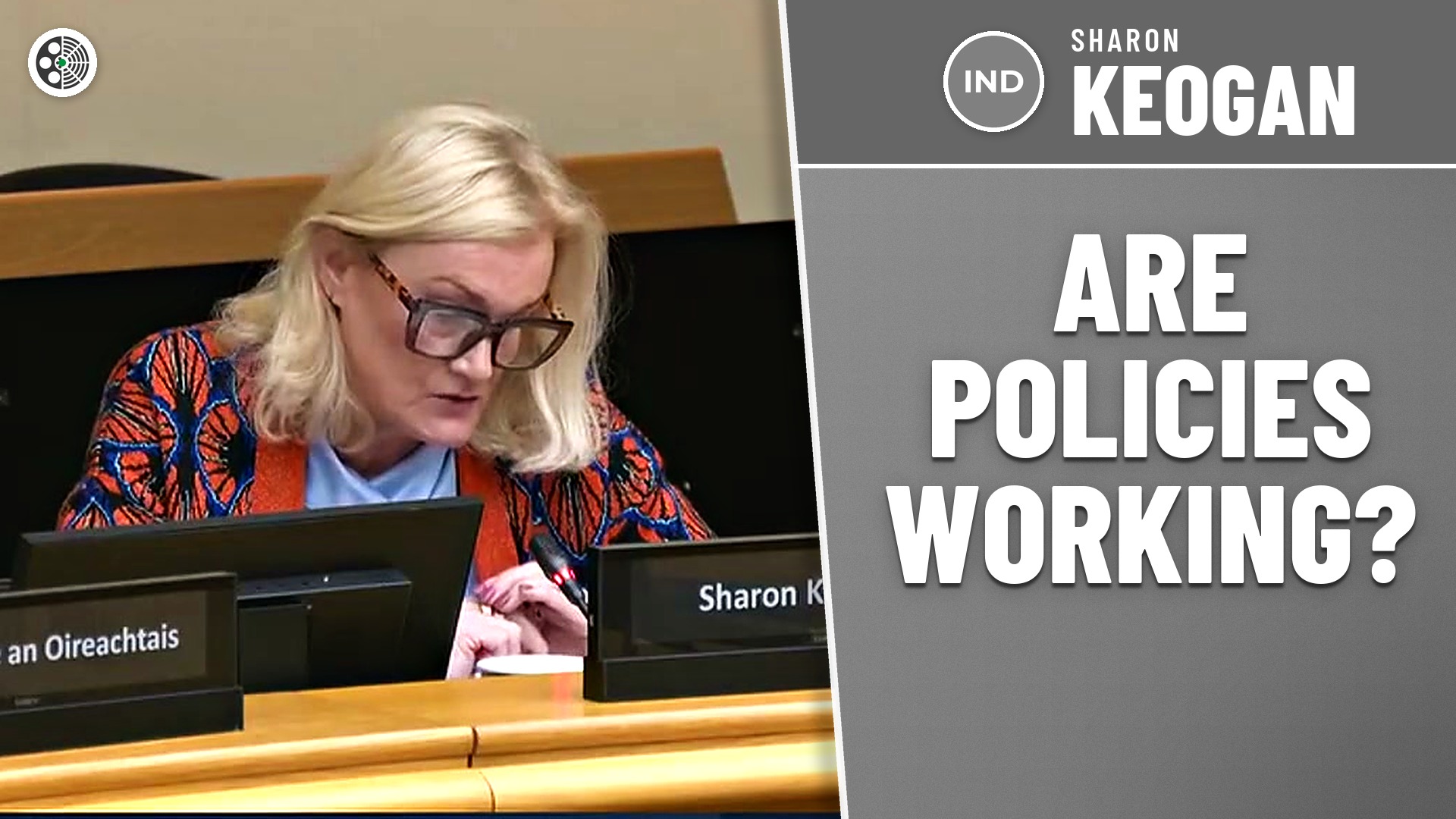


Sharon Keogan Questions Priorities on Trafficking and Online Regulation
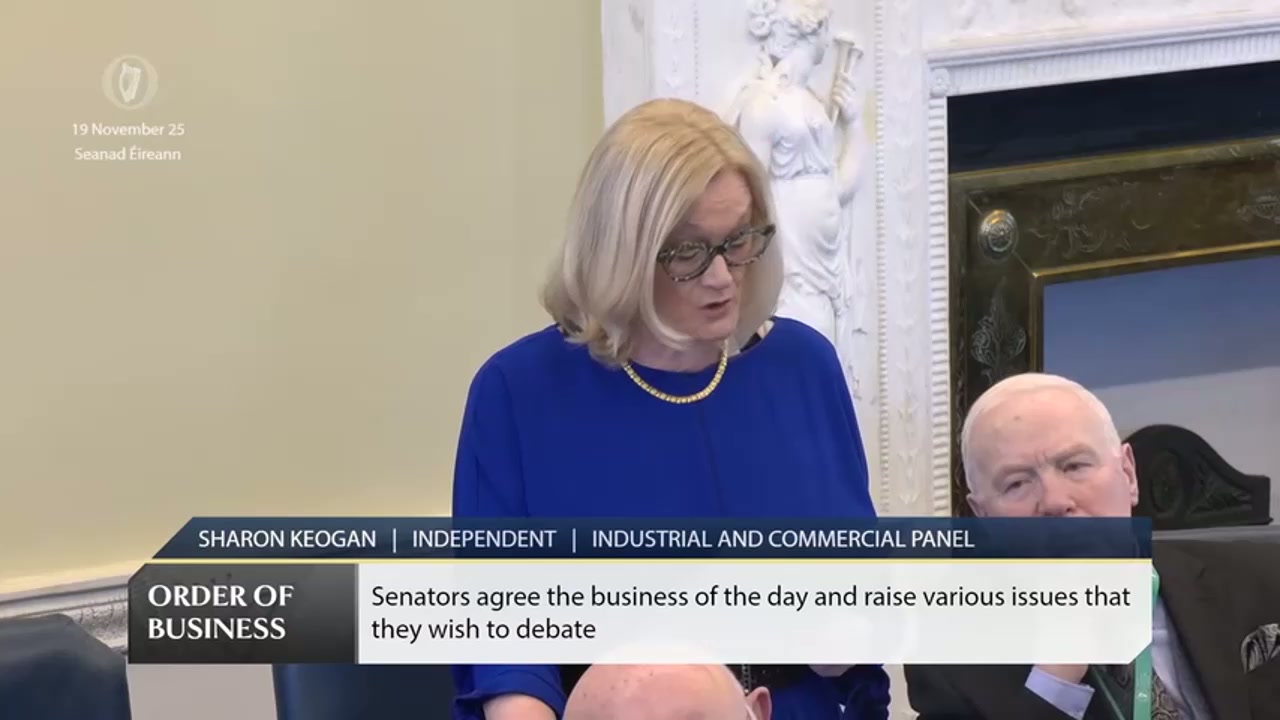
Sharon Keogan raised human trafficking, online regulation and the prevalence of lone-parent families during a discussion on gender equality and family policy. She also asked what evidence shows that existing measures have improved outcomes for women, carers and lone-parent families, and whether support services are available for domestic violence in the LGBT community.
Keogan called for greater attention to websites used for trafficking, saying that the trafficking of women in Ireland was more important to address than what she described as tradwife algorithms. A representative of the national equality body welcomed her focus and said trafficking into and within Ireland, including sexual exploitation, was a current area of work connected to online regulation.
Keogan cited census figures of 186,500 mother-led families and 33,000 father-led families, and asked why lone parenthood was more common in Ireland than elsewhere. The discussion noted that census figures do not reflect shared parenting and that differences in family counting, repartnering and remarriage may affect comparisons. Keogan also asked what evidence demonstrates that policies on childcare subsidies, parental leave, workplace rights and income supports have made a positive difference.
The discussion covered progress and continuing gaps in gender equality. A representative of the national equality body pointed to the need for more data and faster improvement, and raised women’s representation in local and national government, Dáil Éireann, Seanad Éireann and Cabinet as an area of concern.
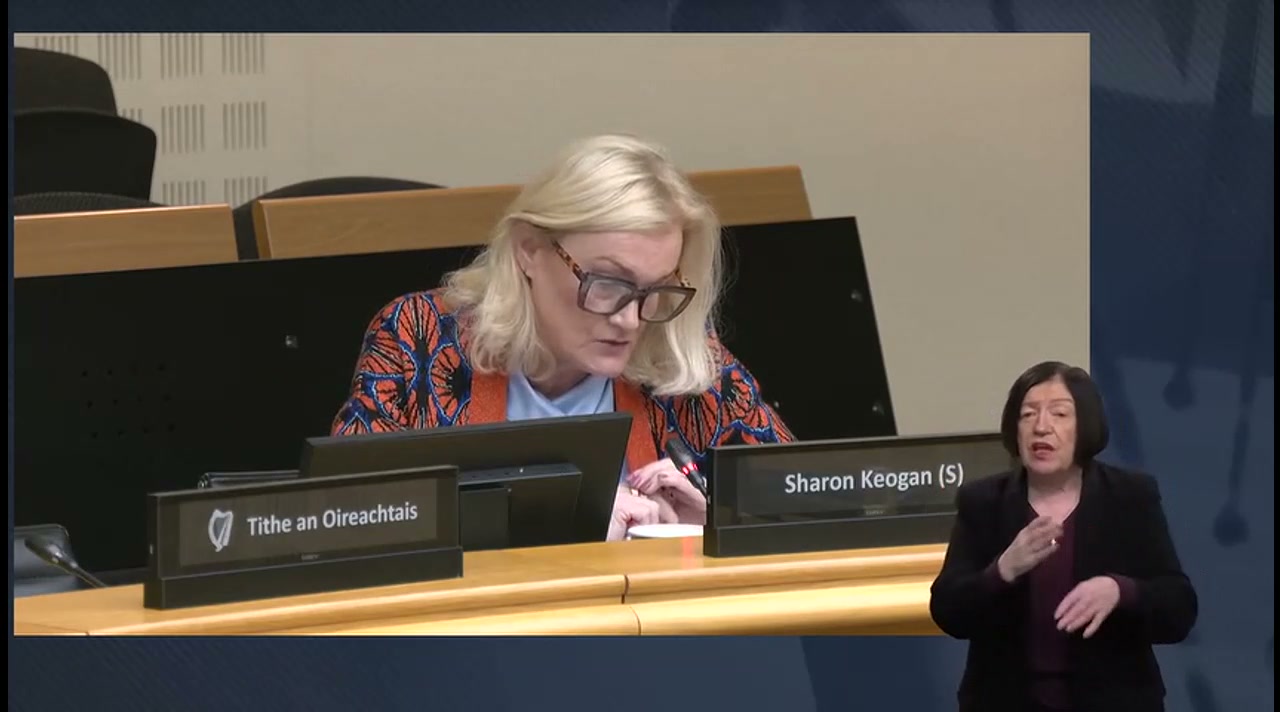
Keogan raised violence within the gay community and asked whether domestic violence services are available to LGBT people. The response emphasised the need for disaggregated data and tailored support services, so people experiencing violence can access information and protection. Watch the recording to hear the full exchange.
Trafficking and online regulation
Keogan called for greater attention to websites used for trafficking, saying that the trafficking of women in Ireland was more important to address than what she described as tradwife algorithms. A representative of the national equality body welcomed her focus and said trafficking into and within Ireland, including sexual exploitation, was a current area of work connected to online regulation.
Lone-parent families and policy evidence
Keogan cited census figures of 186,500 mother-led families and 33,000 father-led families, and asked why lone parenthood was more common in Ireland than elsewhere. The discussion noted that census figures do not reflect shared parenting and that differences in family counting, repartnering and remarriage may affect comparisons. Keogan also asked what evidence demonstrates that policies on childcare subsidies, parental leave, workplace rights and income supports have made a positive difference.
Gender equality and political representation
The discussion covered progress and continuing gaps in gender equality. A representative of the national equality body pointed to the need for more data and faster improvement, and raised women’s representation in local and national government, Dáil Éireann, Seanad Éireann and Cabinet as an area of concern.
Violence and tailored support
Keogan raised violence within the gay community and asked whether domestic violence services are available to LGBT people. The response emphasised the need for disaggregated data and tailored support services, so people experiencing violence can access information and protection. Watch the recording to hear the full exchange.
We publish thousands of recordings to make Irish politics transparent and resistant to manipulation. Spotted an error? Report it — together we are building a reliable archive of Irish politics.
Other speeches

Tego samego dnia All speeches from this day →
Ryan O'Meara
Ryan O'Meara calls for dedicated Treatment Unit in the Midwest
Richard Boyd Barrett
Richard Boyd Barrett challenges multinational R&D tax credits
Pearse Doherty
Pearse Doherty: Grandfather's plea over speech therapy delays
Séamus McGrath
Séamus McGrath presses for answers on school transport and places
Brian Stanley
Brian Stanley presses for childcare places in Laois
Richard Boyd Barrett
Richard Boyd Barrett: Redirect R&D tax breaks to education
Transcript
The Commission on Law obviously has a role in relation to regulation, whether it be on
websites or whether it be, so I would love you to advocate in relation to the abolition
of the websites for trafficking as much as you would trafficking, human trafficking in
this country, as much as you would advocate for the abolition of the tradwife algorithms
that appear as well. I think the first one is slightly more important, the trafficking
of women in this country is more important than dealing with the tradwife. I don't think
it's a thing at all in this country. Just in relation to numbers, the numbers in relation
to single parents, whether it be mothers or fathers, you're looking at 186,500 for mother
families and 33,000 father families, so one in four children in this country live in a
one in seven. Why is that, do you think?
Why is it higher? It's similar to Britain, we have a similar demographic in that respect.
Those figures are from the census and what they don't reflect is shared parenting and
I would wonder whether how the families are counted in other countries and whether people
repartner at higher rates because divorce happens quicker and there's higher remarriage
rates in other countries, whether that is masking it a bit. So there needs to be a bit
of an analysis done to explain that. But yeah, it is a very common family form with one in
four families with children, 25% of children, so when we're talking about issues like poverty
and family equality, we're talking about a lot of people in Ireland.
A question for the panel as a whole. All your organisations have advocated for policy changes
over many, many years and governments have introduced a range of measures in areas such
as childcare subsidies, parental leave, workplace rights and income supports. What evidence
do you have already introduced that have made a positive difference? Where can we point
to clear improvements in outcomes for women, carers or lone parent families and where do
you think the evidence shows current policies are still falling short?
If I could just revert to the point you were making on human trafficking, I suppose just
to flag that AIRAC is the EU national rapporteur on human trafficking, so we very much welcome
your focus on that area and we will revert to you about the specific questions that you
mentioned there, because I do think this whole area of people being trafficked into
Ireland but trafficked within Ireland and sexually exploited is a really current and
important area of work and certainly it does speak to areas such as online regulation and
a range of different things, so we very much welcome your focus on that.
And also the number of Gardaí that we have actually working in that section at this moment
in time, it's 16 for the entire country, it is tiny.
We'd be very happy to engage with you around that and I'm conscious during the EU Presidency
Ireland is hosting the European Network of National Rapporteurs so there will be a focus
on that area in the next month. I think in terms of the whole range of different areas
around gender equality, I think we still need to have more data and evidence but I would
like to see it be improved to understand what are the issues facing gender equality,
what are the barriers to it and the effectiveness of interventions in a changing world, so I
would say the fact that we now have a national equality data strategy is very important.
I think there has been movement on a number of the issues, I suppose maybe the main comment
from IRAC is that improvement needs to be accelerated, so of course as I said in my
opening statement, the establishment of COO and the fact that we are about to have a national
strategy on domestic sexual gender based violence, there is a whole range of different elements
around gender equality where we can see progress and I think it's important in the context
of maybe rehearsing some of the real challenges around gender equality that we don't lose
the wins. I would say in terms of areas we would have particular concerns, we have talked
about violence against women but I think the whole area of political representation of
women in all areas of local government and national government and that was one of the
areas that we did raise with the UN CEDAW committee, the fact that Ireland is so low
in terms of the number of women in the Dáil and the Shannad and in the Cabinet, I think
that was very shocking to us, how deteriorated that situation about political representation
has now become in Ireland, so I think that would be the area we would say, particularly because
we now haven't several years until the next national election, that is an opportunity for us
to really take action in that area. Thank you.
I really welcome the reflection on some positives for women and gender equality in Ireland,
so I actually pre-emptively prepped some facts and figures for us to reflect on.
So Ireland ranks sixth in the European Institute for Gender Equality Index from 2025,
this is an increase of 7.8 points since 2020, so we sit well above the wider EU average,
we rank first in the EU in terms of our education system, women are nearly three fourths of graduates
in health, in humanities and in arts, we rank fourth in the EU for women in senior management
as well, which is great to see, and we already reflected on women in business in terms of
childcare also. Our gender pay gap sits between 8 and 12%, which is also massively below EU average,
so that's really great to see, but more work as we have already discussed at length today is needed,
and particularly for us, we will keep banging the drum around care, around the recognition of
unpaid labour as necessary for paid labour, the need around looking at family leave policy again
and moving towards that public model, so thank you.
What's not talked about very much is violence within the gay community, and while we focus on
violence against women, there's a lot of violence that goes unreported within the gay community as
well, so I think that's something that maybe Iris you might know, there might be statistics,
I think one in four men actually in the country that are in gay relations experience violence,
in it. So maybe.
I think it's really important when we are talking about violence in Irish society that we are as
inclusive in the conversation as possible, and so as a national equality body, we sit on monitoring
committees for all of the equality strategies, and that includes the LGBTIQ strategy as well,
so thank you for raising that as a matter of concern. I don't have the data to hand,
and I suppose it goes back to what I have already said about the importance of disaggregated data
by all the equality groups, and in terms of violence against any group in Irish society,
where that appears, so it's very important that An Garda Síochána breaks down its status so we can
see who it has contact with, it's very important that the court service do that as well, and it's
very important that the support services do as well.
And are the support services there at this moment in time for domestic violence within
the LGBT community?
I think that would be when I would want to come back specifically with you in terms of
there's a comment and a recommendation there, but I think more generally what we have said is the
lack of support services and tailored support services and those sorts of different pathways,
so people can have awareness that they are experiencing violence and have information
about how they are safe and protected and can move forward. Thank you for your question.
Thank you.