

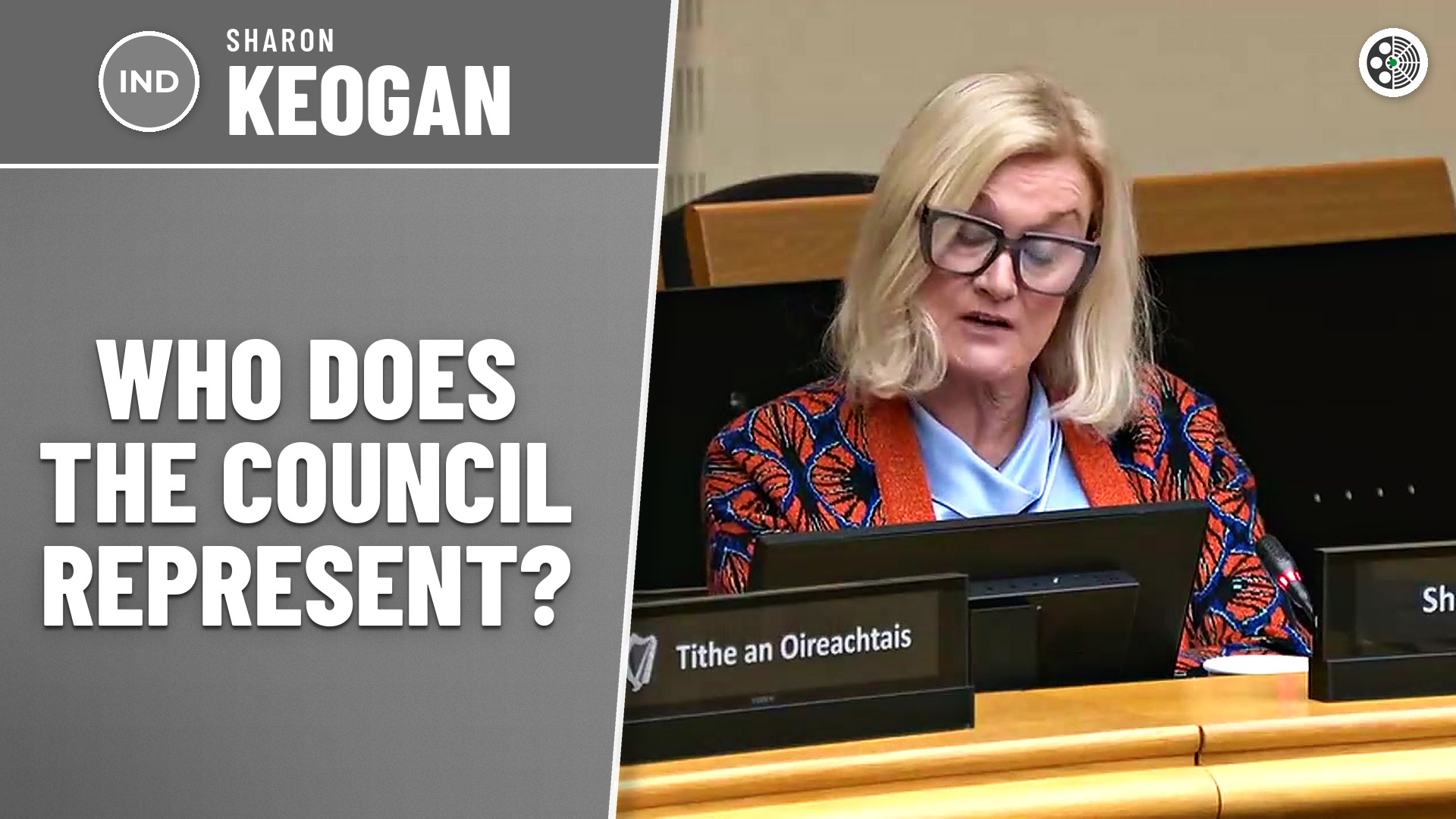


Sharon Keogan Questions Women’s Council on Who It Represents
Senator Sharon Keogan questioned the National Women’s Council about whose views it represents during a committee discussion on feminism, family policy and equality. She asked how women who disagree with the organisation’s positions are heard, and challenged its account of campaigning for a Yes-Yes vote in the family and care referendum.
Keogan said there is no single feminist viewpoint and raised disagreement among women over gender identity, sex-based rights and family life. She asked how the National Women’s Council distinguishes representing women generally from advocating for one strand of feminist thought.
The Council’s representative said the organisation has more than 200 members, including grassroots organisations, NGOs and unions, and takes its mandate from them. The representative said members’ views inform its advocacy and policy work, while the organisation aims to advance equality in Ireland.
The exchange also covered support for parents who want to stay at home with their children, the financial pressures affecting that choice and the Council’s calls for a parent to be able to stay at home during a child’s first year. The representative said children can thrive in different circumstances with loving adults around them.
Keogan challenged the Council over its support for a Yes-Yes vote, asking what it learned from the electorate’s rejection of the proposals and whether there was a gap between advocacy organisations and families. The representative said the campaign was intended to promote equality and that the wording did not help. Watch the recording to hear the full exchange.
Representation and feminist viewpoints
Keogan said there is no single feminist viewpoint and raised disagreement among women over gender identity, sex-based rights and family life. She asked how the National Women’s Council distinguishes representing women generally from advocating for one strand of feminist thought.
Membership and policy priorities
The Council’s representative said the organisation has more than 200 members, including grassroots organisations, NGOs and unions, and takes its mandate from them. The representative said members’ views inform its advocacy and policy work, while the organisation aims to advance equality in Ireland.
Care, parental leave and family life
The exchange also covered support for parents who want to stay at home with their children, the financial pressures affecting that choice and the Council’s calls for a parent to be able to stay at home during a child’s first year. The representative said children can thrive in different circumstances with loving adults around them.
The family and care referendum
Keogan challenged the Council over its support for a Yes-Yes vote, asking what it learned from the electorate’s rejection of the proposals and whether there was a gap between advocacy organisations and families. The representative said the campaign was intended to promote equality and that the wording did not help. Watch the recording to hear the full exchange.
We publish thousands of recordings to make Irish politics transparent and resistant to manipulation. Spotted an error? Report it — together we are building a reliable archive of Irish politics.
Other speeches
Tego samego dnia All speeches from this day →
Cathy Bennett
Cathy Bennett challenges school transport eligibility and fares
Richard Boyd Barrett
Richard Boyd Barrett challenges multinational R&D tax credits
Ciarán Ahern
Ciarán Ahern: Tech firms must answer for online abuse
Jen Cummins
Jen Cummins Challenges Tánaiste on Special Education
Brian Stanley
Brian Stanley presses for childcare places in Laois
George Lawlor
George Lawlor: Deepfakes expose a dangerous gap in the law
Transcript
Just for the National Women's Council, in your statement you speak about the
ambition of building a feminist Ireland. So I'd like to explore what
exactly that means. There's no single feminist viewpoint. Many women would
describe themselves as feminist, disagree with the National Women's Council on
significant issues, and I'm one of them, including questions around gender
identity, self-identification and the balance between sex-based rights and
gender-based rights. Equally, there are many women who take more traditional
views on family life, care and motherhood, and who may not identify as feminists at
all. Given that diversity of opinion, how does the Women's Council
distinguish between advocating for the interests of women generally and
advocating for one particular strand of feminist thought? When you come before
this committee and present policy recommendations in the name of women, what
do you do to ensure that women who disagree with your organisation's
positions, including dissenting feminists and women with more traditional
viewpoints, are genuinely heard and represented? Are these women heard and
represented by the National Women's Council? Thank you for your honesty as well,
Senator, it's much appreciated. I think just to go back to the fact that we are
a membership-based organisation, so we have over 200 members in the National
Women's Council. That goes from grassroots organisations, other civil
society members, NGOs, right up to the unions. So we take our mandate from our
members. Every year we have an AGM, motions are brought forward. This year
I think we had 21, which is quite large. So we listen to our members, and they're
the people that we advocate for, they're the people that we, I suppose, are
holding to. But we then also use that information that we're taking from
voices of women on the ground to bring it to government, to lobby, to get into
policy, to, I mean, the National Strategy for Women and Girls, the next DSDBB
strategy that we spoke about earlier. So a huge part of our work is looking at
the members and what they want us to do, but also by looking at equality and
essentially the work of the National Women's Council, we would think, is to
progress equality for everybody in Ireland. I mean, our opening statement, we
men being able to take up more paternity leave and having it actually related to
their pay, because we want an equal Ireland for everyone. In terms of the
people who don't agree with us, I mean, everybody has a right to an opinion.
And we do take everybody's voices on board, but our mandate is from our
members, and they're the people that we will listen to the most. I think the
traditional views, I know there's been a lot of talk about the child wife
influencer movement, and that came up very strongly a couple of months ago.
And for us, if a woman wants to be at home raising her children, she should
also be supported to do that, and we're very strong about that. I mean, today
we're talking about our leave policies, about extending leave, increasing
support for women to stay at home to raise their children, and our issue with
the child wife influencer movement is there's women out there that are making
a lot of money telling other women to stay at home and to not have jobs and to
have financial independence, and I would take concern at that. But I mean,
if a woman, as I mentioned, wants to stay at home to raise children...
Do you think a child would thrive better with the mother at home?
I think children thrive in all sorts of circumstances. I think children need
love, they need care, they need nourishment. We call out that we would
love to have a parent at home for the first year of a child's life, and that's
why a lot of our policies call out for that first year, because that is
important. And there's a lot of women in Ireland right now who can't do that,
because financially they can't afford to...
But it is financially?
Oh, I'd say a lot of it is...
Driven financially?
I would say for some people it is, not everyone, but...
Would you say the majority?
I wouldn't have figures on that at hand, and I can look into what maybe evidence
we would have there for that. I think it's definitely a factor of it. I know
I have friends who have children who would love to have stayed off but
couldn't afford it. I also have friends who were looking forward to getting
back to work, to be contributing in the way that they wanted to contribute.
But I don't think children necessarily need that for long periods of time. I
think children thrive whenever they have loving adults around them, whether that
be parents, foster parents, whatever the case may be. But definitely in terms
of our organisation, we definitely see our role to advance equality in Ireland
and to listen to our members as well.
But listening to your members, let's go back to the... Because I actually
haven't seen you since the yes, yes vote that you promoted during the
family and the care referendum. So the electorate actually decisively
rejected those proposals. So what lessons did you learn from that result?
Did you lead to any reflection that there may be a substantial gap between
the priorities of professional advocacy organisations and the priorities of
many women carers and families across the country? Or do you consider the
public simply got it wrong? I mean, here you are telling us that you represent
over 200 members. Did the unions get it wrong? Did every organisation in the
country get it wrong? And also, you used public money at that time to promote
that message. I think lots of organisations that were either in the
yes, yes or the no, no. I think everybody learnt a lot, I think, and we've
spoken about it before. But there was no organisations on the no, no. There was
very few people on the no, no side, particularly that used public money,
taxpayers' money. So you were one of the organisations that would have promoted
a yes, yes vote. You would have used public money to do that.
Do you want to allow the... Just give the answer, there's a minute left.
And for us, we felt at the time that the yes, yes was about equality and ensuring
that both a mother and or a father... So did the public get it wrong?
I think the wording did not help. And I think that the core of what we believe
for that campaign to be was about equality. So the public got it wrong?
75% of... Absolutely not, what I'm saying.
Okay. But your members got it wrong then. So somebody got it wrong. So did your
members, the 200 organisations that you seem to represent, they were fully behind
you on the SES campaign? Is that what you're saying?
A lot of them were. A lot of them were?
Yeah, yeah, yeah. Was there people that weren't with you?
I wasn't there at the time, but I imagine possibly. But we went to our members,
we asked them what they wanted us to vote for and they said yes, yes. But again,
and I will come back to it, Senator, our belief at the time was that that was about
equality. And as an organisation that is here to promote equality at the time,
that is what we believed and that's what we advocated for.
Okay, well, thank God the public got it right.
And now we're...