



Sharon Keogan presses National Women’s Council on trafficking
Sharon Keogan questioned the National Women’s Council about support for lone parents and carers seeking education, and about online prostitution services and human trafficking in Ireland. She raised these issues while discussing barriers created by social welfare rules, childcare and housing costs, and the accountability of technology companies.
Keogan asked whether carers and lone parents can take up education or training without risking social welfare payments. The National Women’s Council representative said lone parents need access to specialist courses and state investment to help them build sustainable careers and improve outcomes for their children.
The exchange highlighted the difficulty faced by lone parents caring for children with additional needs. Keogan queried whether a parent receiving a domiciliary care allowance could access education, and challenged the value of increasing education allowances if some parents cannot take up courses while receiving support.
The National Women’s Council representative identified childcare, out-of-school care and housing costs as barriers for lone parents. They said nearly 60% of families in homeless and emergency accommodation are one-parent families, and argued that the costs of childcare and housing are difficult to meet on a low or single income.
Keogan questioned the Council about its work on online escort services and human trafficking, distinguishing the issue from its previous focus on sex for rent. The representative described work on sex-for-rent legislation and said technology companies and the way online platforms are regulated remain a challenge.
Keogan pressed for stronger accountability, noting that websites can continue to carry ads despite legislation. Watch the recording to hear the full exchange.
Education and social welfare
Keogan asked whether carers and lone parents can take up education or training without risking social welfare payments. The National Women’s Council representative said lone parents need access to specialist courses and state investment to help them build sustainable careers and improve outcomes for their children.
Payments and access to courses
The exchange highlighted the difficulty faced by lone parents caring for children with additional needs. Keogan queried whether a parent receiving a domiciliary care allowance could access education, and challenged the value of increasing education allowances if some parents cannot take up courses while receiving support.
Childcare and housing pressures
The National Women’s Council representative identified childcare, out-of-school care and housing costs as barriers for lone parents. They said nearly 60% of families in homeless and emergency accommodation are one-parent families, and argued that the costs of childcare and housing are difficult to meet on a low or single income.
Online prostitution and technology companies
Keogan questioned the Council about its work on online escort services and human trafficking, distinguishing the issue from its previous focus on sex for rent. The representative described work on sex-for-rent legislation and said technology companies and the way online platforms are regulated remain a challenge.
Keogan pressed for stronger accountability, noting that websites can continue to carry ads despite legislation. Watch the recording to hear the full exchange.
We publish thousands of recordings to make Irish politics transparent and resistant to manipulation. Spotted an error? Report it — together we are building a reliable archive of Irish politics.
Other speeches



Tego samego dnia All speeches from this day →
George Lawlor
George Lawlor: Deepfakes expose a dangerous gap in the law
Richard Boyd Barrett
Richard Boyd Barrett: Redirect R&D tax breaks to education
Brendan Smith
Brendan Smith seeks next round of childcare grants
Pearse Doherty
Pearse Doherty: Grandfather's plea over speech therapy delays
George Lawlor
George Lawlor presses for Wexford student accommodation
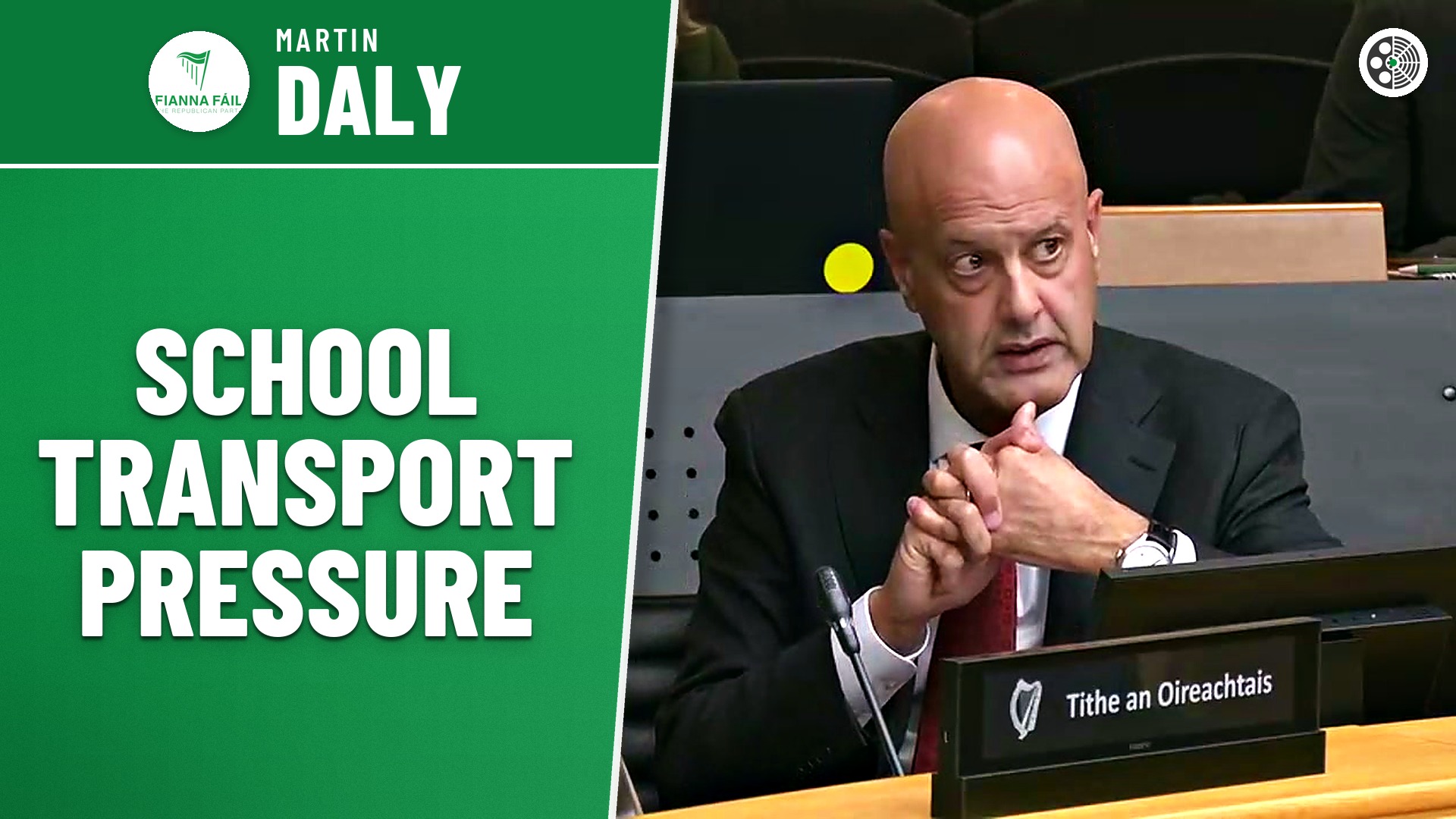
Martin Daly
Martin Daly questions school transport overspends and access
Transcript
You're all very welcome here today and I'll start off with one family and
Ailish and Karen. I have to commend you on the work that you do for families and
lone parents throughout the country. Everyone recognized the practical
assistance and advocacy that you provide for people that are facing challenging
issues every day so I really appreciate the work that you do. So one issue that
has been raised with me considering the interaction between caring
responsibilities, social welfare supports and access to education. In some cases
people feel they're caught between maintaining an allowance and
pursuing education or training that could improve their long-term employment
prospects. From your experience are there barriers within the
current system that discourages carers or lone parents from taking up education
and skill development opportunities and if so what changes would make a
difference. Yeah I think we've mentioned the fact that our experience is the
Department of Social Protection has a work first approach to activating lone
parents who are on social welfare and what we believe is needed because
unfortunately if you look at the statistics there are there's lower
educational levels amongst lone parents and for whatever reason than
other people and where there is investment in the education and the
well-being of mothers their children do much better and longitudinal studies
show that. And what we have been looking for is the time and the specialist
courses that lone parents can have access to nationally and not just
wherever we can get money either from Europe or from philanthropy to run new
futures but actually where the state will invest in those programs so that
what that means then is they can have time to move into higher and further
education and ultimately build sustainable careers move off social
welfare and become net tax contributors and lift their children out of poverty.
So at this moment in time if you're a parent a lone parent and you have a child
possibly with disability and you're getting your carer's allowance you
cannot access education programs at this time without losing that payment is that
correct? I'm going to admit I'm not the most technically technically minded
person on the intricacies of social welfare because it is incredibly
confusing yes but what we do see often is that if somebody cannot access a
payment if they're on another payment. So that really inhibits the
person that is and that child might be gone to school for five or six hours of
that day or whatever but that inhibits a mother that's living on her own to not
pursue the route to education. It may I think what every family needs to do is
maximize their income in whatever way is sensible we know that lots and lots of
parents have dropped income and try to survive on less income in order to get
through education but sometimes that is not possible and I think where there
isn't a support or a second parent around childcare and someone is relying
on college you know that is very difficult so some of the recommendations
we have to increase access to education is to increase the cost of education
allowance for parents and to exclude child maintenance from means testing for
the Susie Grant, the Student Assistance Fund and the National Childcare Scheme.
So there are practical things there isn't a clear pathway. But there is no
point increasing an education allowance if they can't access it. If you if you're
getting a carer's allowance for a child as well as if you're getting a carer's
allowance and you're a lone parent you cannot access education and you're not
allowed to access education while you're getting a carer's allowance. So increasing
an education allowance is it might be good for a lone parent that's on their
own that doesn't have a child with additional needs but it doesn't really
serve the purpose for a parent, a lone parent that may have a child with
additional needs where that parent needs to be at home most of the time
outside school. Do you mean a domiciliary care allowance? A domiciliary care allowance, yeah.
Okay yeah yeah. So you spoke about the importance of helping low
parents access employment, education and financial. In your view what are the
biggest practical obstacles preventing low parents from making that transition
today? Is it childcare? Is it housing costs? Welfare design? Access to
education or something else? And if the government could address only one issue
what would you prioritize? I think all of those things, I mean
childcare is a universal issue, it's out of school care, it is quality childcare
that you want your child to go into that you can actually find locally and
that's a massive challenge and requires massive investment. We also know that
nearly 60% of all families in homeless accommodation and emergency
accommodation are one parent families. So that is not, you know, that's not an
accident, that is by design. It is possible in Ireland practically to pay
for your childcare and housing costs on a low income or one income. Okay. We have
designed Ireland to be different and it's very very difficult. Thank you, well look
I've only two minutes left and I want to go back to the human trafficking, you
know, in this country because I feel it is something that's not talked about and
given the time that it needs and particularly the online prostitution
services that are offered in this country. I just want to know what have
your organisations done about that? We have 3,000 women, 4,000 women every
single day that are offered on websites. What have your organisations done in
relation to trying to get websites banned in this country that offer those
services illegally in this country? So I'd like to know from the National
Women's Council, how far have you done to represent those women?
At the minute what we've focused a lot on has been sex for rent in terms of the online space. So a couple of years ago we put
together a report to show the intersection between housing and homelessness
and violence against women and the big thing that came up at the time was sex
for rent. So women were often leaving domestic violence situations. I'm talking
about the online escort services that are available in this country today. The
websites that are available online today that are prostituting
women throughout this country and many of them would be trafficked into this
country. So what have you done to help and prevent that happening in this country?
Our first protocol has been around the sex for rent and we had that
legislation change this year. We're going back to assess our next protocol but the
big thing is we're trying to hold the tech companies to account for many
different things but we find that the biggest challenge and that's where we
need the support of the government to come behind us in terms of the
algorithms, in terms of what's allowed, in terms of what's been viewed as okay
because a lot of those sites are deemed appropriate and are not breaking any
breaches. So we need to hold the data protection. Well how is it appropriate if
it's illegal in this country? They find ways around it, that's the problem. So we
need to have better legislation to make sure that we can hold them to account.
Legislation is there but they're still allowed to go through with this. They
still get through gaps, they're in the dark web. So we need to hold the tech
companies to account for still allowing this to happen. The sex for rent
legislation I mentioned earlier, we still know that there are websites that are
still allowing those ads to go up. So again it's going back to big tech. Okay
thank you.