

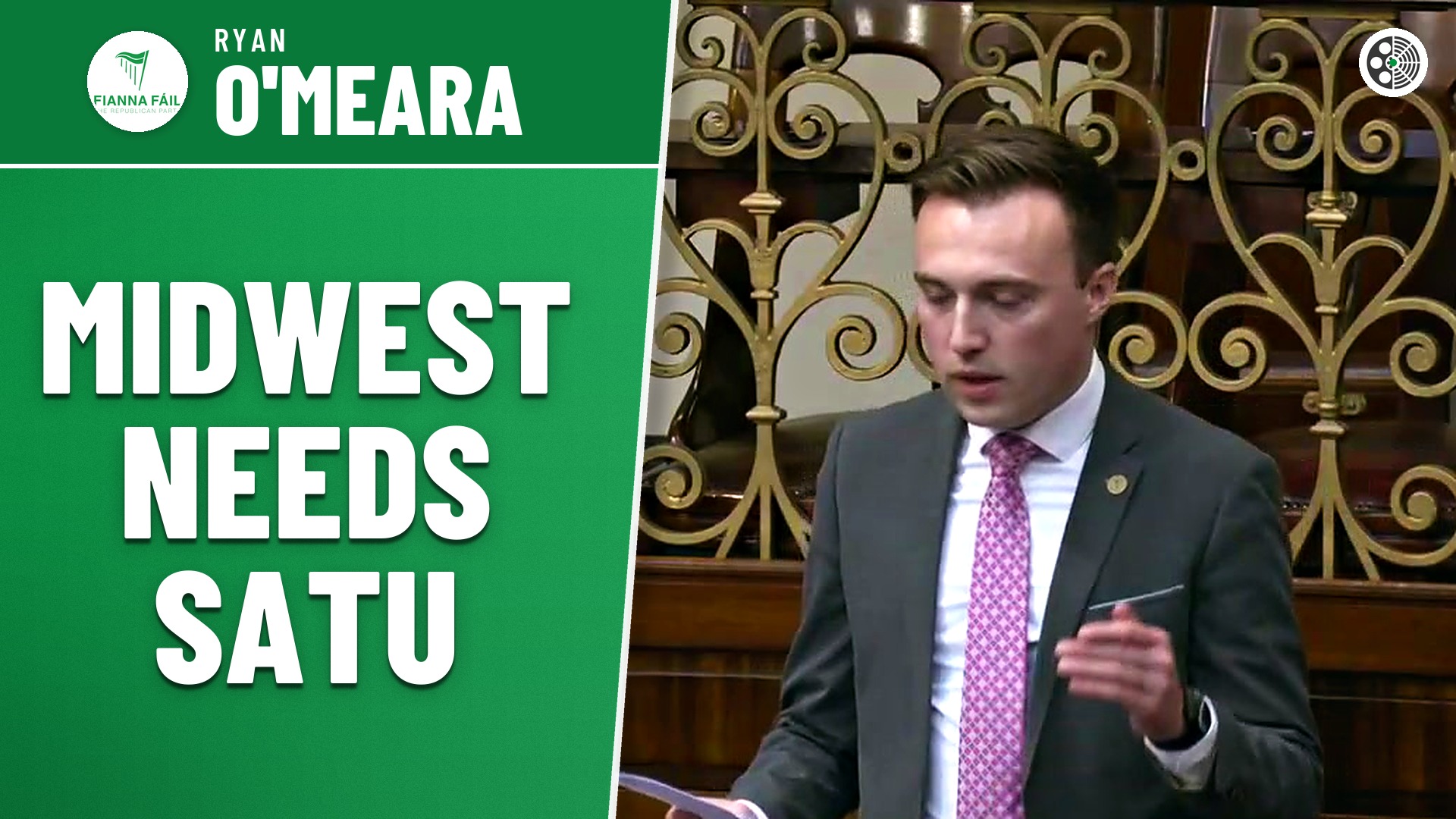


Ryan O'Meara calls for dedicated Treatment Unit in the Midwest
Ryan O'Meara has asked the Government to establish a dedicated sexual assault treatment unit in the Midwest, highlighting gaps in local access for survivors across Tipperary, Clare and Limerick. Speaking during a parliamentary debate, he said survivors can face restricted service hours, a requirement to report to Gardaí for a forensic examination and long journeys to Cork or Galway for specialist care.
O'Meara said the Midwest has a Forensic Medical Examination Service but no dedicated sexual assault treatment unit. The local service is unavailable between 7am and 7pm on weekdays, and survivors must report to Gardaí before accessing a forensic examination. Dedicated units elsewhere can provide examinations without requiring survivors to decide immediately whether to make a Garda report.
He said dedicated units bring forensic examination, immediate medical care, STI screening and psychological support together. Without an integrated local service, survivors may face waiting or travel after an assault, including journeys to Cork or Galway. O'Meara argued that access to timely and compassionate care should not depend on a person's address.
In response, the Government representative acknowledged the impact of travel on survivors and said a scoping report for a proposed Midwest unit had been finalised and submitted to the regional clinical director. A multidisciplinary working group in the Midwest had considered possible service models, with governance approvals and next steps still to be addressed.
O'Meara said he had repeatedly raised the issue through parliamentary questions and that responses had provided further data on people accessing services in Cork, Galway, Waterford and Limerick. He stressed that the figures do not capture people who do not seek care, and said a local unit is needed to improve access for survivors.
Access to specialist care
O'Meara said the Midwest has a Forensic Medical Examination Service but no dedicated sexual assault treatment unit. The local service is unavailable between 7am and 7pm on weekdays, and survivors must report to Gardaí before accessing a forensic examination. Dedicated units elsewhere can provide examinations without requiring survivors to decide immediately whether to make a Garda report.
Care and dignity
He said dedicated units bring forensic examination, immediate medical care, STI screening and psychological support together. Without an integrated local service, survivors may face waiting or travel after an assault, including journeys to Cork or Galway. O'Meara argued that access to timely and compassionate care should not depend on a person's address.
Scoping work underway
In response, the Government representative acknowledged the impact of travel on survivors and said a scoping report for a proposed Midwest unit had been finalised and submitted to the regional clinical director. A multidisciplinary working group in the Midwest had considered possible service models, with governance approvals and next steps still to be addressed.
O'Meara said he had repeatedly raised the issue through parliamentary questions and that responses had provided further data on people accessing services in Cork, Galway, Waterford and Limerick. He stressed that the figures do not capture people who do not seek care, and said a local unit is needed to improve access for survivors.
We publish thousands of recordings to make Irish politics transparent and resistant to manipulation. Spotted an error? Report it — together we are building a reliable archive of Irish politics.
Other speeches


Tego samego dnia All speeches from this day →
Brendan Smith
Brendan Smith seeks next round of childcare grants

Richard Boyd Barrett
Richard Boyd Barrett challenges EU summit priorities
Séamus McGrath
Séamus McGrath presses for answers on school transport and places
George Lawlor
George Lawlor: Deepfakes expose a dangerous gap in the law
Charles Ward
Charles Ward presses for independent engineering oversight
George Lawlor
George Lawlor: 20,000 Taekwondo practitioners shut out of funding
Transcript
I would like to raise a profound issue of importance to survivors of sexual assault
and rape across Tipperary, Clare and Limerick, and that is the absence of a sexual assault
treatment unit for the Midwest.
There are six dedicated sexual assault treatment units in this country in Cork, Dublin, Galway,
Donegal, Mullingar and Watford, but the Midwest is a glaring omission.
What we have instead is a Forensic Medical Examination Services.
It operates from 7pm to 7am, Monday to Friday and 24-7 at the weekends, but that means that
between 7am and 7pm on a weekday, there is no access to this local service.
But the disadvantage goes much further than opening hours.
Unlike a dedicated sexual assault treatment unit, the Midwest Forensic Medical Examination
Service requires a survivor to make a report to Gardaí before access to a forensic examination.
At a sexual assault treatment unit elsewhere in the country, a survivor can access the
examination without first having to decide whether to go to Gardaí in the aftermath
of an assault.
A sexual assault treatment unit also brings forensic examination, immediate medical care,
STI screening and psychological support together under one roof.
In the Midwest, these elements are not provided for in the same integrated way.
We need to consider what this means for someone who has just experienced a sexual assault.
They may be traumatised, frightened and uncertain about what to do next.
Instead of accessing immediate specialist care locally, they may face hours of waiting
or travelling to get to that sexual assault treatment unit.
At the moment, for North Tipperary, which I represent, but this is an entire Midwest
issue, people, if they want to get to a sexual assault treatment unit, and Gardaí generally
want them to go there, they have to choose Cork or Galway.
I've had local Gardaí tell me in my constituency that if someone appears in the station following
an assault or a rape, if the Gardaí can, they will drive that individual often to Galway.
But talking to people, and this is sensitive, but talking to people after an assault, they
are told that if they want the best treatment in that best centre, they have to go immediately
there without changing their clothes, without a shower.
It is a horrible thing to have to discuss with someone, but that is what they're facing
because they can't go and get that in Limerick.
This is not about seeking preferential treatment for the Midwest.
It is about equality of healthcare, dignity and basic access for specialist services.
A survivor of sexual assault should not face obstacles to timely, compassionate and comprehensive
care and dignity on the basis of their air code or address.
I am asking the government to intervene.
I have repeatedly asked the government to intervene through parliamentary questions
and I'm raising it here today.
Will the government establish a sexual assault treatment unit in the Midwest?
First of all, can I thank Deputy O'Mara, the Minister for Health, for joining me in
relation to raising this very important issue.
You're quite right to say, while you proudly represent North Tipperary, that this is actually
an issue for the region, but it's also actually an issue for the country in terms of how we
properly respond to the needs of victims and survivors of sexual assault and also to the
criminal justice piece as well in terms of the preservation of evidence and the likes
and the important role that our sexual assault treatment units play in relation to this.
I remember back when I was Minister for Health doing a piece of work with Dr Maeve Ogan at
the time in the Rotunda.
She did very good work in relation to this at the initial iteration of the Women's Health
Task Force.
I know there were, I think, six statutes around the country at the time, Cork, Dublin, Galway,
Mullingar, Leicester, Kenney and Waterford, and they were responding to around 900 plus
cases annually.
Unfortunately, this is a number that's rising year on year, so that review did make a number
of changes to protect victims, many of which have been implemented and progressed in the
intervening years.
A rapid responder on call, ROTA, so that forensic examiners can travel to support patients in
their local unit.
A rollout of more frequent and flexible modular units, interprofessional training, a pipeline
of qualified staff as well.
But there's no two ways about it.
What the Deputy has identified is true.
While our statutes are distributed nationally with the aim of providing access within that
universal three-hour window, and while yes, as you say, patients can, of course, in the
Midwest access Cork or Galway, you are right to outline the impact that having to travel
a longer distance of time can have on somebody after experiencing the most horrific crime
as well.
And I think you've described that situation very, very well too.
Now, what I will say is, I know this is something the Minister for Health wants to make progress
on.
I want to work with her on this too.
There is now a scoping report for the proposed development of a dedicated SATU service in
the Midwest.
I know it's been finalized and submitted to the regional clinical director.
I believe the Midwest region of the HSE did convene a multidisciplinary working group.
They had representatives of HSE primary care service at Midwest, the primary care team,
the regional rape crisis service, HSE social inclusion to scope potential future models
for the Midwest as well.
So we'll now obviously have that report considered by the regional clinical director and we'll
need to work together in the time ahead on next steps, looking at things like relevant
governance approval processes as well too.
But I do want to recognize the importance of the role that our sexual assault treatment
unions play and the point that you make in terms of the Midwest region too.
The overarching objective here is to ensure that all survivors of rape and sexual assault
have timely access to high quality specialist trauma-informed care delivered with compassion,
dignity, and as you rightly say, regardless of geographical location.
So the government will continue to work with you on this issue and I know the Minister
for Health will work with you on this too.
Thank you so much and Minister, thank you for your work on this.
I have consistently raised this, particularly through parliamentary questions, pretty much
this entire calendar year and what I can see from the responses coming back and from your
response today is that we are seeing some progress, most definitely.
I first raised it on the 17th of February through a parliamentary question and it was
quite a bad response at the time coming back from the HSE which was, no they weren't going
to do it.
I asked further questions on the 4th, 2 on the 4th of March, 26th of March, 14th of April,
28th of April I asked 5, I asked 10 questions, 28th of May, 9th of July, 14th of July, 7th
of September and 15th of October and each time we've been getting more data.
The data is now on the record for people who have gone to Cork, gone to Galway, gone to
Watford, who have gone into the forensic unit in Limerick but that only shows a historic
example of numbers or figures, there's people behind those but there are so many people
out there that don't go anywhere, particularly because we don't have the SATU in Limerick
and we need it for them.
Thank you very much.
Look I want to thank you Deputy O'Mara, no one can doubt the huge amount of work you've
done on this and your commitment to this issue and I want to thank you for that and I want
you to know as I know you do that the Minister for Health who's here with me is also deeply
committed to making progress in relation to how we better support victims and survivors
of sexual assault from a healthcare point of view and how that obviously feeds into
the wider whole of government and whole of society approach that we're taking to having
a zero tolerance approach to domestic sexual and gender based violence.
You've identified a very real, a very pertinent issue.
I want to thank all of those involved, the stakeholders in the region, in the Midwest
region for the work that they've done in getting things to this point and what I'd suggest
on foot of you raising this again today is that we keep the lines of communication open
now and I know the Minister will be continuing to work through this and we'll all have to
support the Minister on this as the next steps progress too.
Thank you.