

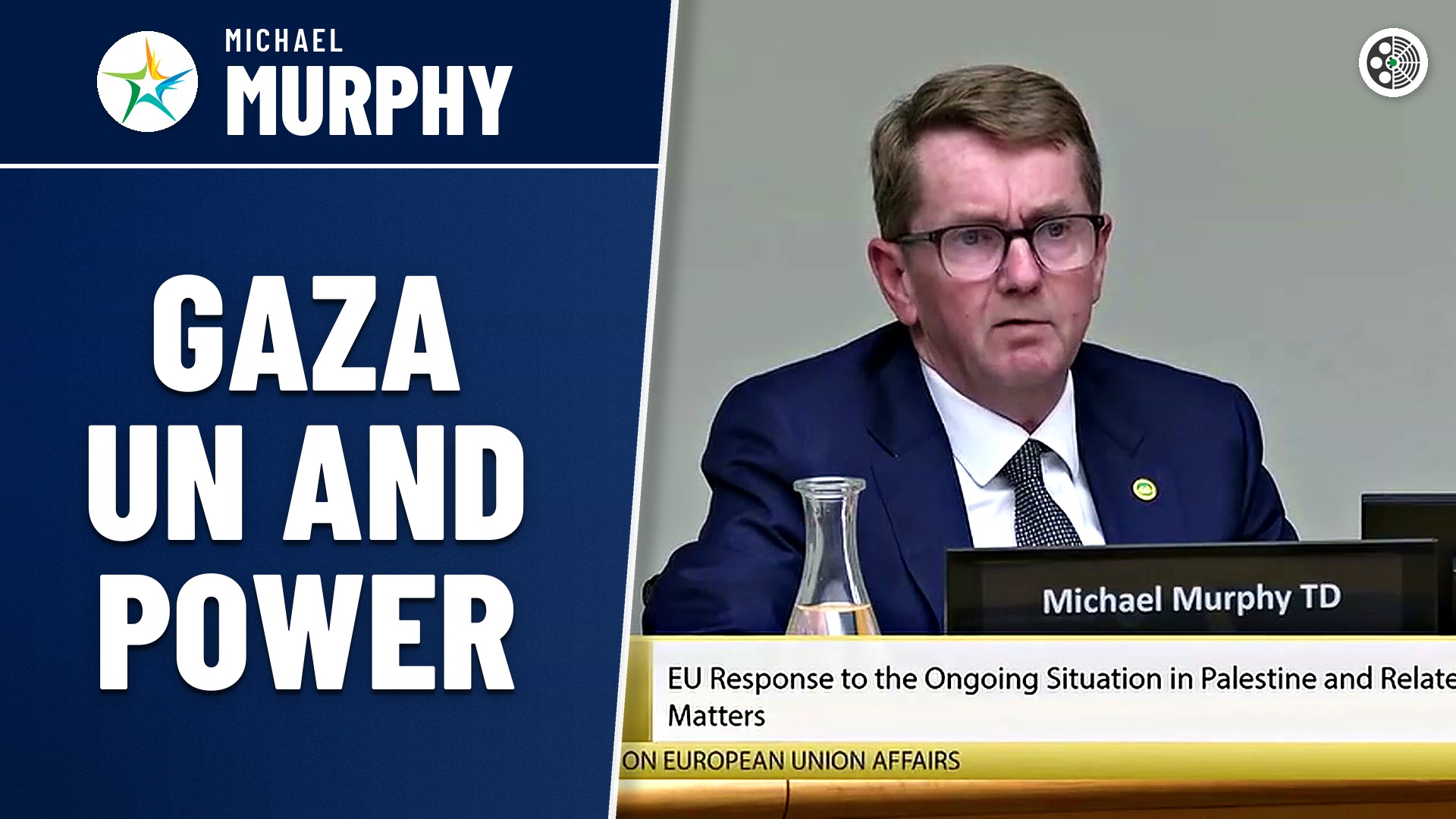


Michael Murphy questions Albanese on Gaza and the UN
Michael Murphy questioned Ms Albanese about the UN Security Council, the US administration and the impact of changes in Congress on US policy towards Gaza and the Middle East. The exchange examined the Council’s role, Palestinian self-determination and the future of multilateralism and international justice.
Murphy asked for Ms Albanese’s assessment of the Security Council and its permanent members, including whether changes in the composition of Congress could influence the US approach to Gaza. In response, she said the Council had failed to fulfil its mandate to guarantee peace and security.
Ms Albanese argued that Security Council Resolution 2803 undermined Palestinian self-determination and questioned why decisions about Gaza were placed in the hands of a body other than the UN itself. She said this approach had weakened the multilateral system.
The discussion turned to US policy, sanctions against the International Criminal Court and the protection of the United Nations and international justice system. Ms Albanese also raised concerns about actions affecting sovereignty and the risk that sanctions could affect people in Europe, including Ireland.
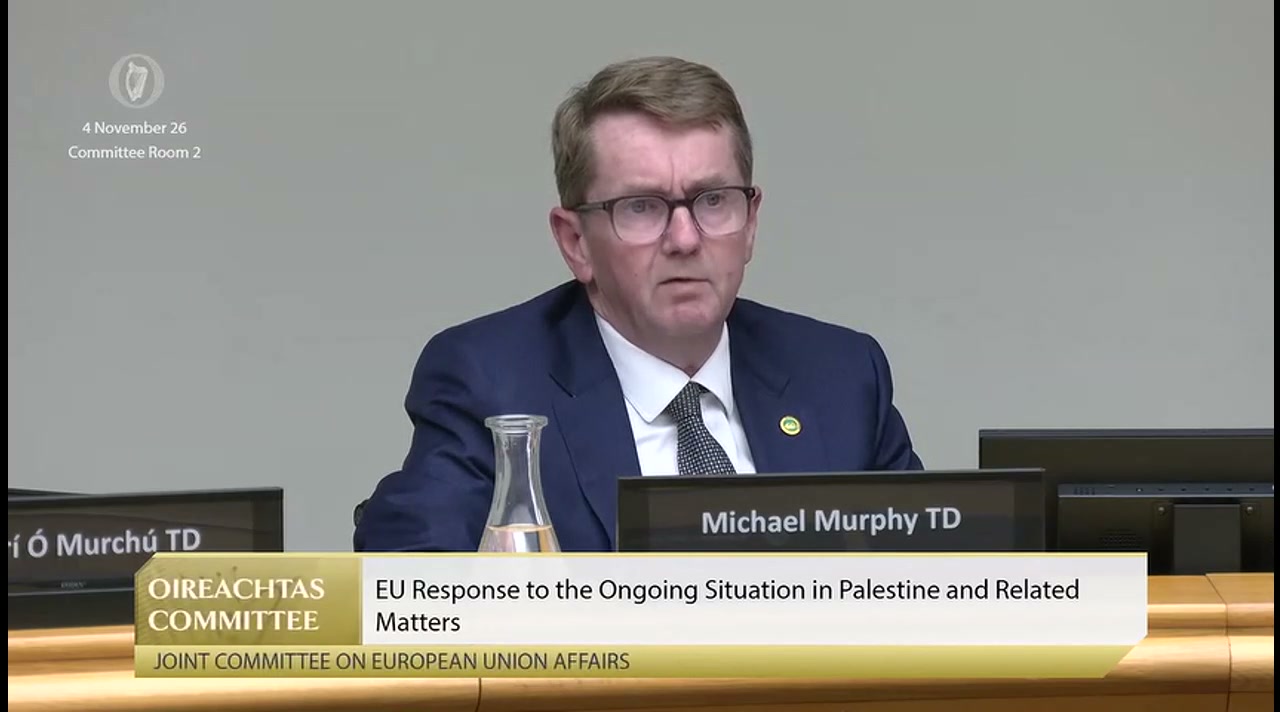
Ms Albanese distinguished the US people from what she called “predatory elites”, pointing to the concentration of power across extractive industries, big tech, the military industry and finance. She described the weakening of multilateralism as a symptom of that concentration.
The UN Security Council and Gaza
Murphy asked for Ms Albanese’s assessment of the Security Council and its permanent members, including whether changes in the composition of Congress could influence the US approach to Gaza. In response, she said the Council had failed to fulfil its mandate to guarantee peace and security.
Resolution 2803 and Palestinian self-determination
Ms Albanese argued that Security Council Resolution 2803 undermined Palestinian self-determination and questioned why decisions about Gaza were placed in the hands of a body other than the UN itself. She said this approach had weakened the multilateral system.
US policy and international law
The discussion turned to US policy, sanctions against the International Criminal Court and the protection of the United Nations and international justice system. Ms Albanese also raised concerns about actions affecting sovereignty and the risk that sanctions could affect people in Europe, including Ireland.
Power and predatory elites
Ms Albanese distinguished the US people from what she called “predatory elites”, pointing to the concentration of power across extractive industries, big tech, the military industry and finance. She described the weakening of multilateralism as a symptom of that concentration.
We publish thousands of recordings to make Irish politics transparent and resistant to manipulation. Spotted an error? Report it — together we are building a reliable archive of Irish politics.
Tego samego dnia All speeches from this day →
Edward Timmins
Edward Timmins: USC proposal would reduce tax take

Michael Fitzmaurice
Michael Fitzmaurice questions fairness in farm supply chains
Victor Boyhan
Victor Boyhan calls for debate on digital election threats
Brian Brennan
Brian Brennan challenges RTÉ on funding and value for money
Mattie McGrath
Mattie McGrath: Rural holiday lets are not housing
Ivana Bacik
Ivana Bacik Challenges Taoiseach on Data Centre Growth
Transcript
Thank you Chair. Ms. Albanese, you've been very critical, you've spoken very strongly
about the failure of the international community in terms of protecting the Palestinian people.
Can I just ask you for your views and your assessment of the UN Security Council and
particularly the permanent members of the Security Council? You've also been particularly
critical of the US administration. We've seen significant changes overnight to the
composition of the Congress. Just to ask you, do you think that's significant? Can it influence
change in the context of the US approach to Gaza and the Middle East?
Maybe it's me, but you sound surprised that I've been critical of the US administration.
Of course I've been critical of the US administration because it's leading, I repeat, the cannibalisation
of international law. I've not been critical of the UN Security Council, but surely the
UN Security Council has failed to work for what it's mandated to do, to guarantee peace
and security. That is the body that needs to make decisions when it comes to peace and
security and it has failed because of internal issues. This is besides the point. But the
thing is that meanwhile, the Security Council passed Resolution 2803, which is really, and
again there is agreement by scholars and other independent experts and the Office of the
Commission on that, it crushes Palestinian self-determination. At the height of the genocide,
how it's possible that the decision-making process regarding Gaza, which is completely
isolated from the rest of the occupied Palestinian territory, is put in the hands of a body other
than the UN itself. In fact, this has paved the way to the undermining of the multilateral
system. The US, with this administration, is severely jeopardising multilateralism because
it doesn't serve its purpose any more. The United States is driving by bullying. For
the past two years, every other day, we wake up to a new absurdity, the Gaza Riviera colonising
Greenland, waging a war of tariffs against us, against Europe or Canada, or they have
infringed upon sovereignty of other countries, really, without any sort of restraint. Again,
we might like it or dislike certain regimes, but still, there is the principle of sovereignty.
If it doesn't work for Venezuela, it might not work tomorrow for Ireland. The fact that
we leave the United States free to sanction EU individuals, today it's me, tomorrow it
might be you if you do the wrong thing. So, this is what I'm saying. It's too much bullying.
It's too much, again, the United Nations has been undermined. The United States has
imposed a sanction on the International Criminal Court. The question is not why it has been
critical. While European countries have not stood up to fully defend the United Nations
and the international justice system. So, yes, it's changing. Thank God it's changing.
Thank God there are people with a nerve who get not intimidated and went to vote and are
changing the system from the grassroots. But, of course, this takes time. And meanwhile,
again, I'm very scared of what Amnesty International calls predatory elites. I don't think that
the problem is the United States as a country, the United States as a people, because it's
also quite an equal country. But the point is that the United States is the headquarter
of the predatory elites. Those 200 people, I mean, who control the extractive industry,
the big tech, the military industry, and the banking and finance sector. And the fact that
there is so much power concentrated in a few hands is a problem for all of us, not just for,
again, the strangling of the multilateral system is a symptom of it.