



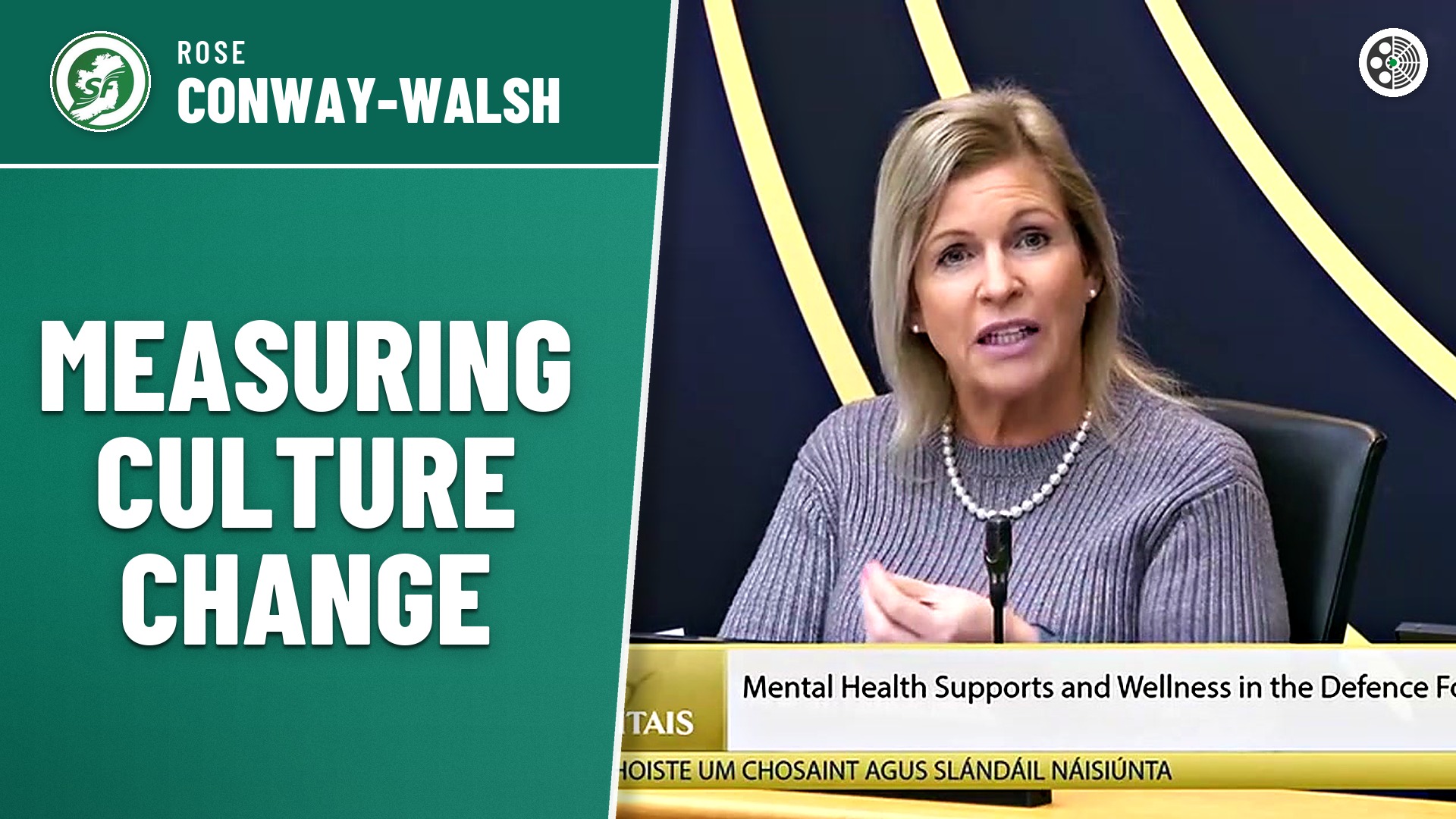
Rose Conway-Walsh questions whether social contract is broken
Rose Conway-Walsh questioned a report’s findings on youth employment and the Youth Guarantee, focusing on low pay, housing insecurity and young people’s ability to build an independent life in Ireland. She also asked about proposed changes to young people’s evening work and whether employers’ financial incentives could increase exploitation risks.
Rose Conway-Walsh asked a representative about the rise in workers aged 20 and under being paid below the minimum wage, and whether this risked exploiting young people. She contrasted the proportion of 25-to-34-year-olds living with their parents in Ireland with figures for Sweden and Finland, and asked whether being unable to afford independent housing despite working was breaking the social contract with young people.
The representative said that minimum-wage protections were intended to prevent poverty and provide a standard of living. They agreed that age-based lower pay, housing insecurity, the cost of living and a lack of hope of building an independent life in Ireland could mean the social contract had been broken for this generation.
Conway-Walsh asked about the representative’s engagement with Minister Dillon on proposed changes to later evening work for young people, including whether concerns about exploitation and risk assessment had been reflected in the legislation. The representative described raising concerns through ICTU, its youth committee and members of the National Youth Council of Ireland, and said they supported calls for an early post-implementation review.
Rose Conway-Walsh asked a representative about the rise in workers aged 20 and under being paid below the minimum wage, and whether this risked exploiting young people. She contrasted the proportion of 25-to-34-year-olds living with their parents in Ireland with figures for Sweden and Finland, and asked whether being unable to afford independent housing despite working was breaking the social contract with young people.
The representative said that minimum-wage protections were intended to prevent poverty and provide a standard of living. They agreed that age-based lower pay, housing insecurity, the cost of living and a lack of hope of building an independent life in Ireland could mean the social contract had been broken for this generation.
Conway-Walsh asked about the representative’s engagement with Minister Dillon on proposed changes to later evening work for young people, including whether concerns about exploitation and risk assessment had been reflected in the legislation. The representative described raising concerns through ICTU, its youth committee and members of the National Youth Council of Ireland, and said they supported calls for an early post-implementation review.
We publish thousands of recordings to make Irish politics transparent and resistant to manipulation. Spotted an error? Report it — together we are building a reliable archive of Irish politics.
Other speeches
Tego samego dnia All speeches from this day →
Carol Nolan
Carol Nolan Questions Short-Term Letting Bill’s Rural Impact
Helen McEntee
Helen McEntee sets out handling of Garda protected disclosure
Micheál Martin
Micheál Martin sets out Ireland’s European Council priorities
Victor Boyhan
Victor Boyhan: Keep horticulture in focus in Food Vision 2030
Seán Crowe
Seán Crowe presses Minister on EU development aid
Mattie McGrath
Mattie McGrath: Rural holiday lets are not housing
Transcript
five minutes and thank you for your presentation today. Thank you for this report. I think it's
really, really important. There's a couple of things that stand out to me in terms of your
reference to the ESRI study that found that previously around 15% of workers aged 20 and
under were paid subminimal wage rates, and that increased to 30% in the first half of 2025.
Now, I look at that in the context because I suppose the concern is, you know, the subminimal
rates and how that's increasing so much, and is that space being used to exploit youngsters? Some
might say give them an opportunity, others might say exploit them, but we are then in the situation
where we have around 40% of young people aged 25 to 34 live in their parental home.
That contrasts sharply with other advanced European economies such as Sweden and Finland,
where it's only around 2% as we spoke about. I think that's stark. So while you have a lot of
people working and working in that space, they cannot afford to leave home. So would you say
the social contract, or that that's a big factor in breaking the social contract with young people
in that, yes, you can work harder, but you still can't afford somewhere to live on your own to
live? Hi, Catherine. I think we have to go back to why, as I said earlier, why the Minimum Wage
Act was put there in place, and it's to protect people from poverty and to give people a standard
of living, and obviously there's the conversation about moving to a living wage. But if you consider
then that young people, just purely because of their age, are getting paid less, and then
you add to that housing insecurity, cost of living, the lack of hope in terms of being able to build
an independent life here in Ireland, yes, you would say the social contract is broken if that
is taken away from this generation of young people. I do note before this session you had
Minister Dillon in, and there was a whole conversation there about the statutory instrument there about later
evening work for young people, and potentially it was going to be moved for more young people then
to be in those sub-minimum rate positions more and more. I want to ask you about the engagement with
Minister Dillon specifically around that, because I was questioning him around that and the exploitation
that could happen there. What consultation did you have with him, and did you express those
concerns, and how much of those concerns were reflected in the legislation in terms of the
risk assessment to it? We had been engaging with ICTU and Paul Gavin in particular, and our
concerns around that would have been brought through ICTU, their youth committee, our members of the
National Youth Council of Ireland, so we would engage through that process. We didn't engage,
I would have to double check what correspondence we had with the Minister, but we would
share the concerns of ICTU and the correspondence that went to the Minister around the financial
incentive for employers to allocate that late evening work and the potentials there, because
we know obviously that that legislation is foremost supposed to be protective legislation, and we
didn't feel that the proposed changes adequately addressed, for example, the potential health and
with later working hours, and given that research with the ESRI, which shows that sub-minimum rates
are on the increase, we would be concerned about what the effects would be, and then we would
obviously share the asks from ICTU to commit to that early post-implementation review to assess
all those factors of those. And I asked him several times about the 800 million, the reduction to VAT
and the impact, did that have any positive impact on young workers in the hospitality sector?
Have you looked at any of that? Has any of that been passed through to young workers in the
hospitality sector? We have done no research on that. Okay, I think it would be very interesting
to do that, because a lot of young people work in that sector. So when we are looking at the
guarantee, I see the conclusions that you have made in your report here, but it is also limited
to the ambition and visibility of the guarantee, and of leaving nobody behind. I think we just have
a critical moment. You see, the whole umbrella thing of, well, we have full employment, so why
isn't everybody out working? We need to lift the bonnet and that to see, you know, is there
where young people cannot afford to work, that they can't get living near the work that they
want, they can't get the transportation and all of that. Five minutes is way too short to discuss
this, but I think your youth unemployment and youth guarantee report is excellent.