



Rose Conway-Walsh: Young workers' voices must count equally
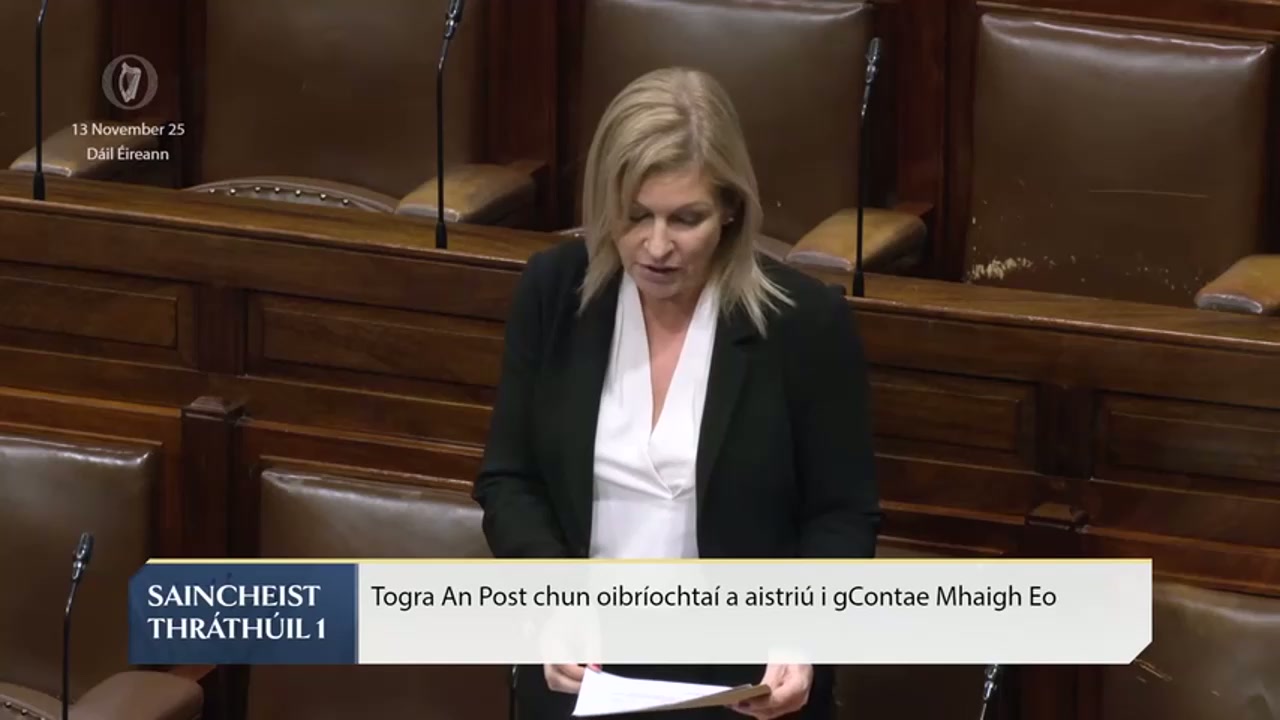
Rose Conway-Walsh questioned a Minister during a committee discussion of proposed changes to young people’s working hours in food and beverage businesses. She asked whether young workers’ voices were being weighed equally with employers’ needs, and raised concerns about exploitation, subminimum rates and the impact of the 9% VAT rate on workers’ rights.
The Minister said the Department had held a 21-day public consultation, with feedback from business organisations, trade unions and youth representative groups. Conway-Walsh asked whether youth groups had met the Department directly and what issues they had raised.
The Minister said the proposed changes would align rules for restaurants, cafés and food outlets with those for licensed premises, while retaining and extending existing protections. The Minister described the changes as offering flexibility for young people who want part-time work, including in tourism, and said 11pm would remain the latest permitted finishing time.
Conway-Walsh pressed the Minister on the risk that the changes could encourage employers to rely more heavily on lower-paid young workers. She also asked whether the Department had assessed the effects of the 9% VAT rate on workers, particularly young workers.
The Minister said the regulations did not set wage rates and that the decision to work late would rest with both the employer and the young person. Conway-Walsh concluded by stressing that young people’s voices must be equal to employers’ voices in shaping the legislation. Watch the recording to hear the full exchange.
Consultation with young people
The Minister said the Department had held a 21-day public consultation, with feedback from business organisations, trade unions and youth representative groups. Conway-Walsh asked whether youth groups had met the Department directly and what issues they had raised.
Balancing flexibility and protection
The Minister said the proposed changes would align rules for restaurants, cafés and food outlets with those for licensed premises, while retaining and extending existing protections. The Minister described the changes as offering flexibility for young people who want part-time work, including in tourism, and said 11pm would remain the latest permitted finishing time.
Concerns about cheaper labour
Conway-Walsh pressed the Minister on the risk that the changes could encourage employers to rely more heavily on lower-paid young workers. She also asked whether the Department had assessed the effects of the 9% VAT rate on workers, particularly young workers.
Young workers’ voices
The Minister said the regulations did not set wage rates and that the decision to work late would rest with both the employer and the young person. Conway-Walsh concluded by stressing that young people’s voices must be equal to employers’ voices in shaping the legislation. Watch the recording to hear the full exchange.
We publish thousands of recordings to make Irish politics transparent and resistant to manipulation. Spotted an error? Report it — together we are building a reliable archive of Irish politics.
Other speeches
Tego samego dnia All speeches from this day →
Helen McEntee
Helen McEntee sets out handling of Garda protected disclosure
Mattie McGrath
Mattie McGrath: Rural holiday lets are not housing
Joe O'Reilly
Joe O'Reilly: Protect women councillors from online abuse
Seán Crowe
Seán Crowe presses Minister on EU development aid
George Lawlor
George Lawlor: Short-term let rules must be targeted
Matt Carthy
Matt Carthy says Horkan family deserve answers
Transcript
I don't oppose this legislation but I am concerned about who is pushing it and if we are balancing
the business needs with young workers' rights. I think this is what this committee will try
and do when we are speaking about this. So maybe my first question is, I know you say
you've had consultation but how much has that consultation been with youth groups and representatives
of young people and I would like to express this time my disappointment that I cannot
see at the moment in terms of the impact of the reduction of VAT 9 has had on workers
or workers' rights and maybe to ask yourself, have you done an analysis of that, I think
and in particular how much has been passed on to young workers.
Thank you Deputy for your question. In regards to the consultation that was carried out,
the department, as I said in my opening statement, entered a public consultation and invited
representatives, stakeholders, we had feedback from business organisations, from trade unions,
IBEC, ICTU, other youth representative groups, indeed the Department of Children, Disability
and Equality also were consulted in regards to the objectives of changing this piece of
legislation. Organisations, as I said, in terms of those representing young people were
also given the opportunity to engage in the process, so it was very transparent, it was
outlining the proposed regulation changes in regards to our website.
Just to get a feel for how much engagement was there in that, did they respond to your
invitation for them to submit it or have you met with the youth groups themselves to discuss
this and what issues have they maybe raised with you?
So again we opened a 21 day consultation period and again, like any consultation, it's up
to the representative bodies themselves to report back. In terms of the feedback, it
varies, I suppose business organisations welcomed it, through the food and beverage sector.
There is a challenge in terms of labour market activation, indeed many young people see the
benefits of taking up a part time job during their educational studies to earn income,
but also to develop their life skills in terms of teamwork, in terms of discipline, in terms
of timekeeping, areas of responsibility, so this is specifically related to the food and
beverage sector and very much our focus is to continue with the existing protections
that are currently in place under the protections act of 1996, but also we are extending them
and strengthening them to coincide with licensed premises.
So this is very much addressing the anomaly that currently exists between food and beverage
sectors such as restaurants, cafes and food outlets, to align them with licensed premises.
We discussed this.
I know what it's trying to do, Minister, absolutely what it's trying to do, but I'm trying to
look, I suppose, at unintended consequences, I'm trying to look at the whole picture in
terms of subminimum rates and the fact that how we then prevent this from leading to even
more and while there are some wonderful employers in terms of employing young people, we have
to always make sure that there isn't an exploitation there and that it isn't used just for providing
greater access to cheaper labour.
So that's why I was just keen to know in what was coming back from, say, the National Youth
Council of Ireland, who we're going to have in after yourselves to discuss this, like
were there, outside of the consultation and the invitation for the submissions, were there
any specific meetings to iron out how that could be balanced or how that could be worked
in to this legislation to ensure that we weren't just going down the route of having, you know,
more cheaper labour, if you like, for the market?
Well, again, Deputy, with respect, the regulations that we're talking about today don't set the
wage rates.
They're very much, you know, that is to the employer and that is set out separately in
terms of the subminimum rates, but, you know, any exploitation of young people is unacceptable
and I think we all appreciate that.
Like, the regulations that are currently in place still are very much focused on ensuring
that we have adult supervision from 10pm onwards.
And I do welcome that.
My time is very limited.
I'm just trying to get into it of how we address the risk of having this as an incentive to
rely more heavily on lower paid workers and just have you done that risk assessment and
maybe just then the impact of, are you doing an analysis of the impact of the reduction
to 9% on VAT, the impact particularly on young workers?
Yeah, but again, Deputy, if you look at the context of why we're making this change and,
you know, the regulation doesn't say that every 16 or 17 year old should work until
11pm.
Again, that is at the discretion of both the employer but also the young person who wants
to take up employment.
And it allows, in specific circumstances, we're providing the flexibility here.
So you take Belmullet, young people who want to work within the tourism sector, at the
minute they would not be able to work within a cafe or restaurant beyond 10pm.
So this is, you know, providing the legal permission to do that.
Again, it is also giving choice to young people that they can work at the weekends or part-time.
It's also, I suppose, providing an opportunity that we have a proactive one united framework
in place.
At the minute you have two systems, which aren't, you know, very accommodating to one
versus the other.
And again, the 11pm time limit is very much the outer limit.
So, you know, you can't have anyone working past that time.
So again, this is about ensuring that, you know, young people have an opportunity to
work shifts and that employers have that flexibility.
And I completely understand, and I'm not going to shake up any more time, but I just need
to make sure that the voices of young people are equal to the voices of the employers in
this situation.
Thank you, Minister.