

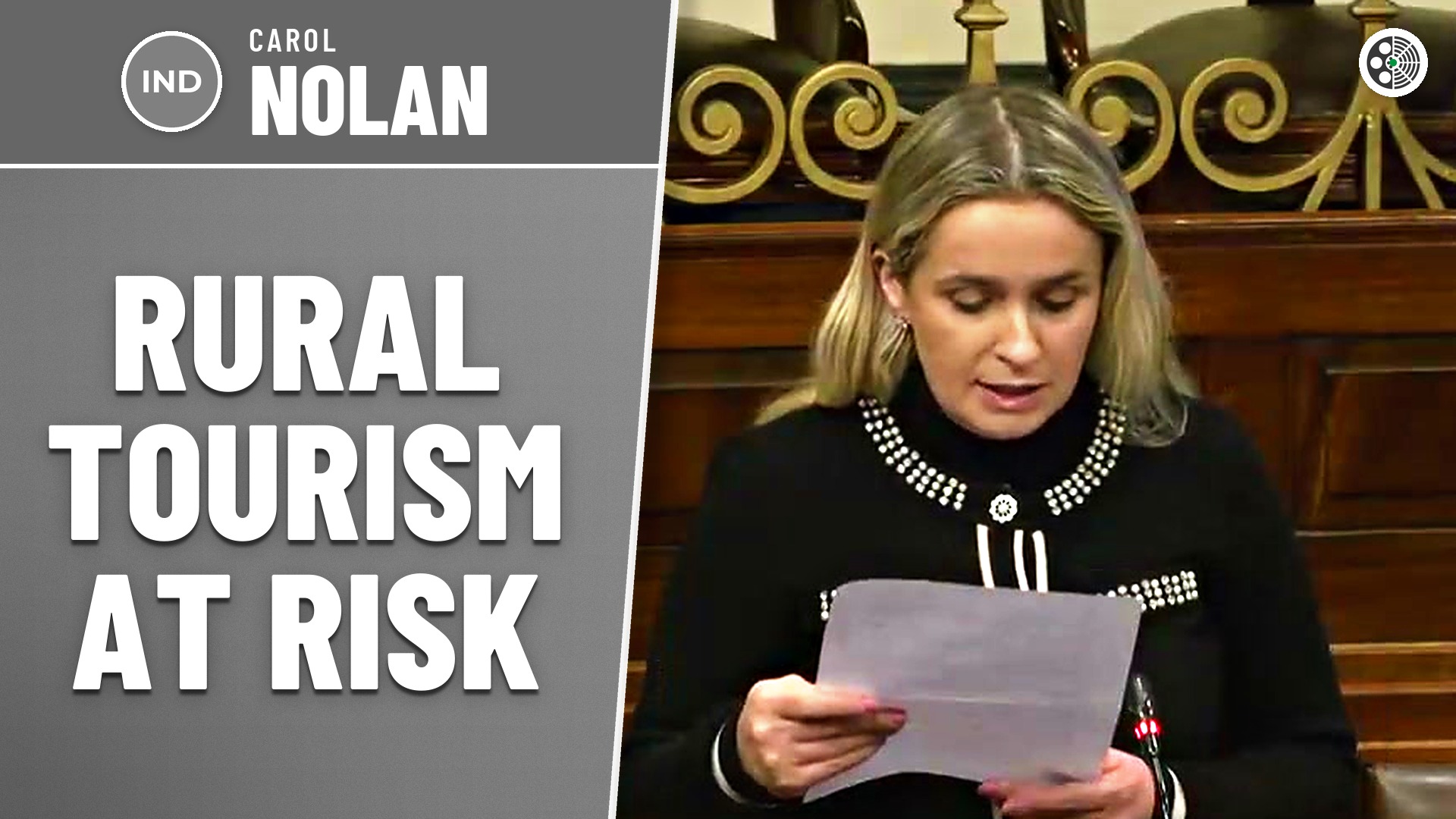


Carol Nolan Questions Short-Term Letting Bill’s Rural Impact
Carol Nolan raised concerns about the Bill’s short-term letting rules during her contribution, questioning whether their impact on rural tourism has been properly assessed. She argued that the Government should provide robust evidence that the measures will benefit housing without damaging tourism accommodation in Offaly and the Midlands.
Nolan said she supports the Bill’s aims of greater transparency, accurate data and registration of short-term lettings. However, she warned that the measures could create difficulties for rural tourism economies without clear evidence of the housing benefits they are expected to deliver.
The Bill provides for a mandatory registration regime, annual renewals and compliance requirements for hosts. It also suspends for two years the requirement for planning permission for a material change of use to short-term letting in settlements with populations below 20,000. Nolan questioned whether the different treatment of smaller settlements reflects a full assessment of the effects on rural communities.
Nolan cited concerns raised by the Irish Self-Catering Federation that the legislation, in its current form, is unworkable and could lead some providers to leave the sector. She also referred to the Irish Tourism Industry Confederation’s warning that many rural areas lack the hotel capacity to replace lost short-term letting accommodation.
Nolan said tourism in Offaly and across the Midlands relies on farmstays, self-catering properties, guest houses and independent providers serving visitors to the Shannon region, greenways and heritage attractions. She said the Government had not provided a county-by-county assessment of how many tourism beds in the Midlands could be affected.
Nolan cited the Irish Self-Catering Federation’s finding that 90% of surveyed operators would not convert their properties to long-term rentals if tourism use ceased. She argued that the State could therefore lose accommodation capacity while gaining little additional housing, and called for robust evidence on the likely consequences before the requirements are imposed. Watch the recording to hear the full contribution.
Rural tourism and the Bill
Nolan said she supports the Bill’s aims of greater transparency, accurate data and registration of short-term lettings. However, she warned that the measures could create difficulties for rural tourism economies without clear evidence of the housing benefits they are expected to deliver.
Registration and planning rules
The Bill provides for a mandatory registration regime, annual renewals and compliance requirements for hosts. It also suspends for two years the requirement for planning permission for a material change of use to short-term letting in settlements with populations below 20,000. Nolan questioned whether the different treatment of smaller settlements reflects a full assessment of the effects on rural communities.
Warnings about accommodation capacity
Nolan cited concerns raised by the Irish Self-Catering Federation that the legislation, in its current form, is unworkable and could lead some providers to leave the sector. She also referred to the Irish Tourism Industry Confederation’s warning that many rural areas lack the hotel capacity to replace lost short-term letting accommodation.
Offaly and the Midlands
Nolan said tourism in Offaly and across the Midlands relies on farmstays, self-catering properties, guest houses and independent providers serving visitors to the Shannon region, greenways and heritage attractions. She said the Government had not provided a county-by-county assessment of how many tourism beds in the Midlands could be affected.
Housing benefits and evidence
Nolan cited the Irish Self-Catering Federation’s finding that 90% of surveyed operators would not convert their properties to long-term rentals if tourism use ceased. She argued that the State could therefore lose accommodation capacity while gaining little additional housing, and called for robust evidence on the likely consequences before the requirements are imposed. Watch the recording to hear the full contribution.
We publish thousands of recordings to make Irish politics transparent and resistant to manipulation. Spotted an error? Report it — together we are building a reliable archive of Irish politics.
Other speeches
Tego samego dnia All speeches from this day →
Richard Boyd Barrett
Richard Boyd Barrett challenges EU leaders’ support for Israel
Victor Boyhan
Victor Boyhan seeks details of antibiotic-use audits
Michael Murphy
Michael Murphy questions Albanese on Gaza and the UN
Albert Dolan
Albert Dolan: EU competitiveness must reach local businesses
Sharon Keogan
Sharon Keogan calls for savings scheme for children in care
Evanne Ní Chuilinn
Evanne Ní Chuilinn challenges RTÉ over hiring transparency
Transcript
I support the principle behind this Bill. Greater transparency, accurate data and proper
registration of short-term lettings are legitimate objectives. However, legislation should be
judged not only by its intentions but by its likely effects and indeed its impact. I am
concerned that this Bill may create difficulties for rural tourism economies without clear
evidence that it will actually deliver the housing benefits it claims.
The Government itself appears to recognise that rural Ireland faces different circumstances.
The Bill amends the Planning and Development Act 2024 by inserting a new section 83a which
suspends for two years the requirement for planning permission for a material change
of use to short-term letting in settlements with populations below 20,000.
If the same policy cannot be applied equally across the state, then it is reasonable to
ask whether the full impact on rural communities has been properly assessed.
Section 11 of the Bill inserts new sections 27a to 27d into the Tourist Traffic Act 1939.
These provisions establish a mandatory registration regime, place responsibility on Fáiltea Ireland
as the competent authority, require hosts to provide specific information, provide for
registration and renewal of fees and create offences for non-compliance. Section 13 then
provides that registrations will last for just 12 months before renewal is required.
Taken individually, none of these measures appear excessive, but the question is what
happens when they operate together. For large commercial operators, registration, annual
renewals and compliance obligations may simply become another business cost.
The Irish Self-Catering Federation told the Oireachtas Committee that the legislation
in its current form is absolutely unworkable and that it risks closing down elements of
rural tourism and this concerns me greatly.
It also warned that many properties which have provided visitor accommodation for years
may leave the sector altogether. The Irish Tourism Industry Confederation has similarly
warned that many rural areas do not have enough hotel capacity to replace the short, the lost
short-term letting accommodation. If bed capacity disappears, the wider tourism economy loses with it.
This is particularly relevant in my own county of Offaly and indeed across the Midlands.
Our tourism offering entirely depends on a dispersed network of farmstays, self-catering
properties, guest houses and independent providers serving visitors to Bòr, Loch Bóire and the
Shannon region, our greenways and our heritage attractions. What concerns me most of all is the
absence of clear evidence. As far as I can see, the government has not produced a county-by-county
showing how many tourism beds in the Midlands may be affected. Indeed, the Irish Self-Catering
Federation states that 90% of operators surveyed would not convert their properties to long-term
rentals if tourism use ceased. If that is correct, then the state could lose valuable accommodation
capacity while gaining very little in terms of additional housing. Before this House imposes a
annual registration regime, renewals, compliance obligations and enforcement powers, the government
should show that it understands the likely consequences for rural tourism and indeed the
impact on counties such as County Offaly. Good legislation requires strong, robust evidence.
I am not convinced that that evidence has been provided because no assessment has been done.
you