

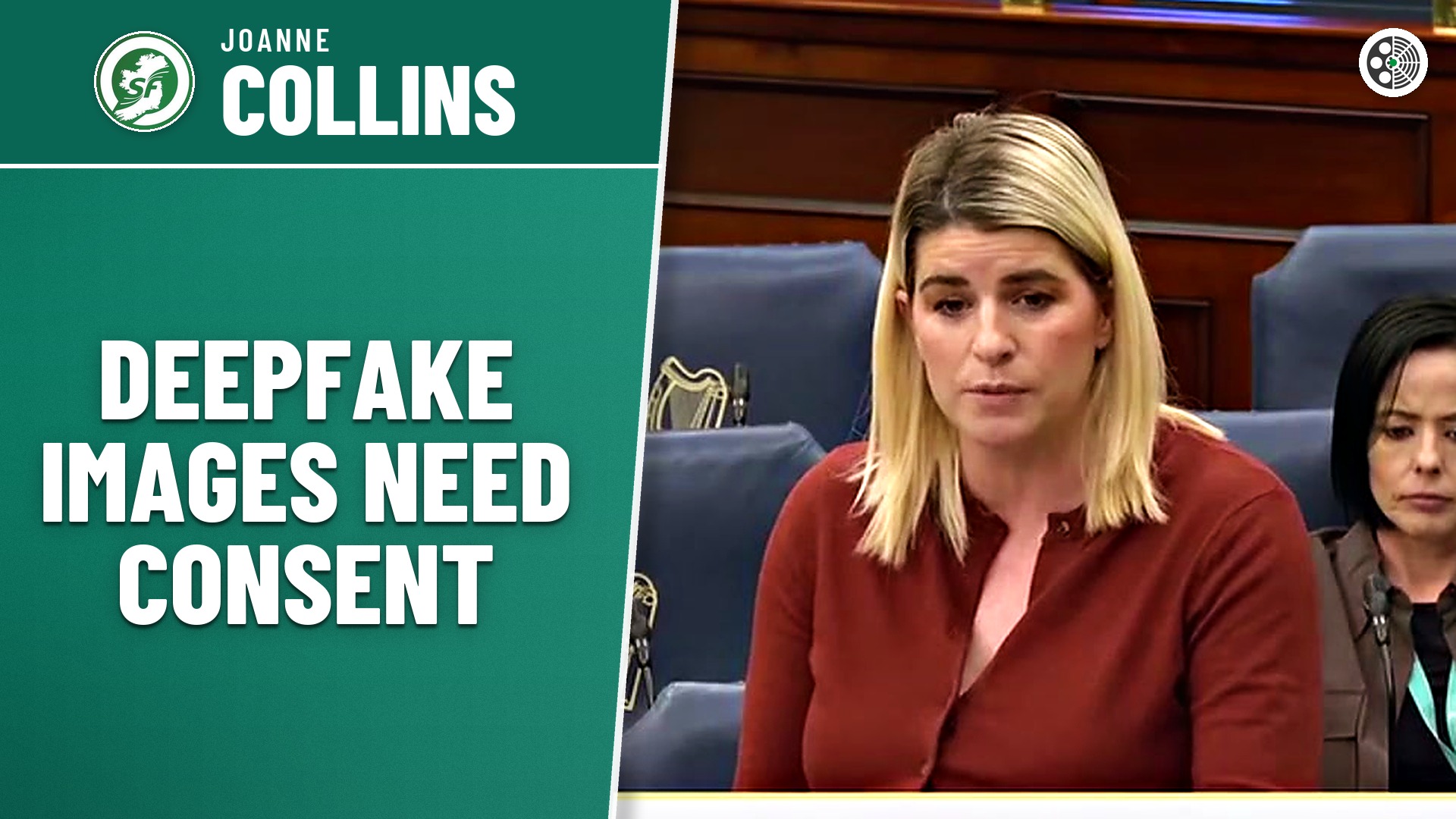


Joanne Collins backs action on non-consensual deepfake images
Joanne Collins supported legislation in Seanad Éireann to create offences relating to non-consensual deepfake intimate images. She said the Bill would help protect people from online abuse and called for laws to keep pace with rapidly changing technology.
Collins said that AI can bring benefits but also creates risks that are not yet fully understood. She warned that manipulated intimate images can cause humiliation, anxiety, depression, reputational damage and a profound invasion of privacy, with images often difficult to control once shared online.
She welcomed provisions creating specific criminal offences for creating deepfake intimate images without consent and with the intention of causing harm. She also backed provisions covering people who induce or attempt to induce someone else to create such images, saying responsibility should extend beyond the person who generates them.
Collins highlighted the provision allowing victims to seek identification orders through the Circuit Court, noting that online abuse is often anonymous. She also welcomed court powers to order access to services to be blocked where they are being used to create deepfake images.
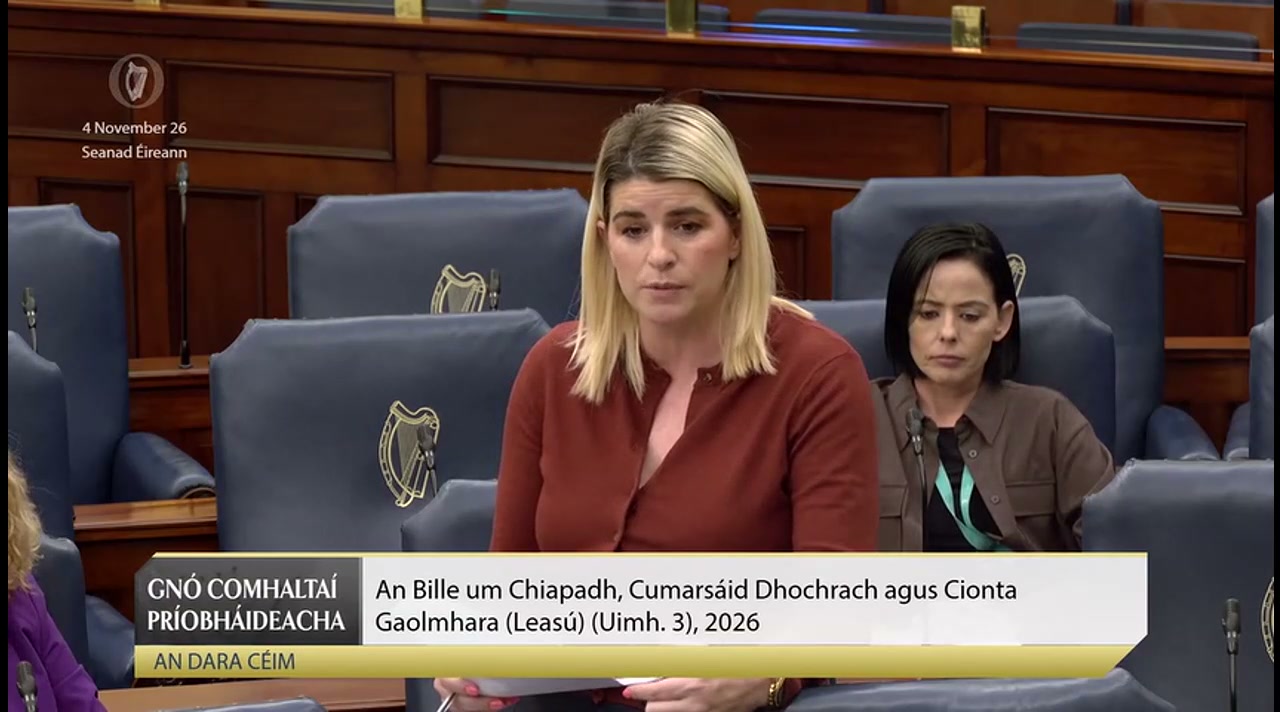
She said online platforms have a role in preventing abuse and protecting users, while stressing that measures must be proportionate and respect users’ rights. Collins said the legislation was about dignity, consent and privacy, and that the law must recognise and address harm caused online.
Protecting consent and dignity
Collins said that AI can bring benefits but also creates risks that are not yet fully understood. She warned that manipulated intimate images can cause humiliation, anxiety, depression, reputational damage and a profound invasion of privacy, with images often difficult to control once shared online.
Offences and accountability
She welcomed provisions creating specific criminal offences for creating deepfake intimate images without consent and with the intention of causing harm. She also backed provisions covering people who induce or attempt to induce someone else to create such images, saying responsibility should extend beyond the person who generates them.
Identifying perpetrators and blocking services
Collins highlighted the provision allowing victims to seek identification orders through the Circuit Court, noting that online abuse is often anonymous. She also welcomed court powers to order access to services to be blocked where they are being used to create deepfake images.
Platform responsibility and legal safeguards
She said online platforms have a role in preventing abuse and protecting users, while stressing that measures must be proportionate and respect users’ rights. Collins said the legislation was about dignity, consent and privacy, and that the law must recognise and address harm caused online.
We publish thousands of recordings to make Irish politics transparent and resistant to manipulation. Spotted an error? Report it — together we are building a reliable archive of Irish politics.
Tego samego dnia All speeches from this day →
Michael Healy-Rae
Michael Healy-Rae: Short-term let bill creates uncertainty
Natasha Newsome Drennan
Natasha Newsome Drennan: Farmers must not pay for EU priorities
Matt Carthy
Matt Carthy Says Criminal Justice System Is in ‘Absolute Chaos’
Seán Crowe
Seán Crowe presses Minister on EU development aid
Seán Kyne
Seán Kyne backs balanced rural short-term letting rules
Daniel Ennis
Daniel Ennis: Short-term lets must return homes to families
Transcript
Welcome Minister, and I just too want to commend my colleagues, Senators Flynn, Ruan, Higgins
and Black for bringing this important legislation forward.
And I'm delighted to hear the government aren't objecting to it, which is great because I
think across the floor it has been brought up, whether it's in order of business or commencement
matters, it is an issue and it's an issue that deserves our attention because like has
been said before, technology sometimes does move quicker than our laws can move, and technology
moves so fast sometimes it's impossible for the law to keep up with it, so I know it would
be nice to have it there before something happens, it's not always possible, so I have
to commend my colleagues for getting this in so quick.
And AI has brought enormous benefit, whether it's in work or whether it's when you ring
up a company and you go through the AI system, sometimes it can be quicker than speaking
to a person in one regard, but it does bring a lot of the other side where we don't fully
understand what can be done, so there's two sides to AI, so no way am I standing here
bashing AI, I think there is a place in society for it, we just need to have the mechanisms
to protect people when it comes to it.
One of the most alarming developments is obviously the creation of these disturbing images.
For a person who is targeted, the consequences are absolutely devastating from anything from
humiliation to the distress, anxiety, depression, reputational damage, and profound invasion
of their privacy, and unlike many other forms of abuse, once an image goes online, it's
almost impossible to rein it back in or rein control over it.
What makes this particularly concerning is that a person no longer needs to have taken
that intimate image or photograph or video for someone to exploit them.
The photograph can now be taken from a social media account and potentially be manipulated
and used for something completely degrading and entirely without their consent.
This is an issue that disproportionately does threaten women and girls, but I have to say
it can happen to anyone, it can happen to boys, it can happen to men, and it's quite
scary how easy it's done.
Consent must remain at the heart of this conversation.
A person's image, identity and dignity are not public property.
Having a photograph online does not give everybody or anybody the permission to manipulate it
into something sexually explicit material.
I particularly welcome the provision in the Bill which creates the specific criminal offences
for the creation of deepfake intimate images without consent and where there is an intention
to cause harm.
Importantly, the Bill also addresses those who induce or attempt to induce another person
to create these images.
That is significant because responsibility must not solely lie with the person who physically
generates the image.
Those who commission, encourage or facilitate the abuse must also be held accountable.
I also want to say that I think it is fantastic to be able to have the provision in there
to allow victims to seek the identification orders through the Circuit Court because I
think it's very important a lot of the time, like I would say 90% of the time, stuff is
anonymous online and it's impossible to figure out, you know, if you're being targeted, who's
targeting you.
So I think that's a very important provision to have in this.
Another particularly important aspect is the provision of allowing the courts to order
access to services to block where those services are being used to create the deepfake images.
Online platforms cannot simply wash their hands of the responsibility and I know it's
being discussed, whether it's through the committees or in the Dáil, I've heard it
being discussed where we have discussed, you know, what the online platforms, what
their responsibility is and all this.
They have a huge role to play in preventing this abuse through their services and they
have a role as well to protect their users and of course any such measures must be proportionate
and respect the rights of users and I welcome the safeguards and judicial oversight that
is being provided in this Bill.
Ultimately the legislation is about more than AI.
It's about dignity, consent, privacy and the right to every individual to live free from
harm and exploitation.
We've seen how quickly technology can move ahead of the legislation, as I said at the
start, but we cannot afford really to wait until somebody else suffers serious harm before
we act.
So I'm delighted to see this coming through the House today.
Our laws must recognise that abuse does not come, or does not, that abuse is not just
in the form of physical or mental, we have to see the law to protect online as well and
to see the damage that it can cause.
So I have to just commend the Senators again for bringing this forward and I'm more than
happy to support it and as I said I'm delighted to hear government is supporting it.
I think it's a very, very important piece of legislation.
I think it moves towards the way the world is moving and how quick the world is moving
and I think it's so important that we keep pace with it.
Thank you.