

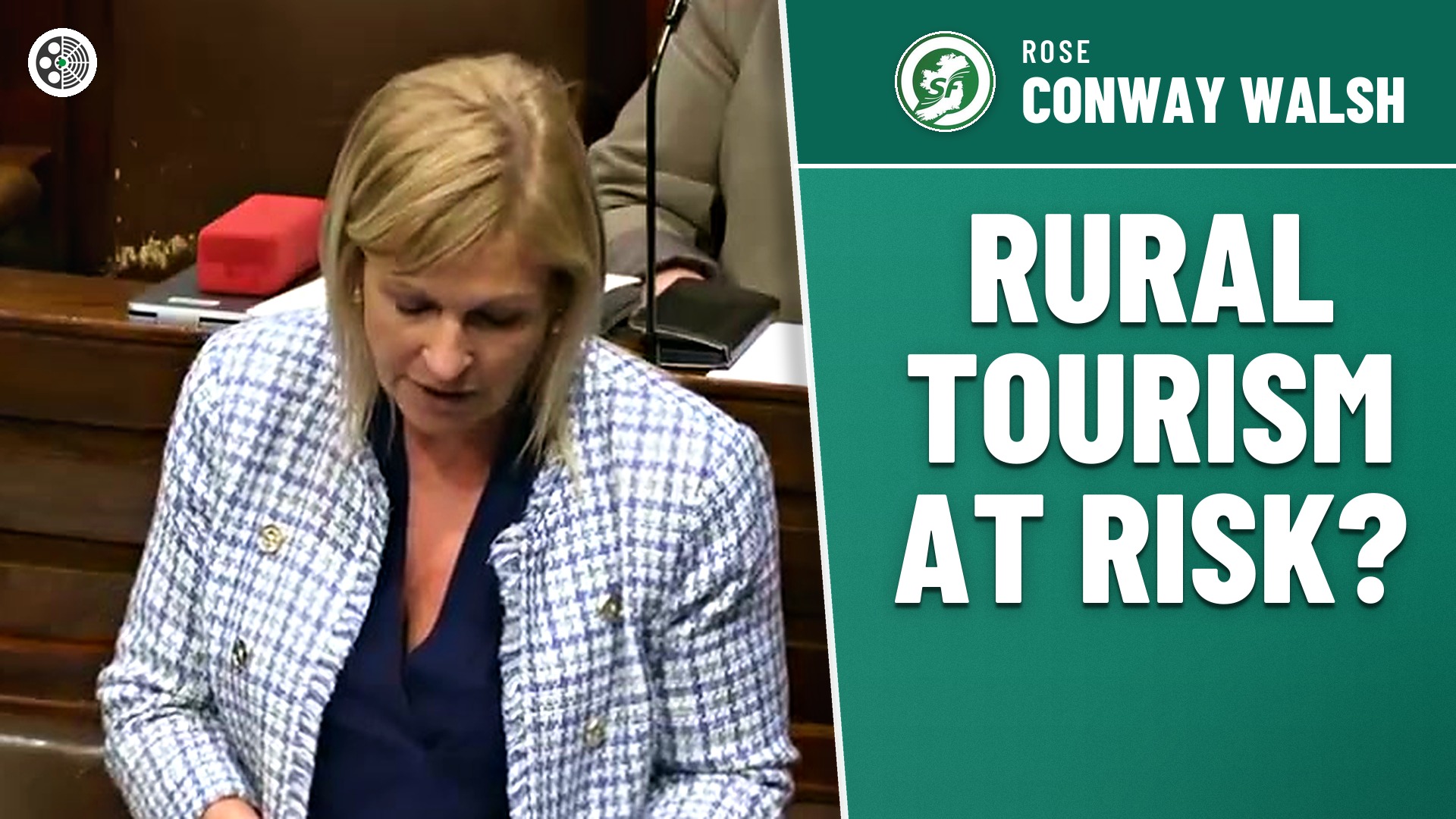


Rose Conway-Walsh: One Day to Scrutinise Short-Term Letting Bill
Sinn Féin TD Rose Conway-Walsh criticised the Government’s plan to complete all stages of the short-term letting and tourism bill in the Dáil in one day next week. Speaking during the debate, she called for the timetable to be reconsidered, citing concerns about scrutiny, stakeholder engagement and the impact on rural tourism businesses and housing.
She says the Government had two and a half years to prepare the legislation but scheduled committee, report and final stages for one day. She criticises the bill’s publication on Budget Day, before the committee had completed pre-legislative scrutiny or published its report, and says stakeholders’ evidence and concerns were disregarded. She also says the National Planning Statement was unavailable during much of the committee’s work.
Conway-Walsh says short-term letting providers, including small family tourism businesses in Mayo and elsewhere, lack clear information about registration, planning requirements and costs. She questions the timing of the 1 December register opening and the 31 December registration deadline, which falls over Christmas, and calls for clear guidance and reasonable timelines.
She asks what assessment the Government has made of possible losses of tourism beds and the effects on rural jobs, visitor numbers and local businesses. She says traditional self-catering accommodation supports rural tourism, and asks whether the Government will encourage hotel investment and help small hotels, guesthouses and family-run providers expand.
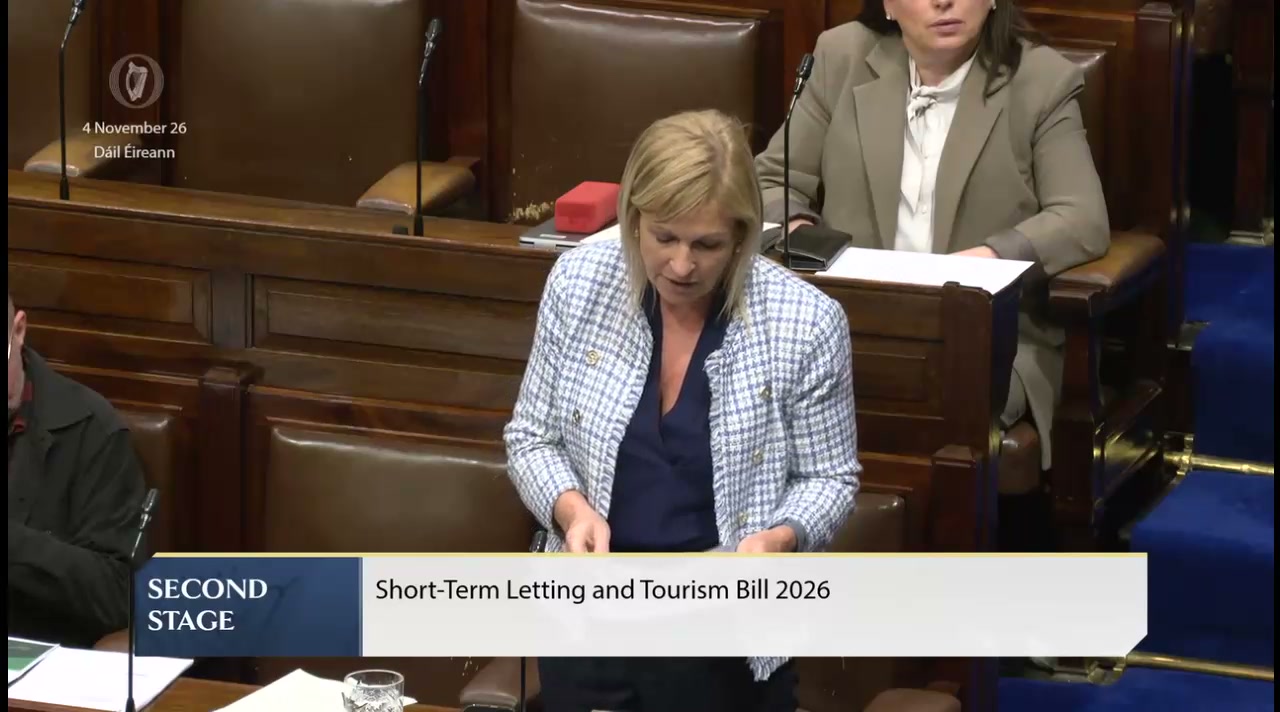
She says the Government had two and a half years to prepare the legislation but scheduled committee, report and final stages for one day. She criticises the bill’s publication on Budget Day, before the committee had completed pre-legislative scrutiny or published its report, and says stakeholders’ evidence and concerns were disregarded. She also says the National Planning Statement was unavailable during much of the committee’s work.
Conway-Walsh says short-term letting providers, including small family tourism businesses in Mayo and elsewhere, lack clear information about registration, planning requirements and costs. She questions the timing of the 1 December register opening and the 31 December registration deadline, which falls over Christmas, and calls for clear guidance and reasonable timelines.
She asks what assessment the Government has made of possible losses of tourism beds and the effects on rural jobs, visitor numbers and local businesses. She says traditional self-catering accommodation supports rural tourism, and asks whether the Government will encourage hotel investment and help small hotels, guesthouses and family-run providers expand.
We publish thousands of recordings to make Irish politics transparent and resistant to manipulation. Spotted an error? Report it — together we are building a reliable archive of Irish politics.
Other speeches


Tego samego dnia All speeches from this day →
Seán Kyne
Seán Kyne backs balanced rural short-term letting rules
Victor Boyhan
Victor Boyhan seeks details of antibiotic-use audits
Helen McEntee
Helen McEntee sets out handling of Garda protected disclosure
Sharon Keogan
Sharon Keogan warns deepfake bill risks chilling free speech
Victor Boyhan
Victor Boyhan presses Veterinary Council on five cases
Richard Boyd Barrett
Richard Boyd Barrett: Europe’s arms plan and Irish neutrality
Transcript
Go raibh maith agat. Before I begin, Minister, I want to put on record my complete opposition
to your plan to rush the short-term letting and tourism bill through the House. This will
severely hinder our collective ability to properly scrutinise this legislation and that,
in all honesty, the Government have made an absolute shambles of this, Minister. After
two and a half years to prepare the legislation, you are now scrambling to meet your own deadline
of December 1st, forcing through a bill with serious implications for tourism, rural employment,
for local businesses and indeed for housing. The EU regulation was adopted in April 2024.
You and the Government knew what was required and when it needed to be delivered by. Yet
you have scheduled the committee stage, report stage and final stage for this bill all in
one single day next week. Two and a half years to prepare the legislation and one day in
the Dáil to scrutinise it. That is simply unacceptable. What makes this particularly
disgraceful is the treatment of the organisations and the individuals who took time and participated
in the pre-legislative scrutiny. Over the past year at the Oireachtas Enterprise, Tourism
and Employment Committee, we engaged with stakeholders and listened to detailed evidence
from tourism providers, housing organisations, local authorities and industry representatives.
These organisations committed considerable time, resources and expertise to that process.
They attended hearings, prepared submissions, answered questions and raised legitimate concerns
about how these regulations would operate in practice. They did so in good faith, believing
that their input would contribute to the committee's recommendations and be laid before the final
legislation was published. Yet the Minister went ahead and published the bill on Budget
Day, on Budget Day of all days, before our committee had even completed our pre-legislative
scrutiny work or published the PLS report. What message does that send to the groups
and individuals that we engaged with? That their time was wasted, that their expertise
was irrelevant, that the Government was simply going through the motions. There is considerable
frustration among those stakeholders who feel completely disrespected by how the Minister
has treated this process. They have every reason to feel that way. Pre-legislative scrutiny
is supposed to improve the legislation, identify problems and ensure that those affected have
a meaningful opportunity to be heard. Instead, the Government have made a complete farce
of this important parliamentary process. To make matters worse, much of the committee's
work took place without the National Planning Statement being available. We begged and begged
for it time and time again, despite planning being one of the most contentious aspects
of the entire framework. How could stakeholders properly assess the implications of the bill
when such a fundamental part of the regulatory regime was missing? I will leave my colleague,
Deputy O'Brien, who will speak next, to highlight the concerns that Sinn Féin has about the
planning elements of this bill. It is important for me to point out that the Committee on
Housing, Local Government and Heritage did not have any role in the PLS of this bill.
Beyond the treatment of the Oireachtas and the stakeholders, there is also another issue that
demands attention. That is the absolute disaster that has been in the Government's communication
with the short-term letting providers on their new obligations. Across Mayo and throughout the
country, people are contacting us because they simply do not know where they stand.
These are people running legitimate tourism businesses, many of them small family operations
that have served their communities and visitors for years. They are worried about whether they
will be able to continue trading. They are unsure whether their properties meet the new requirements,
whether they need planning permission and what evidence they must provide.
Indeed, up to now, they were wondering what costs would be put on the planning process.
I see now that you said €25. The Government expects people to navigate these changes with
an extraordinarily tight framework. The Fáilte Island register is due to open on 1 December,
with the STL operators required to register before 31 December. Who thought it was sensible
to introduce such significant changes with a deadline falling over the Christmas period?
What happens if an application encounters difficulties where public offices are closed
or operating reduced services? Where are the providers supposed to turn to for reliable
advice? People are being left to piece together information themselves, relying on industry
groups, public representatives and conflicting interpretations of Government announcements.
That is no way to treat people whose livelihoods depend on getting these decisions right.
It is not simply uncertainty about paperwork. For some operators, this is uncertainty about
their income, their investment and the future of their family businesses.
These people feel completely disrespected. They have spent years providing accommodation,
supporting local tourism and contributing to their communities. The very least they
deserve is clear information, reasonable timelines and a Government willing to engage properly with
their concerns. I want to turn briefly to the wider implications for tourism, particularly
in rural Ireland. Tourism is an economic lifeline for communities in places like Mayo and the West
of Ireland. It supports thousands of jobs directly and indirectly and sustains hotels,
restaurants, cafes, pubs, shops, transport operators and visitors' attractions.
In many rural communities, tourism is one of the few industries capable of generating
substantial local employment and keeping young people living and working in their own areas.
Self-catering accommodation is an essential part of that tourism economy in some areas.
Traditional holiday cottages, converted farm buildings and family-run properties provide
visitor accommodation in places where hotel capacity is limited. When visitors stay in
Westport, Belmolish or Belnather, spending supports businesses throughout the local economy.
If that accommodation disappears, the impact goes far beyond the individual provider.
This is where I have serious questions about the Government's approach. Has the Minister
assessed how many tourism beds could be lost if providers withdraw from the market because
of these regulations? What assessment has been carried out of the consequences for rural employment,
visitors' numbers and local businesses? Crucially, what is the Government's plan to
mitigate any reduction in tourism accommodation capacity? Will there be incentives to encourage
investment in additional hotel beds in rural and high-amenity areas? Will small hotels and
guesthouse and family-run accommodation providers be supported to expand? We cannot spend millions
promoting the Wild Atlantic Way and encouraging tourists to visit the West and then fail to
sufficient accommodation for them. Building new hotel capacity takes time, investment and
certainty. The Government needs to demonstrate that it has thought this through, rather than
simply hoping the market will adjust. Sinn Féin has consistently supported the regulation of
short-term letting. We want properties returned to the long-term residential market in areas where
housing demand is acute. Over recent decades, huge commercial investors have been allowed to buy up
portfolios of properties in communities. These vulture funds make huge profits and pay very
little tax. There has to be a clear distinction between that activity and legitimate rural
tourism accommodation. Removing a traditional holiday cottage from the tourism market does not
automatically create a permanent home, but it could mean lost visitors, spending and employment.
That distinction must be reflected in the implementation of these regulations.
We support a national register, proper standards and effective enforcement,
but we also need a practical and affordable process for existing operators, sufficient
resources for Fulch Island and for the local authorities, and a clear plan to protect rural
tourism capacity. Can you explain how local authorities are expected to process thousands
of additional planning applications, or how Fulch Island is going to have sufficient resources to
new regulations? On 1 January, will enforcement officers be out in force to inspect short-term
let properties to ensure they are compliant? That gets to the heart of the fear and uncertainty
that the genuine short-term let operators are feeling. Minister, this is not how legislation
affecting thousands of businesses and communities should be handled. People deserve clarity,
not confusion. They deserve proper legislation, not a last-minute rush to meet self-imposed
Government deadlines. Minister, I am asking you this evening to provide that clarity
and to reconsider your intention to rush this through the Dáil next week. It is far too
important. Finally, Minister, you need to trust the local authorities, who know their own areas,
to be able to make the decisions about getting the balance between housing that is desperately
needed to staff in hotels and in other tourism amenities, but also the amount of accommodation
that is needed in any particular area to support the tourism objectives in that area. Minister,
I think rushing this through is a mistake, and I think it is one that will be regretted by Government.
Thank you.