

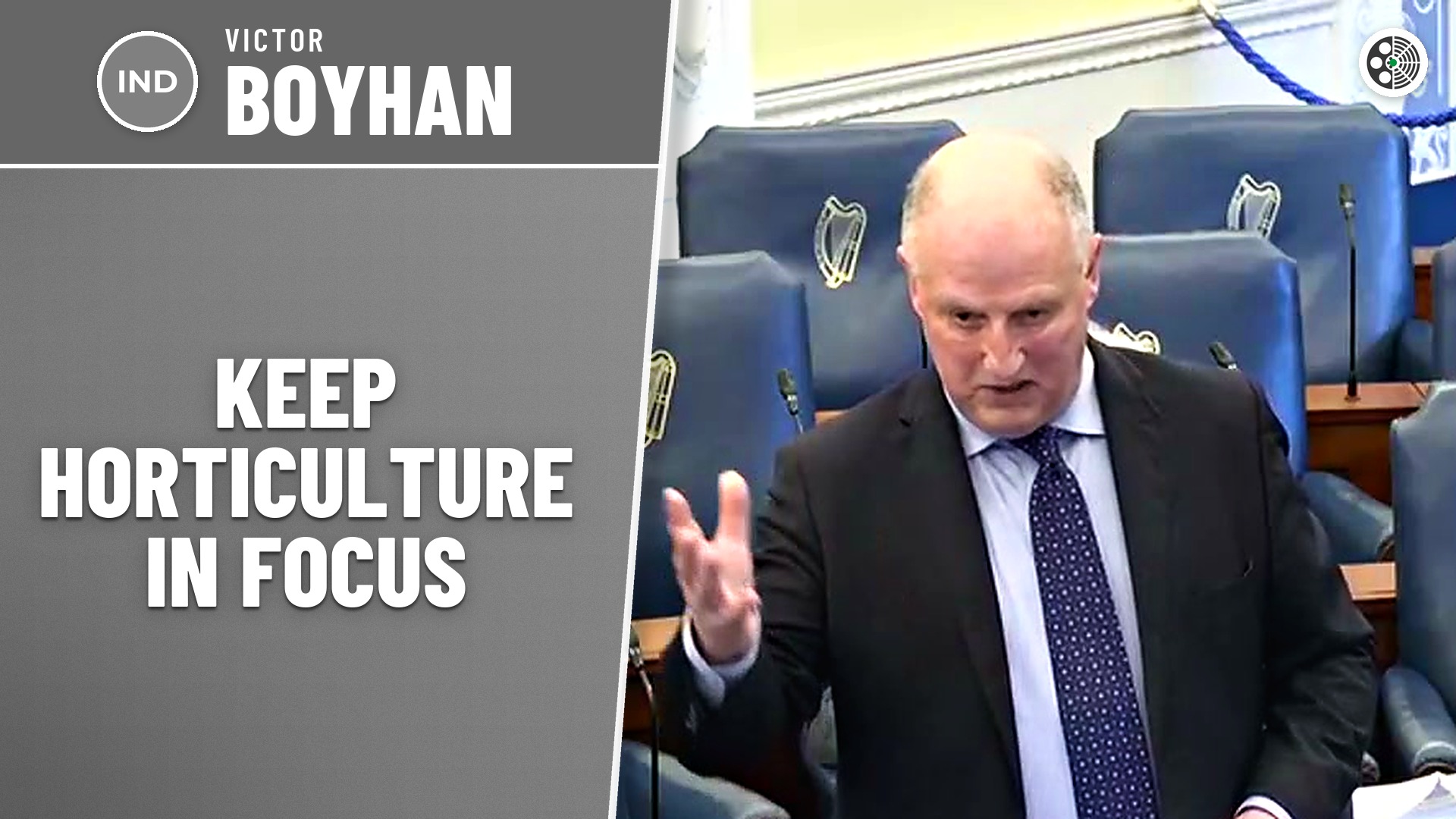


Victor Boyhan: Keep horticulture in focus in Food Vision 2030
Senator Victor Boyhan called for horticulture, farm succession and the viability of primary producers to receive greater attention during a Seanad Éireann debate on Food Vision 2030. He said the strategy must balance economic, social and environmental sustainability while strengthening food security and ensuring farmers can see the benefits of their work.
He highlighted farm succession and women’s role in agriculture, and urged that horticulture receive a stronger focus. He pointed to the small number of registered commercial carrot growers in Ireland and the need for irrigation, energy support and climate resilience for food production. He also called for training pathways that include apprenticeships as well as higher education, so that people are not left behind.
He said Food Vision 2030 should maintain equal weight for economic, social and environmental sustainability, with farmers and primary producers able to see clear benefits from their work and investment. He suggested the next review give greater attention to climate-smart agriculture, the viability and resilience of primary producers, and safe, nutritious food that consumers can trust.
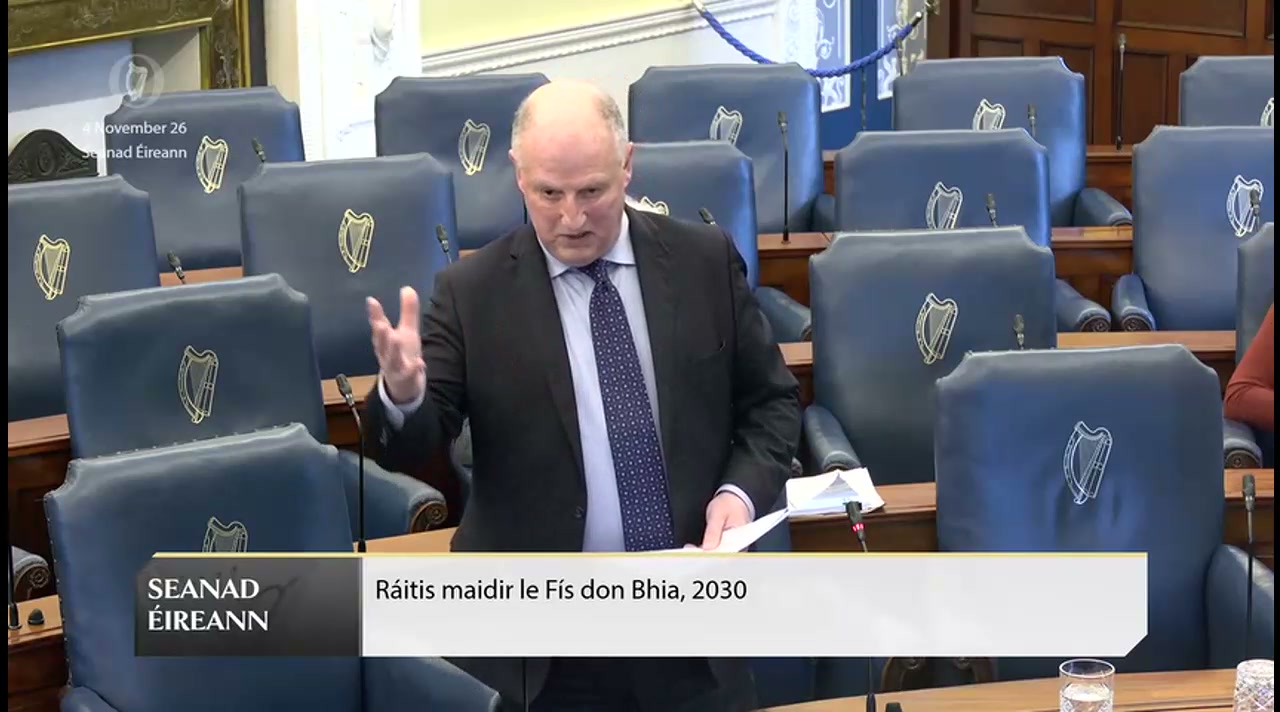
He highlighted farm succession and women’s role in agriculture, and urged that horticulture receive a stronger focus. He pointed to the small number of registered commercial carrot growers in Ireland and the need for irrigation, energy support and climate resilience for food production. He also called for training pathways that include apprenticeships as well as higher education, so that people are not left behind.
He said Food Vision 2030 should maintain equal weight for economic, social and environmental sustainability, with farmers and primary producers able to see clear benefits from their work and investment. He suggested the next review give greater attention to climate-smart agriculture, the viability and resilience of primary producers, and safe, nutritious food that consumers can trust.
We publish thousands of recordings to make Irish politics transparent and resistant to manipulation. Spotted an error? Report it — together we are building a reliable archive of Irish politics.
Other speeches



Tego samego dnia All speeches from this day →
Richard O'Donoghue
Richard O'Donoghue warns Airbnb rules could hurt rural Ireland
Liam Quaide
Liam Quaide challenges Taoiseach over CUH staffing
Richard O'Donoghue
Richard O'Donoghue challenges Garda investigation over holster
Michael Healy-Rae
Michael Healy-Rae: Short-term let bill creates uncertainty
Sharon Keogan
Sharon Keogan warns deepfake bill risks chilling free speech
Carol Nolan
Carol Nolan Questions Short-Term Letting Bill’s Rural Impact
Transcript
Firstly, I want to welcome you, Minister, and for Green, I want to thank you for Green
to come in to talk about Food Vision 2030.
We shared a table this morning at the Childless Breakfast briefing of OACTA's members, and
I just want to tell you from the feedback of the members that I spoke to as I was leaving,
they were highly impressed that you should give the time and listen from beginning to
end and do a summary of the engagement, so I just want to pass on that because it was
really important.
There were a variety of stakeholders at that, and without recapping too much of that, just
to say that one of the really, really strong messages was about farm succession.
You heard it yourself.
I also raised the issue of horticulture and the importance of horticulture somewhat getting
lost in the bigger remit of agriculture and forestry, and that's critically important.
I also spoke this morning, you will have been there and have heard it yourself, that there
are now nine registered commercial carrot growers in Ireland.
That's a shocking situation, and I think that's a real pity.
In terms of vegetables, and remember, we talk in here about a lot of the technical aspects
of agriculture and food production and food security, but for the average punter outside,
one thing is certain in here, we're all going to die, and in the meantime, we're going to
have to eat, and everyone needs to eat food, so there is no division between rural and
urban that some people might suggest, but there are major challenges in a country with
a climate like ours that we cannot extend the growing season.
I want to acknowledge also the government's commitment to the horticultural energy supports
that have been put in place.
I'm thinking particularly of soft fruit producers who require energy for water and irrigation.
I'm thinking, we know even in the carrots that we need irrigation.
We know from potato growers the importance of bringing water to the crops, and of course
with diesel engines, whatever they use as energy to pump water.
So there are major challenges about resilience and climate resilience and how that's evolving
so fast.
It's going way ahead of us so fast, how we can bring irrigation to crops, how we can
embrace innovation in terms of horticulture and food production, and how we can address
the issues around food security, and I think that's really, really important.
So I want to also acknowledge, as Senator Daley did, the importance of Chagas and their
work, and their remit, of course, is Irish Agriculture and Food Development Authority.
That's what their main focus is.
So we have to look at training.
Have we the necessary training skills for people in forestry, agriculture, food production?
And you know, you don't have to be an academic to be a farmer.
That's not to say it will help, but I'm making the point, there are people that have learned
the practices of agriculture from the age of 11, who've left school at 12 and 13, and
owned hundreds of acres of very sustainable and proper farms.
They have to be commanders.
So let's not shift at all a gear that it becomes a major academic.
It is, agriculture is a science, but there are places for apprenticeships in farming,
there are apprenticeships for placements, there are places and opportunities in higher
education and third level education for agriculture too.
But let's not, as we seek to progress in terms of policy for agriculture and horticulture,
that we don't leave people behind.
Because there is a place in every facet of agriculture and food production, and our educational
system must respond to that important need.
So I want to thank Charles for that.
I suppose when you look back at the teams and the messages and the objectives, what
is the aim of Vision 2030, the Vision Food Vision 2020-30?
And it is aimed to become a world leader in sustainable food systems.
We're not there yet.
It's progressive.
We're making great strides.
But over the next decade, that's what the Vision sets out to do.
The Vision has to be fully adhered to.
And the temptation, of course, is that we go off track because of other considerations.
But why I'm really encouraged today, Minister, by your contribution to the debate here is
that there has been ongoing review.
And as Senator Daley said, this is a bottom up.
The stakeholders have been involved in this Vision.
And that's clever.
So everyone is a stakeholder in this Vision for Food Vision 2030.
But I think we have to stay focused to deliver on the significant benefits of Vision.
Because farmers are businessmen, businesspeople, not men, businessmen and women, and families.
And they have to be able to see the benefits.
Irish agriculture in the sector has to see the benefits.
Also conscious of the environmental considerations, sustainability and all that goes with that.
I think it's important at the very core of this Vision we remember the economic sustainability,
the social sustainability and the environmental sustainability.
And they carry equal weight in my book.
And that's what sustainable future and sustainable food and sustainable vision has to be about.
So our sustainable food system has to demonstrate, very clearly demonstrate, that it is profitable
throughout but bred on basis of benefits for society generally.
So that's what I'm saying.
The stakeholders, the farmers, the producers, the primary producers, need to see benefit
in terms of their pocket, in terms of their investment.
And somehow I think with all our policies we sometimes lose the ability to keep clarity,
simplicity in terms of our communication strategy.
And I'd say, Minister, when you're talking to officials again about this, let's always
strive to keep the messages simple and give absolute clarity in relation to them.
Can I suggest four areas that the next review might look at in somewhat more detail?
They're already included in the strategy but I'd like to see a greater focus in the next
12 months.
And that is about the climate smart, environmental sustainable agri-food sector, the viability
and resilience for primary producers, which is totally critical, food and safety in terms
of nutritious, because that's the key aspect when you talk to people about food.
Be they producers, be they consumers, be they retailers, they'll all talk about the importance
of safety.
And the Irish public and the international people who consume our food, they want to
know our food is safe.
They want to know our food is nutritious.
They want to know that they can trust our suppliers of our food and the value of both
home and abroad.
And we saw true controversies in Bordbier, that people's confidence was slightly shocked
and it was a difficult area.
Let's not shy away from it.
There were huge issues of communication and messaging around Bordbier and its brand.
And I always like to stick to the topic rather than the personality, and at this point I
want to acknowledge the very significant and positive contribution of Bordbier in terms
of promoting our food.
I also want to acknowledge your very significant commitment to trade missions in terms of all
of our foods, but particularly in the meat sector.
And I know you addressed a conference, Asia Matters, recently in Galway, and again the
feedback of that was very, very positive.
So there are markets, international markets.
We tend to look at European markets, critically, of course, our markets in the UK.
It's phenomenal.
They are our nearest neighbours and there are enormous opportunities there that we need
to look at.
But Asia Matters, and the Asian market matters, and particularly in the areas of pork and
in beef, and I think there's great potential for expansion.
We also need to support in terms of our own poultry production.
There are serious concerns about our own Ireland, poultry production in Ireland, and we know
the amount of poultry, particularly chicken meat, that's imported into this country.
This country is quite capable, if organised, if supported, if structured, to upscale its
pork reproduction.
I want to leave you with a few points.
Farm succession, clearly you heard that this morning.
Women in agriculture, I spoke numerous times in the last few months.
We have another two months to go before we finish the year, the UN International Designated
Year for Women in Farming, and I think we have to acknowledge the very significant role
of women in agriculture, and you mentioned that again this morning in your own presentation,
and it's very significant.
I'll finish on this, horticulture.
Keep the focus on horticulture, Irish horticulture, the marketing by Irish horticulture, and our
wonderful success, which is Irish mushrooms.
So look, well done, it is a good news story, there's a lot to be told, keep it simple,
keep the messaging clear, and keep the focus on quality Irish, and the potential of greater
collaboration.
I'm sorry just to finish on this point, and I appreciate you bearing with me, Corhael,
but in terms of the enormous potential of greater collaboration between North and South,
the island of Ireland, in terms of marketing for good, nutritious, safe, and healthy food
from the island of Ireland.
Thank you.