

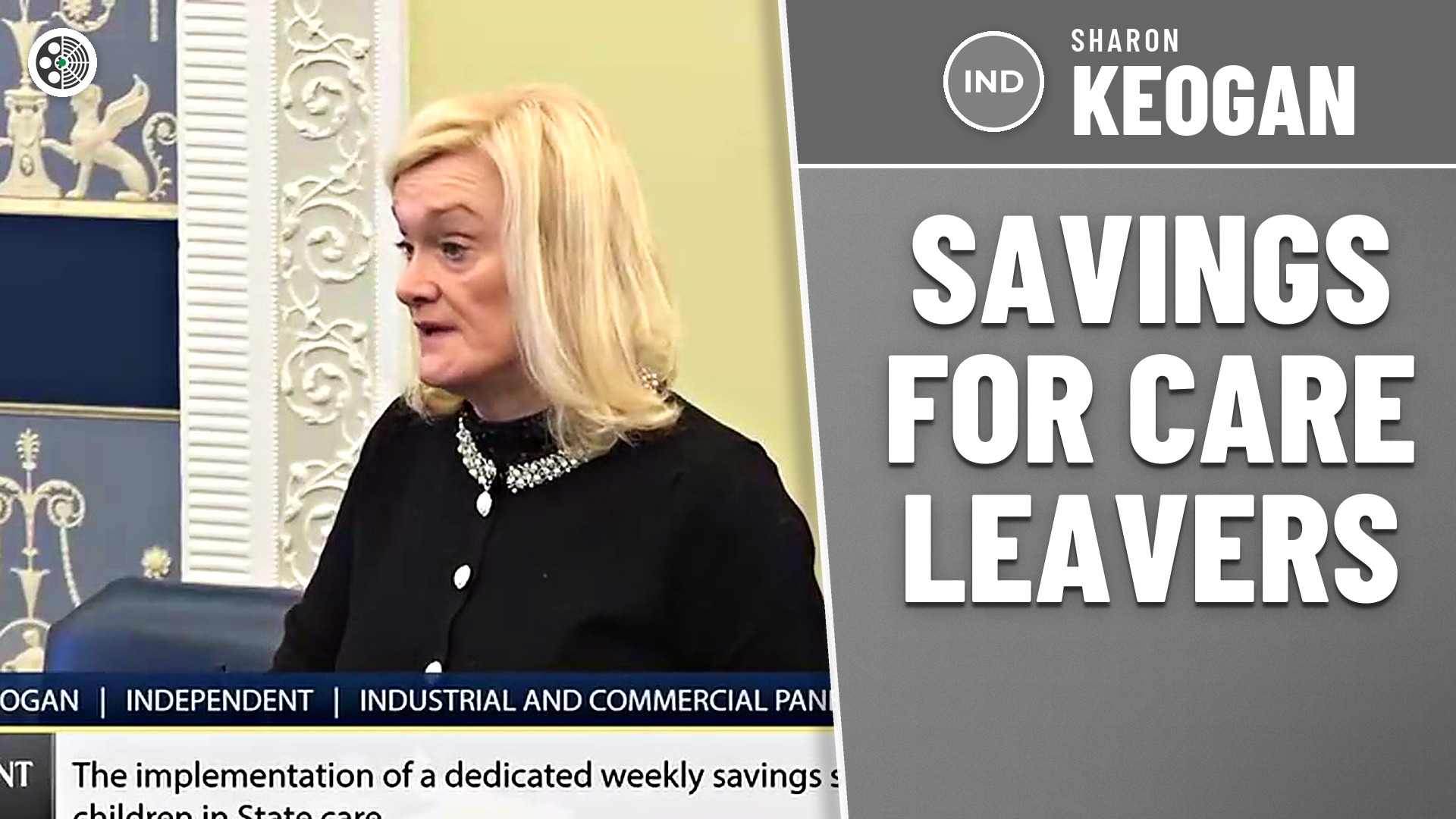


Sharon Keogan calls for savings scheme for children in care
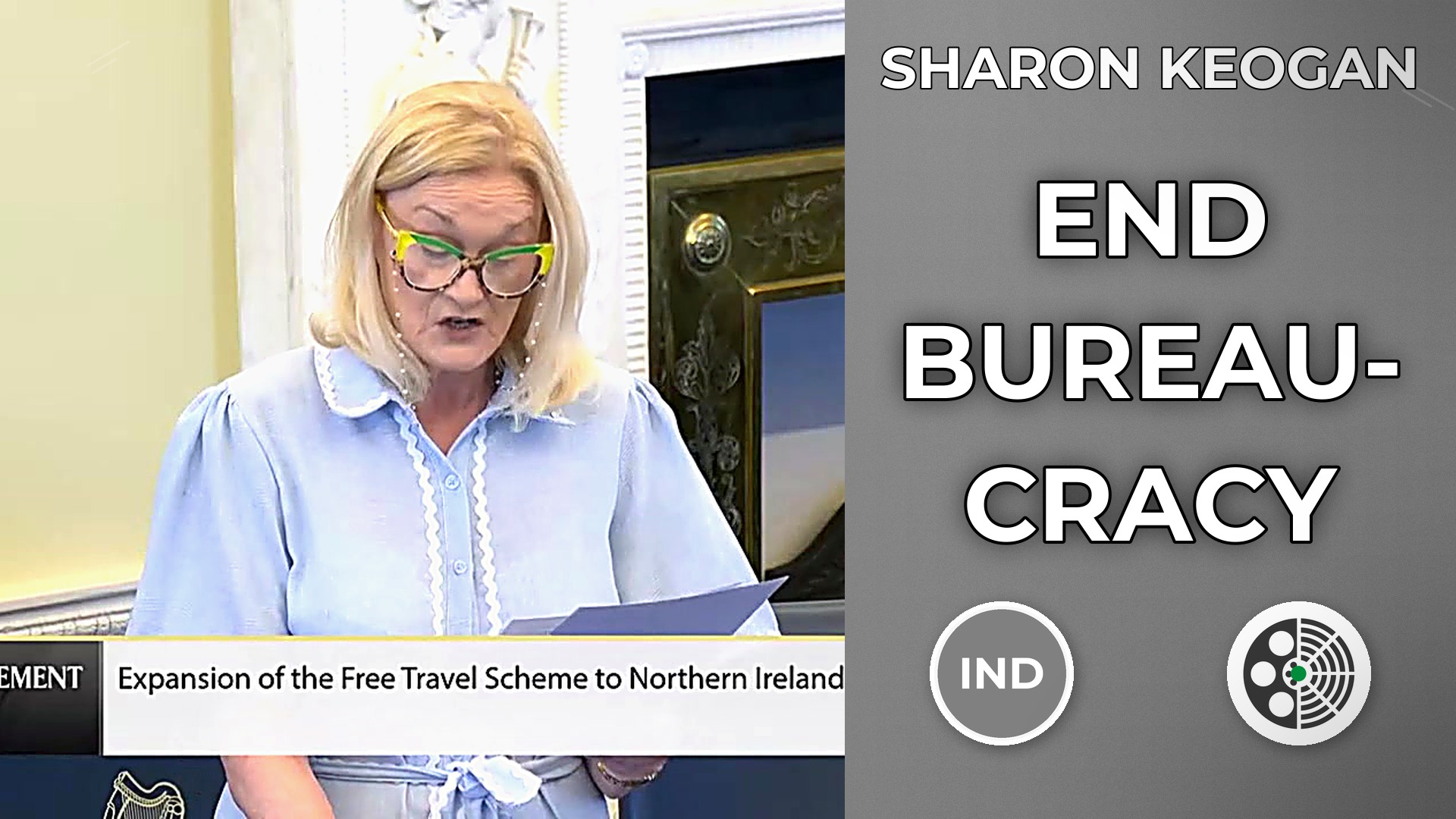
Senator Sharon Keogan has called for a state-funded weekly savings scheme for children in care during a Seanad debate on their transition to adulthood. She urged the Government to examine Guernsey’s model and consider building savings for care leavers before they turn 18, arguing that existing supports leave gaps, particularly for those not in education or training.
Keogan pointed to a scheme in Guernsey that sets aside £10 a week for each child in care until they turn 18. She asked the Minister to consider an Irish version, saying a lump sum could help young people meet costs such as accommodation, education and everyday living expenses.
The Senator acknowledged existing aftercare allowances and the work of organisations including Crosscare and EPIC, but said support was not sufficiently coordinated or adequate for every care leaver. She argued that assistance often depends on young people applying when they are already in need, rather than giving them savings of their own to support independence.
In response, the Minister’s representative referred to the forthcoming National Policy Framework for Alternative Care and described planned measures for 2027. These include an increased aftercare grant, a transitional aftercare allowance for care leavers not in education or training, and support for foster carers whose young people continue second-level education after turning 18.
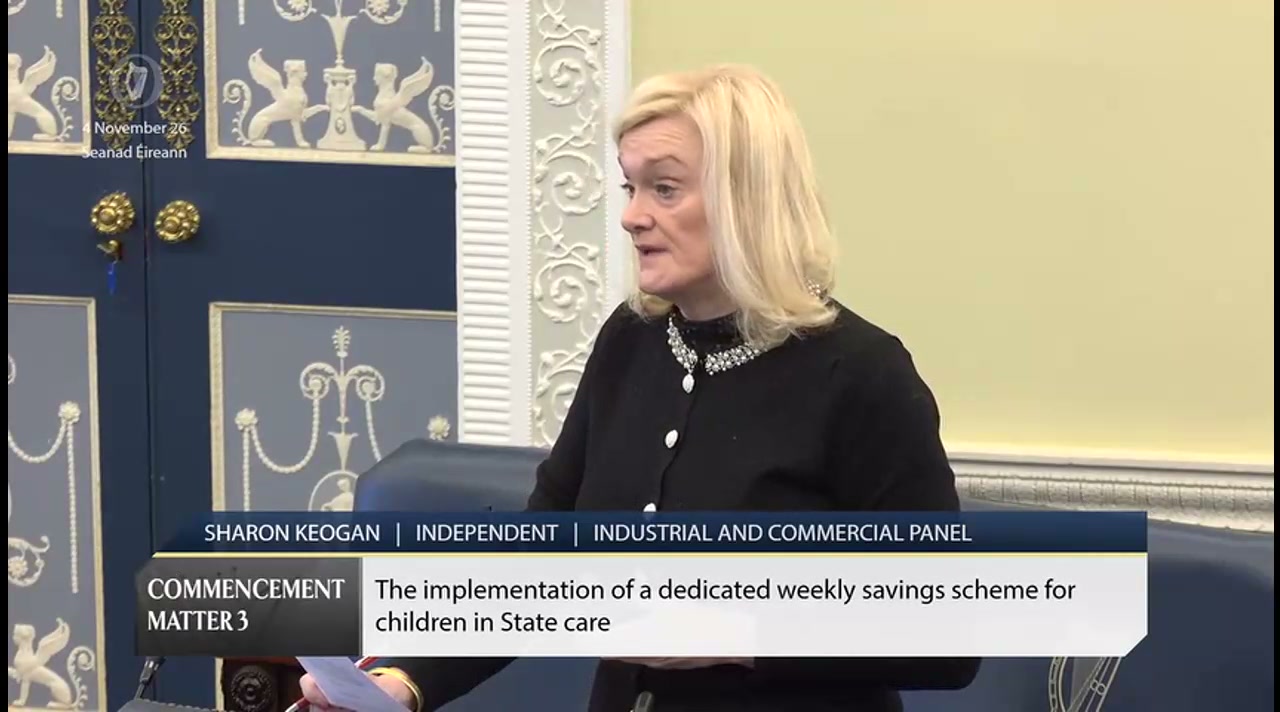
Keogan welcomed the planned increase to the aftercare grant but questioned whether funding reaches the young person directly. She said some children leave foster care with only a plastic bag and urged the Government to consider even a small weekly payment, noting that 6,500 children were in care at the time of the debate.
A savings fund for care leavers
Keogan pointed to a scheme in Guernsey that sets aside £10 a week for each child in care until they turn 18. She asked the Minister to consider an Irish version, saying a lump sum could help young people meet costs such as accommodation, education and everyday living expenses.
Gaps in current support
The Senator acknowledged existing aftercare allowances and the work of organisations including Crosscare and EPIC, but said support was not sufficiently coordinated or adequate for every care leaver. She argued that assistance often depends on young people applying when they are already in need, rather than giving them savings of their own to support independence.
Government measures outlined
In response, the Minister’s representative referred to the forthcoming National Policy Framework for Alternative Care and described planned measures for 2027. These include an increased aftercare grant, a transitional aftercare allowance for care leavers not in education or training, and support for foster carers whose young people continue second-level education after turning 18.
Keogan’s appeal
Keogan welcomed the planned increase to the aftercare grant but questioned whether funding reaches the young person directly. She said some children leave foster care with only a plastic bag and urged the Government to consider even a small weekly payment, noting that 6,500 children were in care at the time of the debate.
We publish thousands of recordings to make Irish politics transparent and resistant to manipulation. Spotted an error? Report it — together we are building a reliable archive of Irish politics.
Other speeches
Tego samego dnia All speeches from this day →
Thomas Gould
Thomas Gould: Cork Prison History and Traffic Gridlock
Edward Timmins
Edward Timmins: USC proposal would reduce tax take
Richard O'Donoghue
Richard O'Donoghue presses Taoiseach on rural Garda cover
Victor Boyhan
Victor Boyhan presses Veterinary Council on five cases
Peter 'Chap' Cleere
Peter 'Chap' Cleere questions RTÉ on €20m funding cut
Matt Carthy
Matt Carthy says Horkan family deserve answers
Transcript
Thank you, Minister Byrne, for coming in today. I arise today to address a matter of profound
importance regarding the long-term welfare and security of some of the most vulnerable
young people in our state, children who are in the care of the Irish system. Specifically,
I want to call upon the Minister for Children, Equality, Disability, Integration and Youth
to consider implementing a dedicated state-backed weekly savings scheme for children in care.
When these children turn 18, our system falls quiet. We essentially tell them that their
time is up and expect them to transition seamlessly into independent adulthood overnight. This
sudden cliff edge is an entirely unfair standard to place on any young adult.
To see how we could do better, I wanted to raise a new model being tried out in a small
island not too far from our own. Some of you may know of the Channel Islands of Jersey
and Guernsey, which are off the coast of France, but under the British Crown, each with their
own small government. Just recently, the Government of Guernsey launched a highly practical, state-funded
initiative in partnership with Guernsey Community Savings. Under this programme, the Government
sets aside a modest £10 per week for every child in the care system. These contributions
build up continuously from the very moment a young person enters care, right up until
the age of 18.
When these individuals exit the system, they are not handed a folder of paperwork and left
to struggle. Instead, they are met with a guaranteed financial nest egg, a highly helpful
lump sum that they can use to navigate the immediate costs of independent adult life.
Whether that means securing accommodation, entering higher education or simply meeting
everyday living expenses, they have a leg up.
I would like to ask the Minister today if they would consider developing a similar common-sense
framework here in Ireland. We are currently a wealthy state, yet we consistently operate
on a reactive model of governance. We wait for care leavers to fall into crisis, housing
insecurity or financial hardship, and only then do we scramble to deploy costly state
interventions.
I would like to acknowledge the work that has been done to date. There are aftercare
allowances, there are supports for those who stay on in education, there are many organisations
such as Crosscare or EPIC, and all of that is a help. But overall, there are three major
issues.
One, there is no overall coordinated systematic plan for how to support care leavers.
Two, we have to be frank here, what's already there is simply not enough.
And three, the way we give support does not foster, nor necessarily help, giving young
people leaving care real independence.
The way supports are now, the simple fact is that the money received by a young person
leaving care is not their own. It's not their own money sitting in their own pocket, which
can give them vital simultaneous combination of both freedom and responsibility. Instead,
we're encouraging them to think of money as something that is given to them after they
fill out a form when they're in need.
By contrast, a dedicated weekly saving scheme is a preventative, empowering measure. It
gives foster children a concrete boost exactly when they need it most. It builds an automatic
buffer against poverty and awards them financial security and independence that their peers
from stable family backgrounds naturally rely upon.
Therefore, I'm asking the Minister for three clear commitments today. First, will the Department
examine the operational structure of the Guernsey model to see how it can be adapted to the
Irish system. Second, will the Minister commission a cost-benefit analysis by introducing an
automatic state-funded weekly saving scheme for all minors currently in state care. Third,
will the Government establish a clear timeline to introduce robust financial transition assets
for care leavers as part of the upcoming budget priorities. We do not need more empty expressions
of sympathy for children in care. We need a Government prepared to deliver practical
long-term security and to ensure that when state steps in as a parent, it behaves like
a responsible one.
Go raibh maith agat.
Go raibh maith agat agus Eireann.
Thank you very much. I want to thank Senator Keoghan for raising this matter. There is
obviously an interest from her of long-standing in advancing outcomes for children and young
people in state care. The Government is committed to supporting children in care at every stage
of their care, including the transition from care into adulthood. The Government will continue
to work to ensure that every child has the right to grow up in a safe and secure environment
that feels as much as possible like home, and to give every child in care the same opportunities
as their peers.
Children in care are some of the most vulnerable individuals in society. A priority for the
Minister for Children and for Tuiste is ensuring that all children in care are well looked
after while in care, and that they receive the supports they need to transition into
adulthood. This is a critically important juncture in their lives. That is why the Government,
for its part, has supported children in care through strong investment in Tuiste.
The Minister for Children is due to publish a national policy framework for alternative
care, which provides the future vision for the provision of alternative care services
in Ireland. Development of the framework was guided by the views and suggestions brought
forward through extensive consultation with young people, with both current and past care
experience of the care system, along with key stakeholders and members of the public.
Financial supports for children in state care and those transitioning from the care system
into adulthood were considered as part of the development of the framework, and that
Children in receipt of aftercare are also entitled to financial and non-financial supports.
Tuiste may provide financial support to eligible care leavers who are engaged in a qualifying
educational course or training programme. The aftercare allowance is provided at the
rate of €300 per week, and is designed to cover young adults' day-to-day costs, including
accommodation, as they progress in their chosen accredited course or training programme. In
2027, it is planned to increase the aftercare grant paid to young adults in aftercare to
help them meet the costs of transitioning into adulthood. A new transitional aftercare
allowance for care leavers not engaged in education or training is also being prepared.
Separately, a new support for foster carers to support young people leaving care to complete
second-level education once they turn 18 is being developed, and that will be rolled out in 2027.
The national policy framework for alternative care will support the implementation of these
measures and provide the basis for further development of measures to financially support
children in state care. Tuiste's overall budget has also increased significantly over the past
number of years, reaching £1.4 billion in 2026. This is going to be increased further in 2027,
and it does highlight the big investment the Government has made in care services to children.
I welcome the commitment in 2027 that they are going to increase the aftercare grant
paid to young adults in aftercare, but that payment goes to the actual parent of the child.
It doesn't actually go to the child itself. There's no compulsion on that parent to allocate
any of that money to the child. If the child happens to leave care and they're in the educational
system and Tuiste has to pay for accommodation for them, they do get the aftercare allowance.
The children do get that aftercare allowance, but what about the children that don't enter
into education? What about those children? They're the children that end up on our streets.
So if we don't support those children, it's the children that are not in receipt of any
aftercare payment. Some of those children leave with plastic bags, Minister,
from those homes that they're in foster care, and I want you to know that.
I've had many of those children that have come into my care over the years with a plastic bag.
So, like, I want you to do more for children in care. We have 6,500 children in care at this
moment in time. Even if it was only five euro a week that they start giving those children
and investing in those children until they turn 18 and they get that lump sum, at least they're
turning 18 with some sort of money in their account at the age of 18. It's a small little fee
that you could give these children in care over the years that they're in care. I think even five
euro a week would be something, even 10 euro a week, but to not have a payment where a child
is turning 18 and has absolutely nothing. It's all right for the responsible parents that might
encourage children to work, which I've always done with my children, the children that have
come into my care, but there's many parents that don't get that opportunity to have children that
get a part-time job. So, I would welcome some sort of estate payment that the government would
look at. Thank you. Look, I'd like to thank you again, Senator Keoghan, for raising this issue
and our long-standing interest and experience of all of this. The Minister, I speak on behalf of
the Minister, she reiterates her commitment to supporting children in state care and the
Department will continue to examine ways of improving the provision of alternative care
and also how best to support those exiting care as they become adults. The Minister views the
publication of the National Policy Framework for Alternative Care as an important new opportunity
for the delivery of key measures for children in care in Ireland and for those leaving care into
adulthood. The measures outlined in the framework will help young care leavers as they strive for
independence and will lay out the policy detail on how the government will better support children
in care in the short, medium and long term. Budget 2027 builds the foundations for these measures,
including the rollout of the new transitional aftercare allowance, continued financial supports
for foster carers of those finishing second level education and the increased aftercare grant.
The Minister and the Department will continue to bring forward measures to improve the lives of
young people in care throughout their journey and to provide the best possible start to their
adult lives. Finally, I would like to acknowledge all of the invaluable work that's undertaken to
support children in care, including those who are transitioning into adulthood. The support
that workers provide to children and young people is critical to providing them with
the best opportunities to thrive in care and then on into their adult life.