

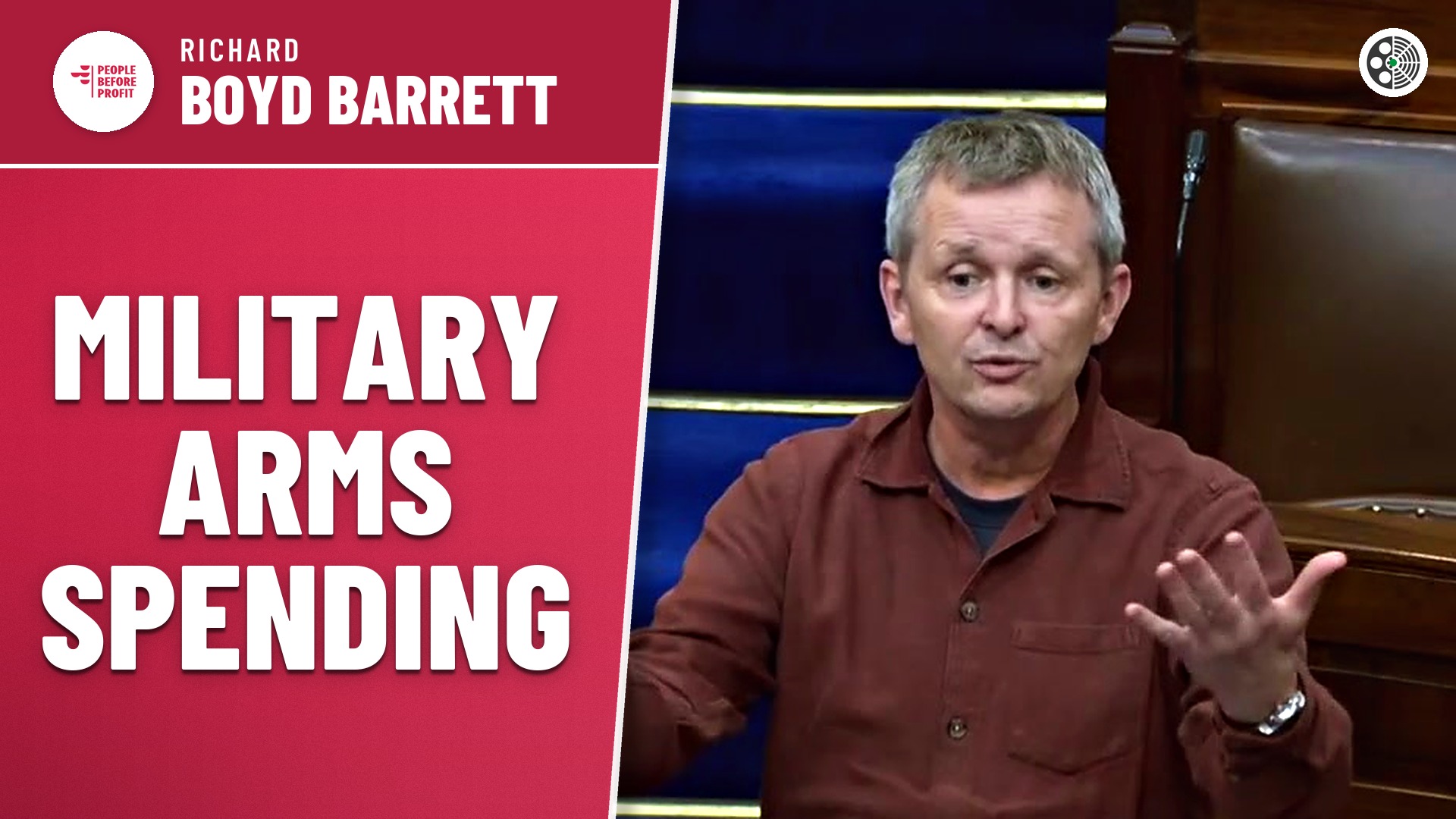


Richard Boyd Barrett Challenges Ireland’s Israel Trade Policy
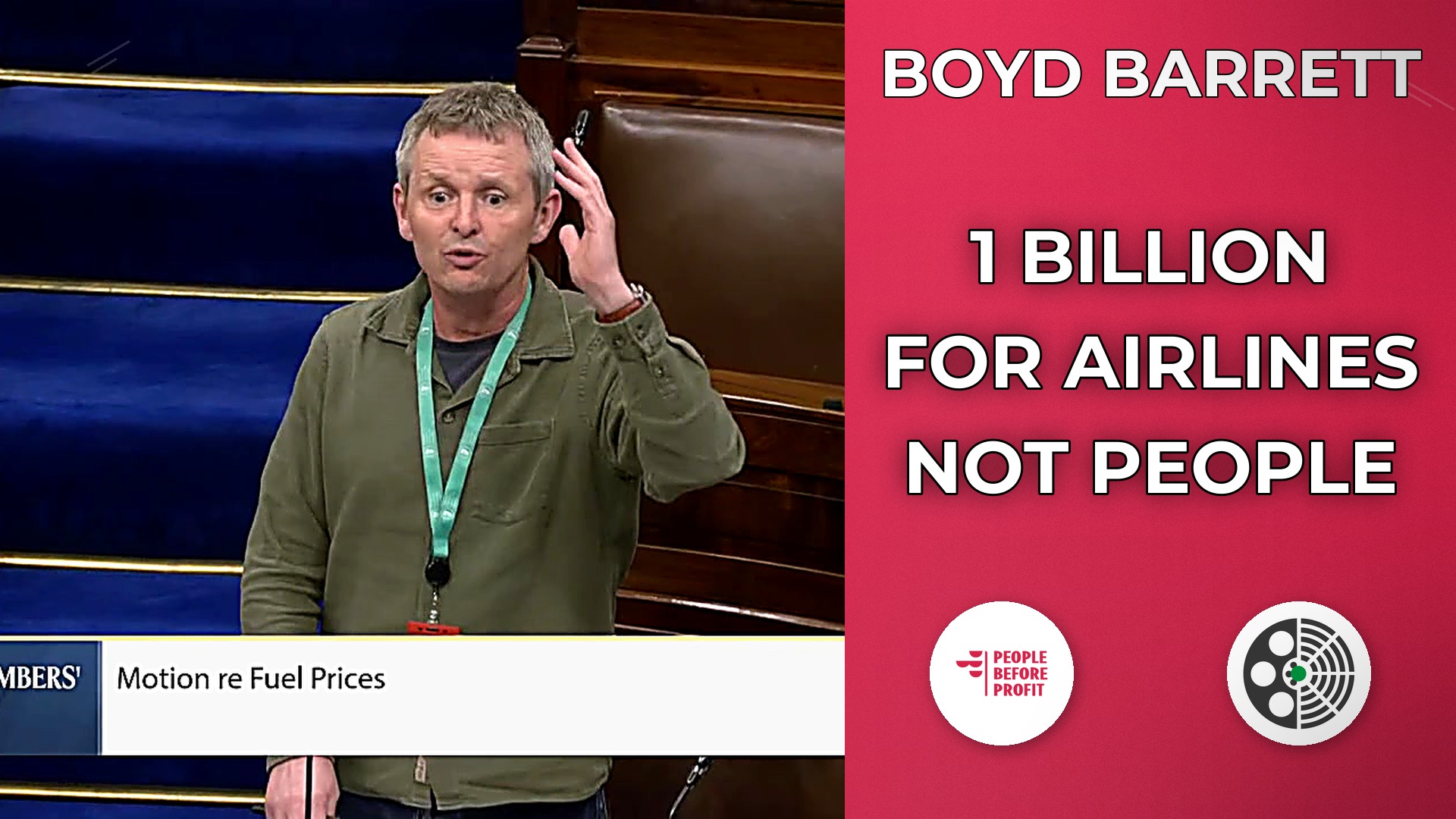
Richard Boyd Barrett challenged the Minister on Ireland’s trade and arms relations with Israel and rising military spending during a debate in Dáil Éireann. He asked the Minister to learn from opposition in the United States to warmongering and the cost of living, while the Minister defended Ireland’s military spending and explained the limits on EU foreign policy decisions.
Boyd Barrett said Ireland should reject what he described as a European embrace of Donald Trump’s agenda, including increased military spending and continued trade and arms flows to Israel. He argued that Ireland was complicit and asked why ordinary working people should bear the cost of military spending while striking for better pay.
The Minister rejected the charge of warmongering, saying the EU was an institution of peace and that Ireland wanted to spend more on its own military. The Minister cited the threat from Russia, cyber security and protection of the country’s seas as reasons for increased defence spending in some EU states, and stressed that the EU is not a defence alliance and Ireland is not joining NATO.
On relations with Israel, the Minister said EU foreign policy and sanctions require unanimity among member states. The Minister pointed to the Occupied Territories Bill and said Ireland could not secure EU-wide measures without every member state’s agreement.
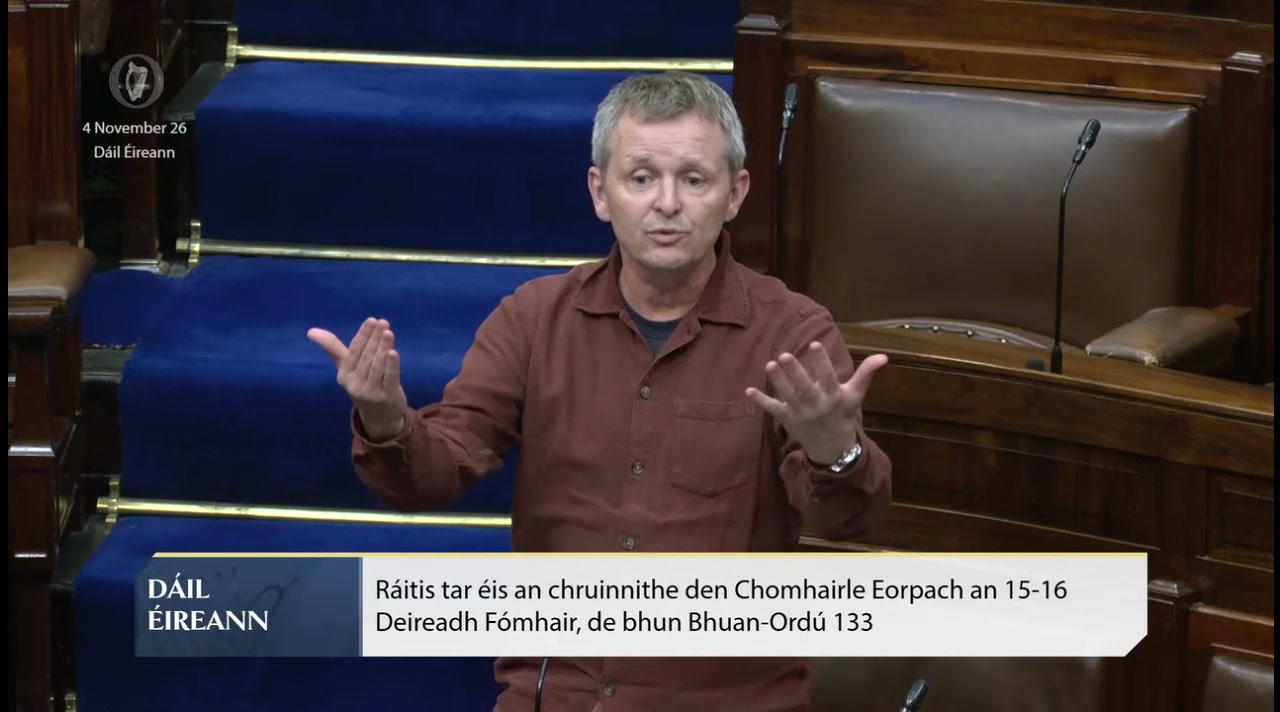
The Minister challenged Boyd Barrett to account for the effects of full trade sanctions on workers’ jobs, citing newspaper reports about Intel and supply chains connected to Israel. The exchange set Boyd Barrett’s call for a tougher approach against the Minister’s arguments about EU decision-making and the potential consequences for workers. Watch the recording to hear the full exchange.
Ireland’s trade with Israel
Boyd Barrett said Ireland should reject what he described as a European embrace of Donald Trump’s agenda, including increased military spending and continued trade and arms flows to Israel. He argued that Ireland was complicit and asked why ordinary working people should bear the cost of military spending while striking for better pay.
The Minister’s case on security
The Minister rejected the charge of warmongering, saying the EU was an institution of peace and that Ireland wanted to spend more on its own military. The Minister cited the threat from Russia, cyber security and protection of the country’s seas as reasons for increased defence spending in some EU states, and stressed that the EU is not a defence alliance and Ireland is not joining NATO.
EU unanimity and sanctions
On relations with Israel, the Minister said EU foreign policy and sanctions require unanimity among member states. The Minister pointed to the Occupied Territories Bill and said Ireland could not secure EU-wide measures without every member state’s agreement.
Trade and workers’ jobs
The Minister challenged Boyd Barrett to account for the effects of full trade sanctions on workers’ jobs, citing newspaper reports about Intel and supply chains connected to Israel. The exchange set Boyd Barrett’s call for a tougher approach against the Minister’s arguments about EU decision-making and the potential consequences for workers. Watch the recording to hear the full exchange.
We publish thousands of recordings to make Irish politics transparent and resistant to manipulation. Spotted an error? Report it — together we are building a reliable archive of Irish politics.
Other speeches
Tego samego dnia All speeches from this day →
Ivana Bacik
Ivana Bacik Challenges Taoiseach on Data Centre Growth
Joe O'Reilly
Joe O'Reilly: Protect women councillors from online abuse
Michael Healy-Rae
Michael Healy-Rae: Short-term let bill creates uncertainty
Barry Ward
Barry Ward presses for EU blocking statute on US sanctions
Victor Boyhan
Victor Boyhan calls for debate on digital election threats
Albert Dolan
Albert Dolan: EU competitiveness must reach local businesses
Transcript
Minister, as I was saying earlier on, the people in the United States have rejected
Trump's warmongering against Iran, his complicity with Israel for its genocide, and the cost
that that has had for ordinary working people in America in terms of the cost of living.
And I put it to you that the European leaders should be rejecting that agenda, but instead
what they're doing is embracing Trump's agenda with the plan to double arms and military
expenditure across Europe, continuing to trade with Israel despite the fact that it's committing
genocide against the Palestinian people, continuing to allow the flow of arms to Israel, treating
it as if it's a normal state, and that Ireland also is guilty of that.
Biggest trading partner in Europe with Israel, ramping up military spending, all the while
working people are being forced to go out and strike because you won't give them a decent
pay increase.
Don't you think you should learn something from what's happening in the United States
now and the fact that ordinary people in the United States are turning against this agenda
of warmongering, complicity with Israel, and the cost that that has on ordinary working
people?
Minister.
There's no warmongering by the European Union, it's an institution of peace, there's no warmongering
by the Irish government.
We don't have a sufficient military, we want to spend more on our own military.
And I would say that within the EU, decisions on military spending are matters for the Member
States themselves.
And why are some Member States deciding to massively increase their military spending?
It's because of the huge threat they face from Russia, a threat that you continually
underplay.
Today, your colleague wanted us to investigate Ukraine.
That's what we're asked to do on the floor of this chamber today, to investigate Ukraine.
At a time when Russia is blowing missiles into civilian populations in Kyiv and around
Ukraine, and where we see all sorts of what's called hybrid activity, some of it is very
much kinetic activity, happening on the boundaries of the European Union and within European
Union Member States.
We saw a cyber attack across the European Union just the other day.
So when we talk about military spending, some countries are rearming for sure, because they
want to make sure that nobody can get past them, particularly Russia.
But we're also talking about increases in spending in terms of cyber security, in terms
of protecting ourselves from these types of threats, in terms of making sure that we
have full vision of what's happening on our seas.
That's what's happening at the moment.
And the European Union is not a defence alliance.
NATO is a defence alliance.
We're not part of NATO.
We're not joining NATO.
We wouldn't even be able to reach the spending targets that NATO members are required to
meet.
So it's not going to rise on our side, or indeed on their side.
So there's no ramping up of military spending.
What we're trying to do in Ireland is to ensure that we have a military that can protect the
people of this country.
In relation to trade with Israel, and relations with Israel, foreign policy is a matter for
unanimity at the Council table.
So every time there's a referendum, we have a discussion about the veto.
You know, in the Lisbon Treaty or the Nice Treaty, you would have been very strong, protect
the veto.
That's the veto in action.
Because if you can't get every single member state to agree, then you can't implement something
at the European Union level from a foreign policy point of view, or indeed a sanctions
point of view.
That's simply the reality.
And it's something, the veto, the unanimity, every member state holds a steer.
And as regards trade with Israel, and this country, we have brought in the Occupied Territories
Bill.
That's in.
But I think you're looking for full trade sanctions with Israel.
Complete end to trade.
You've got to tell the workers in Ireland, who would lose their jobs because of that,
what the consequences would be for them.
I don't know the details, but I read in the paper, Intel, employing thousands of people,
is actually, seems to be, from newspaper reports, seems to be the main source of trade with
Israel because of the supply chains that are there.
If you want to go down to the factory and tell people what the consequences of your
proposal would be, then do that.
But the government has to make decisions that are not just in the interest of good foreign
policy, which is what we always try to do, but also are in the interest of the Irish
people.