



Micheál Martin sets out Ireland’s European Council priorities
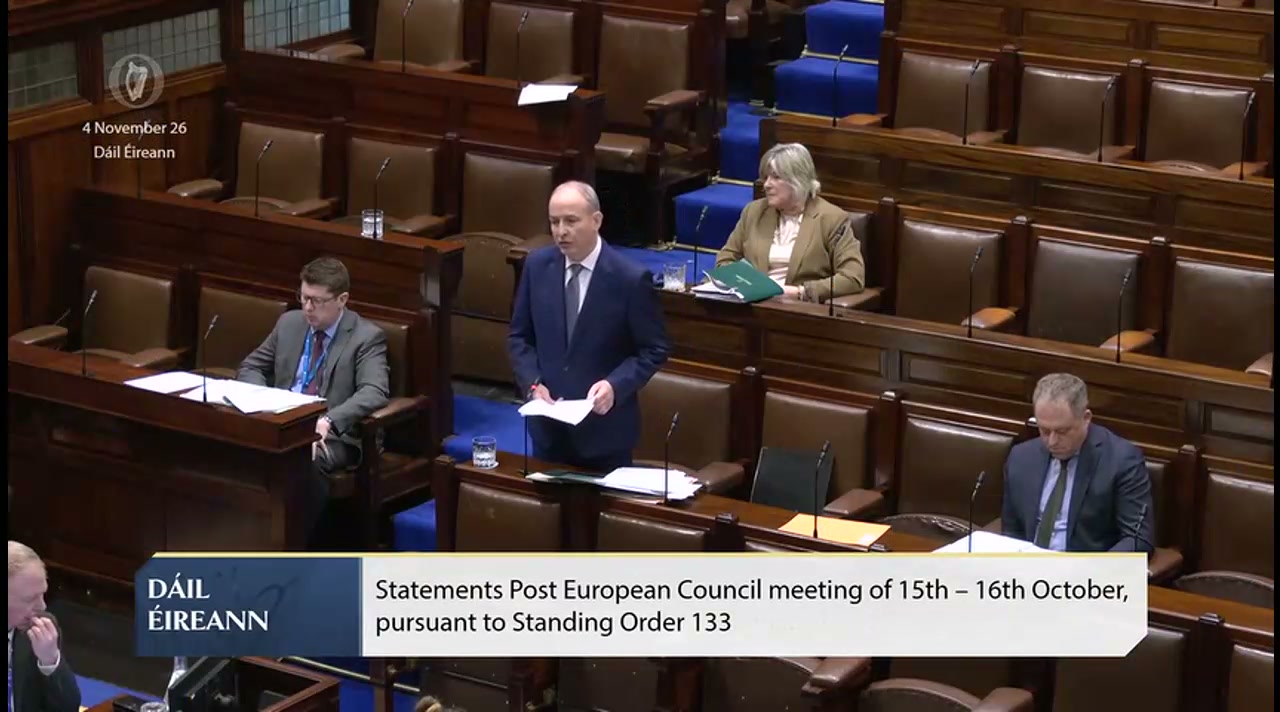
Micheál Martin outlined the outcomes of the October European Council meeting in Dáil Éireann during Ireland’s presidency of the Council of the European Union. He addressed European competitiveness, the proposed 2028-2034 EU budget, support for Ukraine and the Middle East, setting out the priorities and challenges facing the presidency.
Martin said the European Council reviewed efforts to strengthen the EU economy, including Ireland’s work on the One Europe, One Market roadmap. He highlighted progress on the European Union Inc. proposal, digital regulation simplification and measures to advance the Savings and Investment Union, alongside discussion of energy prices, emissions trading and trade with China.
He presented the Irish Presidency’s revised negotiating proposal for the 2028-2034 EU budget. The proposed €1.62 trillion framework is 30% larger than the current budget and includes more than €400 billion for competitiveness. Martin said it sought to balance investment in emerging priorities with protection for the Common Agricultural Policy and cohesion funding.
On Ukraine, Martin said EU leaders reaffirmed their support and condemned Russian attacks on civilian infrastructure. He noted that Ukraine faced significant financing needs for 2027 and said Ireland was working to advance its EU accession negotiations. He also highlighted Moldova’s membership path and the opening of four of its six negotiating clusters.
Martin said the European Council reviewed efforts to strengthen the EU economy, including Ireland’s work on the One Europe, One Market roadmap. He highlighted progress on the European Union Inc. proposal, digital regulation simplification and measures to advance the Savings and Investment Union, alongside discussion of energy prices, emissions trading and trade with China.
He presented the Irish Presidency’s revised negotiating proposal for the 2028-2034 EU budget. The proposed €1.62 trillion framework is 30% larger than the current budget and includes more than €400 billion for competitiveness. Martin said it sought to balance investment in emerging priorities with protection for the Common Agricultural Policy and cohesion funding.
On Ukraine, Martin said EU leaders reaffirmed their support and condemned Russian attacks on civilian infrastructure. He noted that Ukraine faced significant financing needs for 2027 and said Ireland was working to advance its EU accession negotiations. He also highlighted Moldova’s membership path and the opening of four of its six negotiating clusters.
We publish thousands of recordings to make Irish politics transparent and resistant to manipulation. Spotted an error? Report it — together we are building a reliable archive of Irish politics.
Other speeches
Tego samego dnia All speeches from this day →
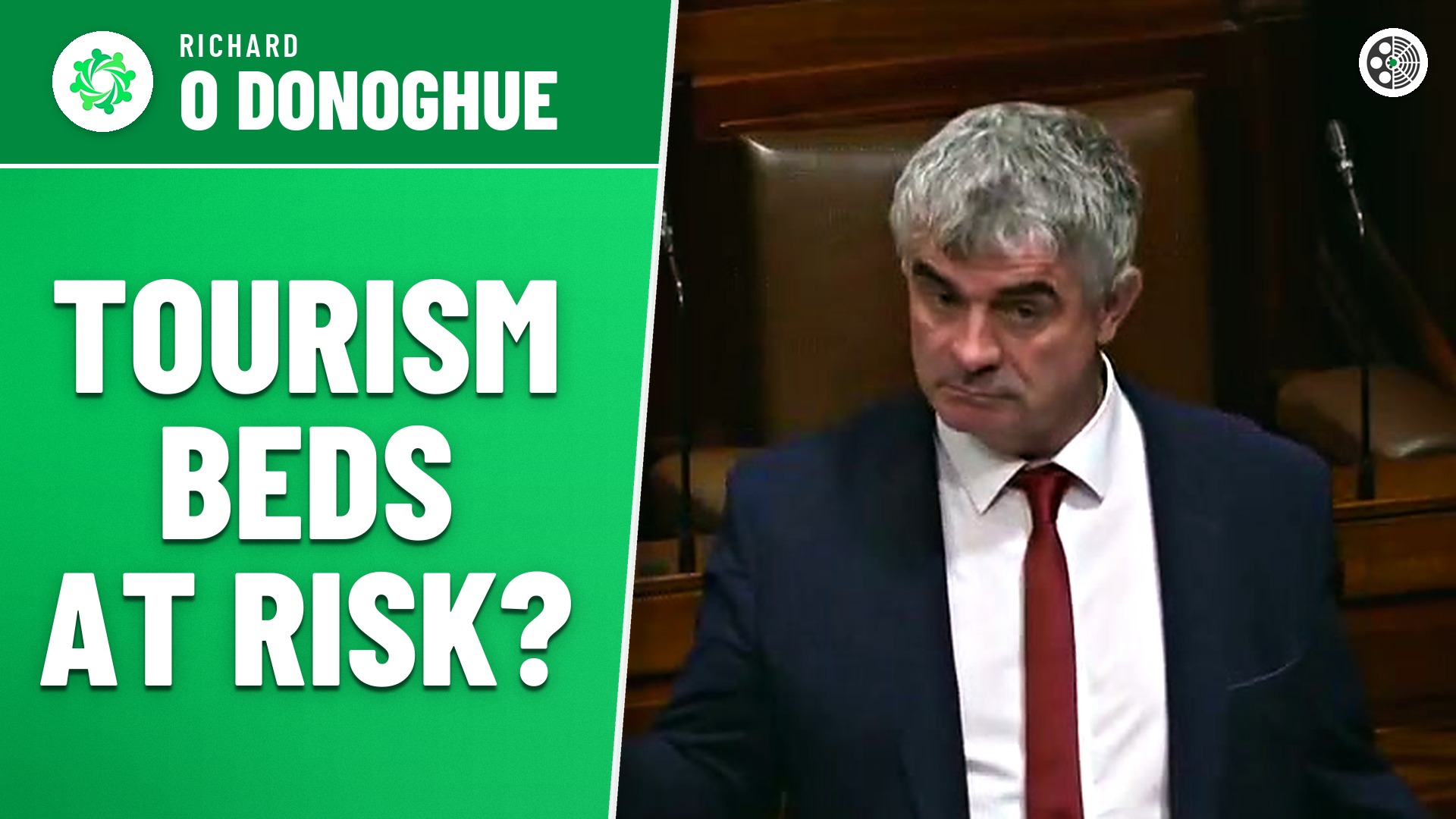
Richard O'Donoghue
Richard O'Donoghue warns Airbnb rules could hurt rural Ireland
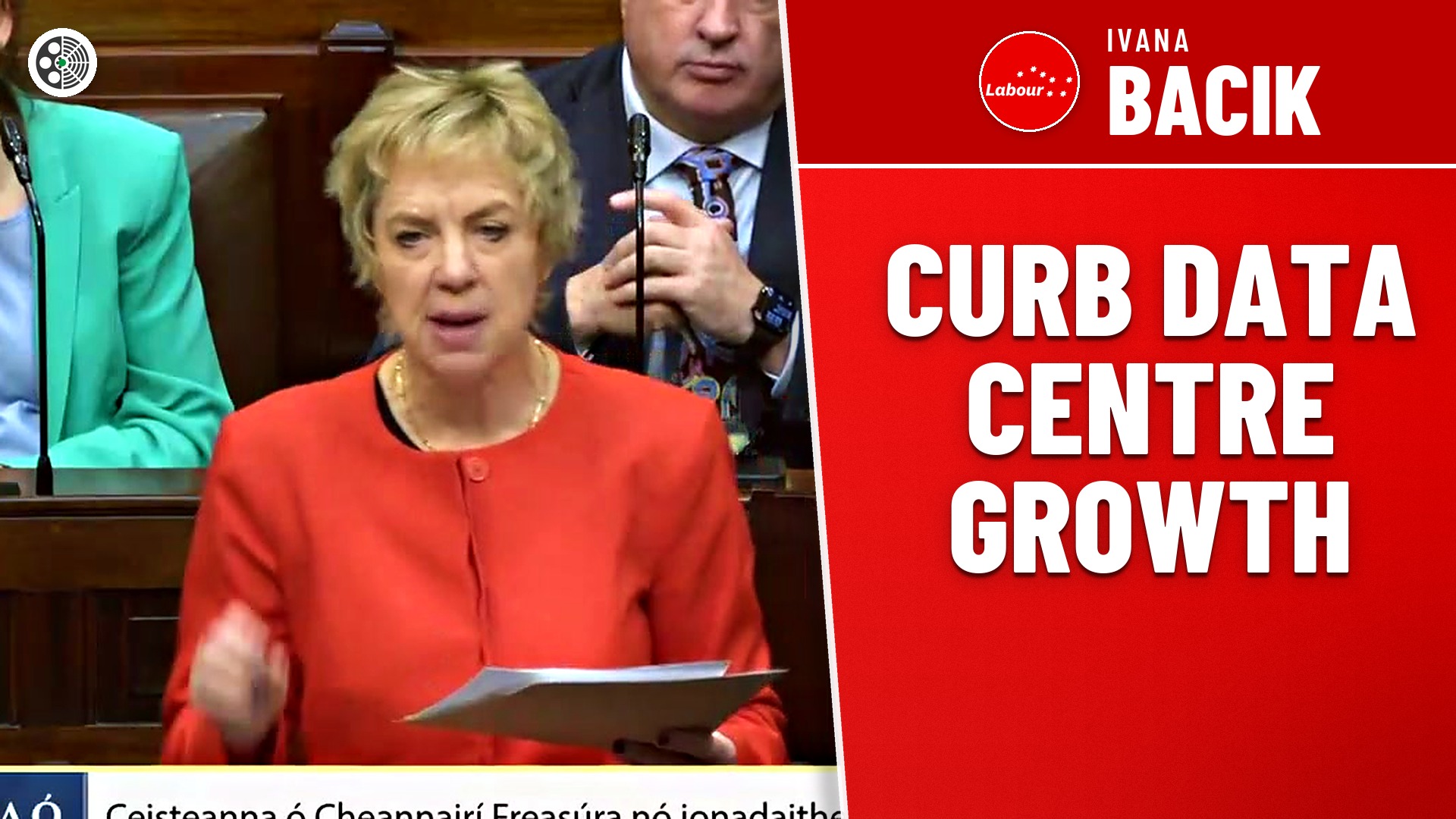
Ivana Bacik
Ivana Bacik Challenges Taoiseach on Data Centre Growth
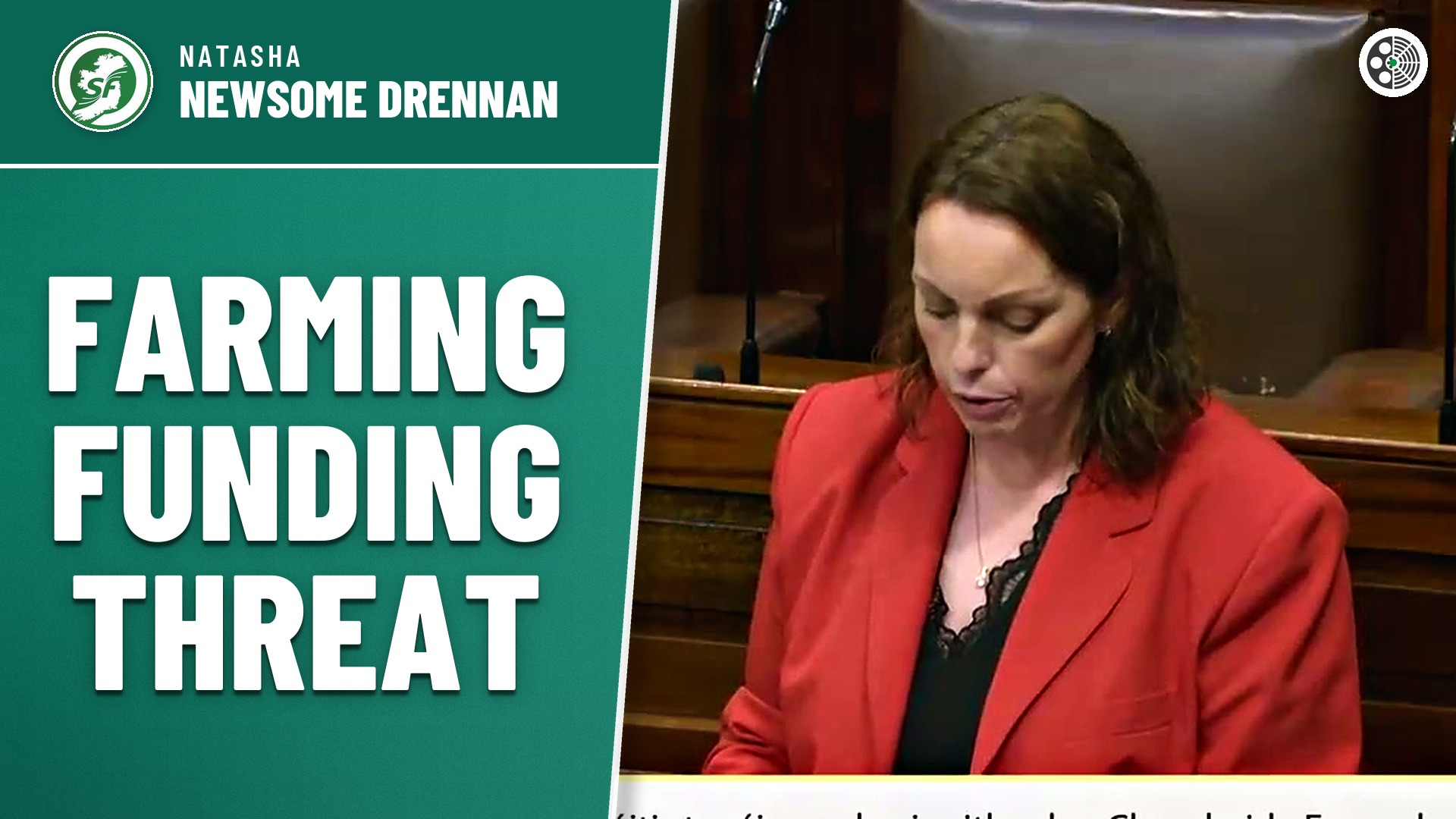
Natasha Newsome Drennan
Natasha Newsome Drennan: Farmers must not pay for EU priorities
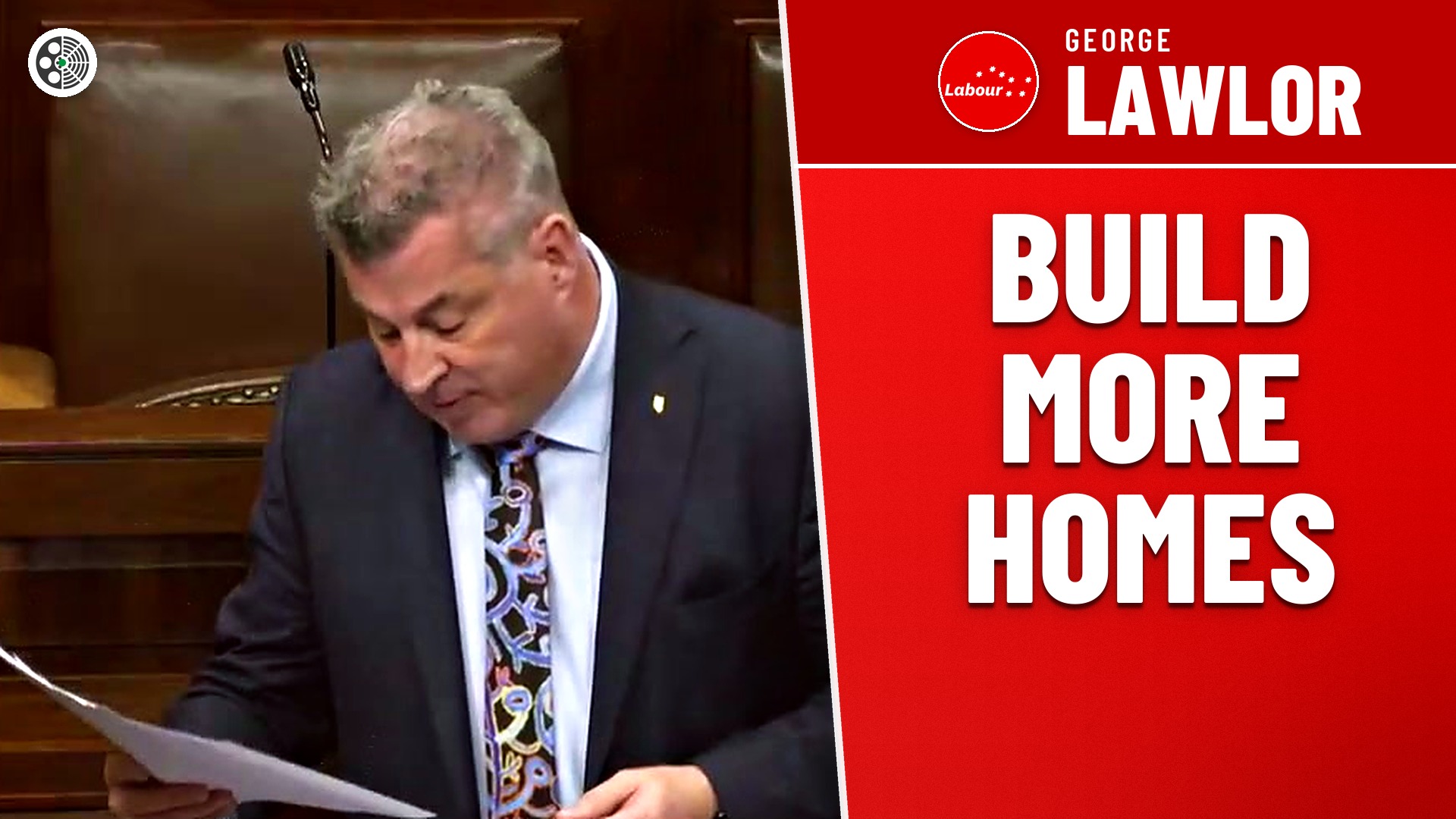
George Lawlor
George Lawlor: Short-term let rules must be targeted
Sinéad Gibney
Sinéad Gibney challenges RTÉ funding shortfall and redundancy focus
Barry Ward
Barry Ward presses for EU blocking statute on US sanctions
Transcript
I welcome the students of Nagle Community College to the chamber, led by Principal Nicholas O'Keefe
and son of the Chief Whip, Mary Butler, Jack Butler, who teaches in the school as well,
and to all of the students who are very welcome to Dail Eireann.
At Ceann Córla, the meeting of the European Council on the 15th and 16th of October was
the first to take place during Ireland's presidency term. It was a long meeting with
a very full agenda, with leaders having discussions on a number of key presidency policy priorities.
The priorities included competitiveness, the next multi-annual financial framework,
Ukraine and enlargement. Other items on the agenda were amongst others migration, European
security and defence, and of course the Middle East. I will set out the main results of the
European Council meeting on competitiveness, the multi-annual financial framework, Ukraine
and the Middle East. Minister Thomas Bourne will speak later to the other issues.
At Ceann Córla, leaders reviewed ongoing work to strengthen the competitiveness of the European
economy against a backdrop of increased geopolitical uncertainty. I briefed colleagues on the
considerable progress being made by the Irish presidency on the implementation of the One
Europe, One Market roadmap, which is the blueprint for European competitiveness, building on the
jointly agreed by the European Union's three institutions, the European Parliament, the
Council and the European Commission. As the current presidency of the Council, Ireland is
doing all we can to meet the goals agreed in the roadmap. In this context, the European Council
had a useful exchange with President Metzola of the Parliament on the importance of continued
constructive engagement by the European Parliament to advance negotiations with the Council
on key files in line with the ambitious timelines in the roadmap. I also took the opportunity
to highlight specific priority files where an extra political push is required. This includes
finding the right balance on the Industrial Accelerator Act, where compromise will be
required in order to reach political agreement this year. On European Union Inc., our political
by the Irish presidency on the 23rd of October. Significant progress there. This is a measure
that will make a real and practical difference to Europe's start-up and scale-up potential.
It represents a very significant milestone for the Irish presidency, and I wish to thank our
hard-working teams both in Brussels and Dublin for their efforts in securing this result.
As presidency, we look forward to early progress in the European Parliament
so that we can advance negotiations to conclude the file. On foot of the leaders' exchanges,
we also secured an agreement on an important package of measures to simplify European Union
digital regulation. We now have agreement on three of the four omnibus simplification packages
that we are aiming to conclude this year. The discussions among leaders also helped
to advance the European Union Savings and Investment Union. The Irish presidency has
an important agreement with the European Parliament on measures to revive and simplify
the European Union's securitisation market. At the ECOFIN Council in October, the Member States
reached a political agreement on the market integration and supervision package. I wish
to pay tribute to the Taunus Chinese team for their hard work in delivering this particularly
important agreement. These key elements of the Savings and Investment Union, or to use another
to create a truly single market for capital, including stronger financing for fast-growing
young firms at the technological frontier. Our October meeting also included important
political exchanges on the review of the Emissions Trade System, or ETS, which will inform the
ongoing work towards achieving political agreement on this difficult package at the
Environmental Council in December. Energy was a key focus of discussion in the broader
competitiveness context, and leaders underlined the critical importance of tackling high energy
prices. We discussed the impact of the current geopolitical context on global supply chains,
energy security and prices, including the effects on citizens, in particular the most vulnerable
industry and the wider economy. We underlined the urgent need for a coordinated European response
with targeted and temporary measures that reflect the specific circumstances of Member States
and safeguard the single market. The Commission's proposal to postpone the methane regulation
was welcomed in that regard. Alongside immediate measures to protect households and industry,
we reaffirmed that accelerating the transition to clean, home-grown energy is the most effective
way to strengthen Europe's energy security and to structurally lower prices of energy.
Our discussion on global macroeconomic imbalances at the European Council
underlined that China's economic model is presenting significant challenges for Europe,
including de-industrialisation. Leaders welcomed the progress made by Commissioner
Sefcovic during the recent European Union-China trading and investment consultations in Beijing,
including agreement by China on an approach to significantly moderate exports of hybrid vehicles
and on ways to improve market access for European exports. I think it is important to acknowledge
that these agreements reached with China represent the first step towards achieving rebalanced trade
between China and the European Union. In parallel with the ongoing dialogue with China,
there was broad support for recent Franco-German proposals which advocated for swifter use of
existing trade defence tools and the development of new ones
in order to rectify structural imbalances in trade. I think that the importance of unity
on this issue cannot be overstated and we should proceed in a manner that ensures
that the European Union remains a strong, innovative economy which is competitive and
open to investment and an advocate for free and fair trade. At the October European Council,
I presented the Irish Presidency's revised negotiating box on the future European Union
budget, the 2028-2034 multi-annual financial framework. In other words, the budget for the
next seven years for Europe. This meeting marked a very significant milestone and achievement by
our Presidency, the delivery of a robust compromise proposal on the future European Union budget.
In sharing our rationale and approach, I made clear to European Union leaders
that the objective of our revision was to present a modernised and flexible budget
that invests in new and emerging priorities on the one hand, while at the same time protecting
treaty-based policies such as CAP, the Common Agricultural Policy. The proposal also reflects
the fiscal realities that all Member States face. The Irish Presidency proposal reflects an
budget of 1.62 trillion, a 30% increase from the current multi-annual financial framework.
Our proposal remains future-oriented, with a strong focus on competitiveness,
research and innovation, while reflecting a greater focus on security and defence
in the context of a more uncertain world. It proposes a package of European competitiveness
funds totalling more than €400 billion, and the competitiveness heading overall
has more than doubled compared to the current multi-annual financial framework.
We have also responded to the calls of a very large number of Member States
that want to see national envelopes under the heading 1, Cohesion and the Common Agricultural
Policy, protected as part of that positive, future-focused agenda. These are valued,
impactful and proven policies that can continue to support and develop our regions,
our rural communities and our farmers into the future. We have also sought to ensure flexibility
within national envelopes in how Member States allocate this European Union funding. We have
protected support for recovery and reconstruction funds for Ukraine, and also humanitarian
assistance for the most vulnerable. We approached our task with an open mind and not with any fixed
agenda. And we also listened to those Member States who contribute most to the budget,
that the previous proposal was simply too large for our current fiscal circumstances.
That is not something that can be lightly set aside if we are to reach agreement. And that is
why we reduced the overall volume proposed by the Commission by about 8%, or €140 billion
compared to the Commission's proposal. That should not distract us from the very real increases
that are being made when compared to the current MFF. The Irish proposal is for a budget,
as I have said, that is 30% above our current MFF, and almost every programme receives an
increase in our negotiating box when compared to the current situation. The revision seeks
to bridge the differences between Member States on volume, long-term spending priorities and how
the European Union will generate its revenue. As is the nature of difficult budget negotiations,
our negotiating box was never going to please everyone. However, it has been broadly welcomed
by leaders as an important step in the right direction. I am confident that it has advanced
discussions further on the path to agreement before the end of the year, which is something
that I am particularly keen on, that we do get agreement. It now falls to President Costa
to take these negotiations forward. The Irish Presidency remains at his service
to assist with this complex and challenging task.
I can't call it Russia's illegal war in Ukraine is deadlier for civilians today than at any point
since the start of the full-scale invasion. By August 2026, more civilians were killed
and injured in Ukraine than during the whole of 2025. At the European Council,
leaders reaffirmed our steadfast support for Ukraine. President Zelensky gave an overview
of the situation on the ground in Ukraine. We maintained our call for a ceasefire and for
Russia to cease its aggression and to engage in meaningful negotiations. We strongly condemned
Russia for deliberately targeting Ukraine's civilian energy and transport infrastructure,
health care and education facilities. Despite all peace efforts, Russia has repeatedly shown
it is intent on escalating rather than de-escalating the conflict. The Black Sea
Corridor remains blocked as Russia strikes targeted commercial shipping and weaponizes,
sorry, Russian strikes target commercial shipping and weaponizes food and global food security.
Russia is a direct threat to global security, to the global security order beyond Ukraine,
repeatedly violating member states' airspace and territorial waters. Ireland is committed to
ensuring that Ukraine receives the support it needs to resist Russian aggression, to strengthening
membership. The European Union's robust targeted sanctions in response to Russia's war of aggression
are impacting on the Russian economy, making it harder to access battlefield foods and to pay
for war. Leaders also reaffirmed the European Union's determination to take forward further
measures to raise the costs to Russia, including by targeting the Shadow Fleet and its enablers.
Ireland is working to ensure that Ukraine has access to the finance it needs to defend itself
against Russia's aggression. As Presidency, we have facilitated the disbursement of the installments
of the European Union's €90 billion support loan for Ukraine. However, Ukraine still has
significant financing needs for 2027, potentially in the region of €70 billion. This is a direct
result of Russia's continuing and escalating aggression. The European Union and its member
states will need to rise to this challenge. Leaders will return to this issue at a special
meeting of the European Council in late November. As part of the enlargement process,
Ireland launched negotiations on Clusters 2, 3 and 6 for Ukraine, in addition to the launch
of Cluster 1 earlier in the year. We are working to achieve the opening of the remaining two
clusters, and hope that this can be achieved before the end of our Presidency.
The Concorde in Moldova is also feeling the impact of Russia's war of aggression
and its threat to the security of the entire region. The people of Moldova are suffering
daily from Russia's hybrid activity. It is therefore important that the European Union
also work to advance Moldova's path towards European Union membership. The European Council
welcomes progress made on its accession negotiations, with the opening of four of
six negotiating clusters to date. The opening of all clusters is a priority of our Presidency.
The Concorde at the European Council expressed its grave concern about the deterioration in
the security situation across the Middle East and the continuing military escalation in the region.
We agreed on the importance of all actors avoiding further escalation.
Dialogue and diplomacy remain the only viable path forward. Maritime security was a particular
focus. Freedom of navigation through the Strait of Hormuz and the Red Sea is vital for global trade
and energy security. We also reiterated that Iran must never be allowed to acquire a nuclear weapon.
The Council clearly condemned human rights violations in Iran, and the European Union
must continue to take measures targeting those responsible for these violations.
On Yemen, Ireland joined the Council in strongly condemning continued Houthi military escalation,
including attacks against Saudi Arabia, including civilian infrastructure, and repeated attacks
on civilian shipping. Leaders discussed the deteriorating situation in Gaza and the West Bank,
and again called on Israel to allow immediate unimpeded access and sustained distribution
of humanitarian assistance at scale into and throughout Gaza.
We reiterated the European Union's commitment to the two-state solution.
Indeed, a key focus of Ireland's presidency of the European Union Council is to reaffirm
the European Union's commitment to a comprehensive, just and lasting peace in the Middle East,
based on a two-state solution that guarantees the right of both Israeli and Palestinians
to self-determination and to live in peace and safety within secure borders.
At Ciancóire, our last Ciancóire, we are now at the fifth month into Ireland's presidency term.
The October European Council meeting marked both a significant milestone with the presentation
of the Irish negotiating box and a significant opportunity for progressing our other
presidency priorities. I look forward to welcoming my fellow European leaders to Dublin next week
for an informal meeting of the European Council. This will be preceded by the European Political
Community Summit the day before, which will be the largest meeting of international leaders
ever hosted in Ireland. I look forward to updating the House on these events and future
meetings of the European Council and on the results of the Irish presidency as we head
into the most intense and pivotal phase of our term in office. Thank you.