

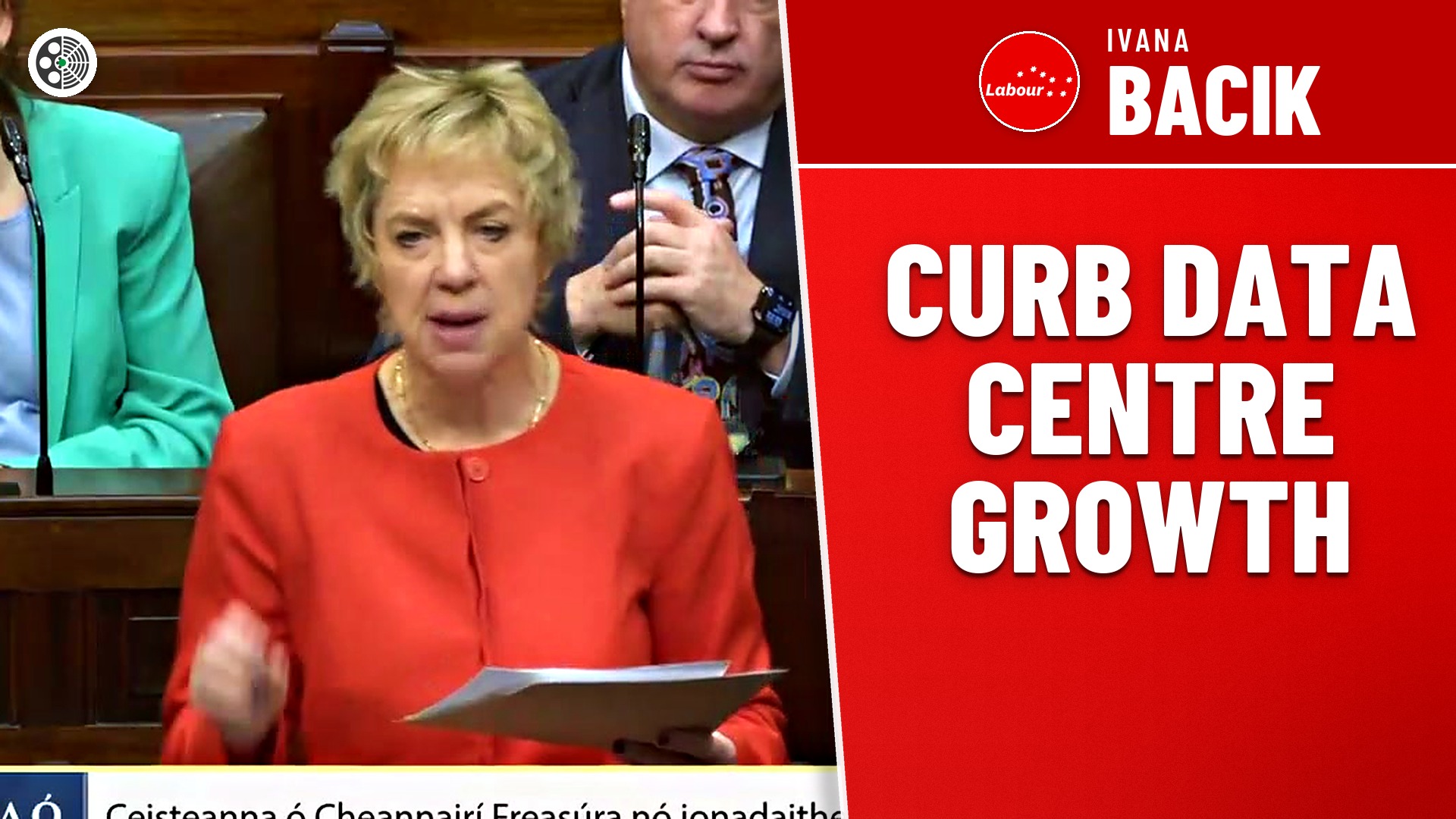


Ivana Bacik Challenges Taoiseach on Data Centre Growth
Labour Party leader Ivana Bacik challenged the Taoiseach in Dáil Éireann over data centre expansion, electricity costs and the regulation of artificial intelligence. Speaking after the US midterm elections, she argued that Ireland should address the effects of data centres on households, energy use and transparency.
Ivana Bacik linked concerns about data centres and AI in Ireland to voter opposition to tech oligarchs and data centres in the United States. She said Ireland had nearly 150 data centres, that they used nearly a quarter of the country’s electricity, and that a lack of transparency made their numbers difficult to establish. She also cited rising electricity costs and households in arrears, and asked the Taoiseach when the Government would curb data centre growth and the power of tech companies.
The Taoiseach said Europe’s AI Act, Digital Services Act and Digital Markets Act provided substantial regulation, and said Ireland had structures to support safe, transparent and responsible AI. He argued that the US election could not be attributed to technology and oligarchs alone, and questioned whether Labour wanted Ireland to abandon AI.
Bacik agreed that the US election had multiple causes, while arguing that data centres and opposition to AI policies also mattered. She said Labour had proposed greater data-centre regulation and transparency, and cited a Friends of the Earth estimate that only one in six operators submitted data under the EU Energy Efficiency Directive.
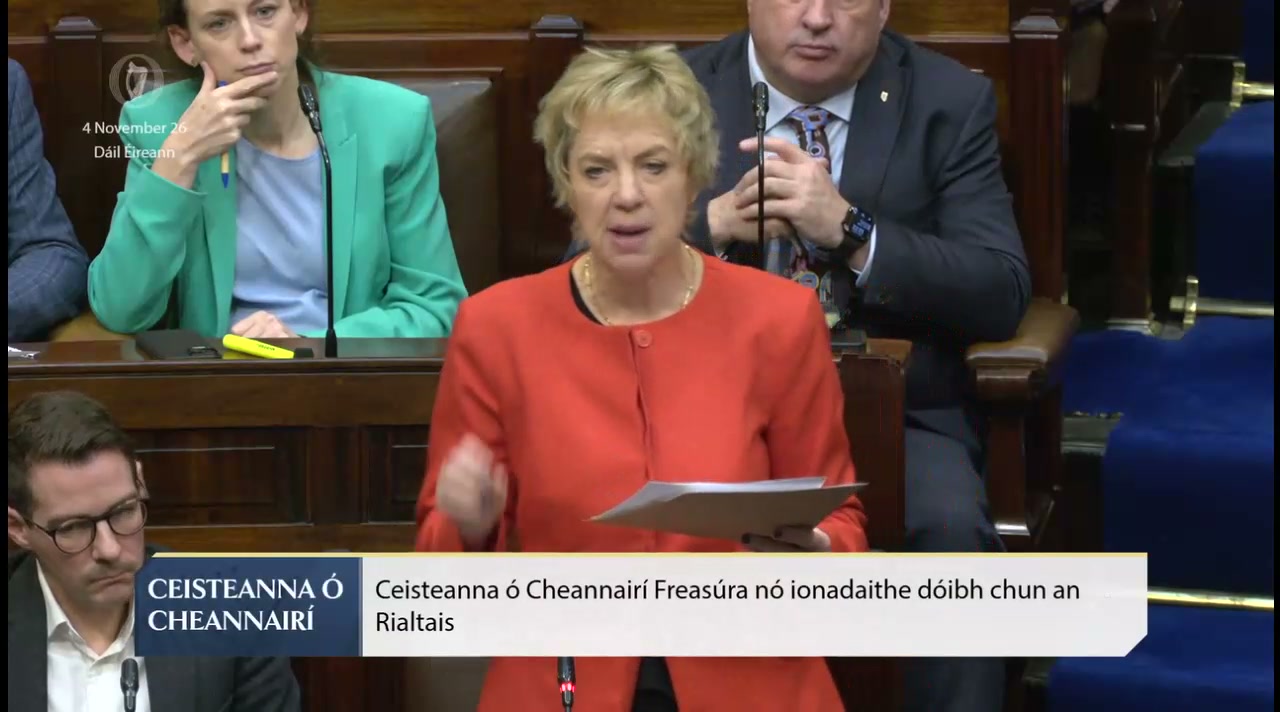
Ivana Bacik linked concerns about data centres and AI in Ireland to voter opposition to tech oligarchs and data centres in the United States. She said Ireland had nearly 150 data centres, that they used nearly a quarter of the country’s electricity, and that a lack of transparency made their numbers difficult to establish. She also cited rising electricity costs and households in arrears, and asked the Taoiseach when the Government would curb data centre growth and the power of tech companies.
The Taoiseach said Europe’s AI Act, Digital Services Act and Digital Markets Act provided substantial regulation, and said Ireland had structures to support safe, transparent and responsible AI. He argued that the US election could not be attributed to technology and oligarchs alone, and questioned whether Labour wanted Ireland to abandon AI.
Bacik agreed that the US election had multiple causes, while arguing that data centres and opposition to AI policies also mattered. She said Labour had proposed greater data-centre regulation and transparency, and cited a Friends of the Earth estimate that only one in six operators submitted data under the EU Energy Efficiency Directive.
We publish thousands of recordings to make Irish politics transparent and resistant to manipulation. Spotted an error? Report it — together we are building a reliable archive of Irish politics.
Other speeches


Tego samego dnia All speeches from this day →

Peter 'Chap' Cleere
Peter 'Chap' Cleere questions RTÉ on €20m funding cut

Michael Murphy
Michael Murphy questions Albanese on Gaza and the UN
Richard Boyd Barrett
Richard Boyd Barrett: Housing for people, not profit
Seán Kyne
Seán Kyne backs balanced rural short-term letting rules

Sharon Keogan
Sharon Keogan calls for savings scheme for children in care

Michael Fitzmaurice
Michael Fitzmaurice questions fairness in farm supply chains
Transcript
Before I begin, my thoughts are with the seven people impacted by the terrible arson attack
off Clambrassil Street yesterday.
I commend the first responders who took brave action and I send my very best wishes to those
still recovering in hospital.
Taoiseach, turning to better news, following the recent great election results in Brazil
and Serbia, the Democrats' surge in the US midterms last night have given us all reason
to hope again.
American voters have pushed back against Trump's warmongering, against his attacks on civil
rights, and against his economic policies that back billionaires over working people.
It's now up to the Democrats in Congress and the Senate to take on the mammoth task of
tempering Trump's worst tantrums before he and his acolytes do any more damage to the
world.
And it's good to see those acolytes damaged by these elections.
Indeed, to quote his occasional boss and longtime frenemy Donald Trump, the perennial bullshit
artist Elon Musk has wasted half a billion dollars in these elections, but despite this,
he wasn't able to buy the race in Texas or elsewhere.
But Taoiseach, there's a lesson for you following the US results too.
American voters have swung decidedly against tech oligarchs like Musk and against data
centres.
They're questioning the power of the AI technology that is furrowing deeper and deeper into everyday
life.
They're questioning how, far from fulfilling its potential for good, AI is threatening
democracies, economies and our planet.
It's generating mass-scale sexual abuse imagery of the kind my colleague Deputy Alan Kelly
hopes to tackle with our new Labour Party bill amending Coco's Law to be heard here
tomorrow.
Private sector bosses are citing alleged AI productivity gains in cutting jobs and freezing
recruitment of our graduates and young people.
Households plagued by the cost of living are watching data centres moving into their communities
and further driving up bills.
Those factors undoubtedly swung voters against Trump and the US, but the same concerns exist
here in Ireland.
Our country is home to nearly 150 data centres already, although the numbers are difficult
to establish due to lack of transparency.
We do know that nearly a quarter of our electricity goes to data centres, the highest per capita
rate in the world, and energy costs are soaring.
The ESB have announced today they'll hike the price of EV charging.
One in seven households are already in arrears on their electricity bills.
A shocking increase, more than 60% in just three years.
Taoiseach, you cite foreign wars as the reason for this, but data centres are directly driving
prices up.
Friends of the Earth estimates data centres added more than €715 million to household
electricity bills nationally, and people are feeling the pinch.
On Saturday, we will have the first national protest against data centre expansion, one
of many taking place across Europe.
But in June, your government voted against our Labour Party motion to halt construction
of new data centres and levy existing operators.
So when will you wake up and smell the coffee?
When will you act to curb the power of tech oligarchs and to end unsustainable data centre
growth here?
Thank you, Deputy Taoiseach.
First of all, Deputy, I appreciate your observations in terms of the US mid-term elections.
I think many people will analyse and study the trends and the factors underpinning that
change.
I would have thought from my initial reading of accounts that the war in Iran was a real
factor in terms of the consideration of American voters and the high prices and inflation in
the US for a number of reasons.
And any anecdotal interviews and so on all refer to the high prices and so on like that.
So I'm not so sure that you can just neatly characterise the election as just one area
around technology and oligarchs.
And I would just sound a note of caution in terms of how one interprets the outcome of
any given election.
But anyway, that's a matter for America, and that's a matter for the people of America.
And I think the people have given their verdict in these mid-term elections and have voted
for the various candidates and the various races and so on like that.
I think from our perspective, though, of course, the situation between the United States and
Europe is much different.
We have an AI Act, for example, in Europe, which regulates AI.
In fact, US authorities and others would criticise Europe for its, by their terms, over-regulation.
I don't think we're over-regulated, but we are regulated and we should acknowledge that
and not give the impression that we are not.
We also on the digital side, the Digital Services Act, the Digital Markets Act, all represent
a very substantial edifice of regulation of the digital world.
You should acknowledge that.
That's not present in the US.
So you can't compare like with like in respect of European regulatory frameworks, vis-à-vis
US or indeed China or indeed other areas of the world.
And we've, here in Ireland, we have established our own structures and powers to support safe,
transparent and responsible AI.
You also refer to data centres, and again, we have perhaps a stronger regulatory framework
governing the construction of data centres maybe than elsewhere, and particularly maybe
than in the States.
But I'd ask you, how many data centres were connected to the grid in the last six or seven
years?
That's your time.
Yeah, it is.
Yeah.
Oh, dear.
Thank you.
But we need a proper analysis of this, less heat and less emotion.
I mean, there was literally a de facto moratorium on data centres from 2000 onwards.
I think you have to go before 2000 before, I think it was only one to two connections
to the grid.
So we have now, prior to that, prior to 2018, 2017, there was a very substantial increase
in data centres in the country.
And, you know, I think relative to other countries, we don't have a heavy industry, we don't have
other large energy users.
But I would be interested to know if you think we should just abandon AI altogether, or what
is the ultimate sort of objective that you're putting forward in terms of how we should
approach it?
Well, Taoiseach, I absolutely agree with you.
There were multiple factors in the US elections, and there's no doubt that Trump's disastrous
war in Iran played a huge part in the Democrat surge and in people turning against him, and
I acknowledged that in my opening remarks.
But it's also the case, and I know you watch these elections closely, I know you'll be
aware, that the proliferation of data centres did play a significant role, in particular
in states like Michigan, people really standing out against Trump's policies on AI and against
tech oligarchs.
And of course, we can harness the power of AI for good.
Of course, there is such a thing as ethical tech, and that's really important that we
speak up for that.
And I agree with you about the different context here, and about EU, strong EU frameworks and
regulation.
But Taoiseach, that makes it all the more extraordinary that your government voted against
our Labour proposals in June to provide better regulation of data centres.
Our deputy, Kieran O'Hearn, putting forward sensible proposals for regulation to ensure
greater transparency.
One of the issues that you mentioned yourself is a simple lack of knowledge about figures,
about how many data centres are operating, just one in six apparently submitting data
to the EU Energy Efficiency Directive, according to Friends of the Earth.
A huge gap here in our knowledge, and therefore a gap in regulation, and meanwhile energy
costs soaring, and being driven up.
Taoiseach, do you want to respond?
Again, I would question the Friends of the Earth's assessments, by the way, and some
would as well.
And in fact, they themselves do as well, in terms of the authors acknowledge has limitations
and quote, extremely difficult to predict with any certainty, unquote.
But park that for a moment.
I mean, the digital economy is important in Ireland, I presume you acknowledge that.
And globally, and in fact, that the position in Europe and elsewhere was that this era
and the year to come is a digital and a green era in terms of going to net zero and so on
like that.
And that the new large energy user policy, the LEAP published only in January of this
year, I think, moves us to a more plan-led system in terms of data centres, greater certainty
for people all round, reinforced by unprecedented grid investment.
And the criteria that are set out by CRU are strong and stringent in respect of seeking
new connections to the electricity system.
And that's the reality of it.