



Richard O'Donoghue questions department funding model
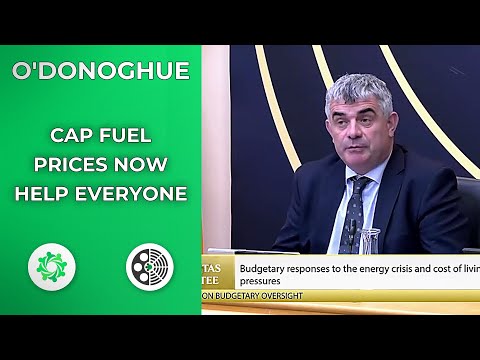
Richard O'Donoghue questioned how government departments budget and distribute funding during a committee discussion on business costs and services. He argued that late funding decisions and “use it or lose it” rules make it harder for businesses and service providers to plan and deliver support.
Richard O'Donoghue said increases to the minimum wage could raise costs across a business, including for workers paid above the minimum, and argued that inflation could offset the gains. He also said decisions on gas supports had overlooked premises using bottled LPG, and described this as part of an urban-rural divide.
He called for funding to be audited against the services organisations provide, with more support directed to those delivering services. He asked whether funding could be measured against the number of people helped and the outcomes achieved, while witnesses noted that services vary and that reporting requirements across multiple funders can create inefficiencies.
O'Donoghue questioned funding arrangements that leave organisations uncertain of their budgets until the first or second quarter, and called for departments to provide annual funding forecasts before the year begins. He also criticised “use it or lose it” rules, saying audits across all four quarters could identify money spent late in the year and help spread funding more evenly.
Richard O'Donoghue said increases to the minimum wage could raise costs across a business, including for workers paid above the minimum, and argued that inflation could offset the gains. He also said decisions on gas supports had overlooked premises using bottled LPG, and described this as part of an urban-rural divide.
He called for funding to be audited against the services organisations provide, with more support directed to those delivering services. He asked whether funding could be measured against the number of people helped and the outcomes achieved, while witnesses noted that services vary and that reporting requirements across multiple funders can create inefficiencies.
O'Donoghue questioned funding arrangements that leave organisations uncertain of their budgets until the first or second quarter, and called for departments to provide annual funding forecasts before the year begins. He also criticised “use it or lose it” rules, saying audits across all four quarters could identify money spent late in the year and help spread funding more evenly.
We publish thousands of recordings to make Irish politics transparent and resistant to manipulation. Spotted an error? Report it — together we are building a reliable archive of Irish politics.
Other speeches
Tego samego dnia All speeches from this day →
Mary Lou McDonald
Mary Lou McDonald challenges Taoiseach on public service pay
Cian O'Callaghan
Cian O'Callaghan challenges Taoiseach over public service pay
Rose Conway-Walsh
Rose Conway-Walsh challenges legacy Bill's human rights test
Pearse Doherty
Pearse Doherty: Rural Ireland needs more than ambitious targets
Donna McGettigan
Donna McGettigan makes case for minimum wage for apprentices
Paul Murphy
Paul Murphy challenges Government on Lebanon mission and triple lock
Transcript
Again, thank you all for coming in. I'm a very practical person. I'm a business person
myself. I'm putting that on the record here myself. And I see myself and Deputy Vinewoods
talking on it there about the minimum wage. I'm just going to give one for instance with
one company that was using, for the minimum wage, one part of their staff was minimum
wage. They were also on receipt of the 9% VAT. When the minimum wage changed, it cost
400,000 that year because of all the different sectors. So the minimum wage, the next person
above and all of them, everyone wanted the same bump on the wages, which meant that the
cost of staying in that place rose as well. So we ended up paying for it ourselves anyway.
So the whole point of having a minimum wage and increase, and I'm not against it, is that
you get more when you have more money. But when you have the inflationary costs of everything
else added in, no matter what wage you rise your minimum wage to, it's only going to drive
inflation in the current status that we're at at the moment. And that's what's frustrating
for all of us because we all want to keep our young people here. We all want to make
sure that people are valued and that their jobs are valued. And everyone, regardless
of what they do in this country, it's a wheel. We're turning the wheel and everyone, regardless
of where their expertise are, from the lowest paid to the highest paid, I have to get this
wheel to go round. And that's what I look at. But they're getting it wrong all the time.
From the point of view of where they're targeting. And Gerald, at the very start of this meeting
you mentioned about the LPG. And you also mentioned in your statement that it was like
a rural and urban divide. I've been saying that since I got elected. Every decision that's
been made from departments here at the moment is an urban-rural divide because the people
that are making the decisions, they forget about urban and rural. To me, urban and rural
is the same. It's Ireland. Let's cover everyone within the sector. But when you have people
making their budgets for this and they leave out the LPG, out of it, so you have the calor
gas and you have the flow gas. They're bottles of gas. They left these out. So you have premises
that can't use, they don't have the facilities of natural gas. They don't have the space
to have natural gas tanks within their areas where they could actually have. So they have
to use tank systems or a small tank system and they're left out of it. That to me is
more than an oversight. When you have a department that should recognise all areas in business
and it's the SMEs that get kicked. If I have to be brutally honest, and I'm an honest person,
in NGOs, in a business term, there's NGOs in this country doing absolutely fantastic
work. But there's some NGO services are getting massive funding and they're not delivering.
When I see the sectors that you've talked about, you've been underfunded and you're
providing massive support for people. So I'd love to see a business model put into the
NGO sector. That areas that are getting funding and not providing any services should be audited
against the NGO services that are providing services above and beyond outside of their
own working hours. They should actually get the funding and should be balanced. So I'd
like to see them audited of what they're providing, what they're providing in services. And if
they're not providing services, give it to the services that are providing that need
it. That's me, the business model. I'm in business all my life. That's the model I use.
So how do we help more people is give the funding to the people that are helping people
and to the ones that are not doing it, give them less because they're not providing a
service. That's me calling a spade a spade. And that's the way I work. And the worst thing
is NGOs get the same name as politicians. We're all the same. You can have people doing
great work, but you'll all be branded under the one sector. But I'd like to see it segregated
and see the great work that there is NGOs doing. And I'd also like to be segregated
that there's NGOs getting massive funding and not providing any services at all to the
people of Ireland. So that's me straight out telling you that way.
But so as I said, I'm from business and I'm going to direct the first question over here.
And from a business sector myself, my turnover in business has gone up.
My profits have not gone up. They've depleted overall. And if I did put my growth and have
my profits based on the same percentage model as I was using in other years with the inflationary
costs, people would be paying an awful lot more for my services to be delivered. So it's
a balancing act. So from the point of view of the PRSI, it may help a small bit, but
not an awful lot. On the price of materials, it's huge. On the price of cost of getting
people to work, carbon tax, it's huge. You've then got the auto enrollment, which I don't
have an issue with myself, but it has to be paid. But if I pay it, it has to come from
me. It's all in your budgeting. And what I'd like to ask the question is,
if the department was a business, would it survive based on the system that they're
using at the moment because they can't forecast? Because to me, for my business, I have to look
at next year. And I have to try and forecast for next year. And I have to try and stay within that
so I can make myself as efficient as possible and also see if I can have growth and how I can
actually future-proof my company. So the department at the moment, you rightly said it, that when
you get your funding, you don't know until quarter one or halfway into quarter two what funding
you're getting. So the model needs to be changed. And to me, it needs to be a business model.
Come the 31st of December, you need to know on the 1st of January what you have to forecast
for the full 12 months. And how can you help that from the point of view of getting our
departments that way? Yeah, I think it's a major issue. We have, like most of our members, will
be well into setting their budgets or will have already set their budgets. So they'll know what
they're doing next year. Now, there's lots of things in the wider world, energy costs in
particular, that control that in any given year. But they'll know more or less than the departments
and divisions within those businesses will know exactly what they're doing. And they can plan on
that basis. I think it's a common theme that we've heard today, that challenge of multi-annual
funding, but also the way we fund in-year that you might not know until, as you say, quarter two,
what your actual budget is for the year. It doesn't allow organisations to plan.
And furthermore, it leads to inefficiencies because if you can't plan, then you can't set up
the best, most optimised way of running your organisation. And that applies to both the
in-between. So there is a challenge in how we budget that is set up to be inefficient. And it's
set up to have the in-year overruns that I referenced earlier. Like really, for any organisation getting
funding from any source, they should be budgeting now for next year and have a fair idea of what
they're doing. And as I said, we know at departmental level what people are getting, but
we won't know at organisational level as that feeds down into Q2. So bringing that as much forward,
we talked about the new efficiency body that's going to come out of PER. I think one of the
biggest challenges for efficiency is how we budget doesn't really suit how organisations,
which have to operate in contact with reality, have to run their organisations and plan.
Thank you. For yourselves over here now, how do I get a model in place that you can
get the rewards that you need to help people? So one thing that I had in my head is,
PER head of persons that you have actually helped, based on a funding from a model last year to a
model this year, if you were to break it into PER head that you get the funding from,
is it a way of trying to audit from the point of view of government saying, right, we helped
1,000 people this year, we got a million euros. Next year, we have to help 2 million people.
Is there a system that can be worked out that shows year on year the amount of people that
you're actually helping and how your service go up and beyond, even within your own time limits
of your day? Is there a way of putting that together so I can actually come with a system
that can come to me and say, listen, I can see this, this is what they've done, this is what
can be done. So in other words, what way can we help your system to make sure that it benefits
everyone that you're helping? Yeah, thanks. Thanks, Chair. I think just a few points. I think
some of the individual people might hear, might answer your last question, because there's
variable costs. So you may have residential services to provide, or you may be just providing
drop-in services. So there may be some difficulty in having a uniform figure that you would allocate
annually. But I think each of the areas like homelessness and health are probably making those
figures available to their individual departments. Maybe that can be improved. I think your idea
about an audit is a good one. And it's happening in a number of ways already. I mean, the COSI report
is effectively an audit of what's required to make the system effective. So it will show up
in funding and will seek to correct it. And we already know ourselves that the Kuhn area,
which deals with domestic and sexual violence, seems to be underfunded. I think the COSI report
hopefully will bring that out as actual, factual data. I think the proposals coming from government
about an efficiency effectiveness task force, or I saw it described as a savings task force
recently as well, is something that we would like to contribute to. Because if you like,
the inefficiencies that exist for us at the moment from our side is having to report to different
agencies and different funders at different times with different stipulations, being paid at
different times. So your staff and your resources come in at different times. That is a clear
waste of energy by the finance department, and then carries over.
Can I ask one question based on that? And it'll be fitting from all of you.
The department set up something the way they'd hand out their funding, use it or lose it by
the end of the year. And it causes problems across each sector, even through local authorities,
where they might be able to save something here, but they might have been trying to put off a
project for the last year, or they might be able to deliver something in the following year,
and they've put down here, use it or lose it. So there's money being wasted at the end of the
year. But if they have it indicated, and they can say, we need this so we can actually forecast
this for next year, there should be allowances put into this, because that's a business model.
And that your funding that you're putting together with the funding to do from the next year,
we now might be able to deliver a service. But this use it or lose it is a thing that has to stop
and has to change. Yeah. Well, do you want to come in on the use it or lose it aspect? Yeah,
I mean, the Section 10 review that the local authorities have conducted has actually now
provided a really strong framework that's based on a very clear delivery model, which is getting
people out of homelessness or preventing people coming in. They're really, really very, very
kind of clear metrics. And the other kind of big metric is health improvement. And John is right
that it's really difficult to come up with unit costs because you might have a set of
accommodation-based services. So we would have a service, for instance, in Cork, where we have 70
men in one building. But we've got another service where we've got 42. But we need the same amount of
staff to go in because of the presence that you need on site. But I think what you're probably
hearing from us through the efficiency framework that needs to kind of come out is that you're
right. I think we've started to tell that we're not telling properly in terms of the impact that
we're having on the ground. I think from a point of view of going forward, we are completely bought
into working alongside government to make sure that the cohesiveness that's required across
organisations for insurance, for procurement, mass procurement and food, for instance,
across organisations, buildings maintenance, the purchase of fuel. Things can be done better
across organisations as well. And also as well, the big question in terms of
the responsibility of the sector as well, to kind of look at the organisations themselves.
We took on six services from the Society of St Vincent de Paul, that's DePaul,
five years ago, because the society concluded that it was more efficient for them to hand over
those services. More of those discussions need to happen. And there needs to be innovation funds
that need to exist in order to facilitate that as well. The approved health and body sector is
another example of that as well. So look, what you're hearing from us is that impact is really
important for us. We want to engage with the efficiency task force and we want to be facilitated
to have discussions ourselves on how we can do things better.
Just one final point about supporting organisations that deliver services and
giving less to those who don't. I think there's some difficulty in classifying where services
begin and end. I'm aware, for instance, of organisations that would have done a lot of
advocacy on things like smoking controls, on alcohol, on sugary drinks, on the need for more
cancer awareness. So I think there is a role for the sector to actually come to government with
ideas and say, we need to do better to government. So it's not purely about delivering a service that
is available and clearly identifiable. There is a role for the sector to work with government
to make things better, whether it's on smoking regulations or other areas.
But if you look at the end of the year, then when you look at the budgets and if you see that they
have a massive purse coming into quarter three, and when you look at your own sector then and
you look at different sectors and our purse is empty since quarter one and we're struggling.
And then that money then is put into something that we must do a big project now and get this
for the end of the year. That's where the audit should come in across the whole year.
So if they're doing that and they're waiting at the end of the year to get rid of money
and it's going into something, even if it has to help on all that sector, it should be forecasted
throughout the year on a quarter one, quarter two, quarter three and quarter four, not at the end of
the year. And if they audit across all the different sectors, they'll see in quarter four
that there's an awful lot of money being spent in quarter four that hasn't been spent in the
first three quarters, which could have been sustained over the whole 12 months. And that's
where I want to try and get the balance right. So if they can do that over three months,
three quarters and get results, and then at quarter four, they're actually spending
that it's gone out of it. But I just want to let, I'll come back around again to you there on Tuesday.
Deputy, just on that point, again, section 10 has introduced that mechanism of in-year
reviews of budgets and it also has a clawback mechanism as well. So just to make that point.
I noticed some of my colleagues in Tusla, one of the issues that we've been discussing over
the last couple of years is any money that's not spent is taken back. And at the same time,
an organisation isn't allowed to have a sinking fund, isn't allowed to have,
so they're trying to break even at the end of each year. So if a building then requires some
works and the money isn't available, it's gone. Or there's something more sustainable comes up,
exactly what you're describing there, because it has to be done by the end of the year,
or it's taken back. And then we find organisations on the verge because there's a sudden rise in
bills and they don't have any, there's no flexibility in the smaller projects,
particularly the budgets that support that.
Gerard, do you want to come in on that?
No, I think, look, that all makes perfect sense. I don't think there's many organisations,
particularly larger service-driven organisations that don't have, in the private sector certainly,
that don't have some kind of reserve for the unexpected. And we've got a lot more
unexpected in recent years than we probably have in the past.
All right, for yourself now, the table there now, have you any suggestion that you think
yourself that could make one, I often say to people that if you have five points that you
could make, is there one thing that you could see that could actually make just one difference,
even the change in the trajectory, small bit for people?
In terms?
In terms of people from the private, it could be taxation, it could be, if there's something
that you think that one small move that could be introduced that it may make a bigger difference.
Yeah, I mean, it's a good question. Look, I tend to, like my colleagues and I,
but take a long-term view on this. And I know the point I was making to Deputy Devine about
the National Training Fund, but I think in terms of equipping people with skills at the moment,
that is the key issue that we see at the moment. If you look at the fund and you look at how it's
designed, its beauty is in its simplicity in the sense that the more people at work,
the more employers pay in because you need a more productive workforce because you don't have,
you've key skills gaps and you don't have as many people to fill them.
When they looked at that, then they saw that there was massive money inside the National
Trade Fund, which wasn't being used. And now they're trying to divert it into something else
where it should go back into the training to keep our younger people here and make it beneficial
for Ireland.
Exactly. So that's where the kind of the blockage is because you don't transmit it
background and it doesn't recycle back into skills. So I would say...
If it's not being used as a training fund, why is it being paid in the first place?
A lot of businesses are asking that. Should they set up their own training fund that they can
actually create their internal training fund within their own sectors that if they're putting
it into a governmental training fund and it's not being used to train people, is it something
that should be done internally themselves? So it's something to be looked at.