



Paul Murphy challenges Government on Lebanon mission and triple lock
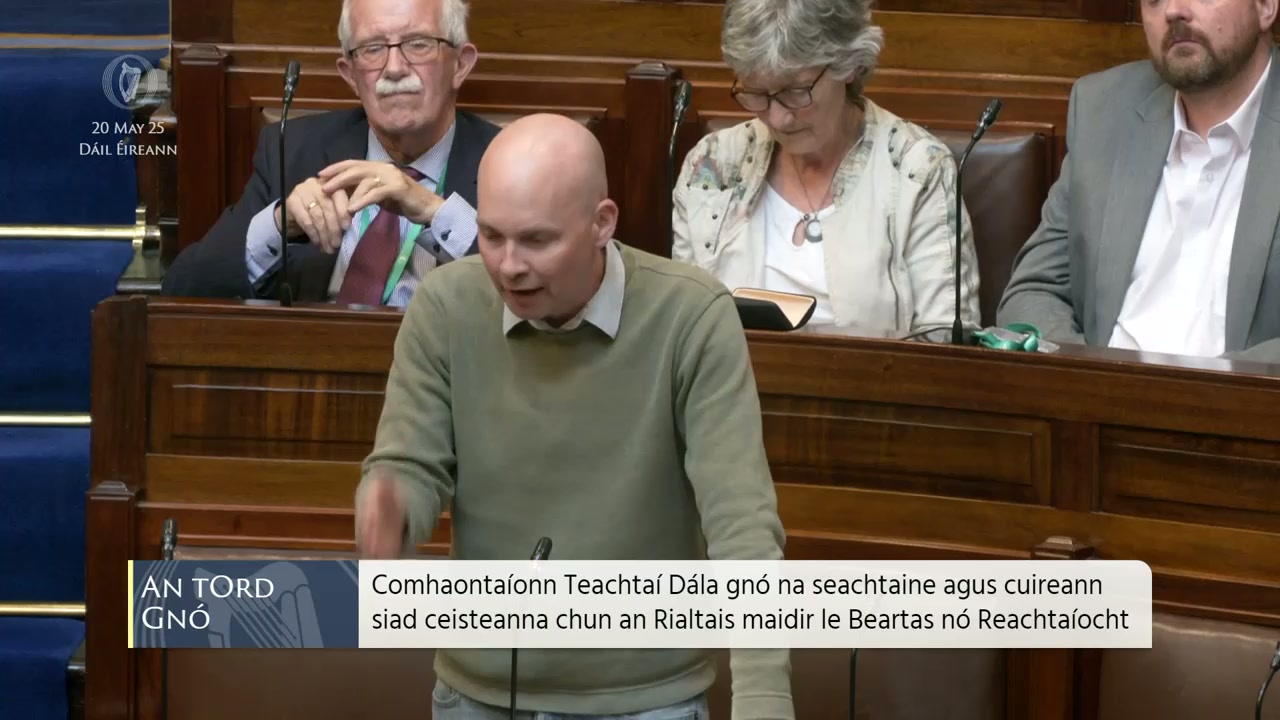
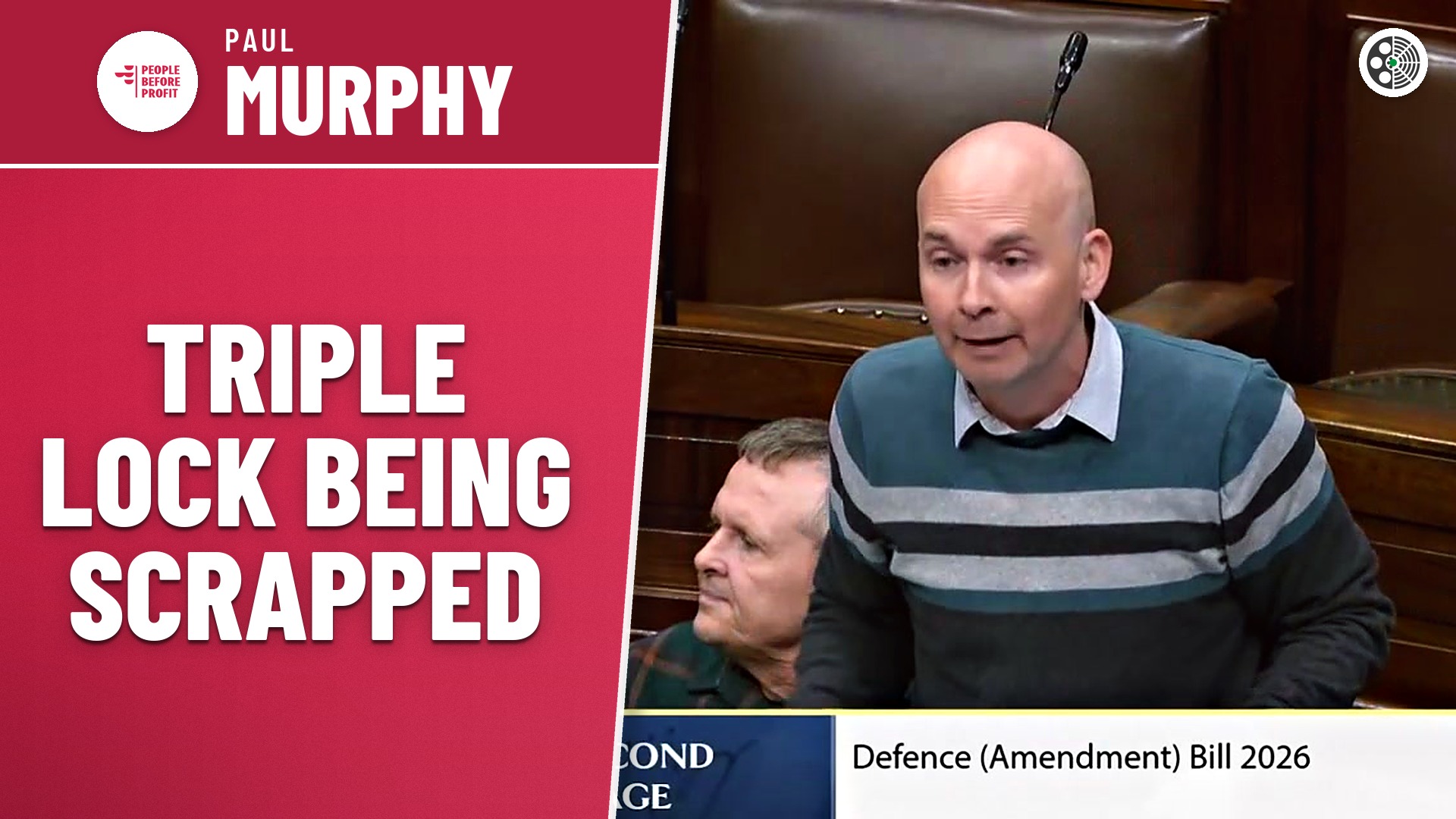
Paul Murphy questioned the Government’s case for changing the triple lock during a Dáil exchange on Ireland’s future role in Lebanon. He challenged the distinction between the EU Support Mission and UNIFIL, and raised concerns about monitoring in southern Lebanon after Irish forces withdraw.
Murphy opened by challenging what he described as an effort to present the European Union Support Mission in Lebanon as a continuation of UNIFIL. He asked the Minister to clarify whether Irish participation in the EU training mission would require the triple lock to be removed.
Murphy pressed the Minister on comments about Ireland’s ability to take part in future missions, asking how those claims fitted with the description of the proposed EU mission as a training mission rather than a peacekeeping or peace-enforcement operation. The Minister responded that the EU mission had civilian and military strands, and that participation in the military strand would require the triple lock to be removed or a UN mandate.
Murphy described the situation in southern Lebanon as devastating and said villages had been demolished and vulnerable communities remained in the area. He warned that, when Irish forces withdraw, there would be nobody to monitor what was happening there, while making clear he was not proposing an Irish mission south of the border.
Murphy argued that Ireland should use every available means to contribute to security and peace in Lebanon, given the country’s long history of service there. The Minister outlined UNIFIL’s mandate and the EU mission’s training and capacity-building role, and said the military strand could include force protection.
The debate also covered the expected end of Ireland’s UNIFIL participation and the possibility of other overseas service opportunities for Irish Defence Forces personnel. Watch the recording to hear the full exchange.
UNIFIL and the EU mission
Murphy opened by challenging what he described as an effort to present the European Union Support Mission in Lebanon as a continuation of UNIFIL. He asked the Minister to clarify whether Irish participation in the EU training mission would require the triple lock to be removed.
The triple lock question
Murphy pressed the Minister on comments about Ireland’s ability to take part in future missions, asking how those claims fitted with the description of the proposed EU mission as a training mission rather than a peacekeeping or peace-enforcement operation. The Minister responded that the EU mission had civilian and military strands, and that participation in the military strand would require the triple lock to be removed or a UN mandate.
Concerns about southern Lebanon
Murphy described the situation in southern Lebanon as devastating and said villages had been demolished and vulnerable communities remained in the area. He warned that, when Irish forces withdraw, there would be nobody to monitor what was happening there, while making clear he was not proposing an Irish mission south of the border.
Ireland’s peacekeeping role
Murphy argued that Ireland should use every available means to contribute to security and peace in Lebanon, given the country’s long history of service there. The Minister outlined UNIFIL’s mandate and the EU mission’s training and capacity-building role, and said the military strand could include force protection.
The debate also covered the expected end of Ireland’s UNIFIL participation and the possibility of other overseas service opportunities for Irish Defence Forces personnel. Watch the recording to hear the full exchange.
We publish thousands of recordings to make Irish politics transparent and resistant to manipulation. Spotted an error? Report it — together we are building a reliable archive of Irish politics.
Other speeches
Tego samego dnia All speeches from this day →
Cathy Bennett
Cathy Bennett warns of winter patient safety risks
Richard Boyd Barrett
Richard Boyd Barrett challenges Donnybrook housing mix
Richard Boyd Barrett
Richard Boyd Barrett says public workers face real-terms pay cut
Donnchadh Ó Laoghaire
Donnchadh Ó Laoghaire calls for Triple Lock referendum
Conor D McGuinness
Conor D McGuinness: Rural strategy falls short on housing
Donna McGettigan
Donna McGettigan makes case for minimum wage for apprentices
Transcript
Thanks Chair. At the heart of the recent propaganda effort by the government to try to convince people
that we need to scrap the triple lock while pretending it has nothing to do with neutrality
has been the attempt to portray the EU support mission in Lebanon as being some sort of
continuation of UNIFIL, which obviously Irish people are supportive of. UNIFIL have positive
support for the idea of our peacekeepers playing a real peacekeeping role there. So the question
is to explore the differences between these two things. Indeed Kyle Callas, when in Ireland, said
the EU is not seeking to replace UNIFIL. It's a very different beast that is being proposed.
And that's grouped with two others with 105 and 175. Okay thank you Deputy. So at the outset I
want to outline very clear that though both UNIFIL and the recently established European
support mission in the Lebanon are intended to contribute to stability and security in Lebanon,
they do differ significantly in their mandate, in their legal basis and their operational tasks.
So nobody is suggesting otherwise, they are different and I'm saying very clearly that.
UNIFIL operates under the authority of the United Nations Security Council Resolution
1701-2006 and the subsequent mandate renewals. Its primary tasks include monitoring the cessation
of hostilities, supporting the deployment of the Lebanese armed forces in southern Lebanon,
accompanying and supporting the Lebanese armed forces as they deploy through the south,
assisting and ensuring humanitarian access to civilian populations and contributing to the
creation of conditions conducive to a permanent ceasefire and a long-term solution. We know that
the situation has changed so we know that many of those duties are not possible at the moment
because of the changed environment in particular in southern Lebanon. UNIFIL conducts patrols,
they operate observation posts, they liaise between the parties, monitor developments along
the blue line and now we have a yellow line which essentially is an occupation in the south
and they support de-escalation efforts in a challenging security environment and I want
to acknowledge that because I travelled to Lebanon and to south Lebanon last week and
saw the environment in which they are operating and I want to commend all of our personnel,
not just those who are there now but those who have served in Lebanon for many decades.
While UNIFIL is fundamentally a peacekeeping mission, it is important to recognise as well
that the mission is also authorised to take necessary action within its capabilities and
area of operations to protect United Nations personnel and civilians under imminent threat
and to ensure its area of operations is not used for hostile activities. By contrast,
the EUSM or the European Union Support Mission is a non-executive training mission. It has been
established as an EU common security and defence policy mission, focused primarily on capacity
building, on training, on mentoring and strategic advice. The mission is intended to support the
Lebanese state institutions, particularly the Lebanese Armed Forces and again, having engaged
directly with our political colleagues in Beirut only in recent weeks, it is very clear that there
is a lot of support that is needed, many of whom are working in the Lebanese Armed Forces, are
on a part-time basis, so this mission is intended to support them and to enhance their capabilities
and other Lebanese security bodies in strengthening their ability to exercise effective control over
Lebanese territory, to improve border security, to enhance maritime security,
to counter illicit trafficking and smuggling, to improve command, planning and operational
capabilities. This is what we are setting out at the outset. The task envisaged for EUSM Lebanon
includes the provision of training, mentoring and advisory support, assistance in areas such
as intelligence, surveillance and reconnaissance, support for broader management and security
sector reform, enhancement of logistics and command structures and strengthening coordination
between Lebanese security institutions. It will be a much smaller mission, it will be focused
primarily north of the Latani River and to say there is no suggestion that we are going to be
of operations will exist, yet nonetheless will operate as an important indicator of EU
and international support for Lebanon following the end of the UN mandate.
If there is any future elements to that, in particular around force protection,
which is another element that is being discussed but that has not been agreed,
we would of course have to look at that and take that on its own in the round. There is no
suggestion here that we are going to propose anything other than a mission that would align
with our values, with the UN Charter, with international law and making sure that we are
focused on peace and security. Both missions reflect the international community's commitment
to support a secure, a stable and a sovereign Lebanon, albeit through different mechanisms
and mandates. In addition, there are other potential missions in support of Lebanon that
are currently being planned and they may provide opportunities for Irish peacekeepers should the
triple lock requirement be removed and again should they align with our national policies
and legislation, but any decision taken in that regard would have to be a decision taken
by government and would likely have to be a decision taken by Dáil as well.
In terms of the UNIFIL mission itself, which will conclude at the end of this year,
the 69th Infantry Group is currently completing its final preparations for deployment to Lebanon
with approximately 294 personnel due to depart later this month as part of what is expected to
be Ireland's final infantry battalion rotation to the mission. They won't be carrying out the
level of actions that the previous and current missions have taken following this is the end of
the mandate at the end of this year. This deployment will be mainly focused on the
withdrawal arrangement for the Irish-Polish battalion and I look forward to attending
the ministerial review in Aitken Barracks this Thursday and meeting the personnel in particular
and thanking them for their contribution, but also recognising their family because we know
that when troops travel abroad, whether it's to Lebanon or anywhere else, their family members
are behind them, they support them and of course they are a crucial part
of that overall commitment to our state. Furthermore, I wish to reassure this House
and the general public that the upcoming end to our participation in UNIFIL
does not mark the end of overseas service opportunities and I have to say that's one
of the things that the troops asked me repeatedly when I met with them two weeks ago,
that we would continue to provide them with opportunities to serve overseas. These are
people who have, many of them, joined the Defence Forces so that they can contribute
to international missions overseas, that are trained and have the required expertise in this
field and it is so important that we work to provide them not just with opportunities but
that our long-standing history, our proud tradition of peacekeeping, of supporting
vulnerable communities, not just in Lebanon but in other parts of the world, that that
can be continued and that is a commitment that I made to them there.
Thank you, Minister. I welcome the clarity and fairness that this is something very,
very different than UNIFIL, it's not a continuation of UNIFIL in any way,
it's not a peacekeeping mission. Could I just dig into it a little bit in terms of what your
position is? If this is a training mission, I agree that's what the EU mandate is,
is it your position that you couldn't send Irish troops to participate in this training mission
without your proposal in terms of getting rid of the triple lock? Or does it require the triple
lock at all? Because as I understand your position from media interviews, I think your position is
saying it doesn't actually require, it wouldn't require the triple lock effectively, we could
send troops there. But if that's the case, then why have you said things like our ability to
take part in missions, for example, Lebanon, is now being diminished? Or explain how you told
the media that the future Lebanon operation could be undertaken on both a peacekeeping
and peace enforcement footing, when in fact what you're talking about here is neither,
it's a training mission. It is absolutely devastating to see what has happened in South
Lebanon, in particular, and I know it's referred to as the buffer zone, it is an occupation,
the IDF have come in and occupied a significant part of southern Lebanon, south of the Latani.
And what they have done is demolished entire villages, 99% of certain villages gone,
demolished. You have a very small minority of the Christian communities, you have orphanages,
you have very vulnerable people that are now left in the south. And what will happen when we pull
out is that there will be nobody to monitor what is happening there. Nobody. And I don't think any
of us want to be in that position. We don't. But I'm not suggesting here that we are now going to
be part of any mission that is south of that border. That's not what we're suggesting here.
What I am suggesting, though, is that we make sure that a country that has spent decades
contributing to peace and stability in Lebanon, where people, every person in Lebanon knows
where Ireland is and knows the Irish troops and the contribution that Irish troops have
made over the decades, and the idea that we would not go to every means possible to participate
in security and peace in that country is beyond me and beyond what has been suggested here.
I'm very clear, Deputy, there are two strands to what has been proposed. A civilian strand,
which does not require the triple lock. A military strand, which does.
No, not military training. A military strand. I've said force protection could be part of that.
This is what our troops are trained for. This is what they take part in. So
suggesting that this is something different or a departure, as part of their current mission,
there is an element of force protection. But that would require the triple lock to be removed,
or it would require a UN mandate. And again, to those who say we're not trying,
there are discussions happening in the UN in the next week or two, specifically, again,
where countries are advocating to try and put place. Deputy, please, Deputy, the Minister has
the floor. I've actually answered this twice. I'm not sure if the Deputy is listening or not.
Deputy Murphy, you had an opportunity to ask the question. Deputy Murphy, the Minister has the
floor. I actually think I've answered it very clearly. I've said the EU mission has two strands,
two strands in one mission. It's possible to... Deputy Murphy, please, Minister.
Do you know, look, this is kind of the attempt that's been made by opposition parties who
oppose this consistently. It's just fire accusations. Let's just shout. Let's just
suggest that we're going to be dragging everybody into this slide and this mission creep. We've been
hearing that for decades, Deputy. We've been hearing that we're going to join an EU army.
It hasn't happened. We've been hearing that we're going to be sending our men and our sons off to
war. It's not happening. We've been hearing that we're going to be forced into all of this.
It's not happening. What I am saying here is that if we want to choose, so two strands,
one mission, we are choosing to be part of a civilian side, and I hope everybody agrees with
that. It's training. It's a lot of it office work. It's about supporting, whether it's surveillance,
whether it's about cyber security, all of these other elements that we want to support the LAF
with. But if we want to take part in other elements of it, which is a military element,
which could include force protection, and we wouldn't decide that until we saw what it was
and what the boundaries of it were, and whether it aligned with our values, with international law,
with the UN Charter, we would not make that decision. But we can't decide that
if the Triple Lock is in place.