



Sinéad Gibney challenges the case for Triple Lock reform
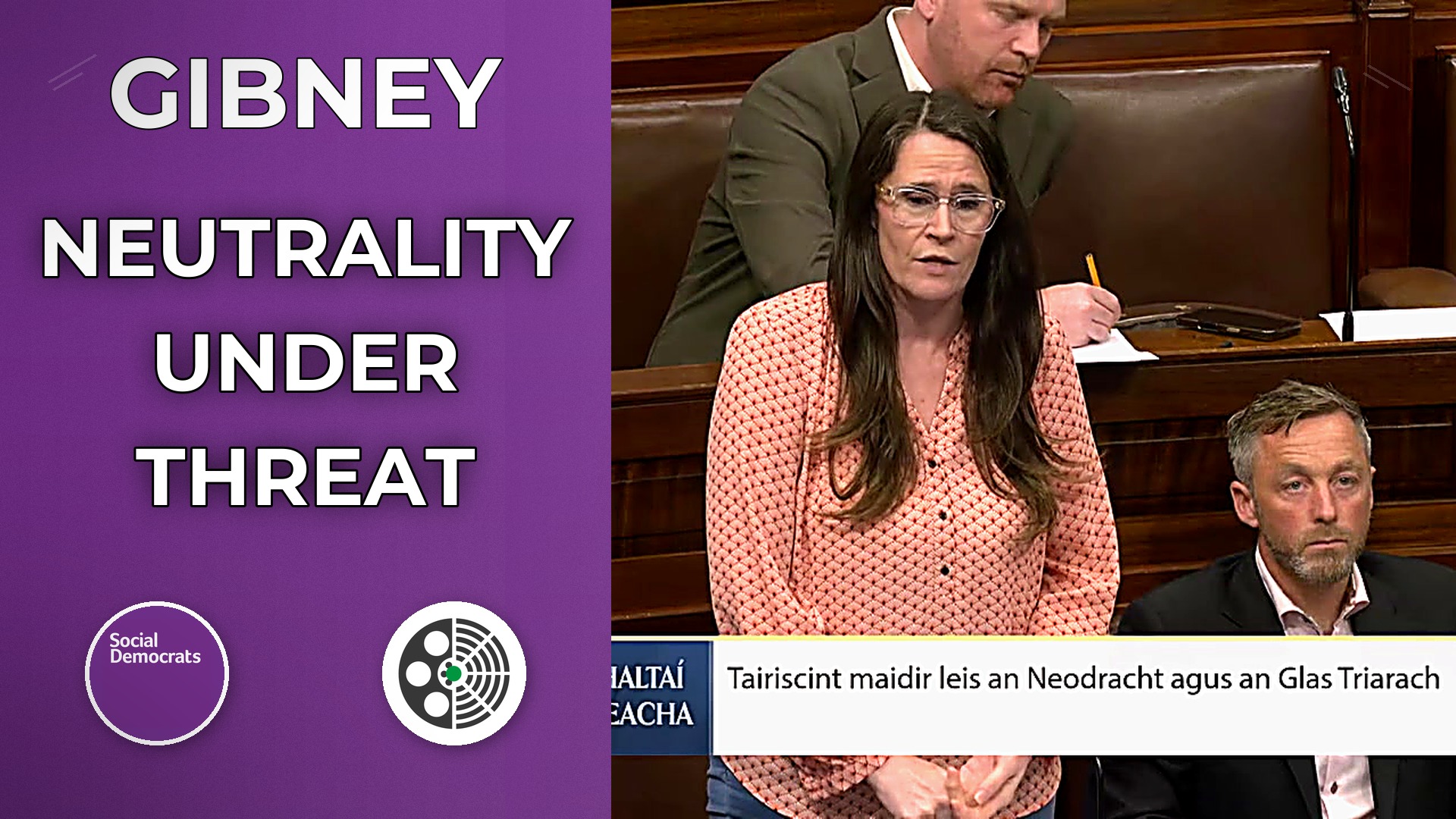
Sinéad Gibney challenges the Government’s Defence Amendment Bill during a Dáil Éireann exchange on reform of the Triple Lock. She argues that removing the UN requirement weakens a safeguard for Irish neutrality and calls for the proposed change to be put to the people.
Gibney asks the Minister to reconsider the plans to abolish the Triple Lock, citing the 2006 Act and guarantees made in the Nice and Lisbon treaties. She says the public view is in favour of retaining it and asks the Government to seek public approval for the change.
Gibney challenges the Government’s claim that the Bill would not allow Irish troops to be deployed in a conflict such as the 2003 Iraq War. She says that, according to comments made by the Department of Defence in committee, the proposed legislation would not have prevented such a deployment.
The debate centres on whether the Bill’s wider definition of a relevant international force would reduce the role of the United Nations in authorising overseas missions. Gibney argues that UN mandates are a guardrail against Ireland being drawn into war and are tied to neutrality, diplomacy and achieving peace through peaceful means.
The Minister rejects Gibney’s interpretation, saying the Bill requires Ireland to act in accordance with international law, the UN Charter and the Constitution. The Government says the change would allow Ireland to join certain peace support operations when agreement cannot be reached at UN level, while retaining the ability to participate in UN and UN-mandated missions. Watch the recording to hear the full exchange.
The Triple Lock and public support
Gibney asks the Minister to reconsider the plans to abolish the Triple Lock, citing the 2006 Act and guarantees made in the Nice and Lisbon treaties. She says the public view is in favour of retaining it and asks the Government to seek public approval for the change.
Dispute over the Iraq War
Gibney challenges the Government’s claim that the Bill would not allow Irish troops to be deployed in a conflict such as the 2003 Iraq War. She says that, according to comments made by the Department of Defence in committee, the proposed legislation would not have prevented such a deployment.
The UN as a safeguard
The debate centres on whether the Bill’s wider definition of a relevant international force would reduce the role of the United Nations in authorising overseas missions. Gibney argues that UN mandates are a guardrail against Ireland being drawn into war and are tied to neutrality, diplomacy and achieving peace through peaceful means.
Government’s case for reform
The Minister rejects Gibney’s interpretation, saying the Bill requires Ireland to act in accordance with international law, the UN Charter and the Constitution. The Government says the change would allow Ireland to join certain peace support operations when agreement cannot be reached at UN level, while retaining the ability to participate in UN and UN-mandated missions. Watch the recording to hear the full exchange.
We publish thousands of recordings to make Irish politics transparent and resistant to manipulation. Spotted an error? Report it — together we are building a reliable archive of Irish politics.
Other speeches
Tego samego dnia All speeches from this day →
Danny Healy-Rae
Danny Healy-Rae: Empty hospital beds and A&E waits
Michael Healy-Rae
Michael Healy-Rae: Kerry A&E pressure is “our fault”
Rose Conway-Walsh
Rose Conway-Walsh challenges legacy Bill's human rights test
Brian Stanley
Brian Stanley presses Taoiseach on delayed wind farm rules
Jennifer Carroll MacNeill
Jennifer Carroll MacNeill: Patient flow key to easing ED pressure
Conor D McGuinness
Conor D McGuinness Seeks Answers on Dungarvan Water Outages
Transcript
Minister, I'm sure that your email inbox, like mine, is full and chock-a-block with
people asking you to urgently reconsider your plans to abolish the Triple Lock.
They point out, like I and many others have, the generosity of the wording of the 2006
Act, the solemn guarantees of Nice and Lisbon.
The will of the people is clear.
So are you going to listen and keep the Triple Lock?
As the Deputy is aware, the Defence Amendment Bill is progressing through the House of the
Oireachtas.
The Bill now goes to committee stage.
We are awaiting a date for a committee stage, as the Minister has said.
It's important to address, of course, some of the claims that have been made about this.
Much of the criticism advanced during second stage has been based on a mischaracterisation
of the legislation and an inaccurate portrayal of its consequences.
The Defence Amendment Bill does not impact Ireland's neutrality.
It does not provide for unrestricted overseas deployment of Defence Forces personnel.
Nothing in the Bill does this.
The central reform contained in the Bill is set out in Section 4, which replaces the existing
concept of an international United Nations force with the term relevant international
force, and this is then defined in the legislation.
In practical terms, the law that we want to pass sets out clearly that Ireland can continue
to participate in peacekeeping, peace enforcement and conflict prevention on overseas missions,
which crucially operate in accordance with the principles of the Charter of the UN and
international law, whether specifically authorised by the Security Council or subject to a UN
General Assembly resolution, or in addition by organisations such as the European Union,
the Organisation for Security and Co-operation in Europe or other regional arrangements.
The reform will ensure that Ireland is not prevented from contributing to legitimate
international peace support operations solely because agreement can't be reached at a UN level.
The legislation will continue, of course, to permit participation in UN and UN-mandated
operations.
Should the Security Council authorise or the General Assembly recommend future peacekeeping
missions, Ireland is fully able to contribute to them.
But with greater flexibility to participate in peace missions organised or led by organisations
such as the European Union, like we have in Bosnia-Herzegovina, or the OSCE or other regional
arrangements where such participation is considered appropriate by the government and approved
in accordance with the principles of the Charter of the UN.
Thank you very much.
Achta.
Thank you.
Minister, the principles of the Charter of the UN were tested in 2003 when the US and
the UK chose to go to war with Iraq.
Those exact same principles were evoked when they went to war and your colleague from the
Department of Defence in committee in response to Deputy Murphy said that had this legislation
been in place in 2003, there would have been nothing, Article 29, anything else, Minister,
there would have been nothing preventing Ireland sending troops to Iraq and engaging in what
was at the time described as in line with the principles of the UN Charter.
That's exactly what was said at the time.
So you're the ones who are being inaccurate, being disingenuous, you are putting forward
this tired rhetoric about sovereignty and taking back control and there is a solemn
guarantee made in Nice and Lisbon, it is clear that the public view is pro-triple
lock and it is clear that the current trajectory is exactly what people were afraid of when
they voted in Nice and Lisbon.
So if you're confident about that legislative legitimacy, push it to the people.
Well, I think it's time to call out the scaremongering and the misinformation about reform of the
triple lock.
The Iraq war was not in conformity with the principles of the United Nations Charter and
the UN General Secretary Kofi Annan said so at the time, that it was not in conformity.
So that's false.
The opposition tells us that we will end up fighting in foreign wars, that's false.
They tell us that we will end up in NATO, false.
They talk about the end of Irish military neutrality, false again.
Nothing in this Bill affects our neutrality.
Decisions on military alliances on the defence forces of this state are this Dáil's and
this Dáil's alone.
And that is what this Bill is about, decisions.
Either we do nothing, which is what the opposition wants, and peacekeeping from an Irish point
of view ends.
Or we act to reform the triple lock and provide ourselves here in Dáil Éireann with the
power to make decisions on Irish peace work abroad, here in this Dáil and not elsewhere.
The example about the UN Charter being invoked for 2003 is exactly what I said.
It was used by the US and the UK to justify that war.
It was clear that the UN didn't agree.
And that's the whole point, is the UN is the only game in town when it comes to multilateralism.
They're the only ones who can offer the mandate to serve under the blue helmet or the blue
beret.
They're the only ones who can guarantee that the work that we do in our defence forces
is peacekeeping.
And you are taking that away.
And it's like you guys don't understand what a guardrail is.
Of course we're not saying that this immediately sends us to war.
But the point is that this guardrail is in place so that we don't go to war, so that
we stay in line with our values of neutrality, of diplomacy, of peace, achieving peace through
peaceful means, which you just seem to have forgotten completely.
And once again, you just cannot continue to maintain that removal of the triple lock,
which is what this amendment or this bill puts forward, in any way allows us to remain
a neutral state.
It is farcical.
The Deputy has said repeatedly that the Iraq war was in accordance with the principles
of the UN Charter, when in fact, the Secretary General of the United Nations at the time
said specifically that it wasn't.
This legislation requires us to act in accordance with international law, with the charter of
the United Nations, and indeed our own constitution.
The Minister has the floor.
Deputy Murphy, the Minister has the floor.
Deputy Murphy, the Minister has the floor.
Deputy Murphy, the Minister has the floor.
Deputy Murphy, the Minister has the floor.
Deputy Murphy, the Minister has the floor.
Deputy Murphy, there's only one speaker.
Deputy Murphy, right now the only speaker is myself and Kahir Richie.
And you have no right to speak.
The Minister has the floor.
The Deputy's opposite completely ignored the Irish Constitution.
As the Minister says, the Irish Constitution prevents us becoming part of a European common
defence.
So when the Leader of the Opposition talks about Ursula von der Leyen's wars, the European
Union were ever to do that, and the European Union has never done that, it's a peace project,
we are not allowed to do it under our Constitution.
Our Constitution requires us to conduct our international relations in accordance with
moral principles, with the objective of friendly relations among the states of the world.
So the argument that you're putting forward, that somehow we're all going to go out to
war, what war are we talking about, is completely ignorant of what's in our Constitution and
what legally prevents us from doing that.