



Jennifer Carroll MacNeill: Patient flow key to easing ED pressure
Jennifer Carroll MacNeill addressed emergency department pressures, trolley numbers and patient flow in a contribution on health services. She said demand is rising, but performance varies between hospitals and better processes are essential to protect patients and manage future demand.
Carroll MacNeill said 454 patients were waiting on trolleys for admission from emergency departments at 8am, describing the figure as too high. She said the experience was not uniform: 17 of 29 hospitals were in the green, eight had no patients on trolleys, and five hospitals accounted for half of the total.
She identified patient flow as the central challenge, spanning community prevention, ambulance services, emergency departments, acute hospitals and safe discharge. Carroll MacNeill said safe staffing framework baselines had been implemented in adult emergency departments and that 96% of baseline staffing requirements were in place across 39 acute hospitals. She also said the HSE had recruited 5,000 people in the previous 12 months.
Carroll MacNeill said Ireland’s growing and ageing population would require changes in how care is delivered, alongside additional resources. She pointed to surgical hubs, community-based care and virtual wards as measures intended to ease pressure on hospitals; she said 115 people were on virtual wards and nearly 49,000 virtual bed days had been provided.
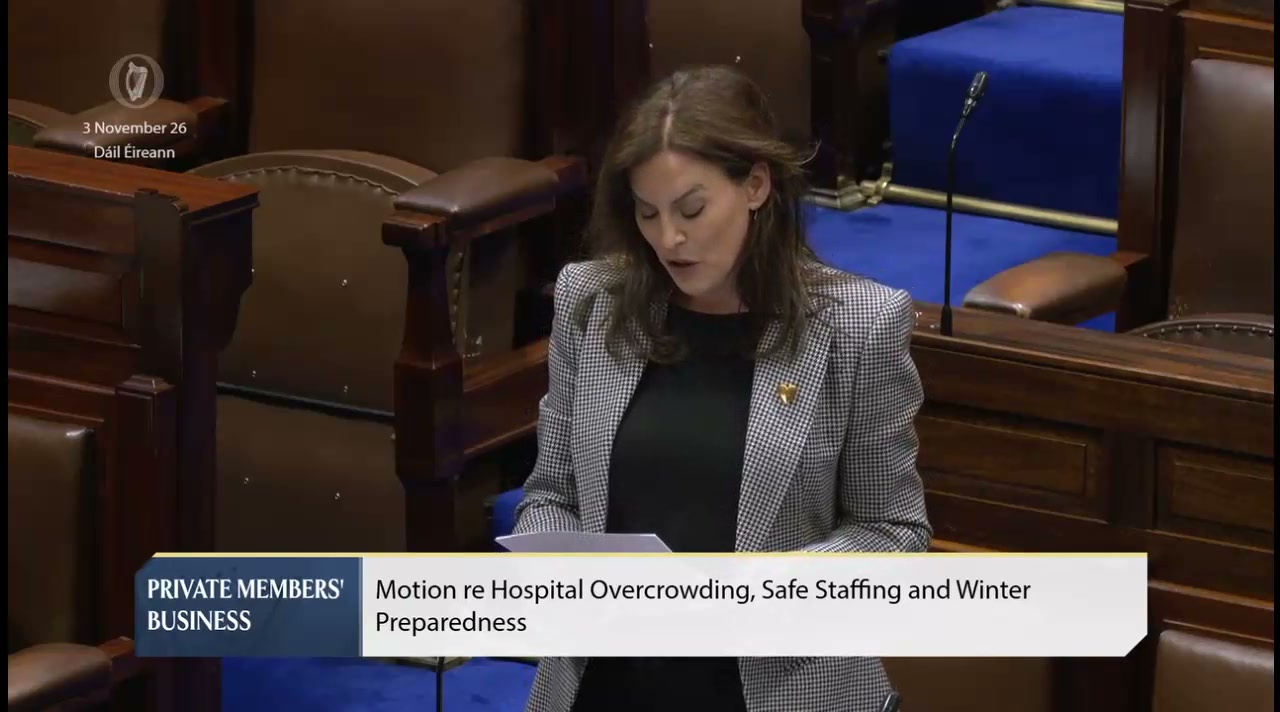
She cited improvements in Galway and Limerick while acknowledging that trolley numbers remained too high and that several hospitals continued to face persistent difficulties. She said each hospital would have an individual patient-flow and elder-care support plan, tailored to its circumstances, and argued that staffing increases alone do not automatically improve patient flow.
Watch the recording to hear the full contribution.
Trolley numbers and hospital performance
Carroll MacNeill said 454 patients were waiting on trolleys for admission from emergency departments at 8am, describing the figure as too high. She said the experience was not uniform: 17 of 29 hospitals were in the green, eight had no patients on trolleys, and five hospitals accounted for half of the total.
Patient flow and staffing
She identified patient flow as the central challenge, spanning community prevention, ambulance services, emergency departments, acute hospitals and safe discharge. Carroll MacNeill said safe staffing framework baselines had been implemented in adult emergency departments and that 96% of baseline staffing requirements were in place across 39 acute hospitals. She also said the HSE had recruited 5,000 people in the previous 12 months.
Planning for future demand
Carroll MacNeill said Ireland’s growing and ageing population would require changes in how care is delivered, alongside additional resources. She pointed to surgical hubs, community-based care and virtual wards as measures intended to ease pressure on hospitals; she said 115 people were on virtual wards and nearly 49,000 virtual bed days had been provided.
Different hospitals, different needs
She cited improvements in Galway and Limerick while acknowledging that trolley numbers remained too high and that several hospitals continued to face persistent difficulties. She said each hospital would have an individual patient-flow and elder-care support plan, tailored to its circumstances, and argued that staffing increases alone do not automatically improve patient flow.
Watch the recording to hear the full contribution.
We publish thousands of recordings to make Irish politics transparent and resistant to manipulation. Spotted an error? Report it — together we are building a reliable archive of Irish politics.
Other speeches


Tego samego dnia All speeches from this day →
Sharon Keogan
Sharon Keogan presses for Navan-Drogheda rail reopening
Mary Butler
Mary Butler sets out Government's response to hospital pressures

Mattie McGrath
Mattie McGrath Urges Support for Ballynoobie Community Hub
Brian Stanley
Brian Stanley: Hospitals lack capacity as trolley numbers soar
Carol Nolan
Carol Nolan says Midlands left out of transition plan
Richard O'Donoghue
Richard O'Donoghue Calls for UHL Staff Sign-Off
Transcript
I want to acknowledge at the outset the very real pressures facing our emergency departments.
This year, attendances have been almost 7% higher than the same period last year, with
admissions increased by over 5%.
I want to acknowledge, first of all, the thousands of healthcare professionals working every
day across our hospitals, community services, primary care teams, ambulance services and
throughout the wider health system, particularly those in emergency departments and emergency
care services.
Their commitment, professionalism and dedication are extraordinary.
We know what the demand growth means in practice.
It means that we have to protect our patients' dignity.
It means that we have to protect patients' safety, and that means that we have to manage
patient flow even better.
Because patient flow matters, and we can all see the impact where it works and where it
doesn't work.
I see it for myself, other deputies see it for themselves.
We visit emergency departments and speak to staff right around the country, sometimes
with notice, sometimes without notice.
I know the impact of overcrowding on patients, on their families and on staff working on
the hospital.
I know what good looks like, and I know what bad looks like.
Every patient in an overcrowded or red hospital is a hospital patient too many.
Comparisons matter because transparency matters.
It matters as much to point out the good practice as the bad practice.
That's why that's relevant and important, and that's why that's enabled, specifically
enabled by the regional structure that I know that you agree with, because it enables us
to compare performance across the board.
Today at 8am there were 454 patients waiting on trolleys for admission from EDs, which
is lower than 544 on the same day last week, and higher than the 375 patients yesterday.
That's too high.
There is a number that is greater than the demand crease, and we have to acknowledge
that.
But there are three really important things.
First of all, that is not a uniform experience across the country.
For example, today of the 29 hospitals, 17 of them are completely in green, so what you
describe is not a uniform experience.
Eight hospitals of 29 today have absolutely zero people on trolleys, and 50% of all of
the patients on trolleys today come from five hospitals.
So in that context it's very relevant to make comparisons.
Very relevant to make comparisons.
There are 34 people in the whole Dublin North East region, which includes Beaumont and the
Mater, two really busy hospitals.
It includes Cavan, Drogheda, Connolly, a really, really busy area.
34 in the whole area, but there's 44 in St Vincent's.
So comparisons do matter, because it matters how we measure progress.
The second thing is there has been progress in 2025 and 26, and those hospitals have stayed
improved, and there remains serious work to be done in a number of sites.
I see and patients see the hospitals doing really well, notwithstanding huge demand pressures.
Navon, Connolly, Drogheda, Tullamore, Port Juncula, Waterford, there are so many, absolutely
no patients waiting on trolleys.
The reality is performance varies considerably, and that matters, and it matters that somebody
articulates that.
Some sites have demonstrated consistently strong patient flow, effective seven-day discharge
practices and robust operational management, and they maintain effective patient flow throughout
the week by focusing relentlessly on demand and capacity management.
But patients also see, as you see, hospitals that are not doing so well.
As I said, today just five out of the 29 emergency departments account for 50% of the trolley
congestion total.
That's Galway, who had been doing much better and had a slip today, Vincent's, who have
been persistently in difficulty, Cork, who have recruited 324 people this year and who
have more radiographers than any other hospital in the country, Cork, who have recruited more
people than Beaumont and Matter and James's and Tala combined this year and have more
radiographers than those hospitals as well.
We have 29 hospitals with emergency departments.
Our persistent problem is with eight to nine of them.
Patient flow is the absolutely key challenge.
It begins with prevention and care in the community.
It includes ambulance services, emergency departments and acute hospitals, and it also
includes moving people out of hospitals safely and promptly when they can.
We have a specific challenge to improve patient flow in specified sites.
This year, the whole of 2026, 13 hospitals accounted for 80% of the 8 a.m. trolleys.
So what I'm saying is we have different issues in different hospitals.
Let me highlight, though, some of the additional important patient safety steps that we have
taken and that you have called for.
So let's just acknowledge that we have a shared perspective on that.
We are absolutely committed to safe staffing, to the safe staffing framework.
Baseline implementation has been achieved in all of the adult emergency departments.
That is a key marker.
It is agreed with the INMO, and I know it is what you want.
That has been implemented.
Also, in 39 acute hospitals nationwide, in practical terms, 96% of baseline staffing
requirements are now in place.
In relation to recruitment, the only reason that there is a freeze on recruitment, that
there is any restriction on recruitment in the last two months of this year, is because
the HSE has already recruited 5,000 people in the last 12 months.
There has been no stoppage in recruitment, and what we will do is make sure that any
additional recruitment this year delivers on agency conversion, which is a priority
for Deputy Cullinan.
I know he tries to stay closer to the budget, which I know is a priority of all of the deputies
on the Health Committee, and responds to specific areas.
For example, we are looking at specific positions that can assist with patient flow and patient
safety in the winter period, along with graduate nursing hiring, which 83% of graduate nurses
have an offer, and that was a couple of weeks ago.
That in fact has increased in the last number of weeks, and we have approved additional
graduate nursing requirements.
But they should not have had the uncertainty, and that will not happen next year.
The truth of all of this is that we are experiencing, and we will experience, a much bigger challenge.
Our population is growing from 5.3 million people to potentially 7 million in 2057.
More significantly, the number of people aged 65 will continue to grow rapidly.
That is a good thing, but we will have to provide care in different ways.
We have to do two things at the same time.
We have to address our current pressures and plan our resources for the future.
Yes, we do need more resources, but we have to change how care is delivered.
Adding resources, while so important, is not going to keep pace with future demand.
We have to become more productive.
We have to separate scheduled care from unscheduled care.
We have five surgical hubs opening this year and in the early part of next year, hoping
to take pressures off everywhere.
They are already making a difference.
For example, Mount Carmel waiting time for surgeries, for example, plastic general and
surgical care, has fallen by over 60% in four months despite increased demand.
The number of patients waiting more than two years has fallen by over 60% in relevant specialties.
The surgical cares do relieve pressures on hospitals where those procedures would otherwise
have to happen in those hospitals, and it is a measure to relieve waiting times for
the many people who need that care.
It is also why we are trying to shift towards community-based care throughout our network
of 180 primary care centres.
It is why, in addition to delivering new bed capacity, we are trying to deliver additional
innovative ways to help get people out of hospital and help them avoid hospital through
virtual care.
That is now operating in every HSE region.
We have 115 people on a virtual ward today that would otherwise be in hospital.
We have provided nearly 49,000 virtual bed days, and they exist in Vincennes, Limerick,
Tullamore, Drogheda, Mersey, Kilkenny and Galway.
It helps prevent unnecessary—
There is also the community care virtual ward in Letterkenny, which is reducing hospital
re-attendances by 83% for people with COPD following their diagnosis and keeping them
out of hospitals.
It is also why we are trying to make sure that we have full use of facilities and equipment
that taxpayers have invested in.
That means using all of the four CT scanners that have been invested in by the taxpayer
in Cork.
It means Bowmount using their CT scanner.
It means using what we have and using it on weekends and in the evenings.
That is enabled by the significant investment that we have made in the public-only consultant
contract, which is now accepted by more than 70% of consultants.
Yes, we will take additional steps this winter, as we always do, as is in your motion.
As we did last year, we will have an additional targeted GP respiratory illness support programme
to coincide with the flu season and reduce pressures on the emergency department.
Each hospital with an emergency department is dedicated to a dedicated additional patient
flow and elder care supports plan, tailored to its own circumstances, because they all
have slightly different needs and pressures.
They will have an individualised plan, which is very important.
The central point around operational grip is the absolutely key one.
There are hospitals that have improved and sustained that improvement from 2025 to 2026,
even in rising demand.
There are hospitals such as Galway, which went through a complete reset in March of
this year.
Although it has had ups and downs, it has a completely different approach and a totally
different wraparound care in relation to how it manages patient flow.
It was having routinely 50 and 60 people on trolleys last winter.
Where it goes into red, it is more often in the 20s.
That is too many, but it is so much an improvement.
It has improved so much within one year, and it did that.
The investment did not increase by that amount.
It had increased recruitment, as all hospitals did.
It was a massive process change.
It was a massive cultural change, and it has sustained.
Limerick has improved enormously.
There are 31 people, or 34, forgive me, on trolleys in Limerick today.
That is too many.
But it was routinely 70, 80, 90.
It has improved so much.
What it needs is additional GP support before people come to Limerick, because there are
too many people presenting who are not sufficiently acute to be in an emergency department who
need better care in other places.
That is what Limerick needs.
They all need something slightly different.
But it is those eight, nine hospitals where we have not improved patient flow in the way
that has happened across the Dublin North East region, across the Midlands largely,
and across so many different hospitals just within that period.
That is because of the dedication and focus of staff, which happens in every single hospital.
But there are key enablers to how patients move through the hospital that reduce the
pressure on the entry point, which is the emergency department, and that matters so
very much.
There is no automatic correlation between increased staff and patient flow.
It is about processes.