



Conor D McGuinness: Rural strategy falls short on housing
Conor D McGuinness says the Our Rural Future 2026-2031 strategy falls short on housing, services and infrastructure for rural communities. In his contribution to the debate, he argues that its central test should be whether people can remain in, return to and build a future in their own communities.
McGuinness says young people want to stay where they grew up but face unaffordable homes, difficulty securing planning permission and a lack of suitable sites. He argues that the strategy lacks sufficiently concrete measures for affordable housing for younger families, local building sites and tackling dereliction. He also cites research commissioned by the National Youth Council of Ireland, which found that 68% of adults aged 18 to 24 were considering moving abroad and 71% believed they would have a better quality of life elsewhere.
The contribution raises the need for certainty for small rural schools, as well as access to childcare, school transport, GPs, primary care, community nursing and mental health services. McGuinness says digital healthcare can help but cannot replace appropriate face-to-face care.
McGuinness points to water services, roads, public transport and broadband as essential to rural communities, and criticises the centralisation of services and investment. He also describes post offices, banks, shops and pubs as part of the social infrastructure that helps older people stay connected and live independently.
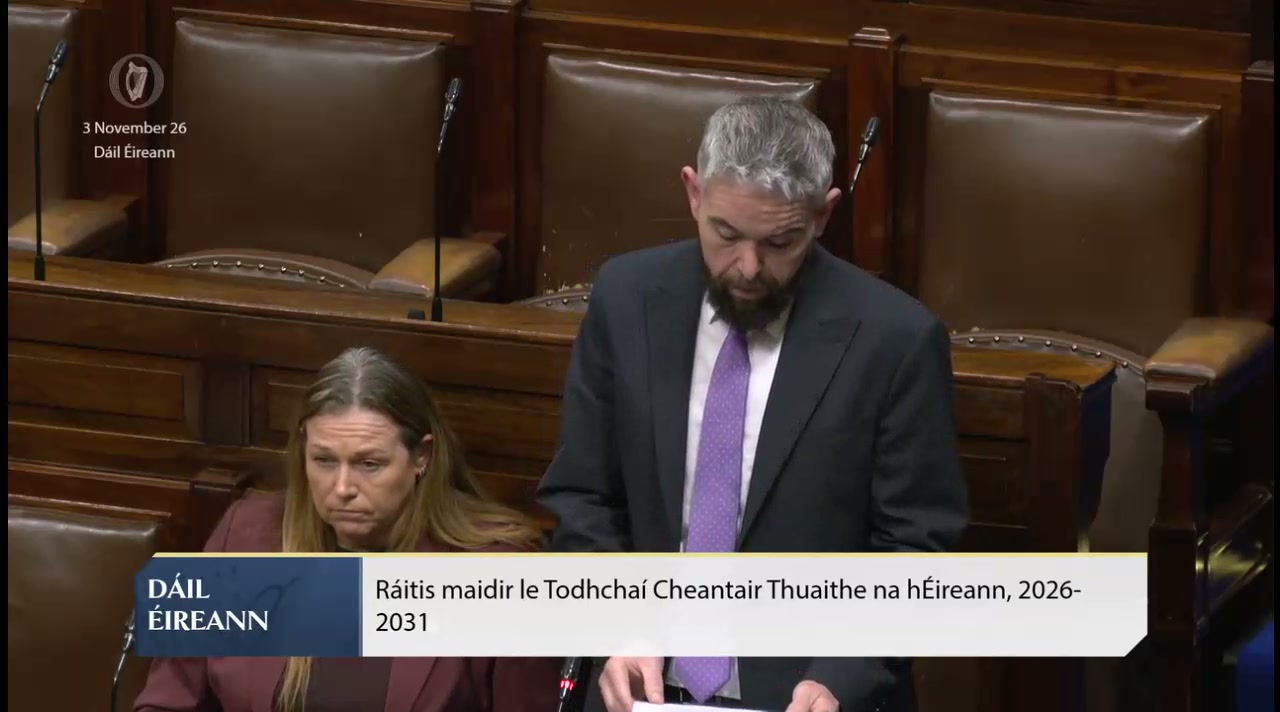
He welcomes the strategy’s inclusion of a pilot initiative to address isolation in farming and rural communities, and refers to the Farmers’ Yard Initiative, developed by Dr Shane Conway and Dr Maura Farrell and piloted in Mountbellew. He says the model shows the value of familiar community spaces, while noting that a pilot initiative to tackle isolation has not yet been established.
McGuinness says rural communities need investment and delivery to match government commitments. He frames the test of the strategy as whether people can remain in, return to and build their futures in their own communities.
Housing and generational renewal
McGuinness says young people want to stay where they grew up but face unaffordable homes, difficulty securing planning permission and a lack of suitable sites. He argues that the strategy lacks sufficiently concrete measures for affordable housing for younger families, local building sites and tackling dereliction. He also cites research commissioned by the National Youth Council of Ireland, which found that 68% of adults aged 18 to 24 were considering moving abroad and 71% believed they would have a better quality of life elsewhere.
Access to local services
The contribution raises the need for certainty for small rural schools, as well as access to childcare, school transport, GPs, primary care, community nursing and mental health services. McGuinness says digital healthcare can help but cannot replace appropriate face-to-face care.
Infrastructure and community life
McGuinness points to water services, roads, public transport and broadband as essential to rural communities, and criticises the centralisation of services and investment. He also describes post offices, banks, shops and pubs as part of the social infrastructure that helps older people stay connected and live independently.
Tackling isolation
He welcomes the strategy’s inclusion of a pilot initiative to address isolation in farming and rural communities, and refers to the Farmers’ Yard Initiative, developed by Dr Shane Conway and Dr Maura Farrell and piloted in Mountbellew. He says the model shows the value of familiar community spaces, while noting that a pilot initiative to tackle isolation has not yet been established.
McGuinness says rural communities need investment and delivery to match government commitments. He frames the test of the strategy as whether people can remain in, return to and build their futures in their own communities.
We publish thousands of recordings to make Irish politics transparent and resistant to manipulation. Spotted an error? Report it — together we are building a reliable archive of Irish politics.
Other speeches
Tego samego dnia All speeches from this day →
Mattie McGrath
Mattie McGrath condemns HSE management failures
Brian Stanley
Brian Stanley presses Taoiseach on delayed wind farm rules
Pearse Doherty
Pearse Doherty: Rural Ireland needs more than ambitious targets
Danny Healy-Rae
Danny Healy-Rae: Empty hospital beds and A&E waits
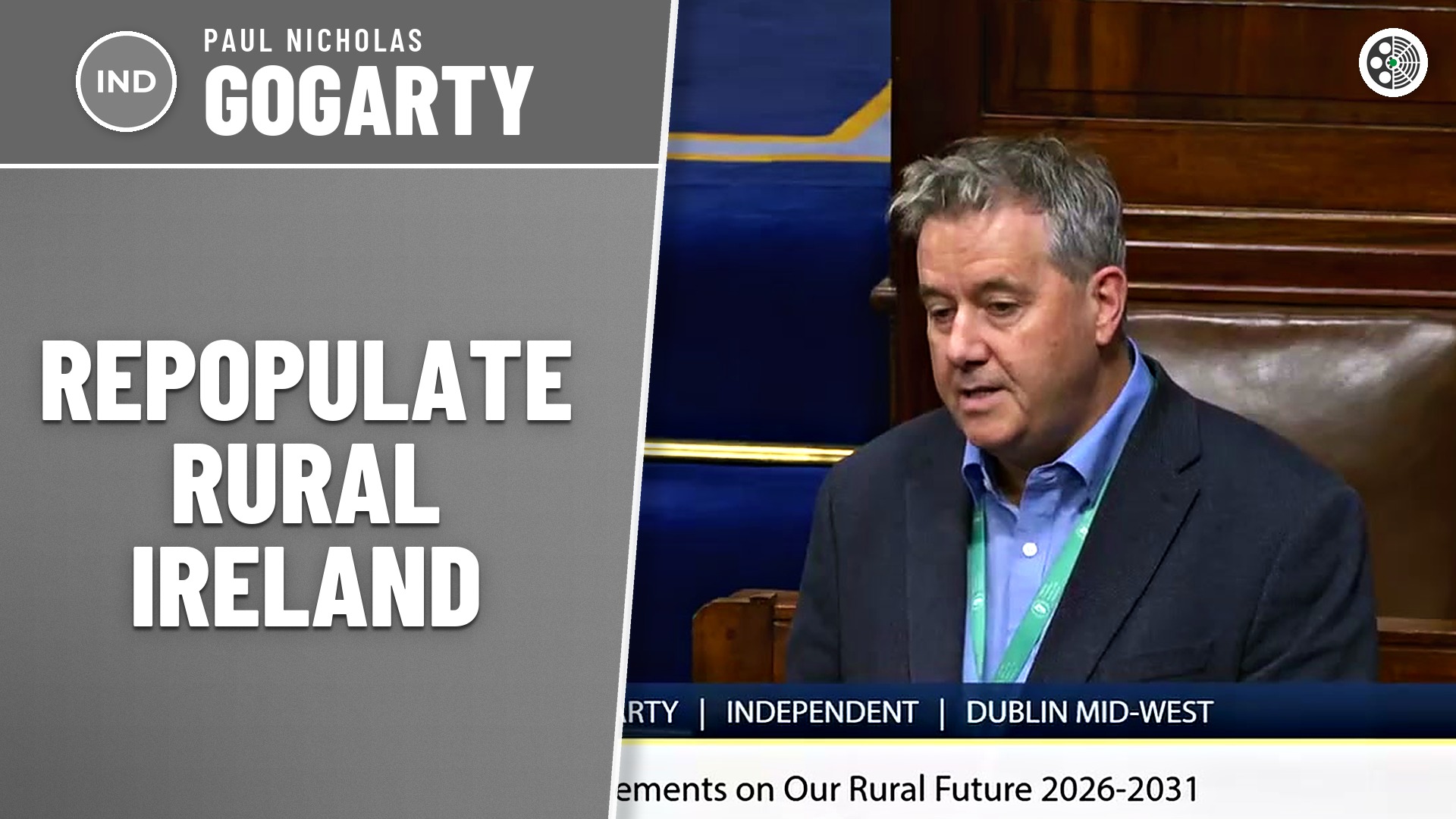
Paul Nicholas Gogarty
Paul Nicholas Gogarty calls for rural Ireland to be repopulated
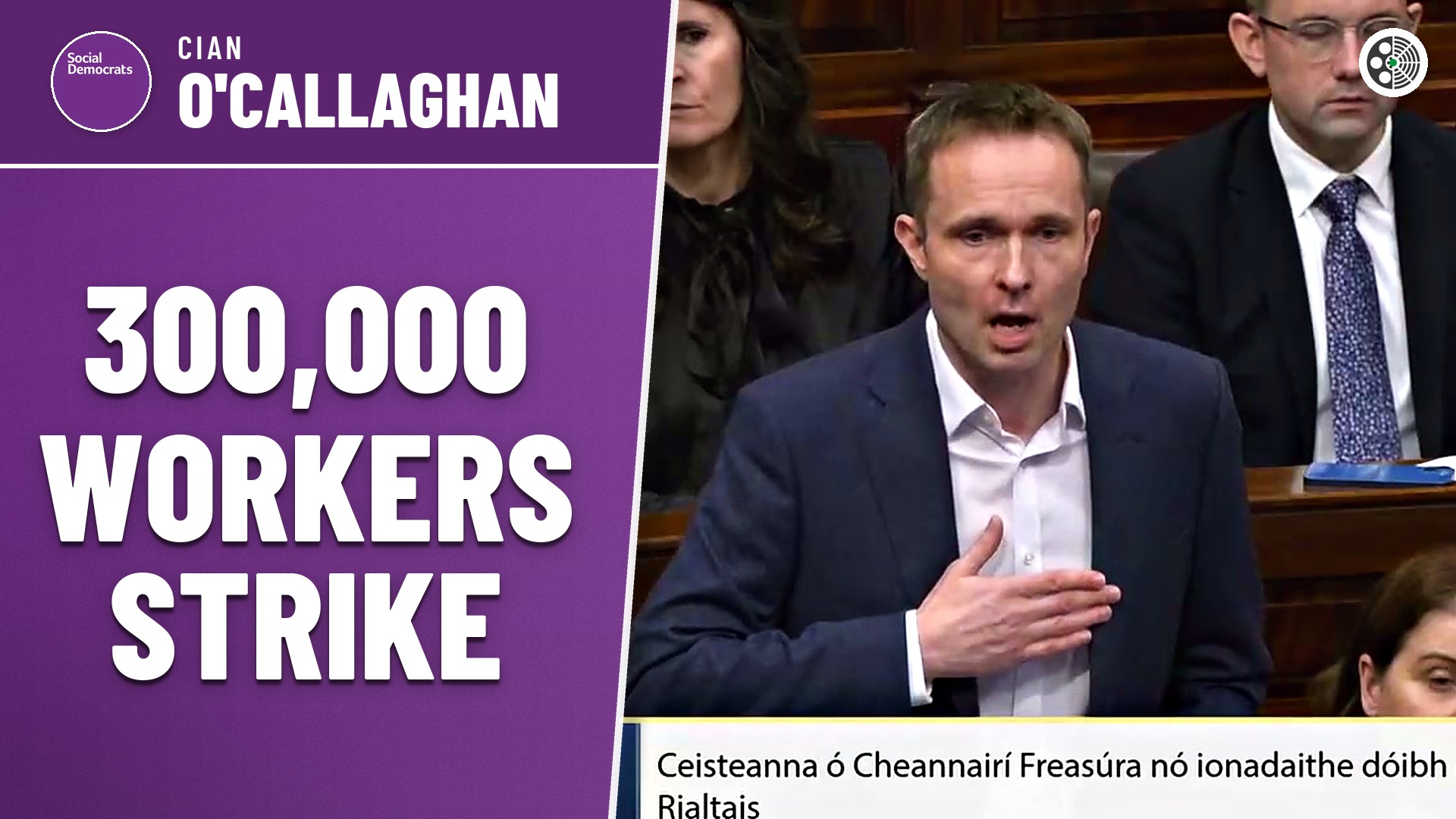
Cian O'Callaghan
Cian O'Callaghan challenges Taoiseach over public service pay
Transcript
Go raibh maith agat, Ceann Comhairle.
Chos draith deis na siúnt a ládair d'a dhíorainn chun t-áchaí na t-uathachainn t-ú is léir sin doainn go léir.
A strategy for rural Ireland is important.
It should set a clear direction, identify the challenges facing our communities,
and establish how government intends to address them.
Our rural future, 2026-2031, is an opportunity to do precisely that.
But unfortunately, while it contains some welcome commitments,
it falls short of what rural communities need and deserve.
The central weakness of this strategy is that it does not adequately address
the biggest challenge facing rural Ireland,
the ability of people to remain in, return to, and build a future in their own communities.
Young people cannot afford homes, families cannot find suitable sites to build on,
and older people are increasingly isolated as local services disappear.
The government's own consultation identified housing and generational renewal as major concerns,
yet there is remarkably little in this strategy that explains how those challenges will actually be addressed.
Young people want to stay in their communities.
They want to build a home, to raise a family, to make a future where they grew up,
but increasingly they cannot afford to do so, they cannot secure planning permission,
or cannot find a suitable site to build on.
It would be right for young people to leave their homes and families
in their own bubble, both locally and internationally.
It's not enough to say, well, that's a matter for housing.
That needs to be seen as core to developing, protecting, and enhancing rural Ireland.
We've heard plenty about housing delivery, vacant property, and planning reform,
but there is nothing sufficiently concrete on affordable housing for younger families,
and as I mentioned, service sites for local people, or for tackling dereliction.
The consequences are already evident.
Research commissioned by the National Youth Council of Ireland found that 68% of young adults
aged 18 to 24 are considering moving abroad,
while 71% believe they would have a better quality of life elsewhere.
That should be a serious warning to government.
Generational renewal is not simply about attracting new businesses or promoting tourism.
It's about whether young people can afford to remain in the places they call home.
But there are other significant weaknesses too, Minister.
Small rural schools need certainty about their future.
Rural families need access to childcare and school transport.
People need access to GPs, to primary care, to community nursing and mental health services.
Digital healthcare has a role to play here,
but it cannot replace appropriate face-to-face care.
The plan, and we in this chamber, need to also talk about infrastructure.
Rural communities are increasingly frustrated by the centralisation of services
and the failure to provide basic infrastructure.
Water services, roads, public transport, and broadband are fundamental to sustaining our rural communities.
Yet people are too often left waiting while investment and decision-making are concentrated elsewhere.
And that's not to ignore the ageing population.
Post offices, banks, shops, pubs and garden stations have disappeared
and are disappearing from communities.
And these are much more than commercial premises and public service buildings.
They're part of the social infrastructure that allows people to remain connected and supported.
That allows people, as they get older, to remain independent
and to continue living independently in rural Ireland.
And on that point, I do want to acknowledge something positive in the strategy.
I welcome the inclusion of a pilot initiative to tackle isolation in farming and rural communities.
As you know, Minister, I've raised this repeatedly with yourself and Minister of State Buttermore
and called for government support for the Farmers' Yard Initiative as an example.
And that model, developed by Dr. Shane Conway and Dr. Maura Farrell and piloted in Mountbellew,
marks, demonstrates the value of familiar community spaces and bringing people together.
I welcome this initiative, but there is no pilot initiative yet to tackle this issue.
And hopefully it will develop as such in time.
Minister, rural Ireland has enormous strength.
Its people, its communities, its businesses, its culture, its primary producers
and its contribution to our national economy should never be underestimated.
But those communities cannot thrive on goodwill and resilience alone.
They need government to match commitments with investment and delivery.
And the ultimate test of this strategy is straightforward.
Can people remain in, return to and build their futures in their own communities?
Thank you.