



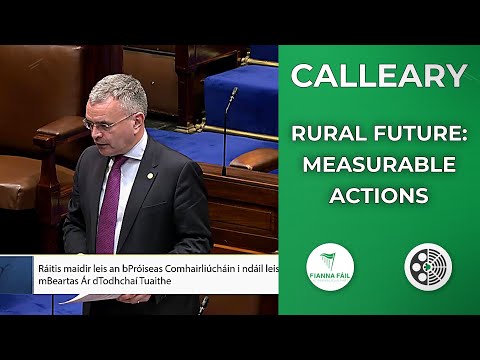
Dara Calleary sets out €500m rural investment plan
Minister Dara Calleary presented Our Rural Future 2026-2031 to the House, setting out Government plans for rural communities and €500 million in capital funding for 2026-2028. The policy aims to improve rural services, support enterprise and jobs, address isolation and strengthen communities through coordinated action across Government.
Calleary said more than €1 billion had been allocated to rural projects since 2020 and that 150 measures, or 84% of the first Rural Future policy’s actions, were completed or being implemented. He cited investment in rural regeneration, transport, broadband, community facilities and local roads.
The 2026-2031 policy is organised around thriving rural places, public services, rural enterprise and employment, resilient communities, and the rural environment. Its commitments cover areas including transport, health and disability services, education, childcare, digital connectivity, climate resilience and biodiversity.
Calleary outlined a new Strategic Rural Investment Fund within the Rural Regeneration and Development Fund, intended to support a targeted number of major regional projects. The policy also proposes pilots to support community-led services in remote areas, tackle rural isolation and use local innovation to address community needs.
The Minister said the policy followed a consultation process involving more than 2,000 participants and includes 34 Government commitments, with more than 230 actions planned for delivery by the end of 2028. He said he would continue engagement through regional events and ensure accountability to the House and rural communities.
Investment and delivery to date
Calleary said more than €1 billion had been allocated to rural projects since 2020 and that 150 measures, or 84% of the first Rural Future policy’s actions, were completed or being implemented. He cited investment in rural regeneration, transport, broadband, community facilities and local roads.
Five pillars for rural development
The 2026-2031 policy is organised around thriving rural places, public services, rural enterprise and employment, resilient communities, and the rural environment. Its commitments cover areas including transport, health and disability services, education, childcare, digital connectivity, climate resilience and biodiversity.
New funding and community-led initiatives
Calleary outlined a new Strategic Rural Investment Fund within the Rural Regeneration and Development Fund, intended to support a targeted number of major regional projects. The policy also proposes pilots to support community-led services in remote areas, tackle rural isolation and use local innovation to address community needs.
Consultation and accountability
The Minister said the policy followed a consultation process involving more than 2,000 participants and includes 34 Government commitments, with more than 230 actions planned for delivery by the end of 2028. He said he would continue engagement through regional events and ensure accountability to the House and rural communities.
We publish thousands of recordings to make Irish politics transparent and resistant to manipulation. Spotted an error? Report it — together we are building a reliable archive of Irish politics.
Other speeches
Tego samego dnia All speeches from this day →
Mary Lou McDonald
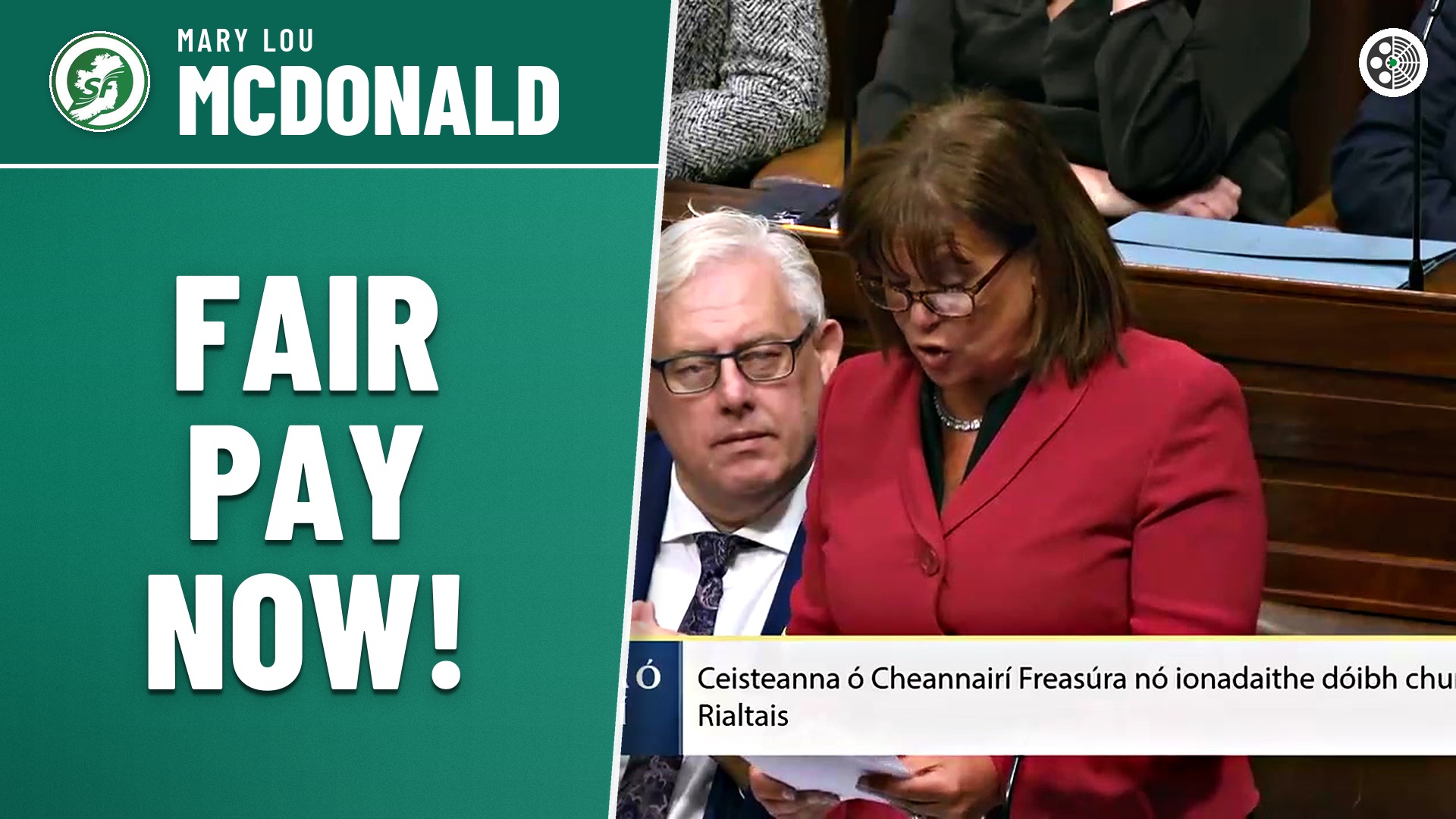
Mary Lou McDonald challenges Taoiseach on public service pay
Donnchadh Ó Laoghaire
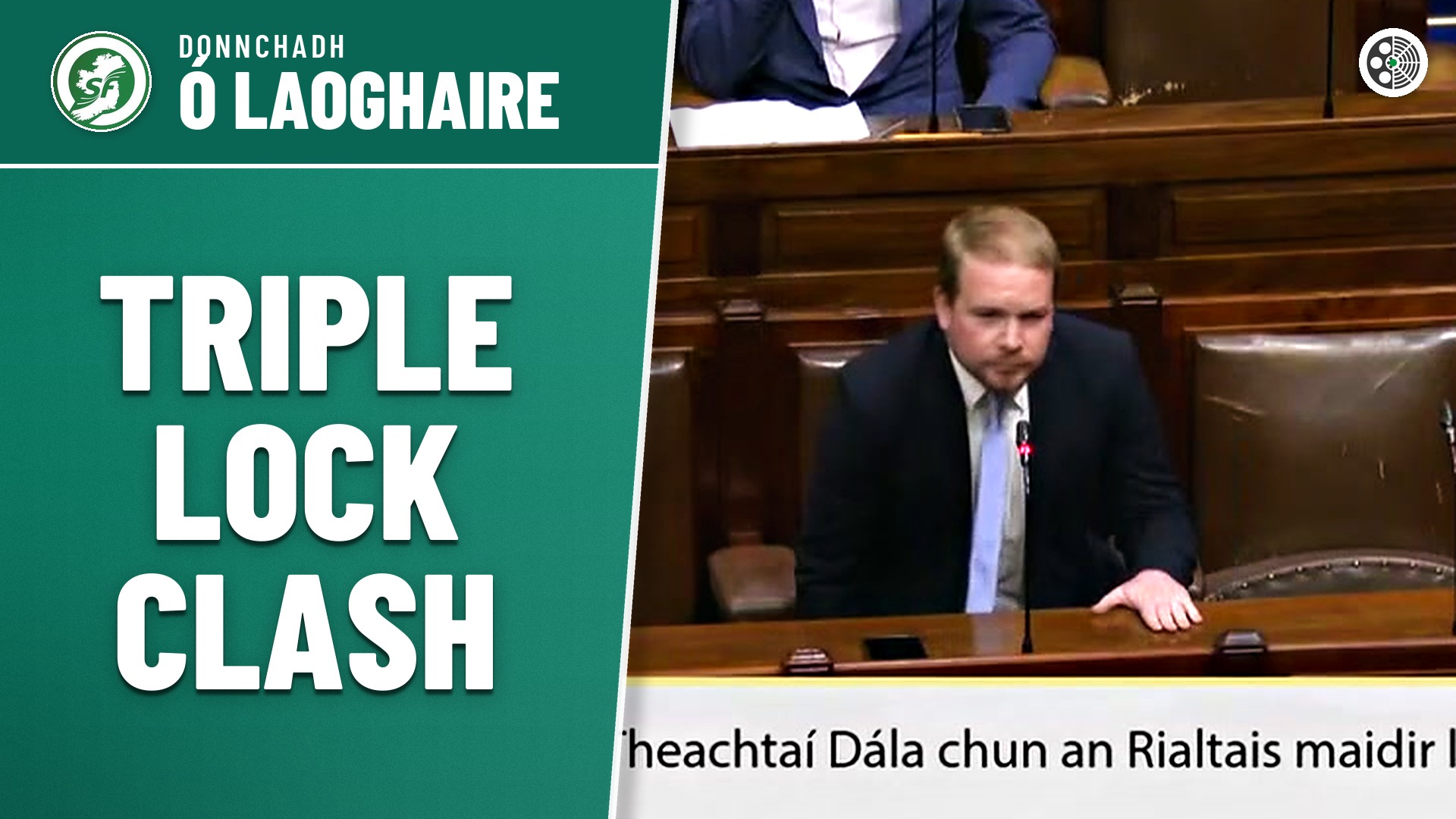
Donnchadh Ó Laoghaire calls for Triple Lock referendum
Mattie McGrath
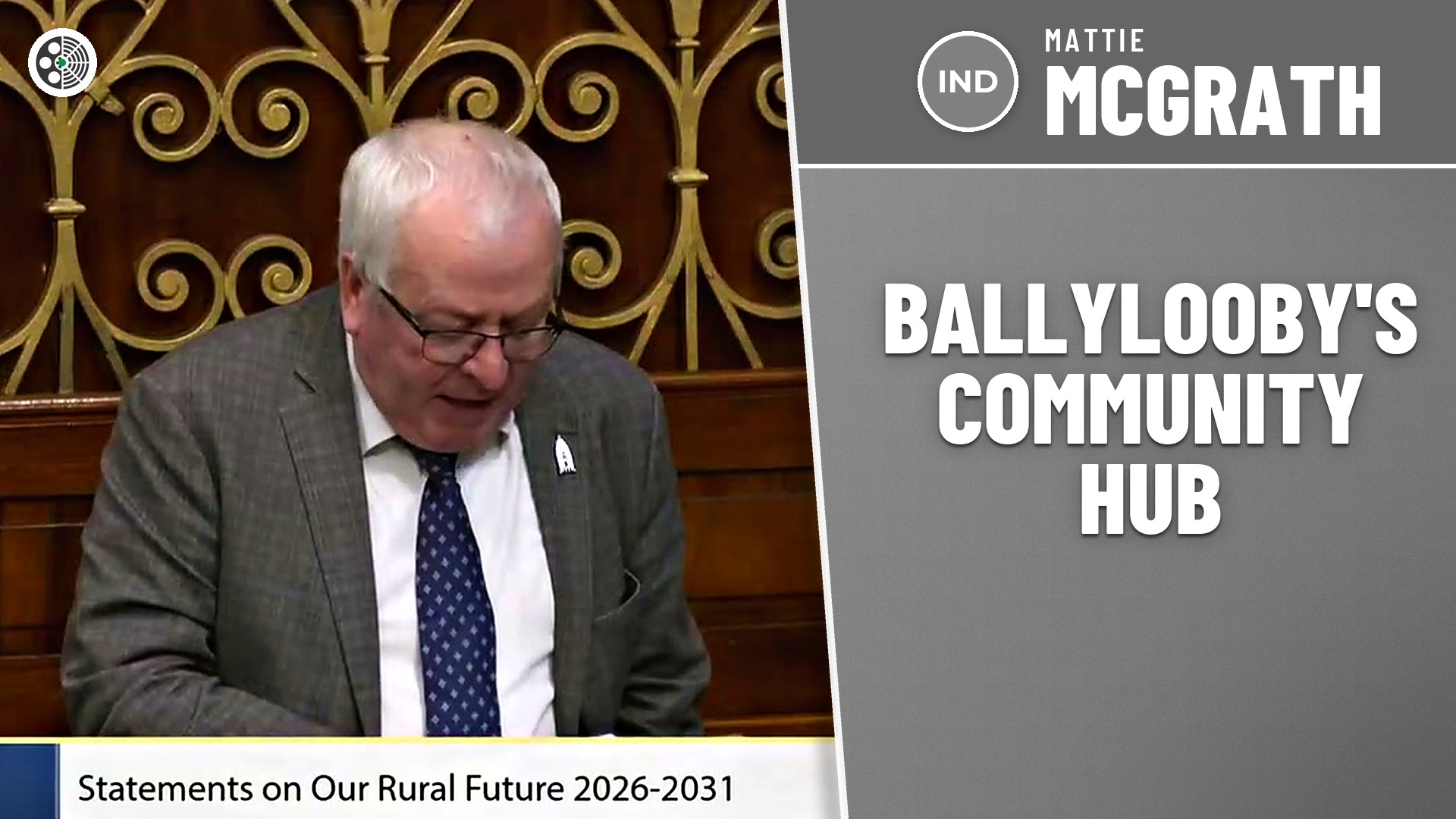
Mattie McGrath Urges Support for Ballynoobie Community Hub
Jennifer Whitmore
Jennifer Whitmore warns Ireland imports 83% of fruit and vegetables
Rose Conway-Walsh
Rose Conway-Walsh Seeks Rail Corridor Timeline to Sligo
Carol Nolan
Carol Nolan warns trolley numbers mask wider health capacity gaps
Transcript
Look, our Rural Future 2026 to 2031 brings together commitments from across government
to ensure that rural communities have the infrastructure, the services and the supports
that they need to prosper. It includes a range of new measures and initiatives to support
rural enterprise and employment, improve access to essential services in remote areas,
tackle rural isolation and strengthen community resilience through innovation and technology.
Before, however, I get into the new details of the policy, I'd like to spend a few minutes
reflecting on what has been achieved so far. In the last five years, our rural future has
delivered vital investment and support to rural areas, strengthened local economies
and improved the quality of life for people across rural Ireland. Through sustained investment
and strong partnerships with local authorities, state agencies and rural communities, the
Government has delivered real improvements across rural Ireland. Government has provided
an unprecedented level of investment in rural communities, with more than €1 billion allocated
to support thousands of projects since 2020. These investments range from small-scale local
improvements to large-scale regeneration initiatives, all delivering tangible social,
economic and environmental benefits for rural communities.
The First Star Rural Future Policy set out an ambitious set of actions over its lifetime,
and our approach to implementation was successful. 150 measures, or 84%, are either fully completed
or are being successfully implemented. This has shown that we can and that we will deliver for
Ireland. Through the Rural Regeneration and Development Fund and the Town and Village
Renewal Scheme, over £560 million has been invested in rural regeneration projects,
helping to tackle vacancy and dereliction, revitalise town centres and support economic
activity in our rural towns and villages. The development of a national network of over 400
remote working hubs has opened up new opportunities for remote working, while the
rollout of the National Broadband Plan has improved digital connectivity.
We have seen significant improvements in essential services. The Connecting Ireland
Rural Mobility Plan, for example, has delivered 185 new or enhanced services since its launch
in 2022, linking over 240 towns and villages to the public transport network.
We have also strengthened the infrastructure at the heart of community life.
The Community Centre Investment Fund has invested over €112 million to support upgrades to over
1,600 community facilities, helping to ensure that communities have welcoming,
accessible and comfortable spaces in which to come together.
We have allocated funding of over €150 million under the Local Improvement Scheme,
funding work on over 3,000 road projects, benefiting over 16,000 people.
This year, Clore has been expanded, bringing the total population under
Clore to over 1 million people for the first time.
We can see the benefits of this investment on the regeneration and revitalisation of town
and village centres, at the enhancement of community facilities, of public communities,
and the enhancement of community centres, walking trails, libraries, playgrounds and public random
works. The funding and supports that are delivered under the Rural Development
Investment Programme will continue to have a critical role to play
in the implementation of the new rural future.
One of my priorities is to ensure that the funding available under the Rural
Development Investment Programme is responsive to priorities at local level.
We will roll out further calls for proposals across all schemes under the Rural Development
Investment Programme to support small, medium and large-scale capital projects in rural areas,
delivering €500 million in capital funding over the 2026-28 period.
We will implement improvements to the Rural Development Investment Programme
to ensure that this funding is more accessible to community groups on the ground.
This will ensure that the communities most in need will receive that funding.
One of the greatest privileges of serving as Minister for Rural and Community Development
in the Gaeltacht is the opportunity to visit communities across the country
and to see first-hand the impact of our investment.
Behind every project and every big figure are real benefits for real people,
tangible improvements that are making a meaningful difference to people's everyday lives.
Just last month, I visited Leitrim and turned a sod on the Glenfarn wood project.
This project received €2.45 million in RRDF funding.
It will transform the woodland and lakeshore of Glenfarn into a major visitor attraction
within Ireland's Hidden Heartlands, bringing more visitors, more footfall,
more visitor spending and, consequently, more jobs to the area.
I opened the new Narrow Gage Trail in Drumshambo, which received €400,000 in AORUS funding.
It demonstrates the real and lasting impact that an investment
in outdoor recreation can have on rural communities.
And in the heart of Manor, I had the privilege of opening the Manor Youth Hub.
This previously vacant building has been redeveloped,
providing a fully accessible, dedicated and vibrant youth hub.
This demonstrates the real change and transformation
that can happen when a local authority, government support and, most importantly,
a community works together to bring their vision to life.
Ní go raibh agaibh d'angann agaibh leannuanth leann ar uilbuíonn a thuart
i Graic i leith ceantar tuaith na hÉireann.
Ní o bhfána t-támaid ag tuasadh,
Is é go raibh cuige na churleis a maid a t-tá d-ceanta le bhíonte bluga níos agus feabhs a chur.
Ceidh guir ceartu na maid a t-tá d-ceanta ag an go daoise a athansh,
tá is agam nach uil ar nubair craigleath.
We know that rural Ireland is continuing to face severe challenges,
from access to essential services, to housing, to climate pressures,
and to the need to create sustainable economic opportunity.
This is why our rural future 2026-2031 is so important.
The overarching objective of the policy remains to support the continued economic,
social and environmental development of rural Ireland.
It brings together commitments from across government to support balanced regional development,
to protect and enhance our rural environment,
and to ensure that rural communities have the infrastructure,
services and the supports that they need to prosper.
We will build on the momentum and the progress that is achieved to date
to deliver targeted, meaningful and practical benefits
that improve the everyday lives of those living and working in rural Ireland.
The policy is structured around five interconnected pillars,
which provide a clear framework for a continued
whole-of-government approach to rural development.
The first pillar, Thriving Rural Places,
focuses on investing in our rural towns, villages and communities,
ensuring they remain vibrant, attractive and sustainable places to live,
to work and to raise families.
Through this pillar, we will build on the significant investment
that's already been delivered through our Rural Development Investment Programme,
with a particular focus on revitalising our towns and villages,
improving essential infrastructure,
and harnessing the opportunities that is presented by digital connectivity.
The second pillar focuses on access to high-quality public services.
It recognises that the availability of these services
and the accessibility of these services
is fundamental to the quality of life of people living in rural areas.
This will include further improvements in rural transport,
ensuring that health and disability services respond to the needs of rural communities,
and supporting access to education and childcare.
Something that's important to you.
You know about this pillar,
but you don't know that you can expect it to be available
for public services throughout the country through Gaelic.
The plan is now being developed in this area
to provide access to 10% of the Gaelic language
in public services throughout the country.
A strong and diverse rural economy
is fundamental to Ireland's overall prosperity and competitiveness.
Our third pillar, thus, focuses on supporting rural enterprise and employment,
developing key sectors of the rural economy,
and ensuring that rural Ireland is well positioned to respond to a changing economy,
to new ways of working,
and to challenges that may come.
We want to see rural business grow and succeed.
New opportunities for enterprise to emerge,
and for people across rural Ireland to have the opportunity
to build rewarding and successful careers
without having to leave their communities.
Through our rural future,
we will build on the strengths of our rural economy,
support innovation and enterprise,
and ensure that rural Ireland continues to make a vital contribution
to our national economic success.
Our fourth pillar, resilient rural communities,
recognises that the greatest strength of rural Ireland
lies in its people and in the communities they call home.
Across rural Ireland, we see the enormous contribution
of local communities, voluntary organisations, and community groups
whose dedication and commitment are central
to our rural areas being vibrant, inclusive, and welcoming places.
Through this pillar, we will build on that strong community spirit,
empowering local communities to shape their own futures
and equipping them to respond to new and emerging challenges.
We'll also focus on supporting the well-being and safety of people
living in rural areas,
while celebrating the rich cultural heritage and diversity
that make our rural communities so unique.
The final pillar, sustaining our rural environment,
recognises the vital role that rural Ireland will play
in delivering on our climate and environmental ambition.
Rural Ireland is home to some of the world's most valuable
natural resources and landscapes.
We have a responsibility to protect and enhance these
for future generations.
Through this pillar, we will support rural communities
to become more resilient to the impacts of climate change,
while harnessing the opportunities presented by renewable energy,
sustainable agriculture and forestry,
and the growing bio-economy and circular economy.
Protecting and restoring biodiversity will also be a key focus,
recognising the importance of our natural environment
to the well-being and future prosperity of rural communities.
We want to ensure that rural communities are not only supported
through the transition to a greener economy,
but are empowered to benefit from the opportunities it presents.
The new policy at Ken Curler is about building on the momentum
of the past five years, strengthening to what is working,
but responding to the changing need and ambition
of rural communities.
We have focused on bringing all new and existing activity
together in one place.
This is how we will ensure that there is an effective focus
on our rural communities across the full breadth
of government activity.
The policy brings together a mix of new interventions
and supports within an expansion and improvement
of existing activities in key areas such as rural transport,
digital connectivity, enterprise support,
support for inclusive community building,
the regeneration of our towns and villages,
and increased investment in our community facilities.
One of the most important developments is the introduction
of a new Strategic Rural Investment Fund for Rural Ireland
within the existing RRDF.
This will provide a new approach to investment
in major strategic investments at a regional level.
It will broaden the fund's remit.
It is aimed to help unlock major strategic capital projects
and consequently attract investment and support enterprise
and employment creation in rural areas.
The goal of the fund will be to improve the long-term
economic competitiveness and sustainability
of regional and rural areas.
We are currently finalising the full detail
of this intervention.
However, my overall aim is to provide support
for a small but targeted number of projects
of significant scale that deliver on our ambition
to drive economic growth in regional and in rural areas.
We recognise the particular challenges that are facing
some of our most remote rural communities.
I believe that a community-led or social enterprise-type
approach can help support things like community cafes,
community pubs or community shops
in rural towns and villages.
A new pilot initiative will be developed to support
the establishment of social enterprise
and community-led approaches in our most remote rural areas
where gaps in local services are at their most acute.
Community-led initiatives such as community shops
and community cafes are becoming more and more prevalent
and I want to be there to support them.
Support will focus on those areas
where these key services may no longer be present
in a rural community.
This support will help to address unmet local need,
create employment opportunity
and strengthen community resilience.
Throughout our consultation process,
the issue of rural isolation was mentioned
and raised extensively.
To respond to this, a new joint pilot initiative
between my department and the Department of Agriculture
will explore locally-based initiative approaches
to address isolation in farming and in rural communities
and to strengthen social connections and well-being.
€600,000 is earmarked for this in year one
and our approach will complement existing interventions
in this area such as CICAP, Tidy Towns, CCIF,
Leader, Clore and Men's and Women's Sheds etc.
The pilot will be place-based
and be formed by local circumstances.
The focus here will be on new and innovative elements
rather than simply funding existing activities
or extending existing activities.
We will see what is effective, what works well
and then we'll take our learnings from this pilot
to inform ongoing initiatives
that can be integrated into wider programs
such as CICAP or Leader.
And through a new community-led Rural Innovation Fund
we will support locally-driven initiatives
that harness innovation technology
to address new challenges
and to build resilience in rural communities.
I want to tap into local knowledge
to see how new technologies would address
specific local challenges in rural communities.
We have set out the Government's 34 commitments
for delivery across all departments
and agencies over the lifetime of this policy.
These commitments are supported
by clear and practical actions.
They're backed by substantial investment
targeted at securing a more sustainable
and resilient future for rural communities.
Over 230 actions are set out for delivery
over the first half of the policy period
to the end of 2028
across a wide range of areas
from health, housing and education
to digital connectivity,
enterprise development and our culture,
our heritage and our language.
The development of these actions
was rooted in a set of principles
which guided our policy making.
These principles were informed
by our consultation process,
our experience of delivering policy
and international best practice.
Very important to me for this policy
to be people-centred and place-based.
This means putting people
at the centre of this policy
but also understanding
there is a huge variety
in the rural places that we all call home.
We recognise the unique circumstances
and the needs of different rural communities
throughout through the development
of these actions.
Another one of our principles is progression.
We will build on our achievements,
however we will retain the flexibility
that is needed to respond to emerging challenges
and opportunities across the wide variety
of rural contexts.
The policy is grounded
in participation and inclusion.
It recognises the importance
of addressing exclusion,
isolation and inequality.
We recognise the interdependence
of our urban and our rural areas.
The success of each contributes
to the prosperity of the other.
Based on this principle,
we took an integrated approach
to policy development
to ensure that our rural future,
26 to 31,
is in line with national,
local and sectoral strategy
so we can coordinate the delivery
of our goals.
Our policy is reflective
of the core principles
of the EU long-term vision
for rural areas.
This vision is for rural communities
that are stronger,
more connected,
resilient and prosperous
with local people
actively shaping their futures.
Rural communities must be
at the heart of Europe's economic,
social and environmental development.
Lidia Cancord,
I have just come from our
EU Presidency event
which is taking place in Nice
over these days,
Europe's Rural Future,
where over 200 people
from across the EU
have come together
to discuss integrated approaches
to rural development.
At the heart of these discussions
is the recognition
that rural development
must remain a strategic
European priority.
We must translate our shared vision
into coordinated policies,
effective investment
and meaningful opportunities
for rural communities across Europe.
That is the central principle
of our approach to rural development,
combining national ambition,
coordinated government action
with local knowledge,
local leadership,
local initiative
and local passion.
I will be returning
to this conference tomorrow
and our discussions
will focus specifically on Lidia,
including its contribution
over 35 years
to rural development
with a showcase of projects
that are supported
through the programme.
Through that support,
we are going to invest
35 million euro
in the new pier
at Innishir.
Progress throughout this summer
has been significant
and that gives a sense
of large-scale investment
in rural communities.
Our Rural Future 2026-2031
is firmly rooted
in a comprehensive public
stakeholder consultation process.
This process captured
the views and the inputs
of more than 2,000 participants.
The process included
an online public survey
with more than 1,200 responses,
a series of eight stakeholders
and public events
across the country,
and online and bilateral meetings
with key stakeholders,
representative groups,
public bodies
and a debate within this house.
We particularly sought
to capture the voices
of the new generation.
The voices of young people
was captured through
the Rural Youth Assembly,
an initiative which was itself
born out of the first
Rural Future policy.
This engagement has ensured
that we had a consultation process
that lasted over a year
and was followed by engaging
with a range of departments.
It was also being informed
by the OECD 2026
Rural Policy Review of Ireland,
which highlighted the strengths
of our whole-of-government approach.
The OECD has said that Ireland
has built one of the OECD's
most sophisticated
rural policy frameworks.
It has a unique
whole-of-government approach
that maintains visibility
on rural impacts
across all departments in Ireland.
I present this to the House
and I look forward to the debate.
However, I also intend
to continue the debate
across the country.
We will host five regional events
in the Midlands, the West, the South,
the Midwest and border regions
during January and February,
alongside an online event
to get progress
and to get feedback on this plan.
Our rural future will continue
to be underpinned by funding
through my department's programmes
and will also have the support
of government colleagues
through their programmes
in each individual department.
The new policy seeks to respond
to the emerging opportunities,
but it seeks to prepare
our rural communities
for challenges that we anticipate
but also those that we can't.
Through a place-based approach
that recognises
that rural areas are unique,
that each of our areas
has different needs,
different priorities
and different strengths,
I think that we will ensure
that the distinct needs,
the distinct opportunities
and the distinct challenges
of reach each rural community
are reflected in delivery
across all government sectors
to strengthen rural outcomes.
I intend to ensure delivery of this
and I intend to ensure accountability
to the House
and to the various committees
of the House,
but most importantly, I intend
to ensure accountability
to communities across the country
whose future is intertwined
with this document.
Thank you.