

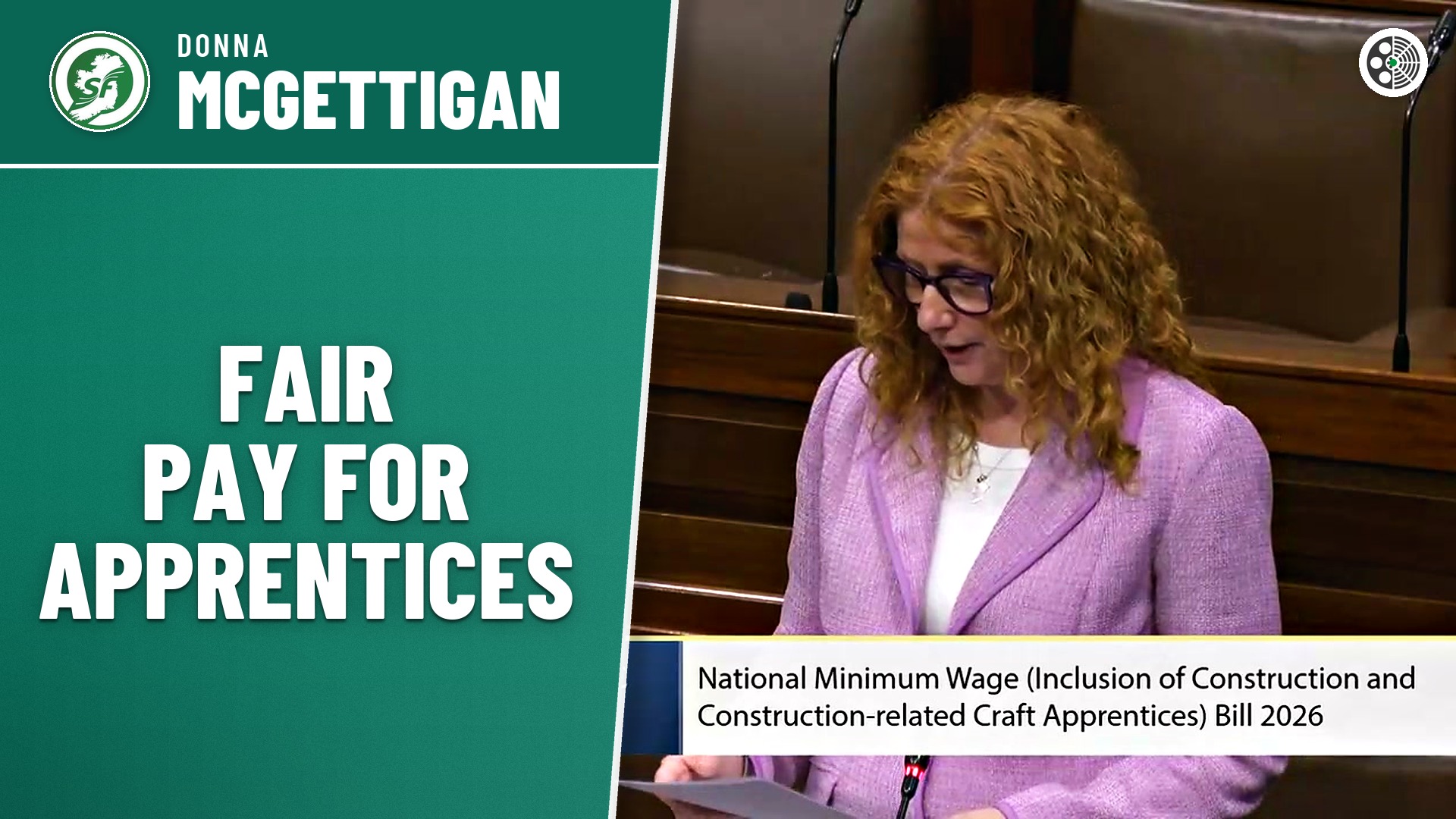


Donna McGettigan makes case for minimum wage for apprentices
Donna McGettigan argues for minimum wage protection for construction and construction-related craft apprentices during her contribution on a Bill concerning apprenticeship pay. She says low wages are contributing to financial hardship and dropouts, while better pay could help build the skilled workforce needed to address Ireland’s housing shortage.
McGettigan cites a Connect Trade Union survey in which 46 per cent of respondents said they earned less than €7 an hour during a stage of their apprenticeship, while more than 90 per cent said they were paid below the national minimum wage. She says low pay is making it harder for apprentices to remain in their chosen trades, particularly as many have rent or mortgage payments and other household responsibilities.
She proposes starting with construction and construction-related craft apprenticeships, rather than extending minimum wage protection to every apprenticeship programme at once. The measure would apply during the on-the-job phase, with other apprenticeship programmes potentially considered in future.
McGettigan argues that improving pay could support retention and completion rates, and strengthen the construction workforce needed to build more homes. She refers to the Construction Industry Federation’s warning that Ireland will struggle to tackle its housing shortage without a greater commitment to apprenticeships.
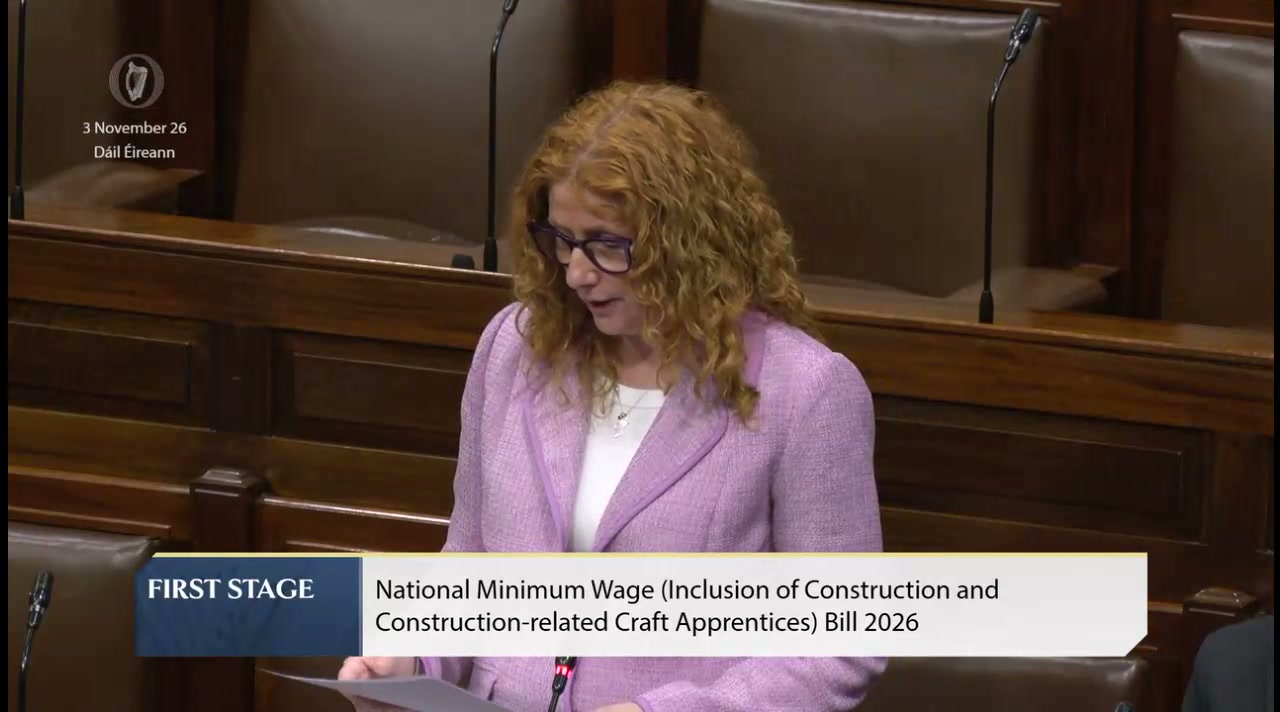
The speaker estimates the annual cost at approximately £43 million and identifies the National Training Fund as a possible source of funding, noting its reported previous-year surplus of £364 million. She says the proposal would reconsider the exemption for apprentices introduced under the National Minimum Wage Act 2000 and could provide a route to wider reform.
Low pay and apprenticeship dropouts
McGettigan cites a Connect Trade Union survey in which 46 per cent of respondents said they earned less than €7 an hour during a stage of their apprenticeship, while more than 90 per cent said they were paid below the national minimum wage. She says low pay is making it harder for apprentices to remain in their chosen trades, particularly as many have rent or mortgage payments and other household responsibilities.
A targeted first step
She proposes starting with construction and construction-related craft apprenticeships, rather than extending minimum wage protection to every apprenticeship programme at once. The measure would apply during the on-the-job phase, with other apprenticeship programmes potentially considered in future.
Skills and the housing shortage
McGettigan argues that improving pay could support retention and completion rates, and strengthen the construction workforce needed to build more homes. She refers to the Construction Industry Federation’s warning that Ireland will struggle to tackle its housing shortage without a greater commitment to apprenticeships.
Funding the proposal
The speaker estimates the annual cost at approximately £43 million and identifies the National Training Fund as a possible source of funding, noting its reported previous-year surplus of £364 million. She says the proposal would reconsider the exemption for apprentices introduced under the National Minimum Wage Act 2000 and could provide a route to wider reform.
We publish thousands of recordings to make Irish politics transparent and resistant to manipulation. Spotted an error? Report it — together we are building a reliable archive of Irish politics.
Other speeches


Tego samego dnia All speeches from this day →
Cian O'Callaghan
Cian O'Callaghan challenges Taoiseach over public service pay

Mattie McGrath
Mattie McGrath Seeks More Gardaí for Clonmel

Paul Murphy
Paul Murphy challenges Government on Lebanon mission and triple lock

Pearse Doherty
Pearse Doherty: Rural Ireland needs more than ambitious targets
Conor D McGuinness
Conor D McGuinness: Rural strategy falls short on housing
Jennifer Carroll MacNeill
Jennifer Carroll MacNeill: Patient flow key to easing ED pressure
Transcript
When the National Minimum Wage Act 2000 was introduced, it was determined that apprentices
would be excluded from the Act in recognition of the unique nature of apprenticeships, which
combine practical work with structured training.
However, there is substantial research showing a relationship between low apprenticeship
pay and poor completion rates.
Surveys carried out by Connect Trade Union and my colleague Mairead Farrell, alongside
discussions at committee level, have highlighted the financial difficulties facing apprentices.
Connect Trade Union reported that apprentices cannot afford to stay in their chosen craft
and that some are being forced out of their training or to emigrate because of low pay
and exploitation by unscrupulous employers.
The findings are concerning.
Forty-six per cent of respondents to the Connect Trade Union survey reported earning less than
seven euro per hour during the stage of their apprenticeship.
More than one quarter reported being paid less than agreed minimum wage apprenticeship
rates, and more than 90 per cent reported being paid less than the national minimum
wage during the stage of their apprenticeship.
Apprentices are dropping out at a higher rate than third-level students.
The average age of someone starting an apprenticeship is now approximately 21.
Many apprentices are adults with rent or mortgage payments, household bills and family responsibilities.
Expecting them to survive on less than eight euro per hour during the early stages of training
is increasingly unrealistic in the current cost-of-living crisis.
Low pay makes apprenticeships less attractive, contributes to dropouts and undermines efforts
to develop the skilled workforce Ireland urgently needs.
The Low Pay Commission has recommended abolishing sub-minimum wages rates for workers under
20, while the National Youth Council of Ireland has also called for the abolition of sub-minimum
rates of pay.
Furthermore, the Committee for Further and Higher Education, following meetings with
apprentices, providers and stakeholders, has recommended introducing a minimum wage floor
for apprentices.
Construction and construction-rated craft apprentices should be the starting point for
Ireland needs more skilled craft workers to address the housing crisis.
Improving pay would help retain apprentices, increase completion rates and strengthen the
future construction workforce.
The Construction Industry Federation at WorldSkilledIreland 26 said Ireland will continue to struggle
to tackle its housing shortage unless it makes a much bigger commitment to apprenticeships.
We all know of the crisis in housing, but future housing requires a skilled commitment
today and we need to encourage young people to enter construction apprenticeships.
We know from customs that it may not be feasible to introduce in one go placing all apprenticeships
in the minimum wage, so prioritising construction and construction-rated craft apprenticeships
would provide a practical first step, with other apprenticeship programmes considered
for inclusion in the future.
This Bill will place those in craft and construction apprenticeships on minimum wage during the
on-the-phase job only.
Year 1 is 13 weeks paid on the job phase and year 2 of their on-the-job phase is 26 weeks,
and the estimated annual cost of this is £43.16 million.
The proposed funding source for this is through the National Training Fund, which has a recorded
surplus of £364 million in the previous year.
This fund is financed by employer contributions and is intended to support training and skills
development.
The exemption introduced in 2000 recognised the distinctive nature of apprenticeship training,
however evidence of financial hardship, low pay and apprenticeships leaving their chosen
trades demonstrates the need to reconsider that approach.
Introducing a minimum wage for construction and construction-related craft apprenticeships
would be a targeted and practical first step.
It would help apprenticeships meet living costs, improve retention and support Ireland's
need for skilled construction workers.
With the estimated cost of £43.6 million under the proposed 2027 rate, funding through
the National Training Fund could provide a route to reform with the longer-term aim of
extending minimum wage protection to other apprenticeships.
For more information visit www.nihr.gov.uk