

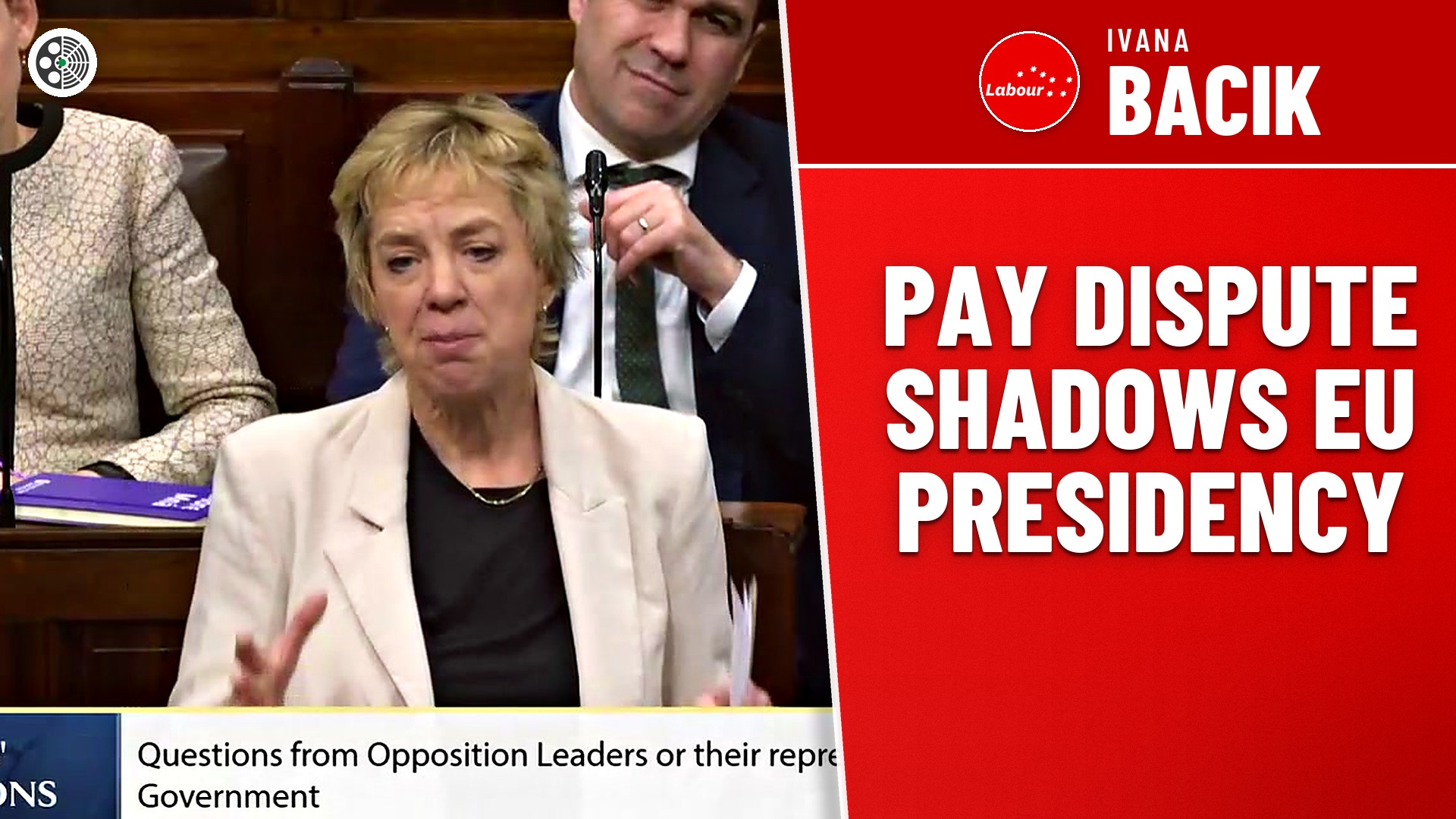


Ivana Bacik: Public Sector Pay Dispute Overshadows EU Presidency
Ivana Bacik challenged the Taoiseach during an Oireachtas exchange on public sector pay negotiations and planned strike action during Ireland’s EU Presidency. She called for a serious offer with meaningful increases for the lowest-paid public servants, warning that the dispute could affect frontline services and the country’s Presidency work.
Ivana Bacik argued that the Government’s failure to renew the previous pay deal before it expired in June had contributed to public service strikes and another threatened stoppage. She said the dispute was overshadowing Ireland’s EU Presidency and called for renewed engagement with unions.
Bacik questioned whether the negotiations would deliver meaningful increases for lower-paid public servants. She contrasted the reported pay rises for some semi-state agency chief executives with the offer she said was being sought from frontline workers, and asked the Taoiseach to put a serious offer on the table.
Bacik linked staffing and retention problems to consequences for public services, citing the Children’s Ombudsman’s warning that children were missing developmental checks because of difficulties recruiting and retaining public health nurses. She also referred to pressure on households from inflation, energy bills and public transport fares.
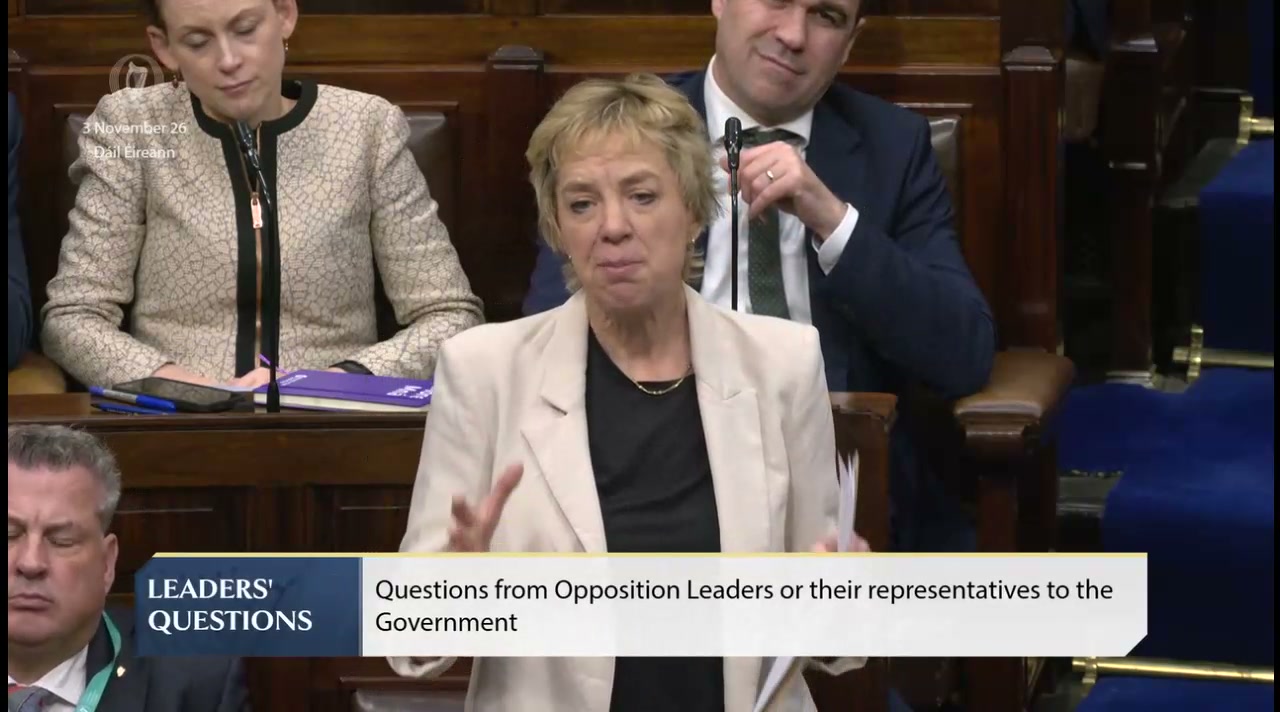
The Taoiseach disputed Bacik’s account of the negotiations, saying the Government had engaged with trade unions and that talks under the Workplace Relations Commission were continuing. He said the previous agreement had delivered pay increases above inflation, including increases for lower-paid public servants, and argued that budget measures were helping workers and low-income households.
Pay dispute and strike action
Ivana Bacik argued that the Government’s failure to renew the previous pay deal before it expired in June had contributed to public service strikes and another threatened stoppage. She said the dispute was overshadowing Ireland’s EU Presidency and called for renewed engagement with unions.
Lowest-paid workers and pay rises
Bacik questioned whether the negotiations would deliver meaningful increases for lower-paid public servants. She contrasted the reported pay rises for some semi-state agency chief executives with the offer she said was being sought from frontline workers, and asked the Taoiseach to put a serious offer on the table.
Frontline service pressures
Bacik linked staffing and retention problems to consequences for public services, citing the Children’s Ombudsman’s warning that children were missing developmental checks because of difficulties recruiting and retaining public health nurses. She also referred to pressure on households from inflation, energy bills and public transport fares.
Taoiseach’s response
The Taoiseach disputed Bacik’s account of the negotiations, saying the Government had engaged with trade unions and that talks under the Workplace Relations Commission were continuing. He said the previous agreement had delivered pay increases above inflation, including increases for lower-paid public servants, and argued that budget measures were helping workers and low-income households.
We publish thousands of recordings to make Irish politics transparent and resistant to manipulation. Spotted an error? Report it — together we are building a reliable archive of Irish politics.
Other speeches
Tego samego dnia All speeches from this day →
Cian O'Callaghan
Cian O'Callaghan challenges Taoiseach over public service pay
Mary Lou McDonald
Mary Lou McDonald challenges Taoiseach on public service pay
Rose Conway-Walsh
Rose Conway-Walsh Seeks Rail Corridor Timeline to Sligo
Paul Murphy
Paul Murphy Seeks ‘Tell Us Once’ Service for the South
Rose Conway-Walsh
Rose Conway-Walsh: Mayo Hospital faces a patient safety crisis
Rose Conway-Walsh
Rose Conway-Walsh challenges legacy Bill's human rights test
Transcript
Thank you for welcoming our visitor, Liam Connell MP, to the gallery here today.
On behalf of the Labour Party, I want to extend my deepest sympathies to the husband and family
of Ciara McGeehan as she is laid to rest today.
Ciara inspired a generation of young women to embrace sport.
By speaking publicly about her diagnosis, she will also have saved many lives, and I
echo calls for bowel cancer screening to be extended in her memory.
May she rest in peace.
Here we go again Taoiseach.
Another public sector work stoppage next week.
Potential strike action on one of the most important days of our EU Presidency.
Just in time for Friday 13th.
Unlucky for some, they say, but this is not bad luck.
This is bad government.
Your government let the last pay deal expire in June, on the eve of the start of the EU
Presidency, a massive undertaking that you knew would place huge demands on public servants.
You may not like us saying it, but it's the truth that your government's failure to engage
then was what brought about the strike last month by 300,000 public service workers, and
now you're doing it again.
Instead of showcasing our country at its best, the EU Presidency is being overshadowed by
a pay dispute of your making.
On his way into Cabinet today, the Taoiseach encouraged everyone to dig deep in good faith.
But you might think of engaging deeply and in good faith yourselves.
We understand that one of the sticking points in talks with the unions is the lack of provision
for the lowest paid workers.
Nothing meaningful, it seems, for those on less than £50,000 per year.
How can Minister Chambers claim to be pursuing a fair deal for workers while leaving behind
those who need the most help?
Meanwhile, the same Minister has been busy approving inflation-busting pay rises for
the heads of semi-state agencies, many rises which are multiples of the rate of inflation.
Let's take a few examples.
Ishka Errin, CEO, got a pay rise of 43%.
The chief executives of Bus Errin and the Land Development Agency each received top-ups
of €50,000.
That increase alone, Taoiseach, matches the total salary a teacher can expect to earn
after six years' service.
And the CEO of the Dublin Airport Authority will draw a wage of €380,000.
That's a €95,000 increase compared with his predecessor.
Taoiseach, these are eye-watering amounts.
Of course we need competitive salaries to attract people to lead our public bodies.
But what message does it send to public servants when chief executives receive increases of
this magnitude while you are reportedly asking those delivering essential frontline services
to settle for less than 2% for now?
Is it any wonder they're preparing to down tools or looking beyond our shores?
The impact is being felt across the country already.
The Children's Ombudsman is telling us that children are missing vital developmental checks
because we can't retain or recruit public health nurses.
The public sector is not a charity case.
So Taoiseach, as engagement continues today, will you put a serious offer on the table,
including meaningful increases, for the lowest-paid public servants so that we can resolve the
dispute now?
Thank you, Deputy Taoiseach.
Again, Deputy, look, I would disagree with your narrative in terms of how this negotiation
has unfolded.
The government engaged very early on with the trade union movement in respect to public
service pay.
This issue about whether pay was first or last, to me, was a complete red herring, if
you want my honest opinion about it, because the national pay agreement talks are about
a national pay agreement.
In the name of God, what do you think we're going to be discussing?
Let's have a bit of common sense into the debate now as well.
A national pay agreement is about pay, fundamentally.
That's what always happens.
That's what happened the last time.
It was about pay.
And actually, as I said, the last agreement that expired in June provided increases of
about 9.6 per cent cumulatively, greater than inflation over the same period of 6.6
per cent.
But, Deputy, for the lowest-paid public servants, pay was increased by 36 per cent over this
period, significantly in excess of inflation.
And the government would share your view of a prioritisation of lower-paid workers.
But again, I don't want to pre-empt the negotiations, and those talks are underway in accordance
with the template that had been agreed with the trade union movement at the commencement
of these latest phase of the talks, with an overseeing panel that was sought by the trade
union movement, which was agreed, and under the aegis of the WRC.
And those talks are ongoing, and we should allow those talks to continue.
And we're not responsible for people making decisions to set a further strike there.
We can't allow that to undermine our approach to the talks or our influences either.
The presidency is a six-month, and we've achieved a lot already in terms of a whole range of
files that have been – and issues from competition in terms of one market, one Europe, particularly
in terms of a capital markets union, in terms of a new corporate legal framework for SMEs,
enlargement of the European Union, real progress with Montenegro, Moldova, and Ukraine.
And we continue to work extremely competently and in a focused and ambitious way in terms
of the remainder of the presidency.
Parallel with that, we want to achieve a fair and sustainable pay agreement.
And as I said, talks are continuing.
We should allow the talks to continue between the unions and government under the aegis
of the WRC.
And that's the logical way to proceed here, and that's what we intend to do.
Deputy Back.
Well, did you have that, that in response to me you said you would be willing to prioritise
the lowest-paid public servants?
I think that's really welcome.
I think that is a very positive sign.
But nobody can accept your assertion that your government engaged early in meaningful
talks.
You keep referring in your responses today to the last pay deal.
But that ran out in June, and what nobody can understand, least of all nurses, guards,
teachers on the front lines, nobody can understand why your government let that pay deal run
out and didn't seek to renew it before the expiry date, and indeed before the EU presidency
began.
There's a passivity that is characterising your government's response to public servants.
And that's what's bringing about the anger.
That's what's bringing about people's desperation, because people are really struggling out there.
With inflation running now at 4%, families not being able to afford to keep food on the
table or to pay energy bills.
We know hundreds of thousands are in arrears on energy bills, Taoiseach.
Public transport fares set to increase, and people really hard-pressed.
So it's welcome to hear a willingness to prioritise the lowest-paid public servants.
I think that's positive.
We know in the Labour Party about negotiation.
We know nobody wants to withdraw Labour, nobody does it on a whim, but this is now being seen
as a last resort in the face of government passivity and inaction.
I don't think that's a fair characterisation at all, and I think the government's engagement
in the talks in the last week has been very proactive, very fair, in terms of seeking
an agreement.
And secondly, I would say to you that the cost of living is the big issue.
And in the budget, we responded to that.
And again, in terms of low-paid and low-income groups, don't take our word for it.
Objective data shows that we looked after the lowest-income groups more than anybody
else.
They were the biggest beneficiaries of the budget.
We brought in tax cuts, which will take effect early next year, tax cuts that are significant,
the £1.3 billion income tax package for workers, both private sector and public service workers.
The reductions in childcare, which are significant, will impact on workers.
And other measures on the budget will take pressure off workers, which is necessary given
the cost-of-living pressures that people undoubtedly are under.
But if you compare our budget in terms of the tax cuts to any other budget across Europe,
there isn't a comparison.
That's the reality.
And we've expanded the public service very significantly as well.
No question about that either.