

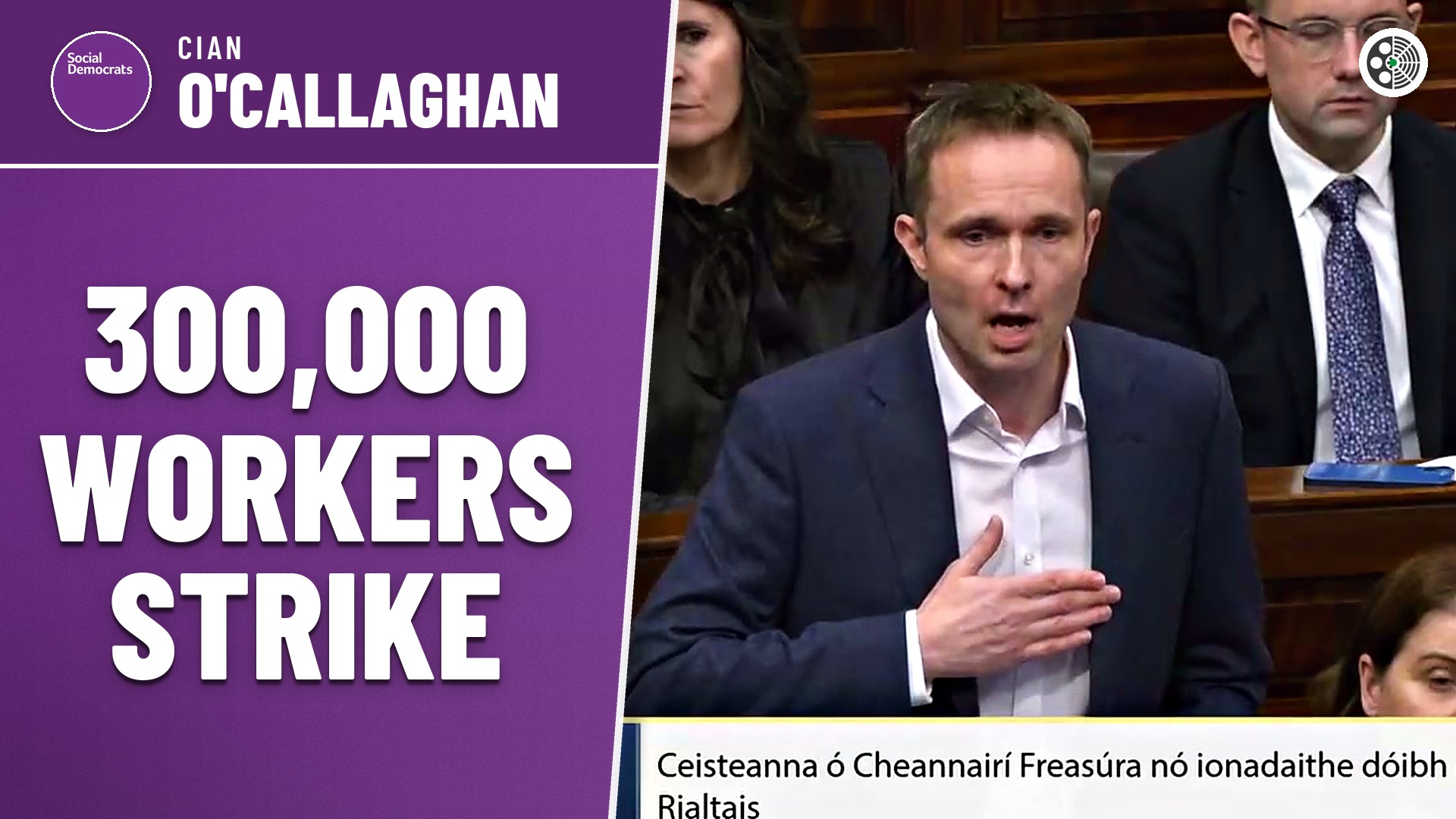


Cian O'Callaghan challenges Taoiseach over public service pay
Social Democrats TD Cian O'Callaghan challenged the Taoiseach in Dáil Éireann over the Government's handling of public service pay talks. He asked the Taoiseach to intervene and make a credible pay offer to avert further strike action, arguing that workers face rising living costs and delays in negotiations.
O'Callaghan said the existing pay deal had expired in June and accused the Government of delaying engagement and refusing to put pay at the centre of talks. He pointed to a strike involving more than 300,000 workers and warned that another day of industrial action was due the following week.
The Social Democrats TD highlighted nurses, gardaí, teachers, special needs assistants and local authority workers, saying they deliver essential services while struggling with food costs and soaring energy bills. He argued that a pay offer below inflation would not be credible during a cost-of-living crisis.
The Taoiseach rejected O'Callaghan's claim that the Government treated public service workers with contempt. He said the Government had entered talks in good faith, described the offers made as substantial and said the agreed process involved the Workplace Relations Commission and an overseeing panel if negotiations reached an impasse.
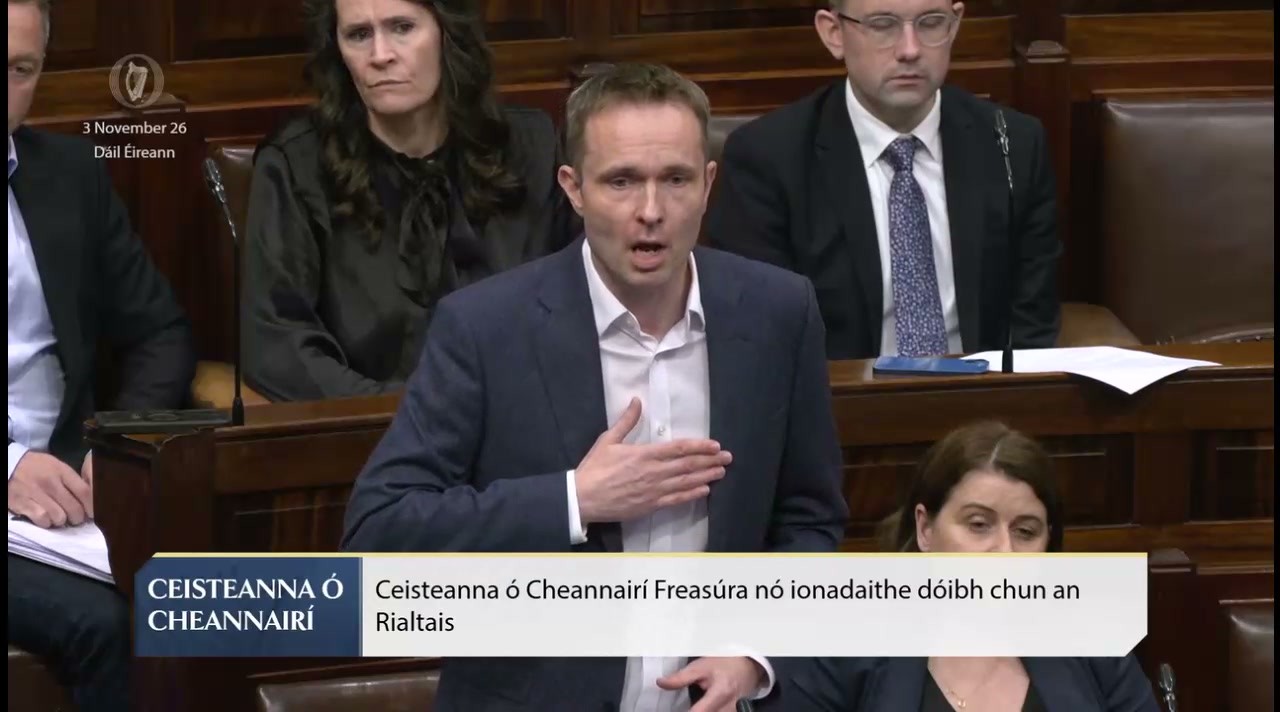
O'Callaghan pressed the Taoiseach to intervene and make a credible offer, while the Taoiseach said there was no need for a strike and urged the parties to let negotiations continue towards a national pay agreement. Watch the recording to hear the full exchange.
Strike threat and pay talks
O'Callaghan said the existing pay deal had expired in June and accused the Government of delaying engagement and refusing to put pay at the centre of talks. He pointed to a strike involving more than 300,000 workers and warned that another day of industrial action was due the following week.
Workers and cost of living
The Social Democrats TD highlighted nurses, gardaí, teachers, special needs assistants and local authority workers, saying they deliver essential services while struggling with food costs and soaring energy bills. He argued that a pay offer below inflation would not be credible during a cost-of-living crisis.
Taoiseach defends Government approach
The Taoiseach rejected O'Callaghan's claim that the Government treated public service workers with contempt. He said the Government had entered talks in good faith, described the offers made as substantial and said the agreed process involved the Workplace Relations Commission and an overseeing panel if negotiations reached an impasse.
Call for an agreement
O'Callaghan pressed the Taoiseach to intervene and make a credible offer, while the Taoiseach said there was no need for a strike and urged the parties to let negotiations continue towards a national pay agreement. Watch the recording to hear the full exchange.
We publish thousands of recordings to make Irish politics transparent and resistant to manipulation. Spotted an error? Report it — together we are building a reliable archive of Irish politics.
Other speeches
Tego samego dnia All speeches from this day →
Rose Conway-Walsh
Rose Conway-Walsh: Mayo Hospital faces a patient safety crisis
Donnchadh Ó Laoghaire
Donnchadh Ó Laoghaire calls for Triple Lock referendum
Brendan Smith
Brendan Smith welcomes Shared Island border tourism investment
Donna McGettigan
Donna McGettigan makes case for minimum wage for apprentices
Richard Boyd Barrett
Richard Boyd Barrett says public workers face real-terms pay cut
Mary Lou McDonald
Mary Lou McDonald challenges Taoiseach on public service pay
Transcript
Ian O'Callaghan.
Ciarán Corle at the outset, on behalf of the Social Democrats,
I want to extend our condolences to the family and friends
of Ciara Mian, and especially to her husband, Thomas.
Ciara was one of Ireland's greatest athletes.
Despite her illness, she showed immense courage and bravery,
sharing her story and raising awareness of bowel cancer.
She remained deeply concerned about others
and was outspoken against the genocide in Gaza.
You've lost an amazing person, Eardeas de go raibh a thanam.
Taoiseach, your government's handling
of the talks with public servant workers
has been an unmitigated disaster.
For most of the year, you ignored them,
barely bothering to engage before the current pay
deal expired in June.
This intransigence and arrogance blew up in your face
and resulted in the biggest public service
strike in nearly two decades.
Up to that point, your government
had refused to countenance talks in which the issue of pay
was front and centre.
It took more than 300,000 workers joining picket lines
before you climbed down.
And now, just a few weeks later, there
will be another day of strike action,
because your government has failed
to make a credible pay offer.
Taoiseach, this mess begs a very important question.
What is your government at?
You've been all over the place all year.
You've treated public service workers
with barely disguised contempt.
You allowed the previous deal to expire.
You refused to discuss pay first.
And then you eventually climbed down on that.
Your intransigence achieved absolutely nothing.
Taoiseach, there are public service workers
who are barely keeping their heads above water.
Nurses, guards, teachers, SNAs, local authority workers,
delivering essential services across the country.
They keep us safe.
They teach our children.
They look after us when we are not well.
And then they go home and wonder how
they will put food on the table or pay their soaring energy
bills.
Taoiseach, let's be very clear.
If there's another strike next week,
it will be the fault of your government.
Your government has spent more time
on internal bickering and rivalries
than addressing the country's problems.
You've sleepwalked your way into an industrial relations crisis.
Taoiseach, the question for you now is,
what are you going to do to avert next week's strike?
Will you personally intervene?
And will you ensure that a credible offer on pay
is finally made?
Taoiseach, please.
Your language is completely over the top, genuinely.
You say that barely disguised contempt.
Barely disguised contempt.
That we treat public service workers
with barely disguised contempt.
I attended the annual conference of Forsa earlier this year.
Does that suggest to you that I treat them with contempt?
It was actually a very agreeable conference.
We had a very good, we got on very well.
No, no.
We've expanded, for example, special needs assistance
to about 23,000 by the end of this year.
Is that treating public service with contempt?
We've expanded the public service very significantly
over the last four to five years.
Is that treating the public service with contempt?
I know you have to do what you have to do.
And I know the old line, which is not that imaginative
or not that creative,
if the strike happens, it's your fault.
Great line, Deputy, and that's what you have to say.
And that's what you're going to say
and you'll continue to say.
But from our perspective,
we've entered into the talks in good faith.
Okay, we agreed a template for these talks
with the trade union movement
in advance of the talks commencing.
By the way, we were available for talks all along
prior to that.
We made that very clear before any strike happened.
So we didn't have to wait for a strike
to say we wanted to get into talks.
But the template was agreed
and the template involved the overseeing panel
under the agency of the WRC and Kevin Foley
engaging with both sides if an impasse arose.
That's all that's happening now.
That was agreed and that was agreed over the weekend.
We should allow the talks to continue.
And you're not a party to the talks.
The offers that have been made are not small offers.
But we're engaged, you've had your say.
Okay.
And there's sustainability involved here.
We have to think of the wider picture as a government,
we have responsibilities.
And that's it.
And we will continue to engage in the talks in good faith
with the trade union movement.
There's no need for a strike next week.
With a will, there's a way to resolving this.
Deputy O'Callaghan.
Taoiseach, you've been around government and politics
for decades and you know what normally happens here
when a pay deal expires, a new one is agreed.
Under your government, that hasn't happened.
You haven't made a credible pay offer.
The media reports are of pay offers below inflation.
How is that credible in a cost of living crisis?
How is that not treating public sector workers with contempt?
You owe it to the people who are working hard
to deliver public services and to the public
that need those services to resolve this quickly.
Make a credible pay offer, get on with this.
But instead, you've let weeks go by, months go by
before talks even began because you wouldn't agree
for months and months, you wouldn't even agree
that pay would be the first item of the agenda.
And where did that get you?
It got you nowhere except delays.
Your government is too busy, ministers,
briefing against each other, Fianna Fáil and Fianna Gael,
trying to out-vow each other.
You've got your eye off the ball.
So when are you actually going to make a credible pay offer
and get this resolved?
Thank you, Deputy O'Callaghan.
Taoiseach, please.
I'll say earlier this year, just by the way,
I did offer an enhanced social dialogue
to the trade union movement.
And we actually circulated a paper to that effect.
And we actually circulated a paper to that effect
in the context of the Leave Forum.
No, but you're characterizing government
as not respecting the trade union movement,
not engaging with the trade union movement.
I'm just laying out the facts.
They said not yet.
Because, no, well, you only see it through one dimension.
I can't be responsible for how others engage
or deal with things.
All I can simply say is this,
that the government wants a national pay agreement.
It doesn't believe there's any need for a strike next week.
And where there's a will, there's a way.
And in our view, we should allow it
to the negotiation process to conclude
and to enable the agreement to be arrived at.