

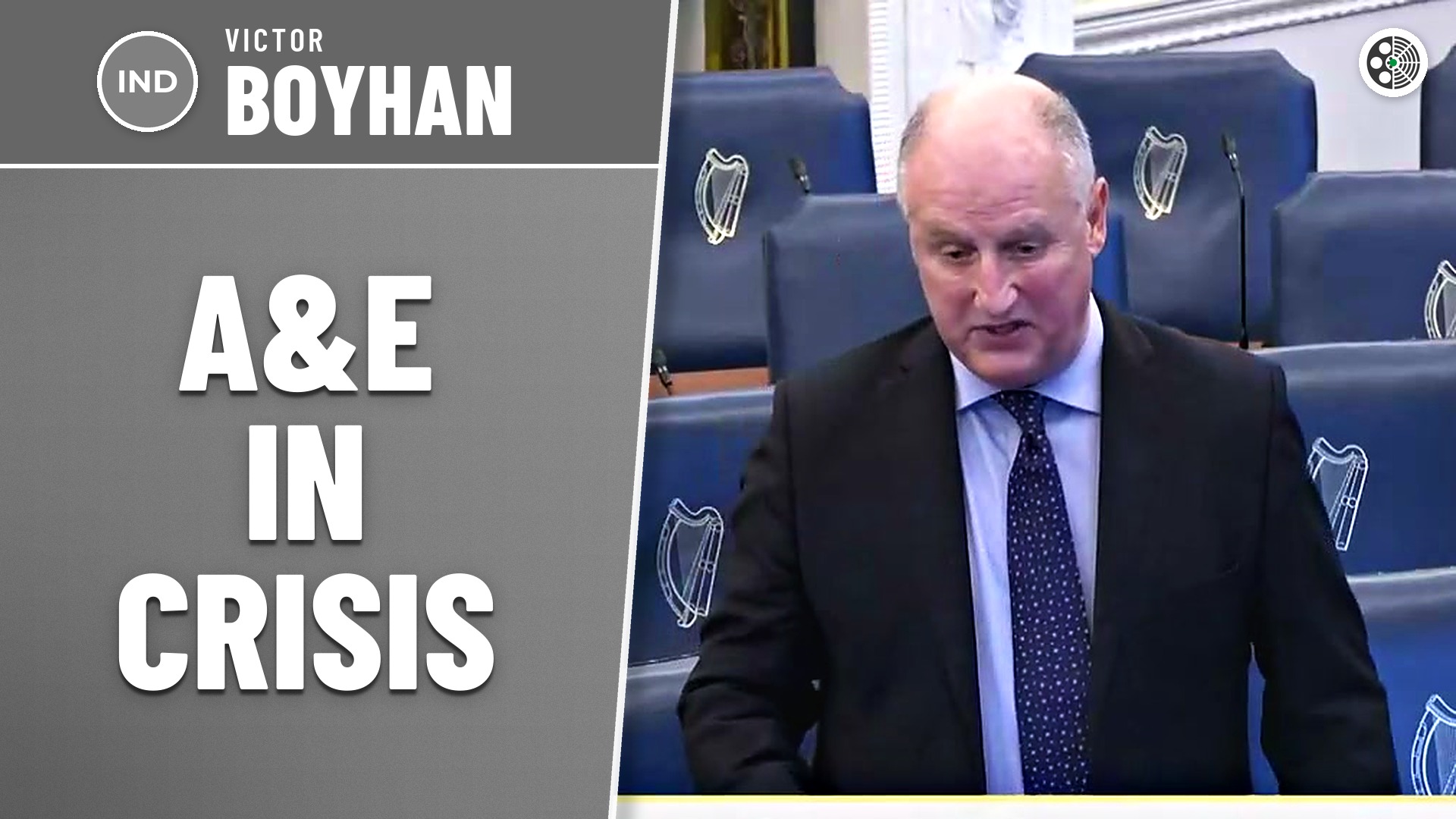


Victor Boyhan challenges Minister over A&E crisis
Senator Victor Boyhan asked the Minister in Seanad Éireann for a plan to address overcrowding in emergency departments, citing more than 70,100 patients who left or did not complete treatment in the first seven months of 2026. He said staffing and bed-capacity pressures were putting patients and healthcare workers under strain, and called for action on patient flow and access to A&E services.
Boyhan said he had seen long waits during a visit to St Vincent’s Hospital and praised frontline staff, while identifying recruitment difficulties, insufficient bed capacity and delays in approving posts as pressures on emergency departments. He also called on private hospitals to provide more emergency care for their insured patients.
The Minister, speaking on behalf of Minister Jennifer Carroll MacNeill, said emergency attendances had risen by 7% from January to October 2026, with attendances by people aged 75 and over up by 9%. She cited delayed transfers of care as a constraint on bed availability and outlined winter measures including enhanced discharge planning, virtual wards, community supports and daily oversight.
In reply, Boyhan said the public were losing confidence in the Government’s ability to address pressure in emergency departments. He referred to nurses’ concerns about recruitment and accommodation costs, and said low morale and staff departures were affecting hospitals. He asked the Minister to keep pressure on the Department and for the Health Minister to visit emergency departments and show support for hospital staff.
Boyhan said he had seen long waits during a visit to St Vincent’s Hospital and praised frontline staff, while identifying recruitment difficulties, insufficient bed capacity and delays in approving posts as pressures on emergency departments. He also called on private hospitals to provide more emergency care for their insured patients.
The Minister, speaking on behalf of Minister Jennifer Carroll MacNeill, said emergency attendances had risen by 7% from January to October 2026, with attendances by people aged 75 and over up by 9%. She cited delayed transfers of care as a constraint on bed availability and outlined winter measures including enhanced discharge planning, virtual wards, community supports and daily oversight.
In reply, Boyhan said the public were losing confidence in the Government’s ability to address pressure in emergency departments. He referred to nurses’ concerns about recruitment and accommodation costs, and said low morale and staff departures were affecting hospitals. He asked the Minister to keep pressure on the Department and for the Health Minister to visit emergency departments and show support for hospital staff.
We publish thousands of recordings to make Irish politics transparent and resistant to manipulation. Spotted an error? Report it — together we are building a reliable archive of Irish politics.
Other speeches
Tego samego dnia All speeches from this day →
Danny Healy-Rae
Danny Healy-Rae: Empty hospital beds and A&E waits
Mary Lou McDonald
Mary Lou McDonald challenges Taoiseach on public service pay
Carol Nolan
Carol Nolan warns trolley numbers mask wider health capacity gaps
Charles Ward
Charles Ward says Donegal needs investment to thrive
Sinéad Gibney
Sinéad Gibney challenges the case for Triple Lock reform
Paul Murphy
Paul Murphy Seeks ‘Tell Us Once’ Service for the South
Transcript
Firstly, I want to welcome the Minister to the House.
And it's always good to see you here, Minister,
and I'm delighted you could come here
on behalf of the Minister for Health.
And I suppose, Minister, what I'm asking for
is for a statement on the fact that over 70,000 people
left accident and emergency departments
without being seen in the first seven months of 2026.
And we have to ask ourselves questions,
why is that the case?
I had an opportunity to be in St. Vincent's Hospital
last week and see firsthand for many hours
the enormous amount of waits.
And I suppose before I talk anything
about the health services,
I want to start off on a very positive note
to acknowledge the amazing work
that our frontline healthcare workers do,
our nurses, our orderlies, our catering people,
all the auxiliary and support staff
that are in our public hospitals
and our private hospitals.
They do an extraordinary job
and under very, very difficult circumstances.
But I suppose then when we read in the papers
a follow-on in relation to a question
that had been submitted by the chairperson
of the Oireachtas Committee on Health,
Pádraig Rice, it really was astounding
that these were what was reported back.
So we're now told that over 70,100 people
did not wait or left before completing their treatment
in emergency departments
due for the first seven months of this year.
And the data, of course, has been obtained
and has been verified by the HSC,
and I've said that already.
And hospitals are operating under enormous pressure.
So there's a combination of things.
There is effectively a difficulty around recruitment.
Should we just leave it at that rather than say an embargo?
But there is a difficulty,
there's a process of now going back
to the department for approval,
and there may be reason or good reason for that,
but it's slowing down the process,
and that's the problem.
The HSC is saying it's committed to improving
the patient flows through our emergency departments.
We know that both public and private patients
are trying to access hospitals through the A&E,
and it begs the question, really,
why is everybody clogging up an A&E?
And of course, I accept that in time
there will be more local clinics
and all of the supports that go with that,
but the problem is we have so many people
coming to our A&Es, they're under-resourced,
they don't have sufficient staff,
they're having the bed capacity,
and I spoke to a number of staff.
Indeed, I want to acknowledge
the Chief Executive of St. Vincent's Hospital,
who I had a long conversation with.
She rang me, actually,
and I want to acknowledge and thank her for that,
and that's really important,
and that was Philomena McGrath,
the Chief Executive of St. Vincent's,
and she pointed out a few issues in terms of the beds.
They're having the bed capacity.
There is a need generally for improved bed capacity
in all of our hospitals, and that's a challenge,
so I really think there are really issues there.
I just want to quote for you very, very briefly
what the INMO has called, in terms of the HSE.
She's called for the target to address
the dangerous levels of overcrowding
in our emergency department.
She goes on to say that the HSE cannot continue
to operate on a keep calm and carry on basis
while patients and staff are exposed
to unacceptable risks.
Going on there to say that given the level of overcrowding
we have seen in our emergency departments
throughout this year,
the HSE must have a plan to ease the pressures
across the acute hospital system.
The current situation is dangerous
and requires immediate action.
The HSE and the Department of Health must be honest,
she says, with the public about the dire situation
facing the majority of our emergency departments.
Patient safety must come first,
and that means taking decisive action now
to address the overcrowding.
I don't want to spend my time looking back,
I want to look forward.
I know you're the same, Minister.
We have to recognize there is a crisis within our A&Es.
We have a lot of people who are waiting
10, 11, 12, and 14 hours to be triaged in our AEs.
We have people over 75 years of age queuing for hours.
I could go on and on,
but that's not going to get us anywhere.
And really what I want to hear, Minister,
how are we going to plan and tackle the issues
that the INMO and their chief has indicated is a problem?
And I support them, and I know you support them,
but let's map out a pathway to end what is chaos
in our accident and emergency departments
around this country.
Thank you.
Thanks, Senator.
Minister.
Thank you so much, Senator.
And I can see the passion and your commitment,
as you always have, in fairness to you,
on this very important matter here today.
And I'm taking this commitment, as you said,
on behalf of Minister Jennifer Karen McNeill.
Senator, patience is everyone's priority.
Long waits in emergency departments.
You know, there is the challenges.
You said it, and we have them.
Departments can be distressing for patients
and their families, and particularly for older people
and those with complex healthcare needs.
The figures referenced by the Senator
must be considered in the context
of a health service experienced
unprecedented growth and demand, Senator.
Emergency department attendances
continue to increase significantly.
From the 1st of January to the 28th of October this year,
attendances were up by 7%,
representing almost 98,000 additional presentations
compared with the same period in 2025.
Presentations by patients aged 75 years and over
increased by 9%, equivalent to almost 17,700
additional older patients.
And these patients are more likely to require admission.
And they have longer stays in hospital,
as we know ourselves.
While attention has focused on patients
leaving emergency departments before treatment is complete,
it is important to note that the vast majority of patients
remain and receive the care they need.
While the proportion of patients
leaving emergency departments before treatment is complete
remains above target, improving patients' experience
and reducing waiting times continue to be priority
for both the department and the HSE.
The challenge in facing emergency departments
cannot be viewed in isolation.
Patients flow throughout the wider hospital system
remains a critical factor.
Very high and sustained levels of delayed transfers of care
continue to impact bed availability.
So between January and October,
the average daily DTOC number was 516 patients
compared with a system threshold of 300.
This results in approximately 150,000 bed days
of lost capacity and represents a 26% increase
on the same period last year.
The department and the HSE are responding
through a range of measures for the winter period.
So this is what they're working on now, Senator.
These include strengthening operational oversight,
enhanced discharge planning,
senior clinical decision-making,
expanded use of virtual wards,
increased community supports
and greater focus on seven-day working.
Daily oversight arrangements are now in place
across the system.
In preparation for winter,
the Department of Health has asked the HSE
to identify critical clinical safety posts
that would have the greatest impact on patients' flow,
patients' safety, and have in regard
to the sustained increase in demand experienced
throughout 2026.
We are also working with the HSE
to develop a target GP respiratory illness support program
ahead of the winter season.
So this program is intended to support
the management of respiratory illness in the community,
reduce avoidable emergency department attendances
where appropriate, and help reduce pressure
on the acute hospital services during peak demand.
Importantly, performance varies considerably
between different hospitals.
So if you look at the region,
so a number of hospitals,
including University Hospital, Watford,
Midland Regional Hospital, Tonnomore,
Cavan, Drogheda, and Port Juncola,
have demonstrated that strong patient flow
remains achievable even through periods of high demand.
Review of these sites indicates that success
is associated with long seven-day discharge planning,
effective use of surge capacity,
balanced admission and discharge activity,
and active oversight of patients' flow throughout the week.
The government is also investing in alternatives
to emergency departments.
As you spoke about yourself there,
injury units continue to provide rapid treatment
for minor injuries,
while virtual wards have delivered
more than 45,000 virtual bed days
and supported almost 5,000 patients nationally.
These initiatives, they help ensure patients receive care
in the most appropriate setting
while freeing capacity within acute hospitals.
There is no single solution
to emergency department crowding.
Addressing these pressures require continued investment
in capacity, discharge pathways, community services,
workforce, and hospitals productivity.
This remains the focus for the department.
Thank you.
And the HSE.
Minister, look, I hear what you're saying
and I'll take back that to the IMO, that response.
But I mean, the reality is the public are losing confidence
in the government's capacity to address a chaos,
a crisis in our A&Es.
And that, I'm not happy to say that.
But I'm happy to say that I spoke and sat down with nurses
in St. Vincent's Hospital this last week.
And they tell me on the cold face,
there's issues around recruitment.
And we know there are issues also
about the cost of accommodation in the Dublin hospitals,
which is feeding into the dilemma.
There's a lack of other preliminary options to go to.
There is a filling up of private patients
in our public A&Es.
And the private sector,
and I make one issue here today,
the private sector are letting down private patients
because they should be taken up, that element.
There's no better place than a public training hospital
if you're sick, as far as I'm concerned in my book.
But the reality is we need to call the private sector
to account to provide A&E services
to the people that are paying huge premiums for that.
Because my understanding from the nurses and doctors
and practitioners that I spoke to in the last week
is that 50% of the people have private health cover.
And they should have another option
to in some way dissipate the huge crowds.
But I want to finish on this.
Our nurses are doing an exceptional job.
Our nurses are under pressure.
Hundreds of our nurses are leaving this country
because of pay and conditions around their employment,
and we're losing out.
And I just finish on this point.
The public at large are with the nurses.
These public sector workers,
I don't like the word public sector.
They are our nurses.
They are our carers.
They are our assistants.
They are our orderlies.
They are our caterers in our hospitals.
And at an all-time low, morale is low with them.
And morale is low with the people
that we all seek to serve.
And I'd ask, Minister,
I know you're commissioned to this area yourself
and the work you've done in terms of Kilkenny
and your own hospital,
but please keep the pressure on.
Please ask the Minister to get up one night
and walk into some A&E.
I know she's commissioned that and she's done it in the past.
Keep on the floors of our hospitals
and send a clear message
that we support our nurses in our hospitals.
Thank you.
Minister.
Thank you very much, Senator, again.
And as I said,
and I certainly will be speaking to Minister Karen McNeill
and highlighting the issues.
And again, our frontline workers, excellent work.
My own daughter's a nurse.
My eldest daughter is actually a nurse.
So I do appreciate their work,
and all frontline workers,
they do absolutely excellent work.
But I can assure you that the government is committed
to working to find where we see the challenges,
how we can work on the challenges.
And look, again, I can only just say to you,
while much work remains to be done,
improving patient flow, reducing delays,
ensuring timely access to safe care
remains the Minister's priority
and the Department of Health and the HSE
will continue to work closely together
to deliver improvements required
across the urgent emergency system.
And again, I certainly will go back and highlight this.
And thank you very much for your commitment
and your passion to this, Senator.
Thank you.