



Martin Daly questions oversight of hot school meals scheme
Martin Daly praised the hot school meals scheme during a discussion on its rollout, while raising questions about food quality, funding and procurement safeguards. He asked how departments and regulators work together to protect children and public funds as the scheme is refined.
Daly said universal access was a strength of the scheme, arguing that it avoids distinguishing or shaming children on the basis of family resources. He highlighted the benefits of nutritious meals for children’s development, school attendance and families who may struggle to provide meals at home.
Daly welcomed survey findings indicating high satisfaction among parents and children, and that most food provided was nutritious and low in salt and fat. He asked whether cooperation between the Department of Social Protection, the Department of Education and food safety authorities could be strengthened, rather than leaving school principals as the sole arbiters of quality.
Daly asked how the reported €34 million gap between enrolled pupil numbers and meal claims would be addressed. He also asked about controls on ring-fenced funding. In response, the department representative said schools must use a dedicated bank account, provide invoices and bank statements, and undergo annual reconciliation; surplus funding is carried forward to the following year.
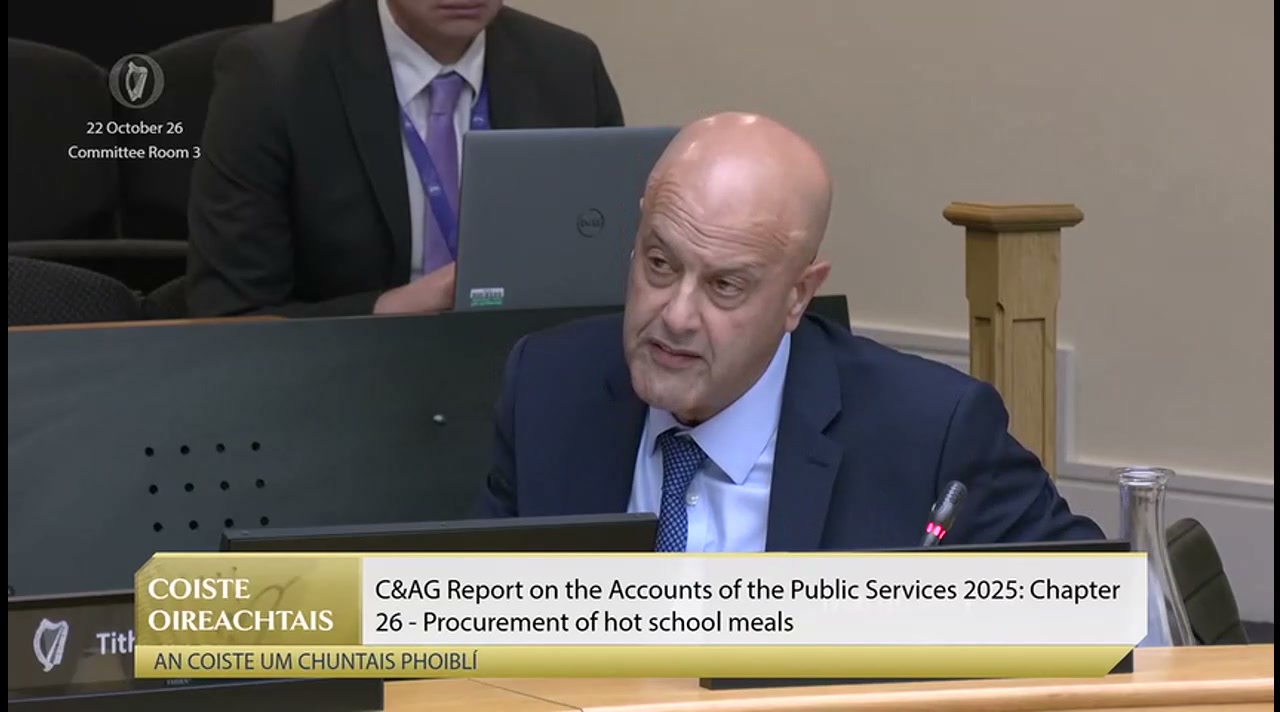
Daly questioned whether local procurement could create risks around supplier contributions to schools and the cost of equipment. He also raised the concentration of supply and asked what contingency plans were in place if a major supplier withdrew. The department representative said replacement suppliers had been found for most of 112 schools after one supplier pulled back, and that new arrangements prevent schools accepting supplier donations and place costs such as ovens and waste management on suppliers.
The discussion focused on refining a rapidly expanded public scheme through stronger standards, auditing and coordination between departments. Watch the recording to hear the full exchange.
An egalitarian school meals scheme
Daly said universal access was a strength of the scheme, arguing that it avoids distinguishing or shaming children on the basis of family resources. He highlighted the benefits of nutritious meals for children’s development, school attendance and families who may struggle to provide meals at home.
Food quality and oversight
Daly welcomed survey findings indicating high satisfaction among parents and children, and that most food provided was nutritious and low in salt and fat. He asked whether cooperation between the Department of Social Protection, the Department of Education and food safety authorities could be strengthened, rather than leaving school principals as the sole arbiters of quality.
Funding and accountability
Daly asked how the reported €34 million gap between enrolled pupil numbers and meal claims would be addressed. He also asked about controls on ring-fenced funding. In response, the department representative said schools must use a dedicated bank account, provide invoices and bank statements, and undergo annual reconciliation; surplus funding is carried forward to the following year.
Procurement and supplier risks
Daly questioned whether local procurement could create risks around supplier contributions to schools and the cost of equipment. He also raised the concentration of supply and asked what contingency plans were in place if a major supplier withdrew. The department representative said replacement suppliers had been found for most of 112 schools after one supplier pulled back, and that new arrangements prevent schools accepting supplier donations and place costs such as ovens and waste management on suppliers.
The discussion focused on refining a rapidly expanded public scheme through stronger standards, auditing and coordination between departments. Watch the recording to hear the full exchange.
We publish thousands of recordings to make Irish politics transparent and resistant to manipulation. Spotted an error? Report it — together we are building a reliable archive of Irish politics.
Other speeches
Tego samego dnia All speeches from this day →
Gerard P. Craughwell
Gerard P. Craughwell asks about PTSD respite care
Gerard P. Craughwell
Gerard P. Craughwell questions barriers to veterans’ mental health care
Jennifer Carroll MacNeill
Jennifer Carroll MacNeill backs CHI inquiry commission
Barry Andrews
Barry Andrews asks how party views align with Pope's teaching
Paul Lawless
Paul Lawless challenges consent advert and demands Tusla action
Pearse Doherty
Pearse Doherty challenges Minister over elderly patients waiting
Transcript
Thank you Secretary General for coming here today with your team and to the Department of Education and also to the Comptroller-in-Order General for his report, his department's report.
Firstly, I want to say this is a really, really valuable scheme towards the provision of nutrition to school-going children in the state with well-recognized benefits,
not just in their physical and intellectual development but also their ability to attend school and also to support families that may well not have the resources to provide school meals to their children going to school but also may not be getting proper nutrition at home.
And the valuable part of this scheme, because there is a move away from universality, but in this particular instance it is a real strength of this scheme that there is no distinction made between the child who actually may depend on the hot school meals scheme and children who may not.
And sometimes the criticism, which I think is unwarranted and unfair if you think about it, has been directed against that universality. My child doesn't need it.
But that particular, I'd say Victorian thing where someone was distinguished or shamed because of the resources and thankfully this scheme doesn't feed into that. So it's an egalitarian scheme and I pay tribute to the Minister, Minister Dara Khalili, in terms of his commitment to the scheme and your department for rolling it out.
And of course if you roll out a scheme as large as this with the types of monies involved and the figures that you're providing and the moving parts that are in the scheme, it's going to expose weaknesses perhaps in governance around procurement and quality and that.
And that's not a criticism. I would personally see this opportunity to refine the scheme in all those respects because this has been rolled out very rapidly. So I mean around areas, and maybe I'll just pick up again on the quality side of it because it would appear to me that the reviews, which I'm really heartened by, because again when I was just first elected I was on the media and there was a lot of criticism.
A lot of sort of urban myths going up around the quality of the food being supplied. And it is really, really reassuring that the vast majority of the food provided is nutritious, of a high nutritious value with low salt or fat intake. I think that's hugely important.
And that there was a high satisfaction rating with both parents and children in relation to that. And we can't always regulate children's behaviour in terms of refusal to eat certain types of food as they get more picky maybe moving into their adolescent years. And that's reflected in the data provided.
I suppose what I want to ask in relation to the quality of the food, and Deputy Dolan has sort of referred to, is having a robust connection between the Department of Social Protection, Department of Education and the regulatory authorities in terms of food preparation like the HSE and the Food Safety Authority. I suppose that's my question. Is there opportunity to strengthen that relationship?
Because, as Deputy Dolan quite rightly points out, it's a public scheme and parents do trust their children to schools and principals. And it's a bit onerous to expect principals to be the only arbiter of that quality.
And we are working very closely, Deputy. So just as you're aware, the department, notwithstanding, I suppose, that the quantitative data from the earlier behaviour and attitude survey and the earlier RSM survey said that a lot of the concerns about quality were somewhat overstated.
They weren't unfounded, but they were somewhat overstated because even the earlier survey showed 80% satisfaction ratings and so on. We were concerned to get to the bottom of it, which is why we funded the employment of a dedicated nutritionist dietician in the Department of Health, in the health safety unit there, to specifically examine the nutrition.
We're funding, continuing to fund work by that unit, which at the moment is looking at the reasons why children might not like some of the food, what can be done to improve the food from a child's perspective. That work is ongoing at the moment. So we funded that work and we're working very closely with the Department of Health and we'll continue to do so.
We've also worked very closely with the Department of Education on the procurement standards and the procurement supports. And all of this is done through the interdepartmental working group. What I would say is that, I mean, government is organised and it's organised in kind of different functions, different silos, and that term is used a lot.
But what you want to get is that the silos work together. And sometimes there's a tendency to say, well, the department should do it all, or the Department of Education should do it. That's not the best way to deliver outcomes. So we do work very closely. We have the interdepartmental working group, as I say. We are funding the Department of Education. The Food Safety Authority is part of that group. And all of that, and they have specified the new nutrition standards, which are much more detailed than the previous ones. And they are going to be audited and we're developing audit tools to use.
It's about sentiment. And you know, it might be only a minority of cases where there's an issue, but it is about sentiment and sentiment can affect the majority feeling about a particular scheme. And I'm on time now as well.
The lack of reconciliation between the enrolled numbers and the parents who claim meals, that has exposed a hole in funding. 34 million, I think is the figure. How do you propose to remedy that?
Yeah, I mean, I think there's a couple of things there, Deputy. First of all, the approach we took at the beginning and will continue to take, though we are reviewing it and we will move away from this, I think, next year after the review, is it was better to fully fund the schools for all the students because they didn't want a situation to arise.
We talked about average attendance rates. So there's average 11% of students won't be in school on any day. That's a great average. But if I'm in a school where there's 100% attendance and we've only provided 90% funding, that's a problem. So we wanted to make sure that we had a database and evidence that we could base a funding requirement on.
We're reviewing that evidence at the moment and we will move to a reduced funding model based on that. It's important to say, though, that any surplus funding from one year is carried over and used to fund the subsequent year. So it's not lost to the state. This is not money which is lost.
It is a really important question again, Don. So the funding for the hot school, and again, this is not a criticism, it's just a question, the funding around the hot school meal is ring-fenced. Are there accounting mechanisms to ensure that that money isn't used by schools for other...
Absolutely. As part of the application process every year, schools are required to operate a dedicated bank account, they're required to provide invoices, they're required to provide their bank statements. We reconcile that every year. We do a full reconciliation that the money has only been used to fund payment for school meals. That's important to us. So we do that full reconciliation every year.
So that, together with the fact that surplus funding is carried over and taken off the next year's allocation, I think is a very good protection to state funds. Now it can always be better, and the CNAG has pointed out ways, it can be better by breaking it down to how much for the hot school meals, how much for the cold lunch option, how much for the after school meal, and we have looked for that information and are doing that from now on.
Again, I would be a supporter of the local procurement if possible, but as you quite rightly pointed out, when you have a scheme with this type of money, you will get a concentration of suppliers, and sometimes by being a bigger supplier you can carry out more easily regulatory requirements and that, because there is a cost to all of that.
So I suppose, very quickly, maybe three questions. One, is there a moral hazard in the procurement process at a local level? And I'm not suggesting that anything, but with the amount of money involved, in terms of, for example, contributions by the suppliers to the school for preparation, who comes to say, for example, if they say we're going to provide a cooker or a heating thing and it costs €25,000, who says it really costs €25,000?
Or it could be provided for €15,000 and there's an overhang. I'm not suggesting that that's widespread, but I'm saying it is an obvious weakness that could be exploited, that's one.
In terms of the concentration of suppliers, it does create a weakness then if the supplier goes down in the system. I know you have 300 suppliers, but the bulk of this has been provided by maybe five suppliers. If a supplier goes down, have you contingency plans to replace that supplier?
Okay, on that one, the second or first, actually, while there is a concentration of supply, and you rightly mentioned there's two suppliers who actually have shared ownership, and then you have a number of other suppliers who account for roughly 70% of the market.
The contingency there, and we've shown it in operation, one of the suppliers pulled back from 112 schools because they said they weren't economically viable for them. Within a number of weeks, we had new suppliers for 100 of those very, very quickly, and the department works at the school.
And there are other suppliers who step up.
Moral hazard question.
We have acted, and we've imposed in our new contract and procurement work with the Department of Education, schools cannot accept donations, which they were previously for things like football jerseys or school outings.
They can't do that. It still exists, and it exists for a reason in the other scope.
One of the feedback we got from school on the RSM study, where schools were saying they had cost of waste management, they had cost of providing eating, and could we address that?
So we've pushed all of that back on the supplier.
So we said to suppliers, they'll have to pay for the waste management, they'll have to pay for the ovens, they'll have to pay for the eating.
So it's up to the supplier to supply those.
So all suppliers have to provide them, if that's the model they're taking.
So, you know, the supplier might say I'm going to give you 25,000 for an oven, but whatever supplier goes in there, it's going to have to put an oven in.
So I don't think it's between suppliers, actually, in that case.
Thanks.