

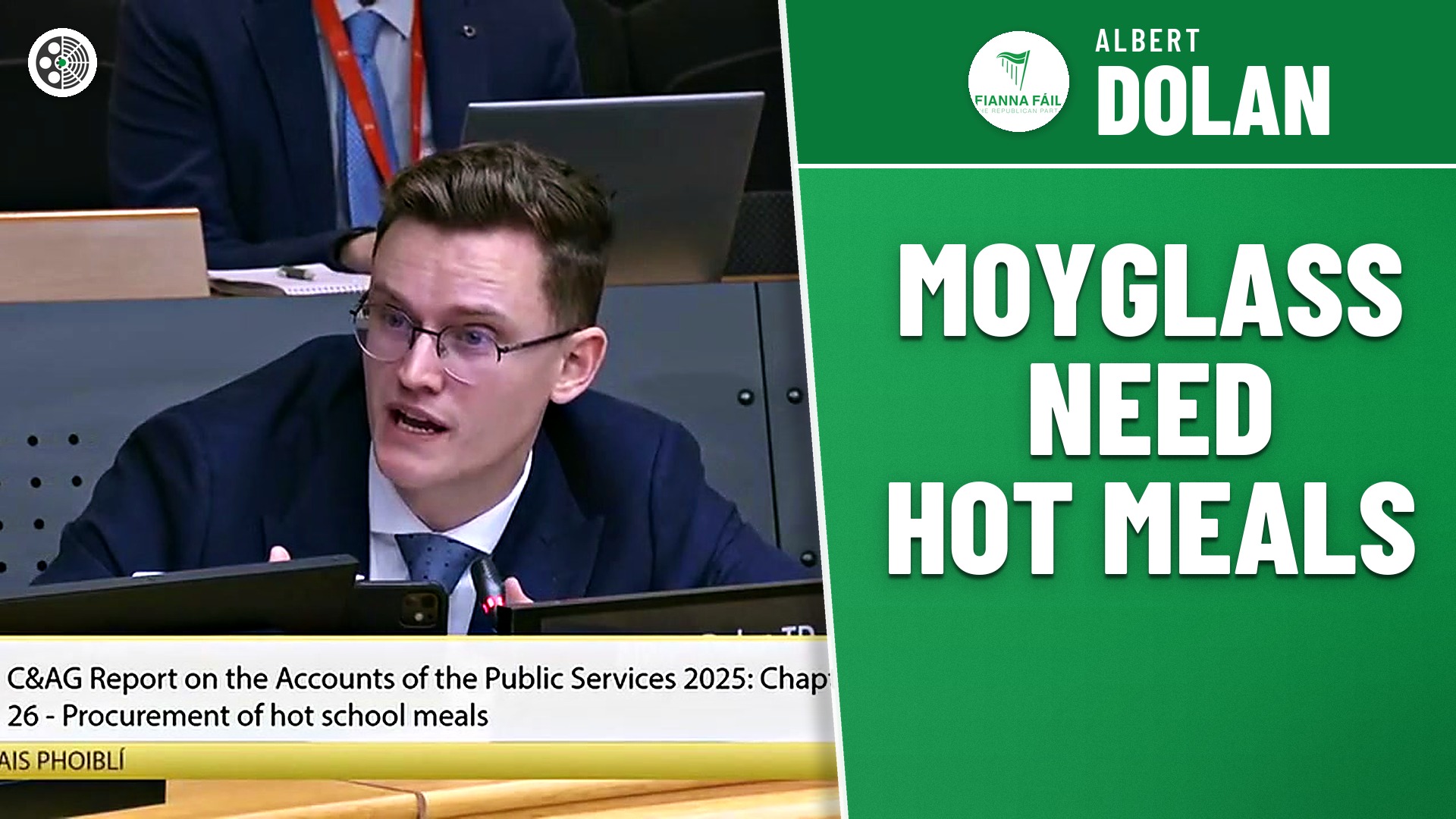


Albert Dolan presses for hot school meals fix in Moyglass
Albert Dolan raised concerns about Ireland’s hot school meals programme during a committee discussion with Department of Social Protection and Department of Education representatives. He questioned the procurement burden on school principals, the concentration of suppliers and meal standards, and asked officials to investigate why Moyglass National School has been without the service since last Christmas.
Dolan said the programme had been rolled out at immense speed and that its problems should be addressed without losing sight of its benefits for children and families. He asked whether the Department had measured the hours principals spend managing contracts, suppliers, food quality, cancellations and invoices, arguing that educators are not procurement experts.
Dolan questioned the concentration of scheme funding among a small number of suppliers, including the estimate that the five largest accounted for 69% of funding and the two largest for about 41%. He said he wanted the programme to create more opportunities for local businesses and asked how smaller suppliers could compete. Department representatives described procurement supports for schools and said tighter rules could favour better-resourced suppliers.
Dolan challenged the use of the same portion size for junior infants and sixth-class pupils, and asked about independent checks on food quality and sourcing. Officials said a standardised menu was being developed, schools and suppliers would be reminded about different portion sizes, and the inspection regime would give the issue greater attention. Dolan also described seeing meals that children did not eat and food waste at schools he had visited.
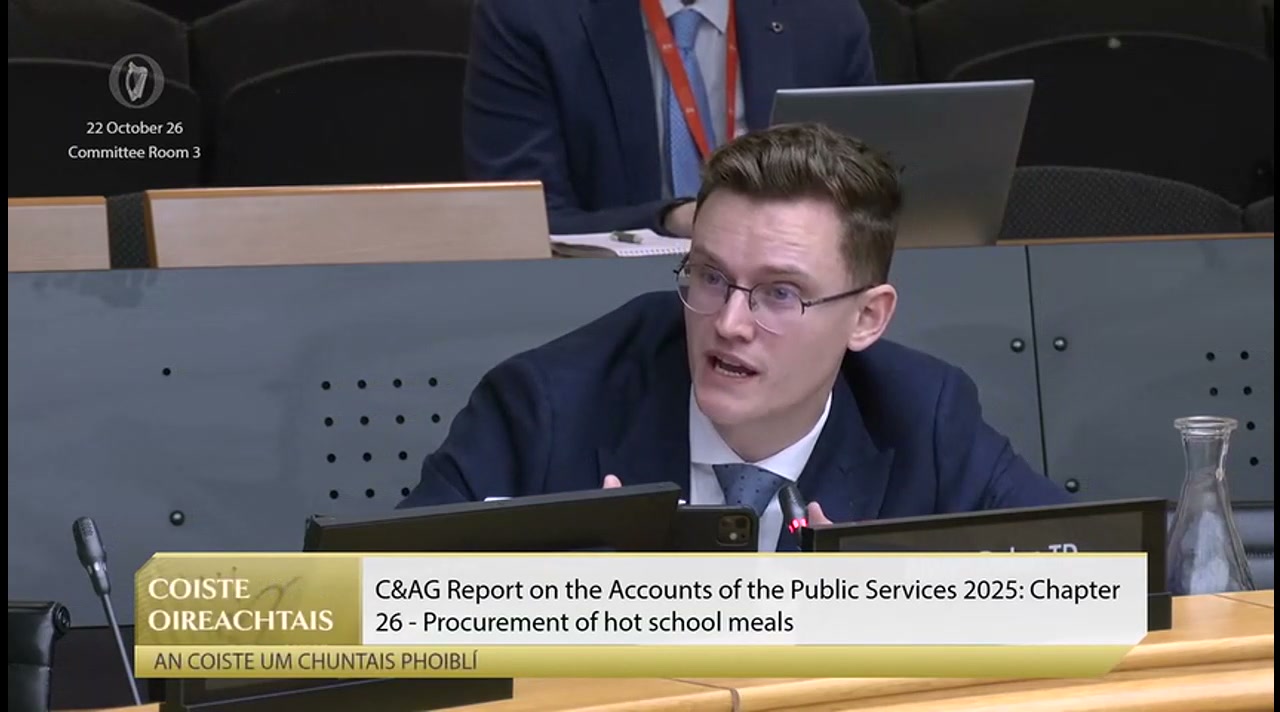
Dolan said Moyglass National School in County Galway had successfully provided hot meals for several years, but lost access to its provider during a change in procurement and delivery requirements. He said children there had effectively been without the service since last Christmas, while nearby schools continued to receive meals under existing contracts. Officials said they would investigate and seek to resolve the situation.
Support for principals
Dolan said the programme had been rolled out at immense speed and that its problems should be addressed without losing sight of its benefits for children and families. He asked whether the Department had measured the hours principals spend managing contracts, suppliers, food quality, cancellations and invoices, arguing that educators are not procurement experts.
Procurement and local suppliers
Dolan questioned the concentration of scheme funding among a small number of suppliers, including the estimate that the five largest accounted for 69% of funding and the two largest for about 41%. He said he wanted the programme to create more opportunities for local businesses and asked how smaller suppliers could compete. Department representatives described procurement supports for schools and said tighter rules could favour better-resourced suppliers.
Portions, food quality and inspections
Dolan challenged the use of the same portion size for junior infants and sixth-class pupils, and asked about independent checks on food quality and sourcing. Officials said a standardised menu was being developed, schools and suppliers would be reminded about different portion sizes, and the inspection regime would give the issue greater attention. Dolan also described seeing meals that children did not eat and food waste at schools he had visited.
Moyglass National School
Dolan said Moyglass National School in County Galway had successfully provided hot meals for several years, but lost access to its provider during a change in procurement and delivery requirements. He said children there had effectively been without the service since last Christmas, while nearby schools continued to receive meals under existing contracts. Officials said they would investigate and seek to resolve the situation.
We publish thousands of recordings to make Irish politics transparent and resistant to manipulation. Spotted an error? Report it — together we are building a reliable archive of Irish politics.
Other speeches
Tego samego dnia All speeches from this day →
Barry Andrews
Barry Andrews asks how party views align with Pope's teaching
Marie Sherlock
Marie Sherlock challenges Government over health service deficit
Sharon Keogan
Sharon Keogan criticises consent campaign on family greetings
Paul Lawless
Paul Lawless challenges consent advert and demands Tusla action
Brian Stanley
Brian Stanley presses Minister on public service pay
Cathy Bennett
Cathy Bennett challenges school meals oversight and supplier payments
Transcript
So Deputy Dolan, 15 minutes.
Thank you very much and thank you to our representatives from the Department of Social Protection and
Education for being with us today to discuss this topic.
We're all going to spend the next few hours talking about everything that is wrong with
the hot school meals programme, but before we delve into that, I do think it's really
important that we remember and are cognizant of the fact that there are children out there
who only for this scheme would not receive a hot meal and I think it's something that
us as a collective should be incredibly proud that our country would make sure that every
child who doesn't have the benefit of maybe a secure family life or for whatever reason
they don't get a hot meal, we just have to keep that to the forefront of our conversation
today.
This scheme has been rolled out at immense speed and when you do something with immense
speed you're inevitably going to make mistakes, you're going to get things wrong and you know
how can we make sure that this gets better going forward and that we're not having this
conversation in a year's time and we're able to have a conversation where we can say do
you know what, those issues got ironed out and that scheme is serving an immense purpose.
Parents I speak to in Galway East, they tell me about the immense cost saving that they've
had in not having to prepare meals for their children for school, so that's a cost saving
for families but it's also a time saving for them as well in not having to prepare
the lunch box in the morning.
These are the real impacts of it but also it treats every child equally in that they
all get access to the same food and the same meals.
So I have a few queries, I'm going to go down through them and look as quickly as you can
answer them, I appreciate it because the time goes quick.
So the first thing I want to talk about and it's something I talk about a lot is around
procurement but this is an interesting one because there's a lot of pressure being put
on principals here who are, let's call a spade a spade, they're not procurement experts.
I'm not a procurement expert, I wouldn't even know where to start if you were deciding to
go out and tender for what could be a very large contract for a school.
So the CNAG's report, it highlights the enormous responsibility that is being placed on individual
school principals and I listened with intent there John, I understand that they are in
their own right contracting authorities so they do have to have some responsibility for
their own management of the contracts but we're asking principals to negotiate contracts,
evaluate suppliers, comply with procurement law, monitor food quality, manage cancellations
and reconcile invoices.
That is a huge administrative burden on principals who are probably, they're educators, they're
not trained to be procurement experts.
So my question is, has the department quantified the number of hours principals are spending
administering this programme?
Direct question, direct answer to the question you have Deputy, but what I would say Deputy
and if you go back to the RSM study in 2023, principals were asked about the devolved versus
the centralised procurement model and they were very clear they didn't want it centralised.
They were very clear that it gave them the ability to make local arrangements with local
suppliers and some of the national suppliers as well, that suited their school.
And I agree with not centralising the procurement on it because what you'll see is, well what
we're actually seeing that 69% of the funds that are allocated, approximately 170 million
are going to the top five suppliers.
So whether it was an intention to centralise it or not, it's essentially been centralised
because those people, those large suppliers are gobbling up the whole market.
So I just want to get to the crux of this.
Like there's no centralised procurement and that's fine, where is the support say for
the principals to make sure that they are above board and that they're not exposing
themselves unnecessarily?
Okay and that's the second point I was going to make Deputy.
We have worked very closely and my colleagues in the Department of Education can probably
cover this in more detail with the schools procurement unit and the Department of Education,
particularly over the last two years to develop standard procurement templates, tenders, contracts,
provided a lot of support to schools, did training webinars with school principals to
give them all the support they need.
So they're not waiting their own tenders, they're not developing their own marking scheme
to assess tenders, they're not waiting their own contracts, all of that is provided to
them.
And so I might ask our colleagues in the Department of Education who can explain in much more
detail than I can, but the approach we took, we did set up an interdepartmental working
group to look at this and to support the devolved model, which is what the schools wanted.
We said that we have to provide support and the best way to do it is to provide centralised
forms and documents and templates that will support the schools.
So we take a lot of the burden off them.
I don't know, Siobhan may want to comment further on this.
Yeah, absolutely, I agree with everything that you've said there, to be fair you fairly
well covered it John.
So Deputy, when we talk about templates, these templates are specifically done for school
meals, they're not generic templates that you can use for any procurement.
So like our priority, you know, from the IDWG or the interdepartmental working group was
to protect schools, you know, from a health and safety perspective and also to ensure
that they're procurement compliant and absolutely, to your point, they're not procurement experts.
So the documentation, while I know it's long, it's a long document, but everything is in
there for the schools with only, you know, the table with the details specific to those
So if a school principal is struggling with it, who do they go to?
Do they go to the Department of Education or do they go to the Department of Social
Protection?
Within the Department of Education, we've a body, the schools procurement unit who sit
in the JMB and they provide procurement support to schools.
So, and this is important now, right?
The Department of Education is providing the procurement advice to the schools on how to
spend the Department of Social Protection's money.
The advice we're providing is in relation to procurement.
Yeah, but, you know, and of course, and I know you have a job to do there to make sure
the schools are not exposing or doing a good job, but just think about that for a second
because I hadn't thought about that.
But it's the Department of Education that's providing the advice on how to spend the Department
of Social Protection's money.
Now, look, it's all the one pot, but at the same time, that could be a risk for the Department
of Social Protection as well.
And I just think you actually might need to get some more clarity on if that's appropriate.
And what I want to move on to now...
I would say on that, Stephanie, that this is all done through the auspices of an interdepartmental
working group, which is chaired by the Department.
We're very satisfied with the competence and capability of the schools procurement unit
and the Department of Education.
And the fact that unit deals with procurement across a number of funding streams, not just
the Department of Education streams, because schools have multiple funding schemes.
So responsibility for overseeing and auditing and managing the procurement practices of
schools is in the Department of Education.
And that's probably appropriate.
It would be, I think, wrong of the Department of Health, the Department of Children, Youth
and Disability...
No, I appreciate that clarity.
Social Protection all have procurement rules for schools.
I appreciate that clarity, John.
Thank you.
The examination estimates that 176 million, or 69% of the scheme funding for 2025-26 was
associated with just five suppliers.
The two largest suppliers account for approximately 41%.
So I'll be honest, that concentration concerns me.
I think this should be an opportunity for that money to get spent in the local economy
and to ultimately have a spin-off effect into local economies, a wraparound economy around
schools.
And I think it's a good opportunity and it's a great intervention by the state.
Why has it emerged that two companies account for 41% of the market?
Well, I think in any industry, definitely, you're going to get some concentration.
That's the nature of business.
It's the nature of competitive practices.
I can argue it both ways, that concentration is a good thing or a bad thing.
On balance, I'd prefer to see less concentration, to be honest.
But I would point out that there are over 300 suppliers, and if you apply the standard
economic measures of concentration to industries, there's two standard ones.
There's what's called the C4 measure, which is the market share, the top four, and the
F&L index.
Both of those would position it as being moderately concentrated.
Just isn't it a set amount per meal that gets paid?
It is, yeah.
So shouldn't all suppliers be, you know, how has it emerged that, you know, obviously they
must be very good at the procurement process or something, but how has it emerged that
two suppliers, if they're offering the same price as a more local supplier, how do they
gobble up so much of the market?
Well, you're asking me to look into the business practices of other suppliers, Deputy.
What we would say and what we would see is that they've invested a great deal of money
in their distribution chains, they've invested a great deal of money in their staffing and
in their production facilities.
So I think when somebody goes to tender and you're asking a supplier, and this is one
of the issues that I think we have to get a balance here, and I know the CNIG has made
some recommendations, but the more you impose procurement rules and constraints on something,
the more likely it is well-resourced suppliers will be able to meet those compared to smaller
suppliers.
And I think we really have to be careful, and we are taking on board recommendations
and we are following them, but I think it is something we need to keep under review.
We don't want to throw the baby out of the bathwater and create a situation through imposing
more restrictive procurement practices, which ultimately just lead in better resourced firms.
And I understand where you're coming from.
I just, I do hope that it becomes more of a spin-off for local businesses across the
country.
And I accept that you've said there's 300 suppliers.
I want to move on to the next point.
I'm just conscious of the time.
I'm just caught on time.
So I do apologise.
Thank you.
The contract requires suppliers to provide healthy, nutritionally balanced meals, preferably
freshly prepared from raw ingredients, but the CNIG found that the department does not
have comprehensive information on portion sizes, and that suppliers generally provided
the same portion size, and I know this colloquially from visiting schools, it's the same portion
size for a junior infant as it is for a sixth class.
And a sixth class child is going to be twice the size of a junior infant, and they'll have
different nutritional requirements.
So how does that make sense?
Actually, we don't believe that it makes sense either, Deputy.
We've always said that there should be different portion sizes, and that should be one of the
things that's taken into account when a school is procuring the meals.
We have taken on board that feedback and indeed from our own research, and we are in the process
of putting together a standardised menu, that's the first thing, which will operate from next
year on a three-week cycle.
Did that come off the back of the nutritional review?
It did, yeah.
And we're also writing to the suppliers and the schools in the next couple of days, reminding
them of their obligations to make sure that they can provide different portion sizes,
that the school should look for it first, and the suppliers, when it's looked for, should
supply it.
And that will be a more rigorous part of our investment of our inspection regime next year.
We'd be looking for confirmation of that.
You know, so we've identified that 41% of the market, or 69% of the market, accounts
for the two or five largest suppliers.
Is there any independent checks and balances going into the quality of the food, the sourcing
of the food that goes into these meals?
Well, they are food production or food service companies that are subject to the same rules
and regulations that every food service provider in the state is.
So you have the Food Safety Authority regulations, the Department of Agriculture regulations,
the Department of Health regulations.
Have you had any reports back to you, from the Food Safety Authority, of issues with
any suppliers?
Or have any suppliers had to cease operations because of food safety concerns?
Well, there have been one or two cases, and there was one reported in the newspaper this
week, which you'll be familiar with, Deputy.
And they are a concern to us, and we do contact the supplier, and that supplier has closed
that hub where there was an issue, and they've moved to a different hub.
It's not to be unexpected in this situation, where actually when you take in the other
meal options, we're doing three and a half million meals a week.
It's going to happen that at some point, some of that food will be contaminated.
They are subject to inspections by the Food Safety Authority, and like any food service
operator, and as you know, Deputy, there have been some of the highest class restaurants
in Dublin, I think, you know, found to be...
I know, but hold on, I know, and I know where you're coming from, but like, it's just important
to say that like, parents trust, parents place their trust in the schools that they're going
to mine their children.
They place their trust that the schools have done their due diligence, and again, I come
back to the pressure that's on a principal here.
There's pressure on them that they've done their due diligence, that the supplier that
they've chosen to go with in good faith is going to provide quality, nutritious meals,
and I have visited schools, and I have seen great examples, and I've heard great feedback
about some of the schools, and then I've seen really bad examples.
I've seen these little pasta dishes, and it was horrible, and then I saw that the principal
showed me the amount of waste that they had accumulated from children not eating it, and
then the parents were just, ended up giving them lunch as well, and a lot of the children
weren't eating the meals.
Like, that does happen as well.
I think it's important, Deputy, when you say that, and there are examples like that, and
you're right, but I think it's important when you say that, that we shouldn't damn the good
because it's not perfect.
100%.
And what you said at the beginning, if you look at the feedback from the survey and the
nutrition report, you're looking at 80% plus of meals meeting standards.
You're looking at 80% plus of parents and teachers saying that the foods are healthy
and nutritious.
So how are you going to get that up to over 90%?
Well, that's a matter, and this is something we are talking to the schools about.
This is a matter for the procurement officers in the schools, the principals, as you say,
to enforce the standards with, first of all, with their supplier, to give the feedback
to the suppliers.
Most of the schools, most of the principals...
I apologise, I have 30 seconds, so I have to get one last point in, because John will
stop me.
I thought about the inspections.
I have to get one last point in.
We do 500 inspections a year as well, Deputy.
My Glass National School in County Galway, it would be remiss of me if I didn't get it
in, for several years, the school successfully provided the hot meals.
It's a GESH school, it's a small rural school, and the school heated the meals itself, and
the arrangement worked well.
However, last year, while the school was changing its catering provider, the new procurement
and delivery requirements were introduced.
Under those requirements, providers were expected to heat the meals on site and collect the
waste daily.
Because My Glass was between contracts when the rules changed, it lost access to its hot
meal provider.
So, nearby schools, just a few kilometres away, have continued receiving meals because
they had existing contracts in place before the changes.
I appreciate this, Chair.
The consequence is that the children in My Glass have been effectively without a hot
school meal service since last Christmas.
Can that please be investigated?
I'll take that away and look at it.
That shouldn't have happened, Deputy, and one of the things that was pointed out in
the chapter was that concern that we told schools, either keep your existing supplier
in that situation, or do a very quick procurement process by calling three, and make sure that
And I will just say, in fairness, I know the department has been trying to solve this problem,
and I know you're trying to solve it, because I've been writing to you and contacting you,
and I know you've been in contact with the principal, but I would just ask, please, it's
unfair.
That's a Jesh school where the children really, really do need that service, and they've been
without it since Christmas.
That's not fair on them, so I'd ask you to go back.
Absolutely, Deputy, and there are mechanisms that could have been used, and we are looking
to resolve that.
And I know we got some criticism about some of the mechanisms, but it was specifically
because we were concerned about schools like that, that we said, call three suppliers,
get a quote, and go with that, or continue with your existing supplier until you have
time to run the new procurement.
It was exactly to avoid that situation.
So I'm surprised it happened in my class.
We're looking into it, and we'll sort it out.
I appreciate that.
Thank you.
Thank you, Deputy.