



Richard Boyd Barrett challenges Cherrywood housing plans
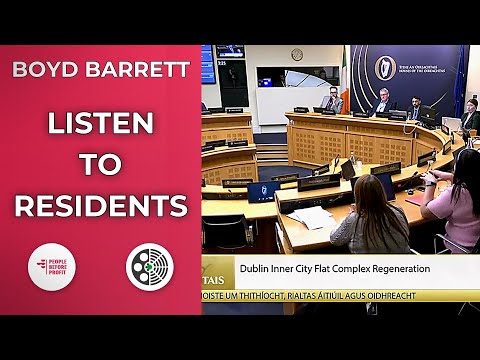
Richard Boyd Barrett questioned Dún Laoghaire-Rathdown officials about the shortage of three- and four-bedroom homes and plans for publicly owned land in Cherrywood. During the exchange, he also raised the situation of working people who qualify for neither social housing nor cost rental.
Richard Boyd Barrett asked Frank Curran why recent housing developments had provided so few three- and four-bedroom homes, citing family homelessness and the long wait for larger homes. Curran said the council planned to increase the share of three- and four-bedroom homes in its next housing delivery programme, and that 40% of its existing stock had three or four bedrooms.
Boyd Barrett challenged the proposed development of DLR Properties’ Cherrywood land, arguing that publicly owned land should be used to deliver social and affordable homes rather than be handed to private developers. Curran said the remaining area was planned for a mix of uses, with at least 20% of its homes to be social and affordable, and that the share could be higher.
Richard Boyd Barrett asked Frank Curran why recent housing developments had provided so few three- and four-bedroom homes, citing family homelessness and the long wait for larger homes. Curran said the council planned to increase the share of three- and four-bedroom homes in its next housing delivery programme, and that 40% of its existing stock had three or four bedrooms.
Boyd Barrett challenged the proposed development of DLR Properties’ Cherrywood land, arguing that publicly owned land should be used to deliver social and affordable homes rather than be handed to private developers. Curran said the remaining area was planned for a mix of uses, with at least 20% of its homes to be social and affordable, and that the share could be higher.
We publish thousands of recordings to make Irish politics transparent and resistant to manipulation. Spotted an error? Report it — together we are building a reliable archive of Irish politics.
Other speeches
Tego samego dnia All speeches from this day →
Barry Cowen
Barry Cowen urges a real plan to close the CAP funding gap
Tom Clonan
Tom Clonan says Ireland is failing disabled citizens
Peadar Tóibín
Peadar Tóibín says Finance Bill ignores real lives
Jim O'Callaghan
Jim O'Callaghan backs united response to drug intimidation
Micheál Martin
Micheál Martin sets out plan to strengthen competitiveness
Paul Murphy
Paul Murphy presses for Riverview school extension
Transcript
Thanks. Thanks. Yeah. Frank, if I could just ask Frank Curran a few issues. We've obviously
made some progress, Frank, in the last while with the delivery of social and affordable
housing, but an issue which I think is a big problem and I just would like you to comment
on it is three and four bedroom accommodation, and the fact that a lot of the developments
that we seem to have have either no three or four bedroom accommodation units, homes,
or very little, and certainly it doesn't seem to be proportionate to the need and demand.
One of the most horrible things about the housing crisis and the homelessness crisis
is child and family homelessness. It's one of the most horrible and unacceptable aspects
of the crisis. Every aspect of the homelessness crisis is unacceptable, but for children
to be stuck in homelessness is utterly unacceptable as far as I'm concerned. But when you look
at what we're delivering, some of the new developments in Woodbrooke, for example, the
LDA cost rentals, no three or four beds. In Woodbrooke Gate, 359 homes, only 10 three
beds, no four beds, and I haven't got time to list off the stats, but we're not delivering
three and four beds, and something has to be done about it as far as I'm concerned.
So I'd just like to hear your comment, and in particular, in that context, I find it
very, very alarming and frankly unacceptable that a subsidiary, a corporate subsidiary
of Dunleary Wrought Down DLR Properties, with zoned land in Cherrywood for more than
1,000 units, is effectively selling that land off rather than using it to deliver family
social and affordable accommodation, which could meet that demand. And I can't understand
why the council would do that. So I'd like to hear from Dunleary Wrought Down why they
think they should do that rather than control it themselves and deliver the three and four
bed units that we desperately need to address, particularly child and family homelessness,
which is not being addressed. And I think, of course, the reason it's not being addressed
is because private developers, when they're building, or even it seems the LDA, want to
concentrate on one and two beds because they can get more units on site, and they seem
less interested in building three or four beds for families that are either homeless
or stuck. And if you're on a RAS transfer list, for example, in Dunleary, you'll be
on it for 18 years on average, 18 years. So I'd just like to hear your response on that,
Frank.
Thanks, Ciarán. So look, the three and four beds, it is an issue, and it's, you know,
you're right, a lot of delivery in the last number of years has been one and two beds.
That, again, is a function of the turnkeys and the private sector delivery through part
fives and the competitive dialogue that's coming through. It's something that we certainly
wish to address, and we're doing our new housing delivery targets now with the department,
so we'll be increasing the amount of three and four beds in that sort of policy that
we'll be putting forward, and we'll meet that in terms of the increased number of three
and four beds. Now, our existing stock, of course, is 40% three and four beds, so we
are looking to our housing as SBC, a right-sizing policy, where if people don't need three and
four beds, they can move to a smaller house in the same area. But look, it's something
we're very live to. We will be increasing the number of three and four beds over the
next housing delivery programme to address that very issue. And DLRP, DLR Properties,
is a company, a standalone company with its own board and staff that took over commercial
office buildings and strategic development land in Cherrywood. Now, they've been very
successful in bringing some of those offices back to HSE, for instance, is building a primary
care centre there shortly. They've leased and sold a lot of the properties. They are
looking at another area now that is a combination of employment, zoned retail, civic, library,
leisure, open space, and residential. So the residential there will definitely get 20%
social and affordable. There's no question about that. That's laid down in legislation.
But there may well be, you know, the LDA may well get involved there and deliver more affordable
units. There may be an AHB get involved. For instance, in other areas of Cherrywood, there's
two schemes now, 200 units each, which are going to be all social, that have come forward
through our competitive dialogue process. But as a general rule, in the whole Cherrywood
area, we want a mix. We want a mix of private, affordable, and social. And the private development
does give us development levies, because Cherrywood is a strategic development zone.
There's a lot of infrastructure built. For instance, Lewis was in there before any development.
There's an extensive road network that has to be built to facilitate all these. There's
the parks, there's the open spaces, a lot of parks are completed.
Frank, if I'm just given the time that's available, okay, I hear you. But to be honest, I just
want to really, to my mind, we don't need unaffordable houses in Dún Laoghaire. And
you just said why earlier, right? The prices are off the charts. They can't be afforded
by ordinary workers. Now, why when we have a site where you are the single shareholder,
right, and you as the chief executive are the single shareholder, why on earth would
we give a site that could deliver 1,000 homes over to private developers who aren't going
to deliver 100% either social or genuinely affordable homes, and when we've admitted
that the private developers have a tendency to deliver stuff that's too expensive and
that's one and two bedroom, when we need stuff that's cheaper and includes more three and
four bedroom? Like, it doesn't make any sense to hand that over to a private developer.
And I just cannot understand why the council would possibly do that.
It's a separate company. It's got its own board. It's working through what was originally
a distressed asset. It's almost air, if you like, in that a lot of the employment uses
are now in use for employment. The area that's remaining, as I say, is a combination of retail,
employment, civic, library, leisure, open space, and housing. So the housing, as I say,
20% will most certainly be social and affordable, probably more than that. In a lot of cases
when we do part five agreements, it's kind of part five plus where we're taking 30 or
40%. On a public asset, why would we take 20% or
maybe a bit more when we could take 100%? Seriously.
You say it's an area that's being developed by a company, a company limited by guarantee
to a certain number of years. It's a publicly owned company, Frank.
Sorry, it's a company that was set up with its own board and its own staff to develop
that area. And that's what it's doing. And it's done a very good job in doing that. And
this last remaining area, there's been more residential zoned as part of the review of
the Cherrywood Strategic Development Zone. But it will be developing the residential
in line with all the other uses that I mentioned. And they would make, that board would make
some very decisions for the right reasons for that particular area of land.
In the last 20 seconds, just want to say, Frank, I believe it's unacceptable. I don't
believe the state should be giving away land that can deliver public and affordable housing.
I just want to say that. And I intend to challenge that all the way.
Just one last question is, like today I had people on to me, but I have them every week
I raise this, of people who are working people. Today a couple, he's earning about 43,000
before tax as a HGV driver. His partner is earning about 23,000 or 4,000 as a hairdresser.
They earn too much between them to be on a council list. But they've now discovered they
earn too much to get the cost rental, which is just coming on stream in Woodbrooke. And
this is happening again and again and again. People earn too much to be on the social housing
list, but too little to avail of cost rental. Would you accept that that's a big problem
and that the government have to address that, and that that cohort of working people who
are left in absolute limbo, they can't get a mortgage, they can't get on the cost rental,
and they can't get social housing. And something has to be done about it. And would you see
it as a problem?
I'll ask Gerard to come in there. But that cohort you're referring to, you would be looking
at affordable housing, if at all possible. So we would be setting down with a couple
in that situation. And we don't set the limits for cost rental, as you know, and for social.
So there's nothing we can do there, really. But they do sound like a couple that could
get a mortgage, that could look down the road at affordable housing.
They're 56.
So it's something that we would be looking at. But we can't change the limits for cost
rental. Gerard, do you want to come in there?
Yeah, we do have a strong pipeline of affordable purchase coming down the stream. Look, it
is a net household income of 66K. And we have to work in the parameters of the scheme.