

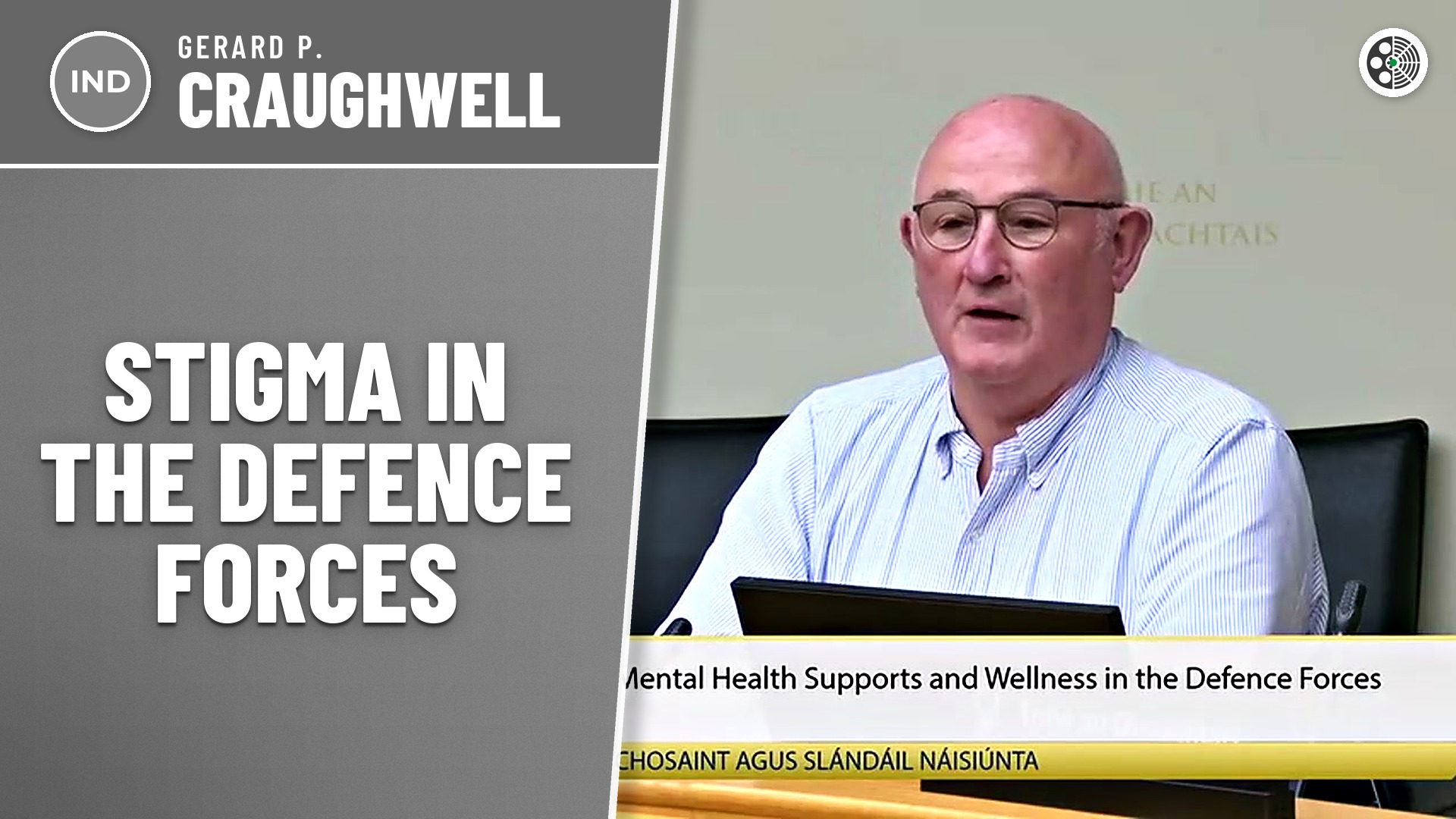


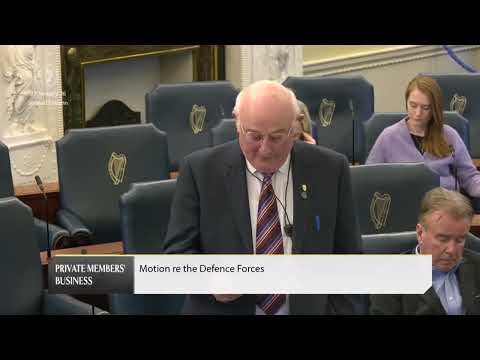
Gerard P. Craughwell questions stigma in the Defence Forces
Gerard P. Craughwell questioned Defence Forces witnesses about the impact of stigma and public scrutiny on serving members’ mental health during a committee hearing. He also challenged the publication of the Independent Review Group report and asked how training, culture and morale have changed.
Craughwell asked whether serving members were making decisions under heightened scrutiny and what effect recent public attention had on their mental health and the organisation. He also asked whether training had changed in response to that scrutiny.
A Defence Forces witness said negative publicity had prompted the organisation to examine its culture. The witness referred to the Cultural Standing Committee and training and education initiatives, and said the current leadership was committed to a healthy culture that included mental health and wellbeing.
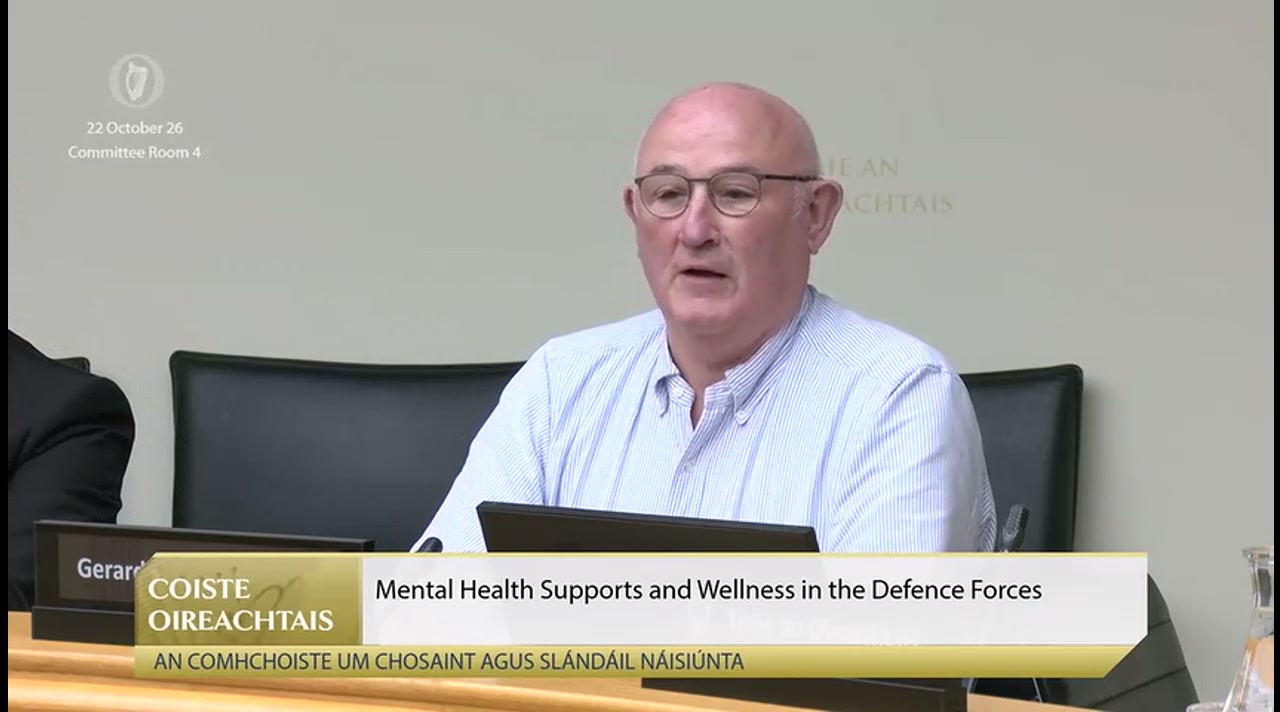
Craughwell asked whether serving members were making decisions under heightened scrutiny and what effect recent public attention had on their mental health and the organisation. He also asked whether training had changed in response to that scrutiny.
A Defence Forces witness said negative publicity had prompted the organisation to examine its culture. The witness referred to the Cultural Standing Committee and training and education initiatives, and said the current leadership was committed to a healthy culture that included mental health and wellbeing.
We publish thousands of recordings to make Irish politics transparent and resistant to manipulation. Spotted an error? Report it — together we are building a reliable archive of Irish politics.
Other speeches



Tego samego dnia All speeches from this day →
Sharon Keogan
Sharon Keogan criticises consent campaign on family greetings
Michael McNamara
Michael McNamara: Europe Must Talk to China on AI Governance
Marie Sherlock
Marie Sherlock challenges Government over health service deficit

Michael McDowell
Michael McDowell condemns state-funded grandparents advert
Jennifer Carroll MacNeill
Jennifer Carroll MacNeill backs CHI inquiry commission
Brian Stanley
Brian Stanley presses Minister on public service pay
Transcript
Thank you very much. I want to thank the witnesses for being here this morning.
First and foremost, I want to acknowledge that it is a disciplined organisation that you work in.
Doctor, you made the point that when you're assessing the mental health of people
who are in possession of live ammunition and weapons, lethal weapons and that,
it's a very different situation than any other walk of life.
And having to downgrade somebody so they cannot carry a weapon, for example,
or they can't serve overseas or something, I'm sure that's a massive question
every time when you're dealing with it.
That leads on to the issue of confidentiality.
It is very hard in a closed organisation to show that Joe Bloggs has been downgraded
with respect to active service for the time being, and it's very hard to hide that.
So I understand the constraints that you work within.
My real issue is the issue of stigma and the stigmatisation that has taken place
of the defence forces in general.
And this is something that comes to me anecdotally and sometimes it comes to me
by way of correspondence, where people feel that as a result of their service
in what should be the proudest organisation in the country,
they feel that they have been singled out, particularly as a result of,
and I'm on record of saying that I believe the publication
of the independent review group report was folly in my view.
It should never have happened.
It should simply have been a question of a prima facie case has been made
and we go to a tribunal or whatever to establish facts.
Because the information that's in the public domain is unchallenged evidence.
It has never been challenged in any format.
So let's wait for the outcome of the tribunal.
But my concern is what is the impact on the overall mental health
of the serving members today?
Are they looking over their shoulder all the time in every decision they make
because they have been put under extreme scrutiny?
And as we have seen with the ambulance service, for example,
some of the things that have emerged through the independent review group
are not uncommon in other organisations.
And in fact, the Defence Forces probably mirrors society in general.
And so I'm interested in the impact that has had on the organisation
and particularly when it comes to training.
Somebody once said to me, if you're going to sign up to the Defence Forces,
you should look at full metal jacket before you go.
There is robust training, there has to be.
So I'm just wondering, has it changed everything?
Look, obviously there has been a period of time here in recent years
where there has been negative publicity surrounding the Defence Forces.
And that has led to the establishment of the tribunal, among other things.
And it has led us to look at ourselves as an organisation
and examine our culture and realise that there is certainly a job of work to be done.
And we are doing that.
And the Organisation of the Cultural Standing Committee
and other initiatives, training and education initiatives that we roll out
are certainly helping to make that change.
The current leadership in the Defence Forces is absolutely committed
to having a healthy culture throughout the organisation.
And that encompasses mental health and wellbeing.
Certainly I think there has been, as an organisation,
those of us who serve in it are very proud of it.
Did the organisation take a hit? Yes, in terms of their standing.
Did we react positively to that and proactively? Yes, we did.
And we are continuing to do so.
And I think we are in a much better place than we were
from a cultural perspective, from a behavioural perspective.
And remember, the tribunal that is currently sitting is looking at systems,
not necessarily individual cases.
And I think from a systems point of view, we are in a much better place and going forward.
And we are not finished developing that.
The grievance management system is still under development.
And we have an interim grievance management system.
That will develop now shortly.
And I think that will serve the Defence Forces well into the future.
But I think that the morale in the Defence Forces is certainly improving
in the last couple of years.
I think we are seeing recognition for perhaps failures in the past.
But looking forward with a positive outlook.
Thank you very much.
I will say that those veterans that contact me have remarked on the change
that they are seeing from outside.
And I compliment you for the efforts you are making to change the culture of the organisation.
Thank you.