

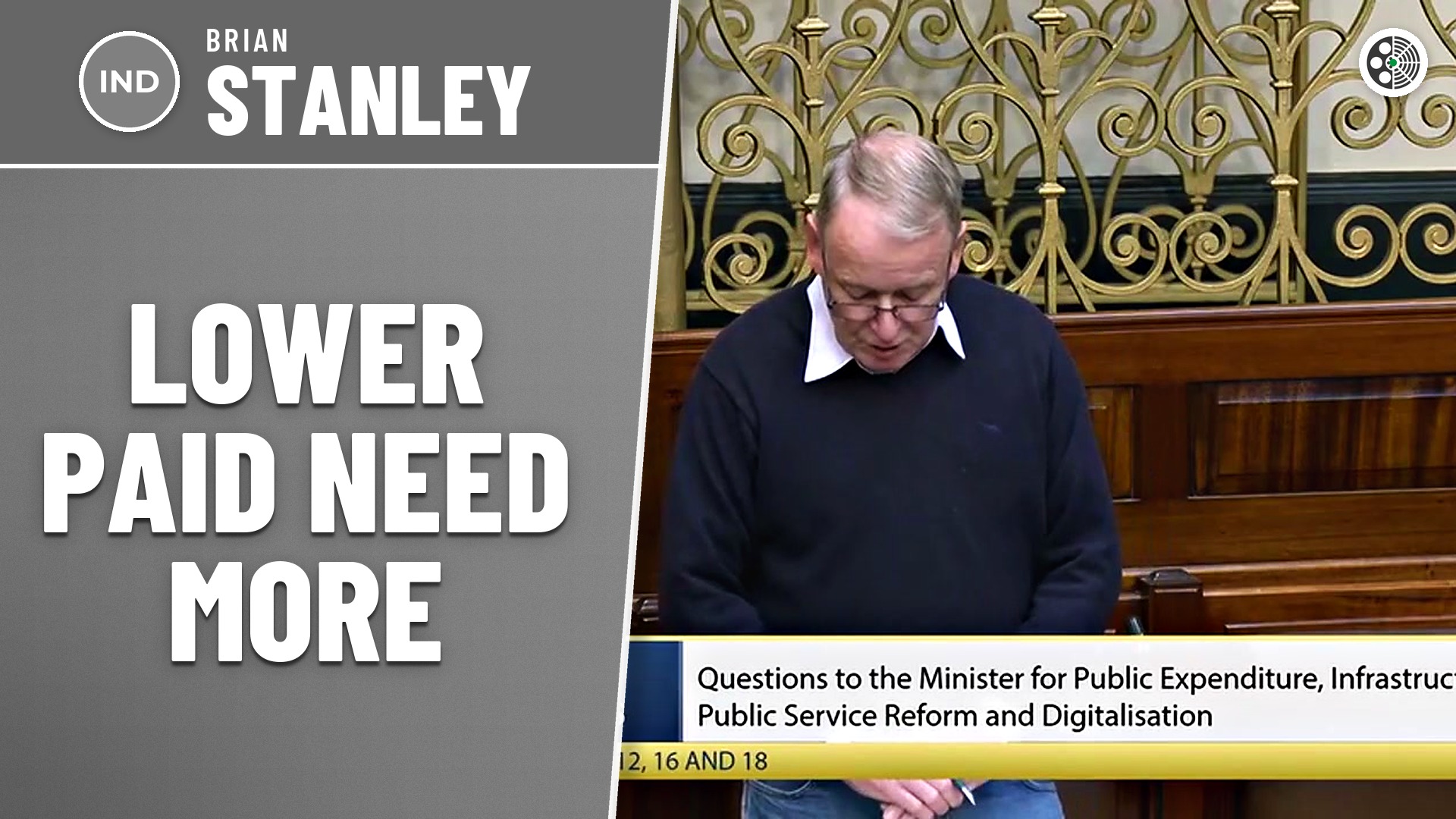


Brian Stanley presses Minister on public service pay
Brian Stanley asked the Minister whether the 1.2 billion budgeted for public sector pay increases in 2027 would be enough to address inflation and reach a sustainable settlement with public service unions. During an Oireachtas exchange on public service pay negotiations, he also urged the Government to prioritise workers on the lowest incomes and raised delays in replies from Government departments.
The Minister said formal talks on a successor public service pay agreement had begun at the Workplace Relations Commission after engagement between the Government and the Public Service Committee of ICTU. The Government had made significant provision in Budget 2027, the Minister said, but would not discuss figures or issues under negotiation while the process remained confidential.
Stanley pointed to rising costs for public transport, rent, fuel, home energy and mortgages, and asked whether the planned provision offered enough headroom. He argued that any settlement should deliver a greater benefit to workers on the lowest incomes, including those in local authorities and across the public service.
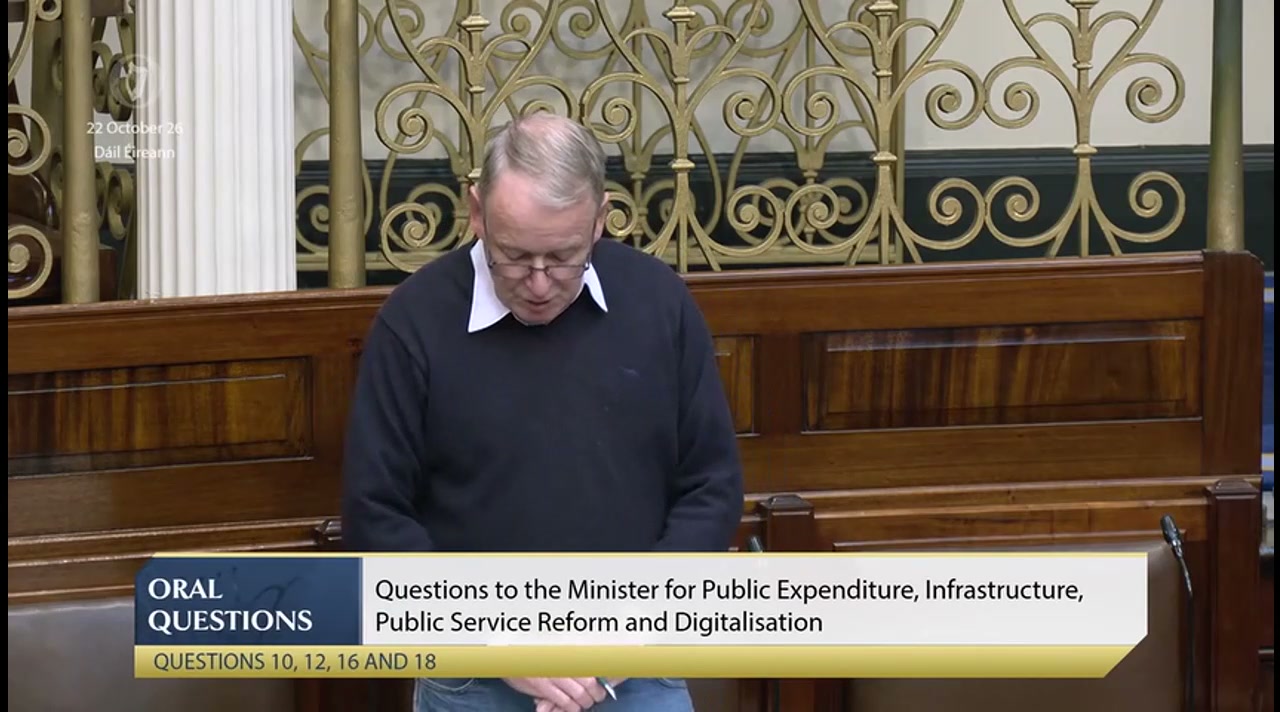
Stanley said he and other Deputies had received replies from Government departments six months after submitting questions or letters. He recognised the work of frontline public servants, while arguing that speeding up departmental responses should be part of the productivity discussion.
The Minister cited the previous public service agreement, saying it delivered cumulative pay improvements of 9.6% against cumulative inflation of 6.6%. He said the Government wanted a fair and equitable successor agreement that was also sustainable and affordable for taxpayers, with productivity and reform discussed as part of collective bargaining.
Pay talks and budget provision
The Minister said formal talks on a successor public service pay agreement had begun at the Workplace Relations Commission after engagement between the Government and the Public Service Committee of ICTU. The Government had made significant provision in Budget 2027, the Minister said, but would not discuss figures or issues under negotiation while the process remained confidential.
Inflation and the lowest-paid workers
Stanley pointed to rising costs for public transport, rent, fuel, home energy and mortgages, and asked whether the planned provision offered enough headroom. He argued that any settlement should deliver a greater benefit to workers on the lowest incomes, including those in local authorities and across the public service.
Departmental response times
Stanley said he and other Deputies had received replies from Government departments six months after submitting questions or letters. He recognised the work of frontline public servants, while arguing that speeding up departmental responses should be part of the productivity discussion.
The Minister cited the previous public service agreement, saying it delivered cumulative pay improvements of 9.6% against cumulative inflation of 6.6%. He said the Government wanted a fair and equitable successor agreement that was also sustainable and affordable for taxpayers, with productivity and reform discussed as part of collective bargaining.
We publish thousands of recordings to make Irish politics transparent and resistant to manipulation. Spotted an error? Report it — together we are building a reliable archive of Irish politics.
Other speeches
Tego samego dnia All speeches from this day →
Jennifer Carroll MacNeill
Jennifer Carroll MacNeill backs CHI inquiry commission
Mattie McGrath
Mattie McGrath challenges South Tipperary water response
Martin Daly
Martin Daly questions oversight of hot school meals scheme
Sharon Keogan
Sharon Keogan criticises consent campaign on family greetings
Michael McNamara
Michael McNamara: Europe Must Talk to China on AI Governance
Albert Dolan
Albert Dolan presses for hot school meals fix in Moyglass
Transcript
I can put the question, yes. So the question I'm asking the Minister here is in regard
to what's budgeted for public sector pay increases over the next couple of years, and for 2027
the £1.2 billion, is it sufficient when taking into account the inflationary pressures that
are out there, and does he believe that that's adequate to reach a sustainable settlement
with public sector unions? Thank you.
A group was appointed by government, as you know, on Friday to undertake a focused and
intensive exercise with the parties aimed at constructing a basis for formal negotiations
at the Workplace Relations Commission. Following positive engagement between government and
the Public Service Committee of ICTU over the weekend, a basis for negotiations and
new public service pay agreement has now been established. I want to express my thanks to
Mr Kevin Foley, Eoin Reedy and Una Buckley for their work which has enabled the parties
to progress into formal talks on a successor public service pay agreement. These talks
began on Monday under the auspices of the WRC. This marks an important stage in efforts
to advance discussions on a new agreement. It creates an opportunity to move discussions
forward in a focused and productive manner. Continued constructive engagement through
dialogue will be important in supporting progress in the period ahead. There are issues of importance
to both sides that they wish to discuss as part of these negotiations and the process
should facilitate a genuine exchange in those matters. Government considers that agreeing
a new public service pay agreement is the best way to provide clarity, predictability
and certainty for our public servants and government is committed to our system of collective
bargaining in the public service. We see the value in continuing a system that has successfully
delivered fair and balanced outcomes for public servants and taxpayers alike while supporting
sustained improvements in public service pay. We greatly value the work carried out
by public servants across the country through their efforts in front line and public facing
services as well as the supporting roles that make a massive and significant contribution
to the wellbeing of individuals, communities and the wider economy. Just to say, given
the confidential nature of the process, it's not appropriate to comment on specifics of
any of the issues raised during the negotiation period. We have obviously set out what was
allocated to your question, Deputy Stanley, made significant provision for this in Budget
2027 and that is in the context of many other measures which will help make a difference,
particularly in cost of living for all workers in the economy, but I'm not going to get into
specifics today and I can't. I know people respect that as well because as we speak,
discussions are ongoing at the WRC.
I'm going to say it just in reply to you that the question of the £1.2 billion, I think the
feeling is there is that it's not deficient and you might just outline in terms of what
headroom there is. I don't expect you to give the details of, you know, of figures, you know,
where negotiations are at because obviously it has to be cost confidential, but there's
substantial pressures out there in terms of rising costs, public transport, rent, fuel,
home energy, mortgages, all double digit increases, Minister. We no longer have single
figure increases in this country, double figures. And just in relation to productivity, the one
thing that I would say to you there is that public servants are doing great work, but one
of the things we do need to get is that we speed up replies from government departments.
I've received, and I'm sure other deputies have, received replies six months after a
question has been to a government department or a letter is sent in and that's not sufficient
and it wouldn't be adequate anywhere. So I would ask maybe that that was, that should be a
central issue in terms of productivity, but just to recognise the good work done by public
servants, I think that we need to make sure that those on low and middle incomes, if you're
reaching a settlement, you know, I'm sure the unions will push the switch, that those below,
those in the middle and at the very bottom, grade three, they're the ones that need a higher
percentage increase. So look, I think our record is clear. If you take the last public service
agreement from 24 to 26, we delivered cumulative pay improvements of 9.6% compared with cumulative
inflation of 6.6%. And that was achieved through the collective bargaining process and demonstrates
that the established framework can and does deliver real benefits for public servants.
We want to ensure that we have a new pay agreement that's fair and equitable for public
servants, and that's important, but also sustainable and affordable for the taxpayer.
And that's obviously, that's part of the broader negotiation process. Deputy Stanley, you raised
the issues of productivity of, in every public service pay agreement, government, as the state,
as the employer, seeks to advance and have a genuine and productive discussion with respect
to wider issues around and priorities around productivity and reform. And that's understood
by the trade union side as well. And that's the process of collective bargaining as well.
So look, we want to ensure we have a pay deal. You know, we're in the middle of a confidential
process, so I'm not going to provide any more detail except to say we made significant provision
for a public sector pay deal and prioritised it in the budget, and prioritised in the context
of moderating day-to-day spending in 2027. And obviously, we want to see a successor agreement
happen. You know, we've listened to public servants around what they've expressed last
week, and government has been consistent throughout the last number of weeks and months
that we want to have a successor pay agreement. So look, I, just with respect to the specific
question, Deputy Stanley, like there will be key performance indicators in each government
department as it stands around response to different, with respect to different replies.
There may be complexity about, with a particular issue that you raised that they haven't been able
to provide an answer, but whatever line minister is involved there, you should ask them about it,
and you know, you shouldn't be waiting months, or indeed your constituents shouldn't be waiting
months for a reply to an important issue. Deputy Stanley. Your reply. I recognise that
some public servants don't have any more to give, particularly ones who are working in the front
line, but I think, you know, and I'm not saying in every department, but I certainly have had
the experience, and I've heard it from members on all sides of the House in terms of delays with
getting a response. Could I just say, and I want to recognise that, you know, the front line staff
out there in general, a lot of them don't have any more to give. It's important though, the key
point I would make to you is this, is that we have to, we have to ensure that those who are on the
lowest incomes in the civil servant, in civil service and public service across the board,
whether it be local authority or whoever else, that we try and benefit them the most in terms
of any pay increases. There has to be, you know, a percentage increase across the board means a lot
for somebody on a high pay. Somebody on a low pay, it doesn't, it can mean very, very little.
I think that's very, very important, and I would just ask that, I mean, it's good that there's
no talks, you know, obviously it has to be sustainable. I hope that a fair outcome can
be got, and we just ask government to keep their eye on that end, that element of things, and
try and make sure that we improve on what's there across the board in the public service.
Thank you both for your comments. What I'd say is that that wasn't what held up. There
were preliminary discussions, and then we had a process of balloting for industrial action,
rather than continued discussions. Look, I think I can only speak to the last agreement,
and Deputy Stanley's raised the issue of the lowest paid, and I think that,
you know, that was an important piece of the last agreement, and indeed previous agreements as well,
but obviously we've, talks are underway with respect to the most recent one. And Deputy
Stanley, just on the point of course, the state as the employer has to, you know, put forward areas
in a genuine and constructive way in respect to every pay agreement around reform and productivity,
and it's done to actually, I think it's in everyone's interest, both the service user
and the work, many workers who have ideas as well of it, how they can, how our inputs are,
and how they believe they can deliver a better system for everybody, indeed in terms of their
workplace, which is, so it's not just, it isn't a, you know, we shouldn't just frame it in a negative
way, it's in a positive way to deliver better public services with an overall expansion of
public services, how can they be reformed, and it's a site for pay agreements. We always need
to keep the focus on reform, on more efficiencies, so that the people we all represent see more from
the overall level of spend, and that's very much distinct from pay agreements, which are done on a,
you know, in different calendar cycles, we need to ensure that that's a constant focus, and it is.