

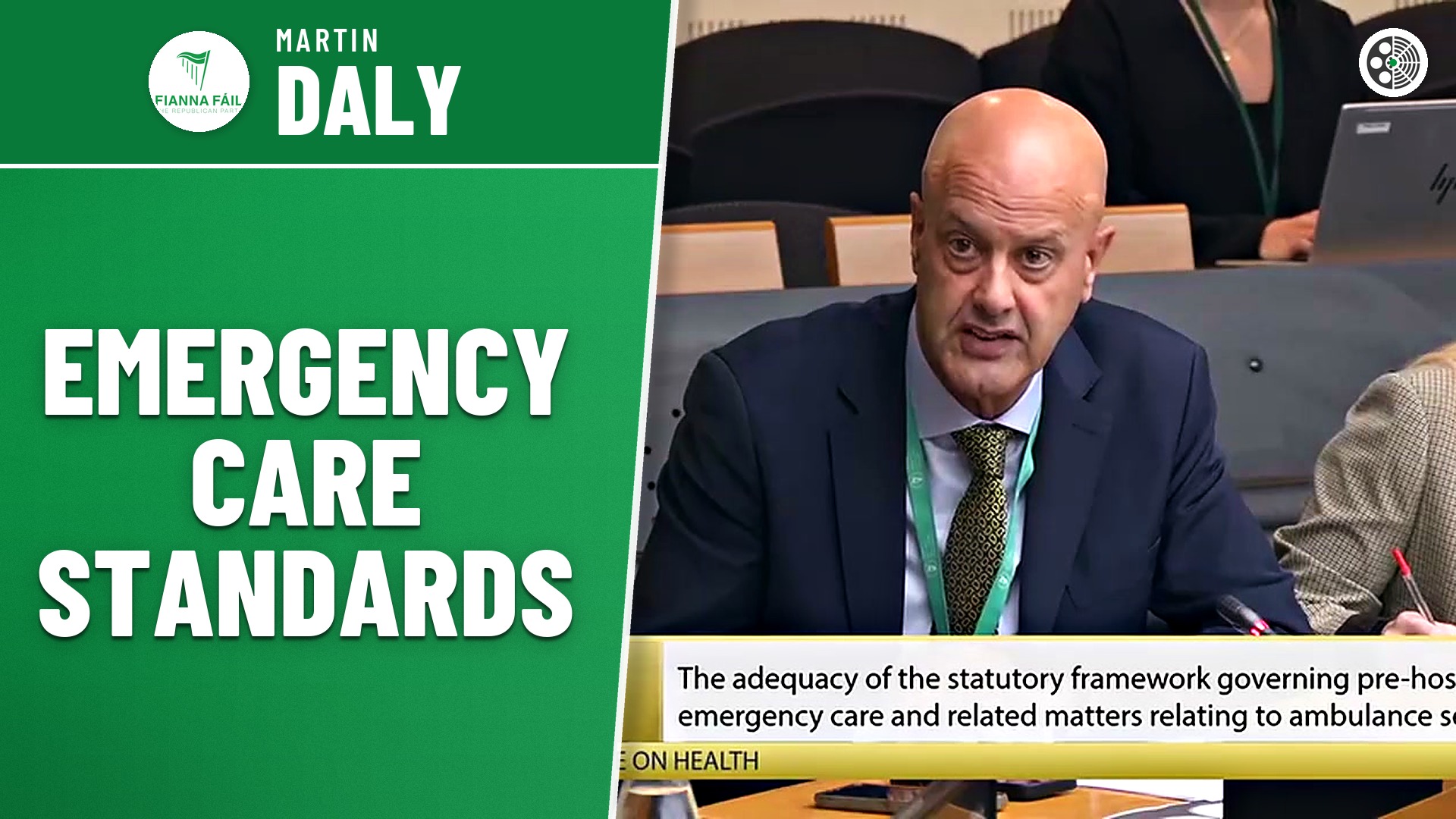


Martin Daly backs stronger regulation of paramedics
At a committee hearing, Martin Daly praised the National Ambulance Service and supported stronger statutory regulation for emergency medical technicians, paramedics and advanced paramedics. Drawing on his experience as a rural GP, he argued that professional titles should reflect clear standards of training, skill and accountability to protect the public and patients.
Martin Daly asked the representatives to explain the differences between emergency medical technicians, paramedics and advanced paramedics, including their training and clinical responsibilities. He noted that the roles had developed substantially over the past 25 years, from ambulance drivers and attendants to highly trained practitioners.
The representatives described EMTs as providing basic first aid and managing conditions including cardiac arrests and respiratory distress. They said paramedics build on EMT training, with wider clinical knowledge, more medications and greater responsibilities for stabilising patients and deciding on transport and destinations. Advanced paramedics were described as the system’s top clinical providers, with advanced medication and airway skills and responsibility for patient care and clinical decisions on scene.
Daly argued that the level of skill, professionalism and responsibility made it important to establish a regulatory body with statutory powers comparable to those of the Medical Council, Nursing Council and CORU. He supported stronger sanctions and a modern fitness-to-practise system, and said protected titles should give the public a clear understanding of practitioners’ training, skills and professional standards.
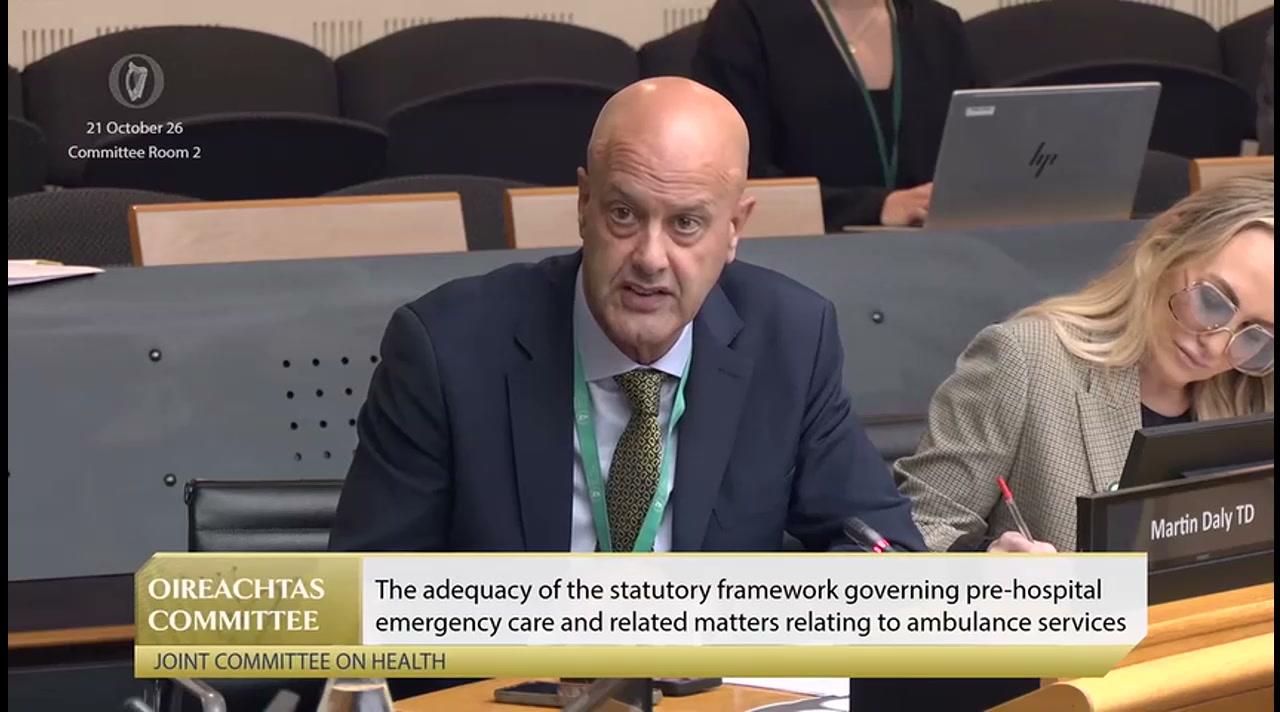
Martin Daly asked the representatives to explain the differences between emergency medical technicians, paramedics and advanced paramedics, including their training and clinical responsibilities. He noted that the roles had developed substantially over the past 25 years, from ambulance drivers and attendants to highly trained practitioners.
The representatives described EMTs as providing basic first aid and managing conditions including cardiac arrests and respiratory distress. They said paramedics build on EMT training, with wider clinical knowledge, more medications and greater responsibilities for stabilising patients and deciding on transport and destinations. Advanced paramedics were described as the system’s top clinical providers, with advanced medication and airway skills and responsibility for patient care and clinical decisions on scene.
Daly argued that the level of skill, professionalism and responsibility made it important to establish a regulatory body with statutory powers comparable to those of the Medical Council, Nursing Council and CORU. He supported stronger sanctions and a modern fitness-to-practise system, and said protected titles should give the public a clear understanding of practitioners’ training, skills and professional standards.
We publish thousands of recordings to make Irish politics transparent and resistant to manipulation. Spotted an error? Report it — together we are building a reliable archive of Irish politics.
Other speeches
Tego samego dnia All speeches from this day →
Helen McEntee
Helen McEntee: Ireland must decide where its troops are deployed
Paul Lawless
Paul Lawless challenges move to change the Triple Lock
George Lawlor
George Lawlor calls for help for clubs after Clearwater collapse
Regina Doherty
Regina Doherty warns on EU spending errors and debt
Mairéad Farrell
Mairéad Farrell challenges mandate to scrap triple lock
Erin McGreehan
Erin McGreehan on the State’s Failures in the Brian Stack Case
Transcript
Thank you, Mr. Lodge, Mr. Thorpe and Mr. Case for coming in this morning with your team.
I'm a practicing GP in a rural area and I've seen first hand the huge contribution that
the development of the National Ambulance Service and the development of the roles of
the emergency medical technician, paramedic and advanced paramedic roles have brought
to the delivery of care to people in communities, especially emergency care.
I am old enough to remember when an ambulance driver was an ambulance driver and that's
no disrespect to them, that's what the role was and we had ambulances which essentially
had no medications in the ambulance.
I remember going on one case with a young child who was in status epilepticus and I
asked for medication and there was no medication in the ambulance.
So it is a massive improvement over a period of time, dedication and the professionalism
of these highly trained professionals.
And I've seen first hand at industrial accidents, I'm thinking in particular one during COVID
where two men fell from a cherry picker and in other times would have died.
And a team of emergency technicians, paramedics and advanced paramedics arrived and stabilised
them without going into the detail but got them by helicopter.
I have to say I was in awe of the skill and professionalism at the site, at a very chaotic
site in a very difficult area to deliver.
So I just want to put that on record that I think people need to understand the level
of professionalism, the level of training, the level of commitment from the emergency
medical technicians, the paramedics and advanced paramedics.
I want to be clear to make distinction in those trainings.
I think it would be important just to maybe tell us, have you from your website the three
roles, maybe to explain the three roles to the committee just briefly so it gives us
an idea of the training.
So as you said there's EMTs, paramedics and advanced paramedics and they develop hugely.
And I just want to make the point, you said you're old enough to remember, it's only 25
years ago.
It's only 25 years that we moved from ambulance drivers and ambulance attendants to the current
state that we have now.
And it really is phenomenal that if you're not, if you haven't had the misfortune to
see these guys in action or you don't work in the field, you probably wouldn't appreciate
exactly what they do.
But my two colleagues with me are both advanced paramedics and they'd be a lot more familiar
with the difference in roles of the EMT.
Just not to interrupt but to say to you that when people say life-saving, emergency medical
technicians, paramedics and advanced paramedics are saving, you can say honestly with your
every single day of the week in this country.
They can put it out.
So I just want to add on to that.
Thank you.
So I'm just going to ask.
Yeah, thank you.
To answer your question, the three levels again are emergency medical technician, EMT,
paramedic and advanced paramedic or AP.
And going from, I don't want to say simplest, but the least complex to the most, the emergency
physiology, pharmacology, they perform a lot of basic first aid but do have the skill to
manage cardiac arrests and other fairly significant respiratory distress, diabetic emergencies,
things like this.
So that's basically the entry level to the practitioner level of EMS care.
The paramedic builds upon the education and training frameworks of an EMT.
So widening and deepening that breadth and depth of clinical knowledge.
More medications are introduced.
They can manage more complex care, have better clinical decision-making and really better
stabilize the patient on scene, make determinations of transport and appropriate destinations.
And then the top level there is the advanced paramedic.
Again, building on those frameworks of the EMT and paramedic, they are the top clinical
providers in our system.
They have a much wider and deeper breadth and depth of knowledge.
Very skilled in medications and administration routes, advanced airway techniques.
And they have that full picture of patient care while on scene and decision-making.
Thank you.
And I'll go to the end, which is to call.
I mean, it is for the level of skill, the level of professionalism, and the level of
responsibility, it really is inexplicable why there isn't a regulatory body that has
the powers of other regulatory bodies in this area, like the Medical Council, Nursing Council
and KORU.
So, I mean, just on the time I have, enhanced statutory sanctions, a modern fitness-to-practice
system which would allow you to sanction a professional who, thankfully in the rare cases
where someone is not competent or is at risk to the public or the patients that they are
again, and that's why I was asking you to outline the roles of the emergency medical
technician, the paramedic, because titles are important.
Titles need to reflect something in the public's mind, that there's a clear understanding of
what an emergency medical technician, what a paramedic is, what an advanced paramedic
is.
It's not just some nebulous title that someone has picked out of the air.
And unfortunately, we do see the misappropriation of titles, not just in the area of paramedics,
but in the area of physiotherapy and other areas in talk therapies and that.
So it is absolutely critical that you have the ability to protect those titles, and those
titles reflect something that the public understand and that there's an expectation of a certain
level of training, skill and professionalism from a person who carries that title.
This was the interesting piece.
So you also are responsible for regulating corporate governance.
Is that over providers then, people who employ paramedics, emergency medical technicians
and that, say in the private sector?
You have a responsibility to regulate the employers, have you?
We do.
We regulate three areas, if you like, of pre-hospital emergency care.
The practitioners themselves, the organizations they work for, and also the education establishments
that deliver the training.
So that's a significant burden of responsibility as well.
And so, look, my clock is running down here, but I just want to say I'm supportive of your
statement and your request, and it will depend obviously on the committee and on the Minister
of the Department how to progress this, but I am fully supportive of what you have stated
here today.
And again, I just want to pay tribute to the professionalism, the skills and the commitment
of the National Ambulance Service and all who work in it.
Thank you.