

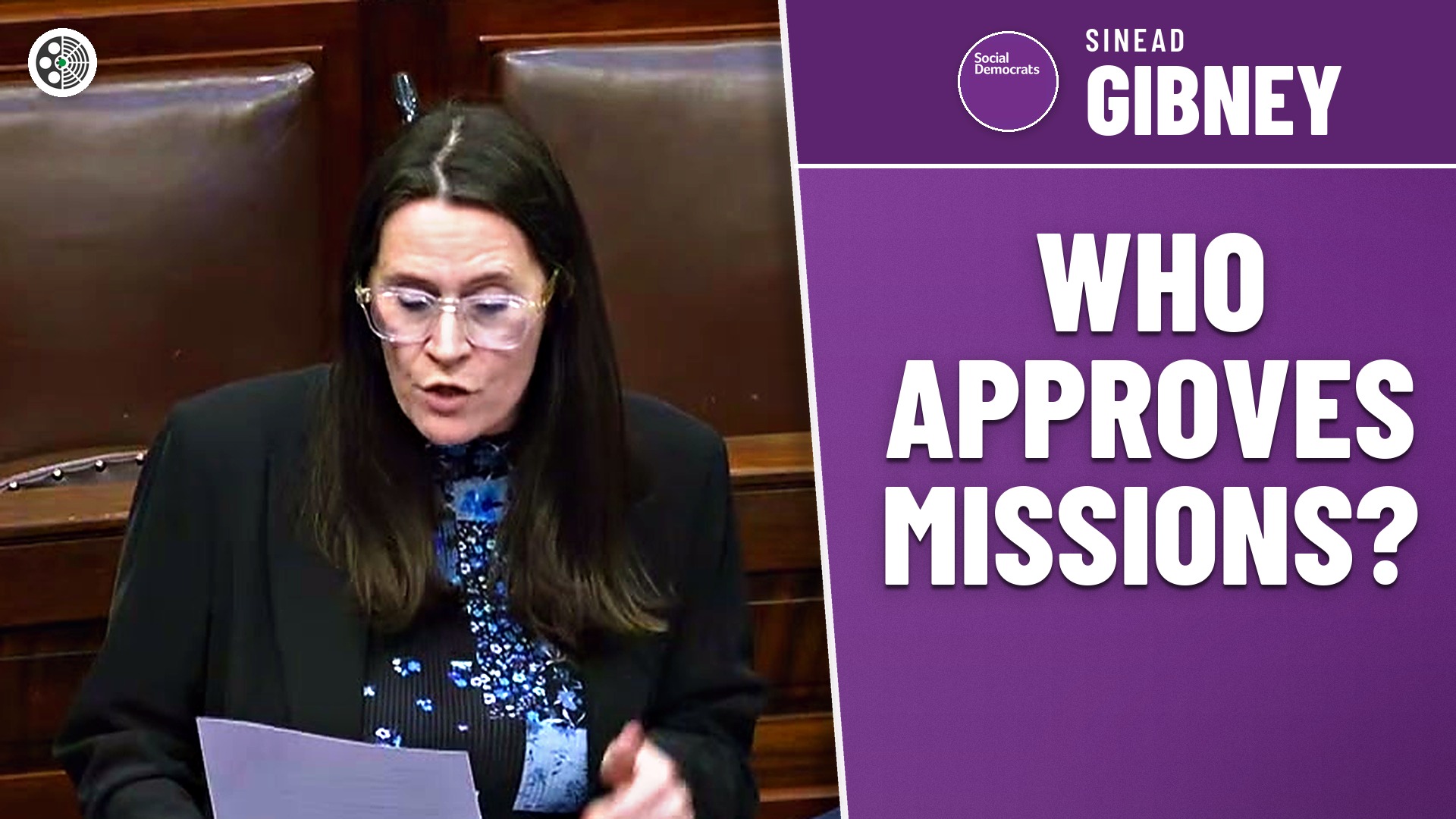


Sinéad Gibney: Triple lock removal threatens Irish neutrality
Social Democrats TD Sinéad Gibney opposed the legislation to remove the triple lock during a debate in Dáil Éireann, arguing that it weakens Irish neutrality. She challenged the Government’s description of the change as reform and warned that it could allow Irish troops to join missions without a UN mandate.
Gibney said the legislation removes a legal safeguard for Irish troop deployments without providing a comparable replacement. She argued that the Government has no mandate for the change, noting that Fine Gael’s 2024 election manifesto was silent on it and Fianna Fáil had promised “sensible reform” while maintaining Irish neutrality.
Gibney cited evidence from pre-legislative scrutiny, including an exchange about whether the proposed framework would have prevented an Irish deployment to Iraq in 2003. She argued that referring to consistency with the UN Charter is not an equivalent safeguard to requiring UN approval, and warned that the legislation could permit missions without a UN mandate.
Gibney disputed claims that proposed EU missions would protect Ireland’s peacekeeping role. She said the new EU mission in Lebanon is a training mission, not a peacekeeping mission, and referred to Operation Irini and other mandates while questioning the humanitarian purpose of the missions being discussed.
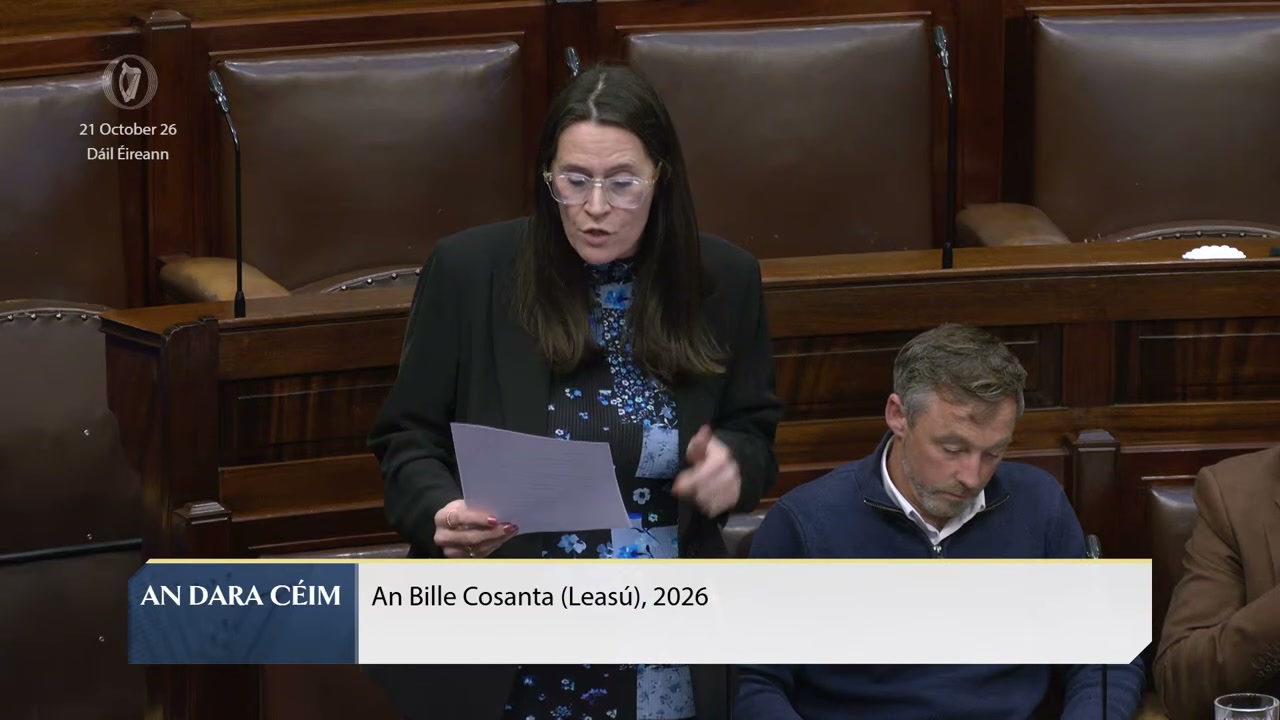
Gibney argued that the 2006 Defence Act already allows for General Assembly endorsement or support as well as Security Council approval, and said the Government should pursue those options. She concluded that removing the triple lock threatens Irish neutrality, while reaffirming the Social Democrats’ support for Óglaigh na hÉireann and funding for the Defence Forces.
Neutrality and the triple lock
Gibney said the legislation removes a legal safeguard for Irish troop deployments without providing a comparable replacement. She argued that the Government has no mandate for the change, noting that Fine Gael’s 2024 election manifesto was silent on it and Fianna Fáil had promised “sensible reform” while maintaining Irish neutrality.
UN mandates and military deployments
Gibney cited evidence from pre-legislative scrutiny, including an exchange about whether the proposed framework would have prevented an Irish deployment to Iraq in 2003. She argued that referring to consistency with the UN Charter is not an equivalent safeguard to requiring UN approval, and warned that the legislation could permit missions without a UN mandate.
Missions described as peacekeeping
Gibney disputed claims that proposed EU missions would protect Ireland’s peacekeeping role. She said the new EU mission in Lebanon is a training mission, not a peacekeeping mission, and referred to Operation Irini and other mandates while questioning the humanitarian purpose of the missions being discussed.
Alternatives and the debate’s consequences
Gibney argued that the 2006 Defence Act already allows for General Assembly endorsement or support as well as Security Council approval, and said the Government should pursue those options. She concluded that removing the triple lock threatens Irish neutrality, while reaffirming the Social Democrats’ support for Óglaigh na hÉireann and funding for the Defence Forces.
We publish thousands of recordings to make Irish politics transparent and resistant to manipulation. Spotted an error? Report it — together we are building a reliable archive of Irish politics.
Other speeches
Tego samego dnia All speeches from this day →
Emer Currie
Emer Currie: The Stacks deserve the truth
Charles Ward
Charles Ward says non-binary rights are a basic human rights issue
Paul Murphy
Paul Murphy: ‘You didn’t reform the Triple Lock’
Richard Boyd Barrett
Richard Boyd Barrett: Neutrality Bill Is a ‘Historic Betrayal’
Verona Murphy
Verona Murphy calls for respect and order in the Chamber
Conor D McGuinness
Conor D McGuinness calls for Triple Lock referendum
Transcript
At the outset, I just want to start by saying that the Social Democrats strongly oppose
this legislation.
Not all elements of it, as Deputy O'Leary pointed out, there are some important parts
of it regarding disciplinary procedures and so on.
But the removal of the triple lock is an erosion of our neutrality.
And although this government won't admit that, that is the basis on which we oppose this
legislation.
The Taoiseach earlier called it reform, and you yourselves in your opening comments have
used the word reform.
It is not reform.
And therefore, you have no mandate.
It is the abolition of the triple lock, it is the removal of the triple lock, with no
comparable replacement, and I'm going to get into some details on that.
But you have no mandate.
Fine Gael, in your manifesto for the 2024 election, you were silent on this.
Fianna Fáil talked about sensible reform.
And in the programme for government, you have talked about that reform, quote, while maintaining
Irish neutrality, which this bill does not do.
And I will get into some of the experts who have testified to that in committee.
I have criticised Minister Richmond for his position in not supporting Irish neutrality,
but I've come around to the fact that at least he is open and transparent about it.
Because that is less than I can say for the rest of the Fine Gael cabinet and TDs who
speak on this issue.
You do not support neutrality.
You never have, and you never will, as long as you're in power.
And what this legislation does is finally puts the nail in the coffin of Irish neutrality
and allows you to pursue your goals, to drag us towards militarisation along with your
EPP partners.
Fianna Fáil at least have had in the past strong support for Irish neutrality.
And going back decades with people like Frank Aitken, who was instrumental in the development
of Irish foreign policy and the multilateralism that is a cornerstone of that.
But of course, this is why we're seeing a schism in the Fianna Fáil membership, where
some of your TDs are seeing through the government spin and recognise that this is an absolute
nail in the coffin of Irish neutrality.
But the rest of your TDs, I urge you to please tune into this debate, listen to the debate,
hear what the opposition are saying, a united, a completely united opposition who are working
together to open the eyes of the Irish public who are with us on this, but also of government
TDs who are being hoodwinked by your cabinet spin.
The cross-party work has been incredibly strong on this, and I'm proud to be a part of the
Irish Neutrality League, along with members here present today and others.
And of course, Catherine Connolly, before she was elected to Orsa Ní Uachtarán, who
was a founder of the Irish Neutrality League.
But I want to get past the politics and into some of the policy of this and have a look
at what you are actually proposing, because that's hugely important.
You are suggesting essentially that we go from a mechanism, a clear legal mechanism,
which acts as a backstop for Irish neutrality in the deployment of our troops, to essentially
a set of vague words and terms that do not have legal standing as meaning and which will
inform our military deployment policy.
So legal certainty to none comparable.
And I'm going to get into your call, Minister, for other ways in which we could satisfy the
triple lock.
But ultimately, what it will bring us from is from peacekeeping to military deployment
for regional interests.
And one of the most tangible examples of this change that I heard in the pre-legislative
scrutiny during the debate in defence committee was in an exchange between Deputy Murphy and
your department's head of defence and security policy.
Because Deputy Murphy put to your colleague, who is here with us today, that if the legal
framework being proposed in the bill was in place in 2003, would there have been anything
stopping us from sending troops to invade Iraq?
And the answer was no.
There would have been nothing in place for us to stop.
There would have been no legal backstop, no triple lock to prevent any government of that
day potentially sending troops to Iraq.
That's what we heard in the pre-legislative scrutiny session within the defence committee.
And it was startling to hear it.
Because they claimed at the time, the UK and the US claimed at the time that they were
doing so in compliance with the UN Charter, which is exactly what you are trying to replace
our triple lock with, adherence to the UN Charter, a term so vague that it is meaningless.
Trite phrases like the UN Charter mean nothing when those kinds of invasions are overseen
without UN oversight.
That is the point.
The UN mandate is the only show in town when it comes to multilateralism and you are choosing
to remove it.
This bill will allow missions with no UN mandate as long as they are quote, consistent with
the principles of the UN Charter.
But who is to determine if a regional organisation or body operates in a manner consistent with
the UN Charter, especially when there is no Security Council or General Assembly oversight?
That is the role of the UN and it is a role that you are actively seeking to erode.
I want to speak to some of the specific missions that have been referenced throughout the debates
on the triple lock and this specific bill.
Because there's been a lot of misrepresentation about those specific missions and about the
types of missions that you purportedly want to go on.
So I want to delve into some of them now.
And at leaders' questions today, the Taoiseach made great statements about how Irish troops
have been absolutely instrumental in delivering humanitarian aid to Chad.
And I agree.
But the simple fact is that your proposed non-triple lock missions have absolutely no
humanitarian functions.
Not in the new functions for Operation Irini, not in the EU missions in Lebanon.
The new Lebanon mission, and we have to clarify this, is not a peacekeeping mission.
And that is not hyperbole, it is not hysterics.
The EU mission doesn't have a peacekeeping function.
It's a training mission to train the Lebanese military.
And the main similarity that it has with UNIFIL is simply that it takes place in Lebanon.
We only need to look at the disaster of the EU training mission in Mali to see the problems
with these kinds of missions.
But crucially, and important to today's discussion on this bill, is that these are not peacekeeping
missions.
Minister, please let me finish.
Now I would like to talk about the non-
She didn't interrupt you, you don't interrupt her.
Thank you.
Keep going, Deputy.
Can I close the clock?
I would also like to speak to the non-renewal of mandates, because that of course is one
of the key things that this government puts forward around this.
The new UN-founded missions, are there any UN-founded missions since 2014?
No.
We all know that.
But are there mandate renewals and mandates for regional missions?
Yes, there are.
Operation Sophia, search and rescue in the Mediterranean and enforcing the Libyan arms
embargo.
UNDOF, peacekeeping in the Golan Heights, which Ireland pulled out of in 2024.
The Haiti mission was approved by the Security Council in 2023 and began in 2024.
Your dialogue around this is an attempt to misdirect the Irish public.
We can't get a mandate for the UN for peacekeeping, so we're going to get rid of the triple lock
so that we can send troops on non-peacekeeping missions with no UN mandate.
There are 11 UN peacekeeping missions currently.
There are also more missions globally which have a UN mandate such as the Haiti mission.
The new Lebanon mission is not a peacekeeping mission.
So how exactly is our peacekeeping tradition being protected?
Now I want to pick up in the few minutes I have left on some of your points that you
raised in your opening statements, Ministers, because you asked us, Minister McEntee, specifically
for alternatives.
You say that you are looking to collaborate.
I find that hard to stomach when you continue to hold this position that the removal of
the triple lock doesn't compromise Irish neutrality, but nonetheless, on that basis, the uniting
for peace resolution and the use of the General Assembly, which I have again and again and
again, Ministers, asked for proof that you are actually pursuing that.
I mean, the Taoiseach was at the UN General Assembly recently.
Did he raise this?
Did he talk about the fact that we would like the UN General Assembly to satisfy a triple
lock as outlined in the 2006 Defence Act?
Did he?
I don't think he did.
Excuse me?
It's rhetorical just in case anyone is going to answer.
Thank you, Kean-Porle.
You'll be closing, Minister, you'll be able to answer.
The General Assembly is increasingly being seen as a crucial mechanism to get past what
we all know to be issues with the veto and the permanent members of the Security Council.
But beyond that, the 2006 Defence Act clearly states that international United Nations force
means an international force or body established, mandated, authorised, endorsed, supported,
approved, or otherwise sanctioned by a resolution of the Security Council or the General Assembly
of the United Nations.
So even beyond the uniting for peace resolution that is available to you to satisfy the triple
lock that you have failed to pursue, it doesn't even have to be a Security Council mandate.
It doesn't even have to be a mission set up via the General Assembly.
Just endorsed or supported.
It's extremely generous language which allows for flexibility in the face of any Security
Council deadlock which, again, we all acknowledge is an issue.
And in that context, your histrionics over the permanent five members and the veto just
does not stand up to scrutiny.
In relation to IRINI, no new mandate was sought for IRINI and, crucially, it is not a peacekeeping
mission.
You spoke about four members of the Defence Forces having to withdraw immediately.
That is false.
They were not legally compelled to withdraw immediately because that was well under the
existing limit of 12 deployed without the EU mandate, which is what Minister Byrne then
confirmed for his contributions.
Sorry, just to prevent all the interruptions, Minister, hold on.
You have a closing statement.
That's when you address these things.
Take note.
Don't interrupt the Deputy again.
I've asked you three times.
Continue, Deputy.
Thank you, Ken Cawdor.
And finally, in terms of picking up on points that you have both put forward and in Minister
Byrne's own comments, you said that the new definition still allows us to participate
in new UN missions, also allows us to take part in missions from the OSCE, EU and other
arrangements.
But we can already do that.
We already have.
We just require a UN mandate because that is the guarantee given to the Irish people
in the Civil Declaration.
Because the invention of the Common Security and Defence Policy, Partnership for Peace
and other EU mechanisms, they pose a threat to Irish neutrality.
They run the risk of us not acting for human rights, not acting for the greater good, not
acting for multilateralism and international law, but for European interests, a bloc that
has been consistently out of step with Irish foreign policy on the genocide in Gaza, our
commitments to humanitarian aid and human rights.
Nobody is raising an issue around your changes on civilian evacuation.
So those points are misleading.
I want to finish with a couple of quotes from the pre-led scrutiny where we had both Professor
Ray Murphy and Joe Noonan in speaking to us.
And Ray Murphy, and I want to read this into the record of this particular debate because
it is such powerful words, he said, we are removing the requirement for the UN to approve
and give legitimacy to Ireland's participation in an international force abroad.
By doing so, we are joining all of those states that we are critical of and that are rendering
the United Nations dysfunctional.
And Joe Noonan said, allowing Irish forces to go to non-UN approved forces is opening
a carte blanche for major operations of a nature which we cannot predict.
If we send forces on the ground as part of an EU or NATO force, will we become embroiled
in an actual armed conflict and be a party to a conflict?
Those are powerful statements in the context of this debate which tell us that we are threatening
Irish neutrality.
That is what is happening here.
No matter what you say and how much you deny that this is a threat to Irish neutrality,
that is exactly what it is.
It is an abolition of Irish neutrality through the abolition of the triple lock.
As others have, I want to reiterate the Social Democrats' support for Eoghlinna hÉireann
and recognition of the unbroken record of peacekeeping that we are proud to hold as
a nation state.
And we, as other parties do, support the mid-level funding which would see our defence
forces be brought back up to a place of functionality which you and your government have allowed
to deteriorate to the point that it now is in.
This is such a vital piece of legislation and it is such a vital point for us to debate
it properly.
We also object to the guillotine that is being put on today, but I urge government TDs to
please tune in, listen in, listen to your consciences, because if you do hold Irish
neutrality dear, you must see through the spin of this cabinet and what is being put
forward is completely disingenuous.
That this can be passed and that we can maintain our neutral status as a nation state is nonsensical
and we have to see through that.