

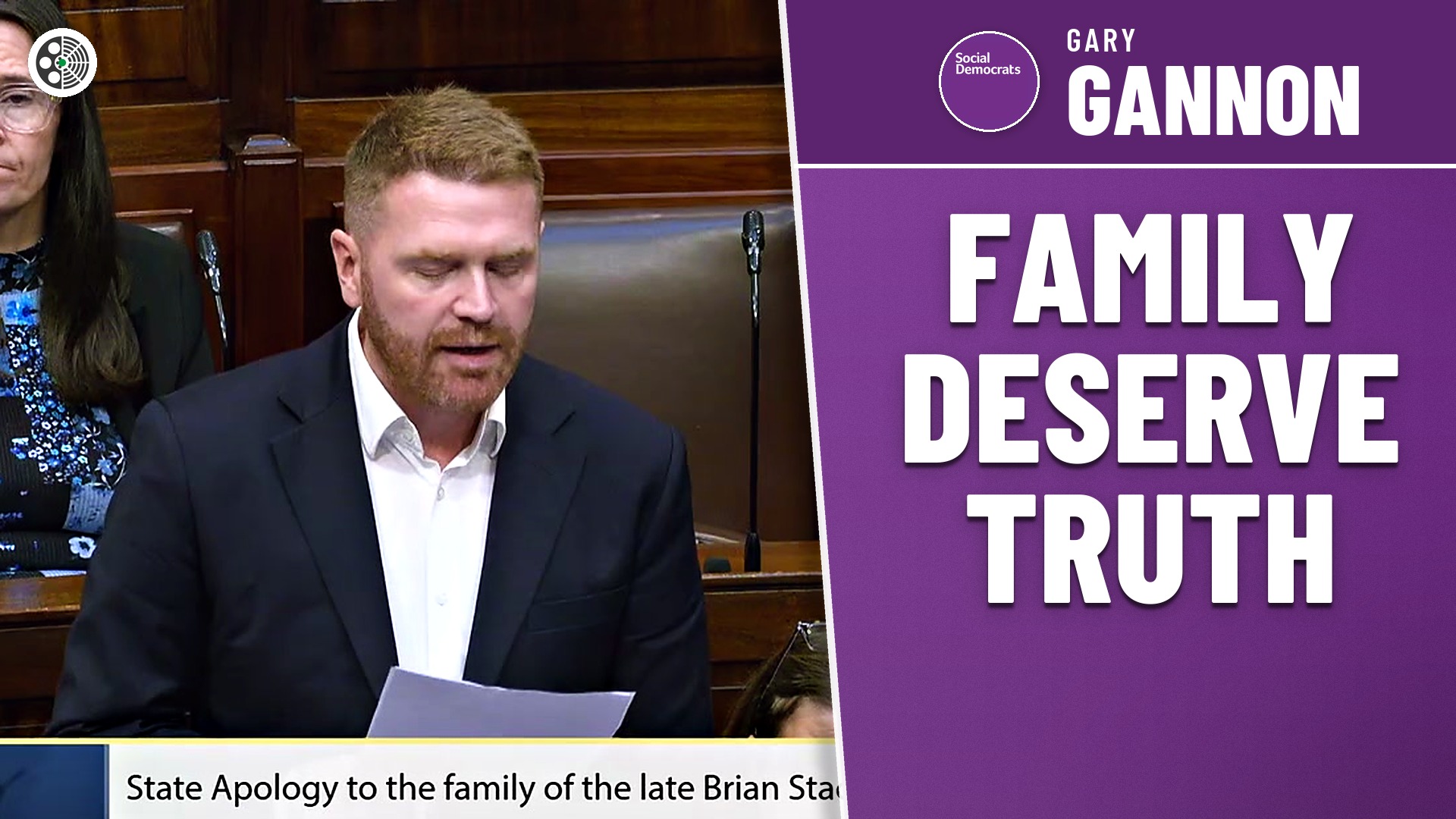


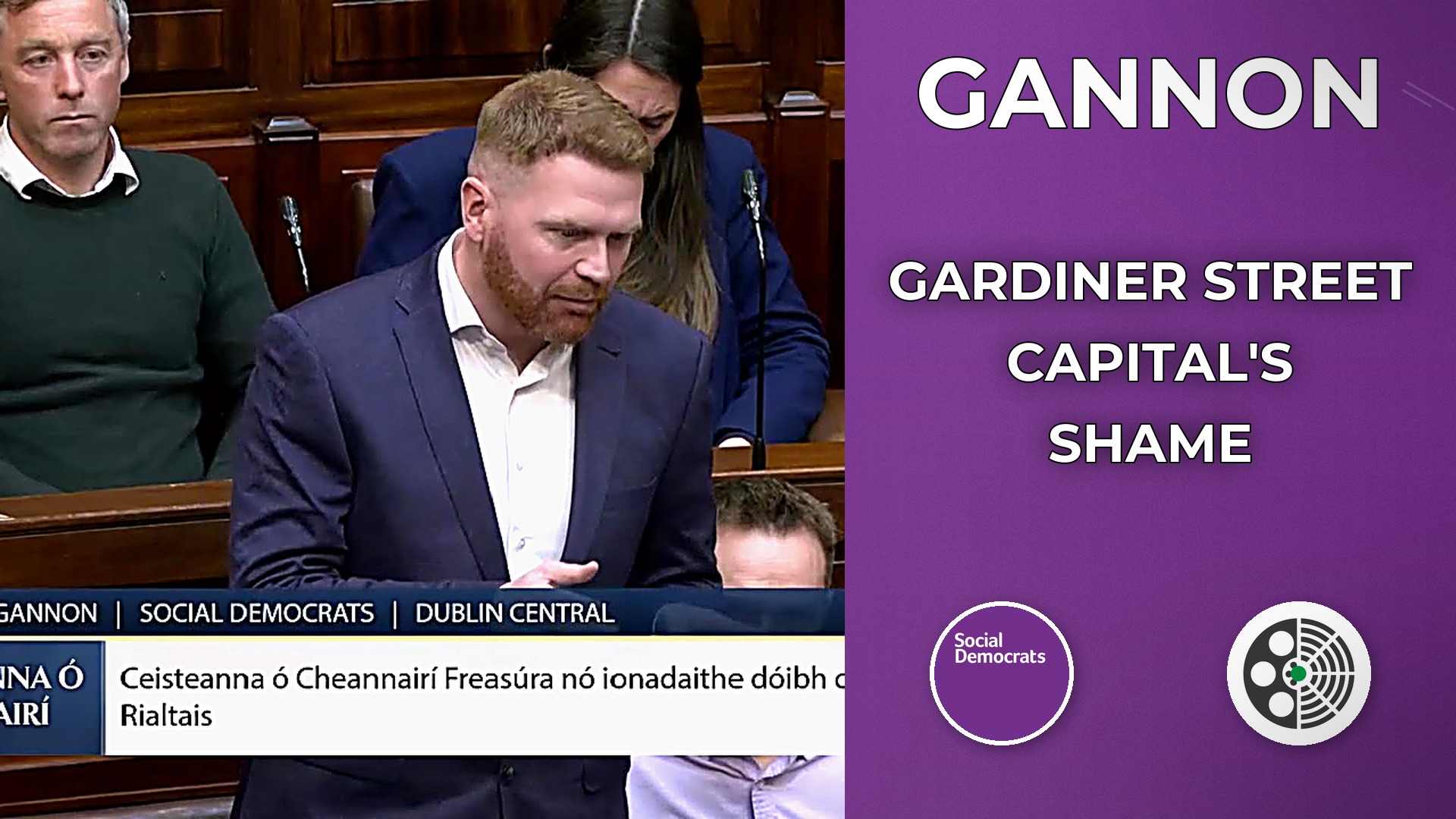
Gary Gannon: Stack apology must lead to meaningful action
Gary Gannon addressed the State’s failures in the investigation into Brian Stack’s murder during a parliamentary debate today. He called for publication of the Serious Crime Review Team report, arguing that the apology to the Stack family must be matched by transparency and meaningful action.
Gannon acknowledged the courage and determination of the Stack family, who spent decades seeking answers, accountability and truth after Brian Stack was murdered. He remembered Brian as a devoted husband and father and a dedicated public servant, and said his family should never have had to fight so hard for answers.
Gannon cited 194 distinct errors identified in the first investigation into Brian Stack’s murder. He said these were serious failures that undermined the investigation and the family’s pursuit of justice, and that information had been withheld from the family.
Gannon supported Deputy O’Connell’s call to publish the Serious Crime Review Team report, saying it would allow the family and the public to understand the full extent of what went wrong. He argued that an apology cannot be the end of the process and must be accompanied by openness about the State’s failures.
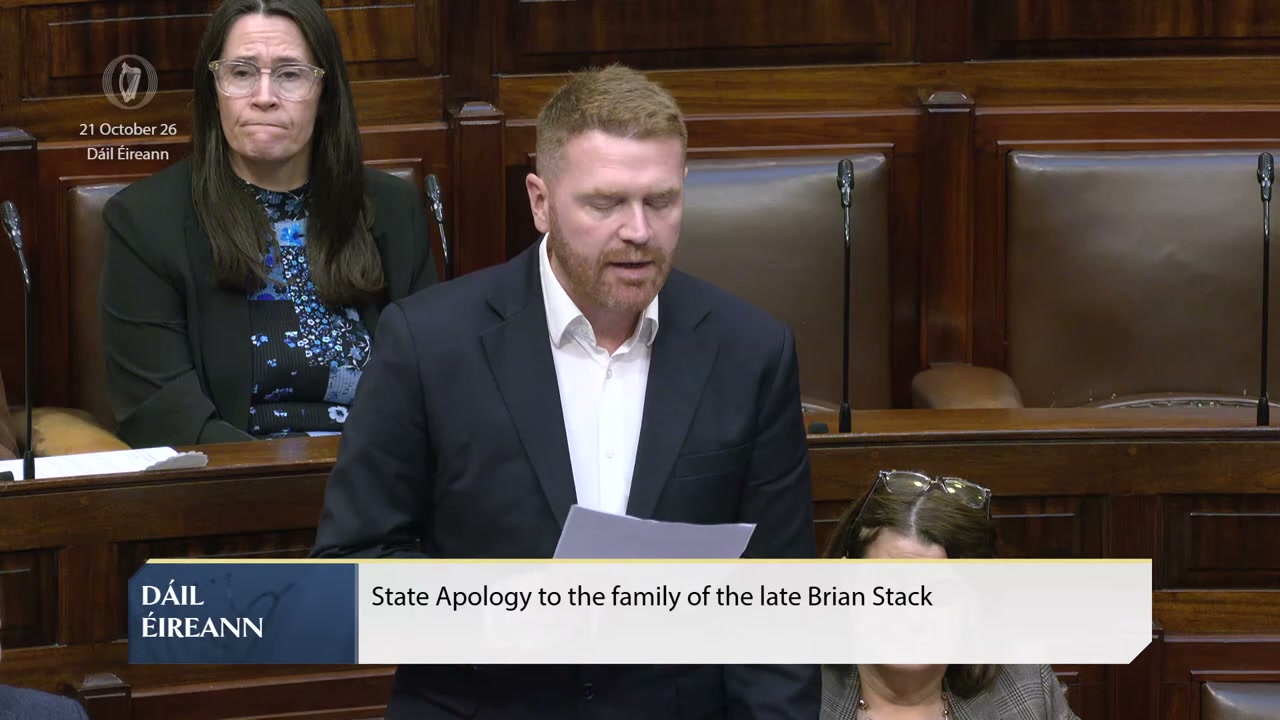
Gannon said reconciliation cannot mean avoiding difficult conversations or asking families to move on while questions remain unanswered. He argued that the State’s responsibility to the Stack family continues beyond the apology, and that the measure of the apology will be the action that follows. Watch the recording to hear the full contribution.
The family’s pursuit of justice
Gannon acknowledged the courage and determination of the Stack family, who spent decades seeking answers, accountability and truth after Brian Stack was murdered. He remembered Brian as a devoted husband and father and a dedicated public servant, and said his family should never have had to fight so hard for answers.
Failures in the investigation
Gannon cited 194 distinct errors identified in the first investigation into Brian Stack’s murder. He said these were serious failures that undermined the investigation and the family’s pursuit of justice, and that information had been withheld from the family.
Report publication and accountability
Gannon supported Deputy O’Connell’s call to publish the Serious Crime Review Team report, saying it would allow the family and the public to understand the full extent of what went wrong. He argued that an apology cannot be the end of the process and must be accompanied by openness about the State’s failures.
Truth and reconciliation
Gannon said reconciliation cannot mean avoiding difficult conversations or asking families to move on while questions remain unanswered. He argued that the State’s responsibility to the Stack family continues beyond the apology, and that the measure of the apology will be the action that follows. Watch the recording to hear the full contribution.
We publish thousands of recordings to make Irish politics transparent and resistant to manipulation. Spotted an error? Report it — together we are building a reliable archive of Irish politics.
Other speeches
Tego samego dnia All speeches from this day →
Dara Calleary
Dara Calleary: Government opposes Non-binary Recognition Bill
Paul Murphy
Paul Murphy: ‘You didn’t reform the Triple Lock’
Helen McEntee
Helen McEntee: Ireland must decide where its troops are deployed
Seamus Healy
Seamus Healy: Triple Lock change must go to the people
Paul Lawless
Paul Lawless challenges move to change the Triple Lock
Thomas Gould
Thomas Gould challenges Taoiseach on doubled house prices
Transcript
Can I begin by acknowledging and welcoming Ciala, Austin, Ciarán and all of our stack
and thanking them for your immense courage and the dignity in being here today.
I think the grace and determination that the Stack family have shown throughout their decades
long campaign for justice has been nothing short of remarkable.
What began as a senseless act of violence for this family became a decades long fight
for answers, for accountability and for the truth.
And at almost every turn we're met with barriers.
Barriers that should never have been put in the way in the first place.
Because the murder of Brian Stack was an appalling act.
But what followed and the manner in which his family were treated in their search for
justice compounded that tragedy in ways that are very difficult to comprehend.
My colleague Deputy O'Connell had just spoken about the enormous loss that Brian's murder
represented to his young family at the time.
But I think that is something that we should all take a moment to reflect upon today.
Because before we speak about investigations, reports, institutional failures or state apologies
we should remember the man at the centre of all of this.
Brian Stack was a devoted husband and father.
He was a dedicated public servant who carried out an incredibly difficult job with diligence
and with integrity.
That bravery was recognised throughout his career and it stands in the starkest possible
contrast to the cowardice of those who murdered him.
A man shot in the back whose killer spent three decades refusing to acknowledge their
responsibility.
And even that acknowledgement did not come willingly.
It came after years of extraordinary persistence from a family who should never have to fight
so hard for the truth.
I think that is something that we cannot lose sight of today.
Because the Stack family were not simply grieving the loss of a husband and father, they were
forced to become campaigners.
They were forced to challenge institutions, to pursue information and to confront people
who had an obligation to tell the truth.
And all the while they were dealing with the most unimaginable personal loss.
I think what makes this particularly difficult is that their suffering was compounded time
and time again by the failures of the State itself.
We know that there were 194 distinct errors identified in the first investigation into
Brian's murder.
That is an extraordinary number of failings in the investigation and a murder of this
seriousness.
And they were not simply administrative mistakes or minor oversights.
They were serious failures that undermined the investigation and ultimately the family's
pursuit of justice.
For years Brian's family's belief about who was involved in this heinous act was not properly
acknowledged.
Information was withheld from them and the transparency that they were entitled to was
not for coming.
There is no way of undoing the damage that those failures have caused.
No apology, however sincere, can give Brian Stack back to his family.
And no word spoken in this chamber today can return the years that his family have had
to spend fighting for answers.
But I think we have an obligation now to ask ourselves what it actually means for the State
to apologise.
Because an apology cannot simply be the end of a process.
It has to be worth the paper that it is written on.
And if we are serious about acknowledging the failures that took place, then we have
to be prepared to confront those failures openly.
I agree with Deputy O'Connell that this should mean publishing the Serious Crime Review Team
report.
It would allow Brian's family and indeed the public to understand the full extent of what
went wrong.
And it would mean recognising that transparency is not something to be feared or avoided simply
because the truth might be uncomfortable.
I think there is a broader point here too about how we approach truth and reconciliation
on this island.
We speak a great deal about reconciliation, and rightly so, but reconciliation cannot
mean avoiding difficult conversations.
It cannot mean asking families to move on while the questions they have spent decades
asking remain unanswered.
And it certainly cannot mean that the passage of time somehow diminishes the responsibilities
of those who committed acts of violence or the institutions that subsequently failed
the people left behind, the families left behind.
If we are serious about truth and reconciliation, we have to be willing to have those hard conversations.
We have to be prepared to acknowledge uncomfortable truths, even when they challenge the narratives
that institutions have held on to for decades.
And we have to understand that reconciliation without truth is not meaningful reconciliation
at all.
I think the Stack family have demonstrated this more clearly than anybody.
They have shown extraordinary courage in pursuing answers, even when doing so meant confronting
powerful institutions and facing enormous resistance.
And I think the very least we owe them now is the willingness to do the difficult things
themselves, to be open about what happened, to acknowledge the full extent of this state's
failures and to ensure that this apology is accompanied by meaningful action.
I want to finish by again acknowledging Sheila, Austin, Ciarán and Oliver.
I have enormous admiration for the dignity and determination that you have shown throughout
your campaign.
You should not have had to fight so hard.
You should never have had to spend decades demanding answers that ought to have been
provided to you.
And while today is an important moment, I hope it is not presented as the conclusion
of the state's responsibility to your family.
Because the measure of this apology will not simply be in the words that are spoken here
today.
It will be in the state that is prepared to do after the words have been spoken.
Go raibh maith agaibh and thank you for your courage and dignity.