



Paul Murphy challenges Taoiseach on the triple lock
Paul Murphy challenged the Taoiseach during a Dáil debate on the Government’s proposed changes to the triple lock, arguing that the legislation would remove a safeguard on sending Irish troops overseas. The exchange focused on Irish neutrality, peacekeeping and whether the proposed rules could permit participation in missions without a UN mandate.
Murphy said the triple lock was central to Ireland’s military neutrality because it limited the circumstances in which Irish troops could be sent abroad. He accused the Taoiseach of describing abolition as reform and argued that the bill would leave only Government and Dáil approval, with the Government holding a majority in the Dáil.
Murphy questioned the bill’s inclusion of peace enforcement and conflict prevention alongside peacekeeping. He argued that peace enforcement could involve action without the consent of the parties to a conflict, and warned that the legislation could allow Irish soldiers to take part in missions beyond traditional peacekeeping.
The Taoiseach rejected Murphy’s characterisation, saying that peace enforcement missions had operated under the UN and that Ireland was not preparing to participate in a war. He argued that the existing arrangements could restrict future peacekeeping opportunities, citing Russia’s position on UN missions and the future of UNIFIL in Lebanon.
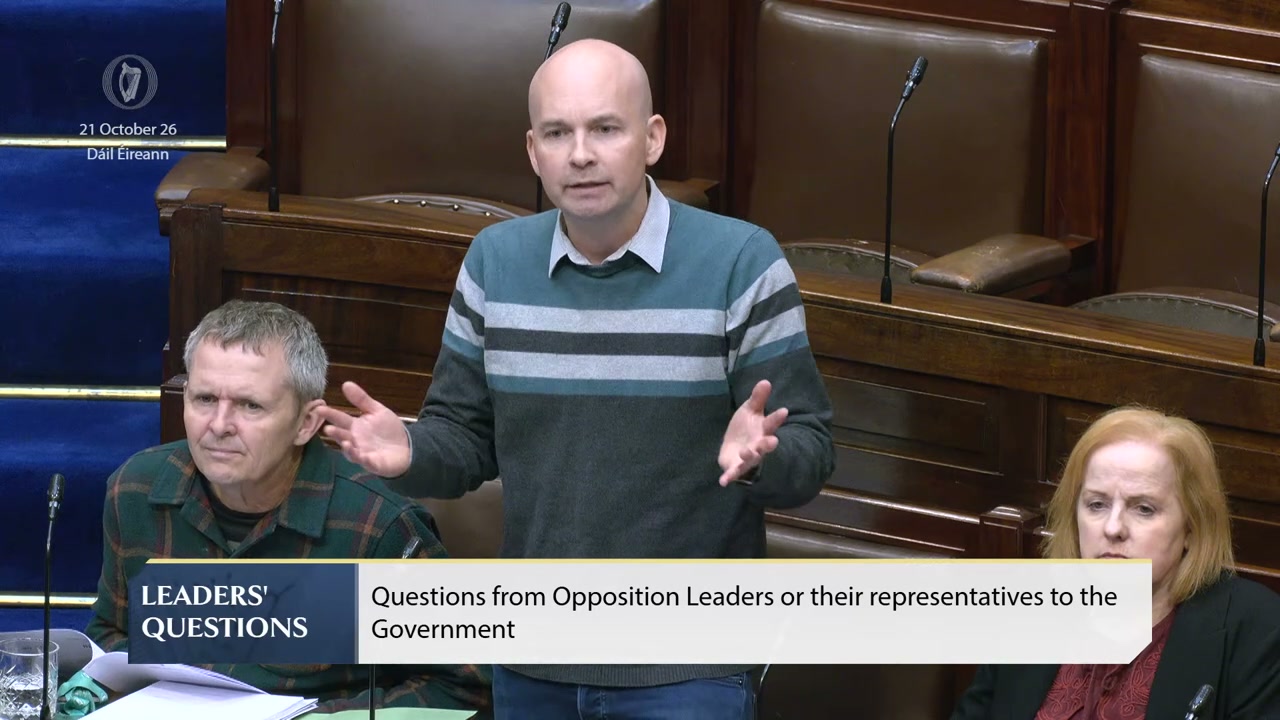
Murphy asked whether Irish troops could be sent to a proposed EU mission to strengthen the Lebanese Armed Forces, which he said was not a continuation of UNIFIL. The Taoiseach said Ireland was not definitively committing to one course, defended the work of Irish forces in Lebanon, and condemned Hezbollah, including over the killing of Irish soldier Sean Rooney.
The exchange put competing arguments about neutrality, international law and Ireland’s peacekeeping role directly before the Dáil. Watch the recording to hear the full contribution.
The triple lock and neutrality
Murphy said the triple lock was central to Ireland’s military neutrality because it limited the circumstances in which Irish troops could be sent abroad. He accused the Taoiseach of describing abolition as reform and argued that the bill would leave only Government and Dáil approval, with the Government holding a majority in the Dáil.
Peacekeeping and peace enforcement
Murphy questioned the bill’s inclusion of peace enforcement and conflict prevention alongside peacekeeping. He argued that peace enforcement could involve action without the consent of the parties to a conflict, and warned that the legislation could allow Irish soldiers to take part in missions beyond traditional peacekeeping.
The Taoiseach rejected Murphy’s characterisation, saying that peace enforcement missions had operated under the UN and that Ireland was not preparing to participate in a war. He argued that the existing arrangements could restrict future peacekeeping opportunities, citing Russia’s position on UN missions and the future of UNIFIL in Lebanon.
Lebanon and the proposed EU mission
Murphy asked whether Irish troops could be sent to a proposed EU mission to strengthen the Lebanese Armed Forces, which he said was not a continuation of UNIFIL. The Taoiseach said Ireland was not definitively committing to one course, defended the work of Irish forces in Lebanon, and condemned Hezbollah, including over the killing of Irish soldier Sean Rooney.
The exchange put competing arguments about neutrality, international law and Ireland’s peacekeeping role directly before the Dáil. Watch the recording to hear the full contribution.
We publish thousands of recordings to make Irish politics transparent and resistant to manipulation. Spotted an error? Report it — together we are building a reliable archive of Irish politics.
Other speeches

Tego samego dnia All speeches from this day →
Peadar Tóibín
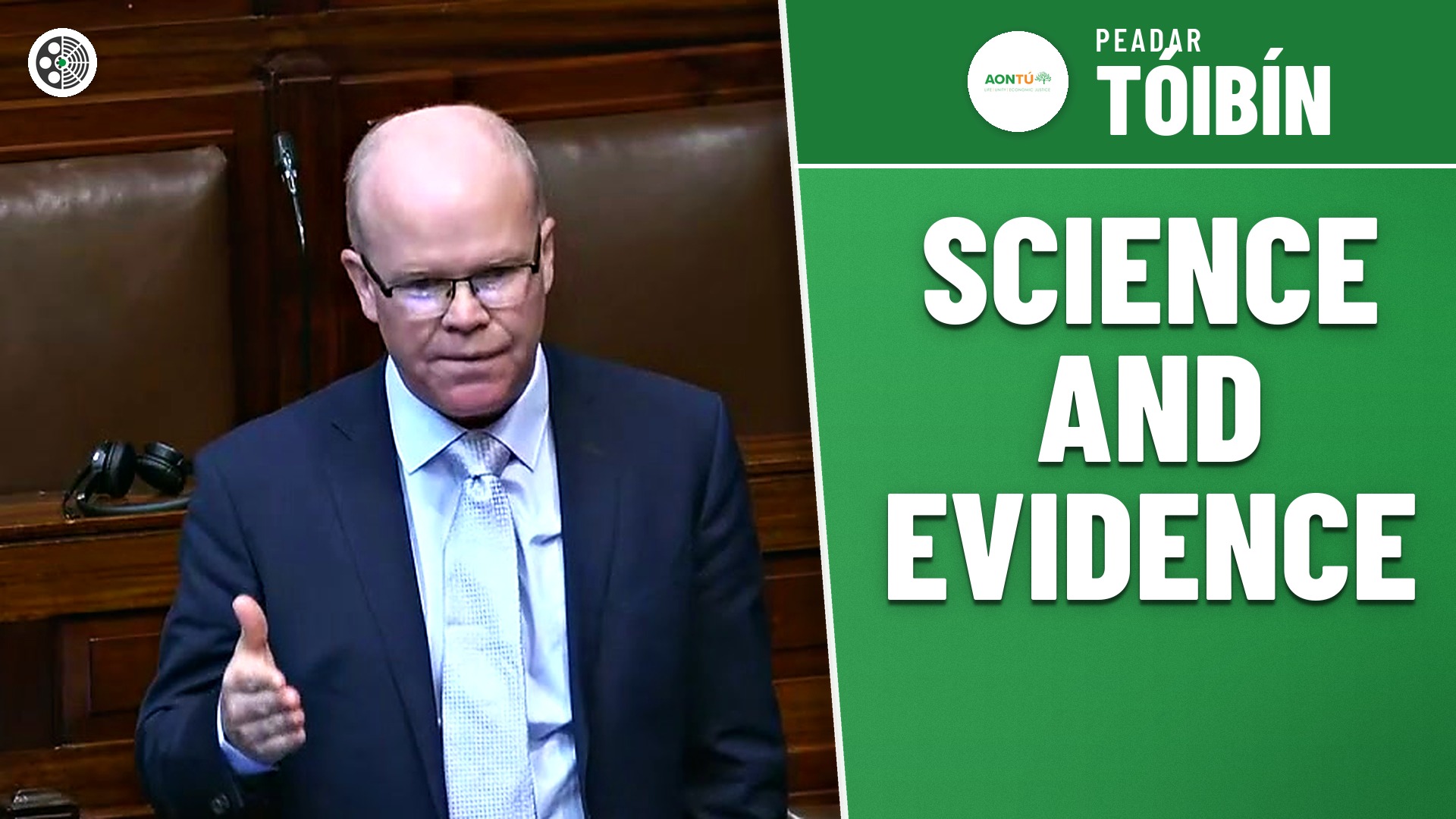
Peadar Tóibín challenges gender recognition bill on science
Duncan Smith
Duncan Smith: Removing the Triple Lock is the Wrong Move
Pearse Doherty
Pearse Doherty welcomes State apology to Brian Stack's family
Micheál Martin
Micheál Martin apologises to Brian Stack’s family in Dáil
Mairéad Farrell
Mairéad Farrell challenges mandate to scrap triple lock
George Lawlor
George Lawlor calls for help for clubs after Clearwater collapse
Transcript
Thanks, Ciarán Córdova.
Taoiseach, yesterday, in your defense of the abolition
of the triple lock, you asked, who
is going to engage in military adventurism?
Do you think an Irish government is?
Taoiseach, do you think people have no memory at all?
In 2003, I was one of more than 100,000 people
marching against the US invasion of Iraq.
You were a minister in a government
that facilitated that illegal, imperialist invasion.
You agreed to allow US troops to use Shannon Airport on their way
to this adventure, an adventure that killed
hundreds of thousands of people.
A top civil servant told the Defense Committee
that if the triple lock had not been in place,
you could legally have sent Irish troops
to participate in that invasion.
You were right, Taoiseach, when you said that the triple lock
is at the core of our neutrality.
Why?
Because it is the only thing that legally ensures
that the government can only send troops abroad
to actual peacekeeping missions.
That's what this debate is about.
You have misrepresented the position again and again
and again today, yesterday.
You present it as reforming the triple lock.
That's what you have an electoral mandate for.
Quote, protect and promote Ireland's military neutrality,
including sensible reform of the triple lock legislation.
But can you be honest today, Taoiseach,
and tell us you're not reforming the triple lock.
You're abolishing it.
The civil servant at the Department of Defense,
at the committee, said you can call it
a removal of the triple lock.
So stop misleading people.
In your legislation, isn't it the case
that there's only two locks left,
the government and the Dáil?
And the government, by definition,
has majority support in the Dáil,
so it's really no lock at all.
Secondly, today, again, you spoke about
getting rid of the triple lock in order to, quote,
keep alive the tradition of peacekeeping.
That's not true either, Taoiseach, is it?
Because let me quote your own bill.
A relevant international force operates
for the purpose of peacekeeping,
peace enforcement, or conflict prevention.
Can you please explain to the public
what peace enforcement is?
Because it's not peacekeeping.
It's explicitly not peacekeeping, isn't it, Taoiseach?
Peace enforcement is different
because it operates without the consent
of the parties involved.
In other words, your bill will involve
Irish soldiers in illegal wars
with no UN mandate in conflicts.
That's explicitly the purpose.
If it wasn't the purpose,
you wouldn't have the words peace enforcement there.
Can you accept as well the fact,
agreed to by your officials at the Defense Committee,
that any other regional arrangement
includes NATO and includes any potential
coalition of the willing?
What this is about, Taoiseach,
is about freeing your hands
on the hands of future Irish governments
to send Irish troops to fight in illegal wars
wherever you want.
And you should tell the people
where you want to send our troops.
Do you want to send them to Ukraine
to engage in a war with Russia?
Or do you want to send them to Lebanon
as part of the EU's mission
to strengthen the Lebanese Armed Forces,
in other words, to fight against Hezbollah?
And you asked the question,
why should there be a referendum on this?
Why?
Deputy, please.
Your allocated time is up.
Deputy, are you unable to conform
with the direction of the chair?
Please.
Taoiseach will respond.
Yeah, again, your presentation, in my view,
is completely disingenuous.
And I note your inability to observe
and articulate the fact that what, in essence,
you are saying is that Ireland should depend
on the say-so and the agreement of Russia,
a state that has violated the UN Charter
in the most egregious way,
killing innocent civilians,
behaving like a rogue state.
We know, and in essence, what you are saying is
we must know that we cannot participate
in any peacekeeping mission from here on
unless a state like Russia or the United States
or China agrees, particularly Russia,
because Russia has broken all rules
in terms of the UN Charter.
Now, you again, in terms of peacekeeping
and peace enforcement,
there have been peace enforcement missions
under the UN.
You know that.
So why did you deliberately create
a false narrative there to suggest that
this is the bill?
No, the bill is, in essence,
in terms of what already exists
in terms of peacekeeping and peace enforcement.
We've been on different missions
ever since we started in the 1960s
getting involved in peacekeeping.
You know that well.
You know it very well.
And again, it would be for the government
or the Doil in terms of deciding
what peacekeeping missions we would become involved in.
We're not a military power deputy.
Let's get rid of all this nonsense.
Ireland is not going to be participating in a war.
We don't have the capacity to participate in a war.
We're very good at the peacekeeping,
particularly good at it,
and recognized internationally.
That's all we want to continue with.
That's all we want to continue with.
And when I've been out in Lebanon,
I talk to our soldiers,
I talk to our navy,
they really enjoy,
I have to enjoy is the wrong word,
they feel fulfillment in their military careers.
And particularly when things were very difficult
during the attack on Lebanon by Israel.
And I said to, when I was out there,
and I said, you know,
this must be particularly tense and difficult.
They said, this is what we're trained for.
So people who join our military
understand fully the importance of peacekeeping
and the impact it has on neighborhoods and communities
who benefit from peacekeeping.
But if I take your direction of travel,
the opportunities for peacekeeping,
the time ahead will be very, very limited
in the years ahead,
if we continue with the current system,
where essentially, the United States
have forced the ending of UNIFIL in Lebanon.
And Russia, because of its geopolitical issues,
will not be sanctioning peace missions
in particular parts of the world.
Because why?
It would prefer the Wagner Group to be involved.
It would prefer its own mercenaries to be involved
to extract minerals from many African states.
If you look at what's happening in the Sahel.
Like Russia's engaged,
this is where it is,
we do need to have an honest conversation about this.
But your defense of Russia and all of this
in terms of they being to decide the decision makers
in terms of whether we get involved in peacekeeping
is no, erroneous.
It has no substantive basis anymore
because of the behavior of Russia
in terms of how it's behaving across the world and others.
This use of Russia and China
to justify Ireland preparing to break international law
is nothing new.
Let me quote from a dull debate in 2013.
It appears that Fine Gael is arguing
that Ireland is failing in its European responsibilities
and is allowing Russia and China
to have a veto over our peacekeeping activities.
This is nothing more than an out-of-touch
ideological obsession on the part of Fine Gael,
which ignores the facts of Ireland's international standing.
A certain Neil Martin.
You were right there.
The problem is you've adopted
the same ideological obsession.
Let's get down to facts and let's be honest.
Do you want to send Irish troops
to participate in the European mission in Lebanon?
Is that what we want to do?
Is that what you want to do?
Let's be honest about that because Kayakallis is clear.
The EU is not seeking to replace UNIFIL.
It's not a continuation of UNIFIL.
Instead, it's a mission, quote,
to strengthen the Lebanese armed forces
and the ability of the Lebanese state to provide security.
In other words, it's a war, internal,
to Lebanon against Hezbollah.
And you want Irish troops to participate in that.
All the triple-locked doors
is saying we can only send troops
within the framework of international law.
Your point is made, Deputy, in the allocated time.
Deputy, your time is up
and I'm going to continuously talk over you
until you accept the direction of the chair.
Taoiseach, please.
No, we don't want to participate.
By the way, there's no one breaking any law here.
And for you to suggest that we want to break international law,
how dare you say that?
Why would you?
Deputy, respectfully allow a response.
Deputy, Deputy, Deputy Murphy.
Under the existing peace missions
we've been on in Lebanon,
Hezbollah have murdered a number of Irish soldiers.
You didn't say that.
Under the existing peace missions,
only very recently,
with the appalling murder of Sean Rooney by Hezbollah.
And he would not have been the first
killed by various groupings there.
And I condemn Hezbollah for what they're doing,
for what they've been undermining Lebanon for so long.
And training other
armies and soldiers and so on.
Ireland have been doing that for a long time.
And demining, for example,
or medevac and so on like that.
We want to create options.
We're not definitively saying one or the other.
And we certainly don't want to be involved in wars.
Thank you, Taoiseach.
That's not our function.
Time is up, thank you.
We now have a message from Sian O'Darren.
Sian O'Darren has passed the employment equality.