



Cian O'Callaghan challenges Taoiseach on special care beds
Social Democrats TD Cian O'Callaghan challenged the Taoiseach in Dáil Éireann over children in state care who cannot access special care places. He asked what the Government would do about staffing shortages and whether it agreed with Tusla’s reported plan to reduce the number of children taken into special care.
O'Callaghan referred to Irish Times reports about three vulnerable children: two girls who were being sexually exploited and a 16-year-old boy involved in drug-related criminality. He said Tusla and the Government knew of the risks, but special care places were unavailable.
O'Callaghan said nearly half of the State’s 26 special care beds remained closed because of staffing shortages, which he said had persisted since 2018. He cited at least nine High Court judgments over the period and argued that children were being failed while successive governments had not resolved the shortages.
O'Callaghan challenged the reported plan to reduce the number of children taken into special care, asking whether this was an appropriate response when places and staffing were insufficient. He pressed the Taoiseach to set out specific action to address the shortages and protect children.
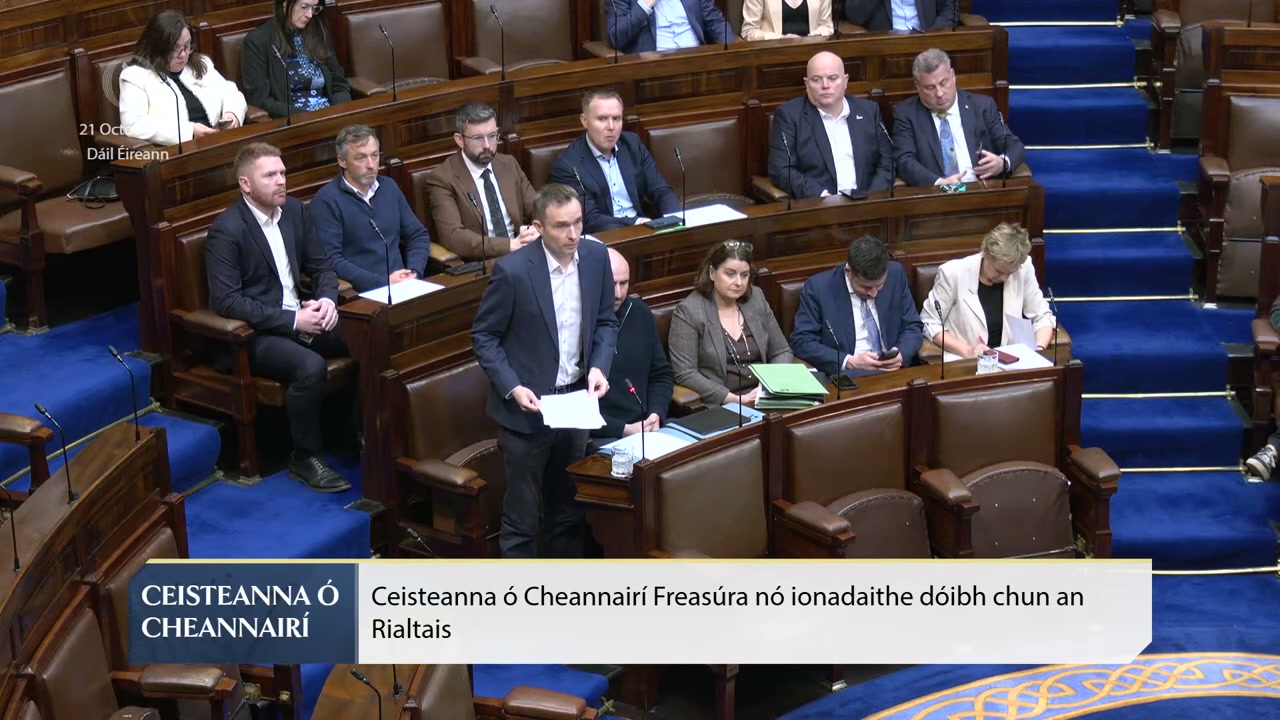
The Taoiseach described the cases as deeply serious and said the Government would work to protect vulnerable children and pursue those exploiting them. He cited rising referrals, recruitment and retention difficulties, increased funding and staffing, and plans for new step-down units. He also argued that special care policy must be considered alongside the long-term direction of de-institutionalising care.
Children without special care places
O'Callaghan referred to Irish Times reports about three vulnerable children: two girls who were being sexually exploited and a 16-year-old boy involved in drug-related criminality. He said Tusla and the Government knew of the risks, but special care places were unavailable.
Staffing shortages and closed beds
O'Callaghan said nearly half of the State’s 26 special care beds remained closed because of staffing shortages, which he said had persisted since 2018. He cited at least nine High Court judgments over the period and argued that children were being failed while successive governments had not resolved the shortages.
Questions over Tusla’s approach
O'Callaghan challenged the reported plan to reduce the number of children taken into special care, asking whether this was an appropriate response when places and staffing were insufficient. He pressed the Taoiseach to set out specific action to address the shortages and protect children.
Taoiseach’s response
The Taoiseach described the cases as deeply serious and said the Government would work to protect vulnerable children and pursue those exploiting them. He cited rising referrals, recruitment and retention difficulties, increased funding and staffing, and plans for new step-down units. He also argued that special care policy must be considered alongside the long-term direction of de-institutionalising care.
We publish thousands of recordings to make Irish politics transparent and resistant to manipulation. Spotted an error? Report it — together we are building a reliable archive of Irish politics.
Other speeches
Tego samego dnia All speeches from this day →
Mairéad Farrell
Mairéad Farrell challenges mandate to scrap triple lock
Seán Kelly
Seán Kelly backs expanding Erasmus+ after UK return
Conor D McGuinness
Conor D McGuinness calls for Triple Lock referendum
John Lahart
John Lahart argues Ireland must decide where peacekeepers serve
Barry Ward
Barry Ward backs removing the triple lock while defending neutrality
Paul Murphy
Paul Murphy challenges Taoiseach on the triple lock
Transcript
Taoiseach, the treatment of vulnerable children in the care of the state is an ongoing horror
and scandal. Yesterday the Irish Times reported from the High Court on the shocking cases of three
of these children. A 14-year-old girl whose mild learning difficulties has been subjected
to horrific sexual exploitation by multiple men. The girl has been approached by men who gave her
alcohol, cocaine and other drugs. Tuisla and the government are fully aware of the
which is happening because Tuisla is unable to provide her with a bed in a special care
unit. She is 14 years old. Taoiseach, another girl is also currently being sexually exploited
by a large number of men. She's been seen in social media distressed and under the influence
of drugs. Again this girl is also in state care. She's supposed to be protected and cared for.
Instead she's been subjected to vile and disgusting sexual abuse.
Tuisla and your government are fully aware that this is happening but you're effectively saying
you can't do anything about it. Taoiseach, another child, a 16-year-old boy, is involved
in criminality, taking and selling drugs. He was holding large quantities of heroin and crack
cocaine for older men. The Gardaíb now sees these drugs. He's in very serious danger and again no
special care place is available for this vulnerable boy. Taoiseach, you told my Social Democrats
colleague Liam Quaid yesterday that nearly half of the state's 26 special care beds remain closed
because of staffing shortages. But those staffing shortages have existed since 2018 for eight years.
There's never been a time when all 26 beds were open. How many children have been failed by the
state during all of those years? How many children have gotten hooked on drugs? How many children
have been pulled into criminality? How many children have been sexually exploited and raped?
All because successive governments have tolerated this abject failure of children
that you are supposed to protect. Taoiseach, today's Irish Times reports that Tuisla's new
plan to tackle this crisis is to reduce the number of children it takes into special care.
This is a shocking approach to take. Taoiseach, what's happening under your government's watch
is an outrage and your current approach to addressing it is not working. Hasn't worked for
the last eight years. It's not acceptable to use staff shortages as an excuse. Children are being
failed and you must act. So Taoiseach, what are you going to do to protect them and do you agree
with the Tuisla plan to reduce the number of children that it takes into special care? Thank
you.
I think the issues that were referred to in yesterday's reports are deeply serious and
extremely worrying. We are engaging, as a cross government, Minister Foley, to see, particularly
in this specific case and indeed other special care cases, some of which you have raised,
and we will do everything we possibly can to protect vulnerable children.
Those men and those people who are exploiting children need to be pursued rigorously also
and brought to justice. There is an enormous increase in demand on child protection and
welfare services. It's not an excuse, Deputy, but there are very significant issues in terms of
recruitment and retention of special care workers. In 2025 alone there was a 10% increase in referrals
and then the referrals increased by a further 11% in the first quarter of 2026 and have more than
doubled since 2014. We have responded with sustained investment, so it's not a resources
issue. We've increased Tuisla's budget to over £1.4 billion in 2027 and we've expanded overall
staffing by over 343. The special care area, as you know, serves to protect and engage with a
small cohort of young people with the most acute and complex needs. But those settings do require
exceptionally high staffing ratios and specialist expertise. There has to be at least one staff
member per child throughout the day, in addition to supervisory staff, and the unions obviously
have to be covered on a 24-7 basis. So that's seven individuals for every one young person.
Children with particularly complex needs may require up to twice that level of staffing
resources or 14 staff to one individual child or young person. Currently 15 up to 26 special care
beds are staffed. The complexity of these cases is why Tuisla have focused on workforce reform
in the last number of years and there have been changes have occurred in an effort to increase
staff numbers in terms of grading and so on like that, but I won't go into the details there.
But they were significant enough in terms of dealing with that recruitment issue and it is
delivering results in terms of those changes. Tuisla successfully filling five new social care
manager, two deputy social care manager and 20 special care worker roles as of September.
But we also have to create stronger care pathways so that young people can transition to more
appropriate settings when ready, helping to maximise the use of special care capacities.
So two new step-down units will open by the end of this year with a third opening in early 2027.
Taoiseach, I did ask you, do you agree with Tuisla's plan to actually reduce the number
of children that are taken into special care? Do you think that's an appropriate response
not to meet the need that's there, not to provide the sufficient level of staffing?
So what is your thought on that? But Taoiseach, what specifically are you going to do about this?
Because this has been happening for eight years, these shortages. There's been at least nine
High Court judgments on this over that eight years, calling out the lack of response from the state in
this and it's not acceptable. I mean staffing shortages and I'm sure there are challenges here
but they need to be addressed. You as the government and you as Taoiseach need to ensure
that those staffing shortages are addressed so that children in these dire situations get the
care that they need. So it's not acceptable to say that this is difficult and it's not getting
addressed. You've had eight years of successive governments not doing this. So what specifically
are you going to do to fix this and what's your view in terms of Tuisla's plan to actually reduce
the amount of places? I don't agree that nothing's been done over the last number of years.
The services have expanded and I just want to make the point here and we need to be careful by the
way of, and I say this now in the most objective sense, of the interaction of courts and the
Oireachtas and government and the proper policy. Like policy resides in here. What I mean by that
is there's over three decades we've been de-institutionalizing care. That's a fundamental
direction of travel which I think everyone in the house agrees with. That doesn't mean that we
don't have institutionalization. We do in this case for very specific care needs of children.
And that's where, and I remember it being a Minister of Health in the early 2000s,
where there was many court orders coming threatening jail for ministers. But actually
what was coming to us was directly contrary to the policy position that had been outlined
by the children's department or unit at that time. Just to share my point. We just need to be
mindful of that. I fully accept what the judge's decision was. I have no issue with that in terms
of sending the details to the Minister. That's fine. But I just think we, not to, you know,
we need to be very careful that we protect the overall policy idea of not institutionalizing.