

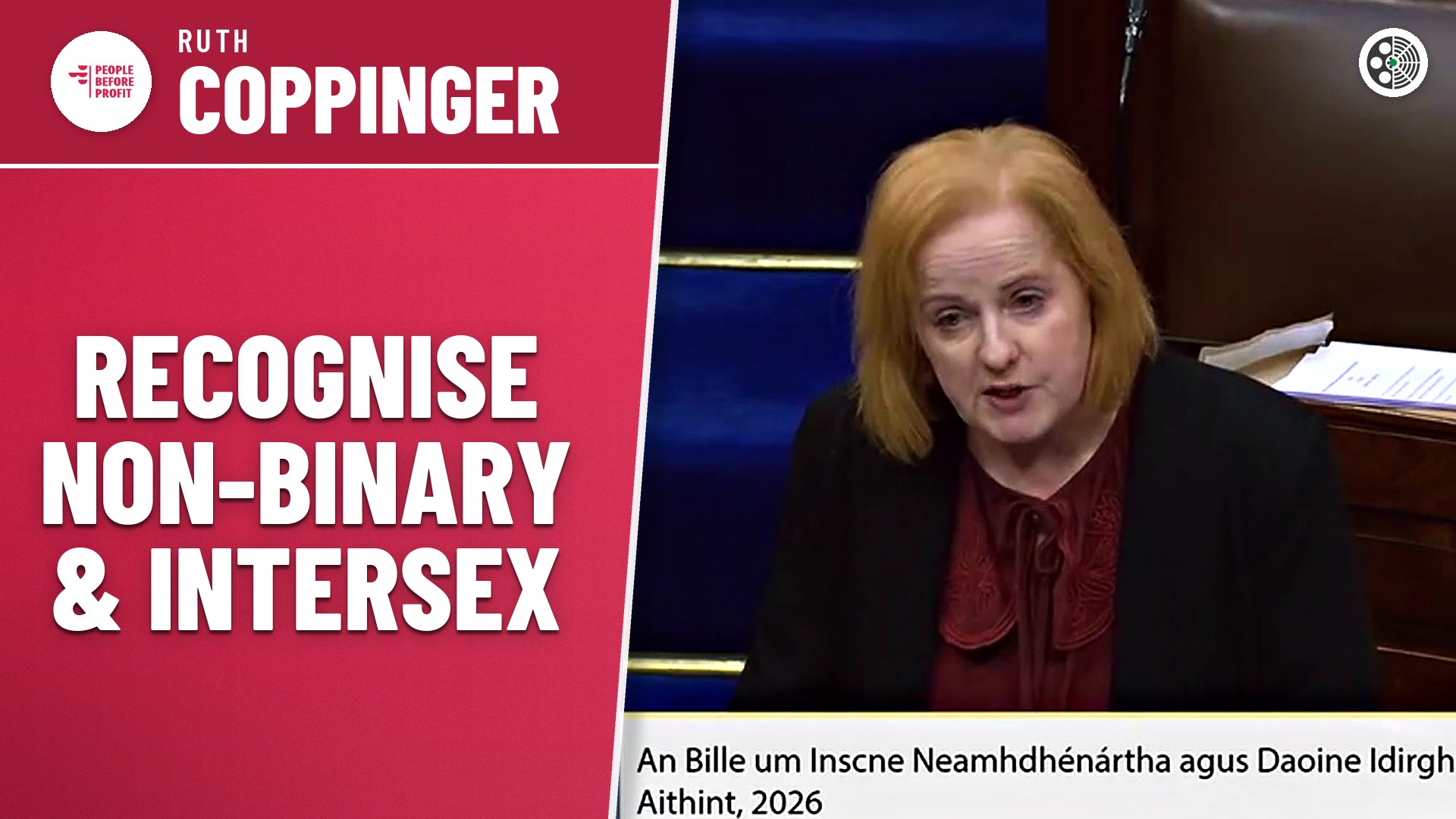


Ruth Coppinger says Ireland must recognise non-binary and intersex people
Ruth Coppinger introduced a Bill in Dáil Éireann to provide legal recognition for non-binary and intersex people in Ireland. She criticised the Government for opposing the proposal, which would add an X or other option to gender recognition certificates and allow an X on the birth certificates of intersex babies.
Coppinger said the Bill would add an X or other option to gender recognition certificates and allow a parent or qualified informant to record an X on the birth certificate of a child born with intersex characteristics. It would also provide equality before the law and protection from discrimination on these grounds. She said the absence of legal recognition affects non-binary people in healthcare, official documents and dealings with the State.
She argued that progress had stalled since the Gender Recognition Act was introduced in 2015, despite a government review recommending recognition for non-binary people. She also referred to Ireland’s October 2025 commitment to a Council of Europe directive on intersex equality, including action on unwanted and dangerous medical interventions on babies.
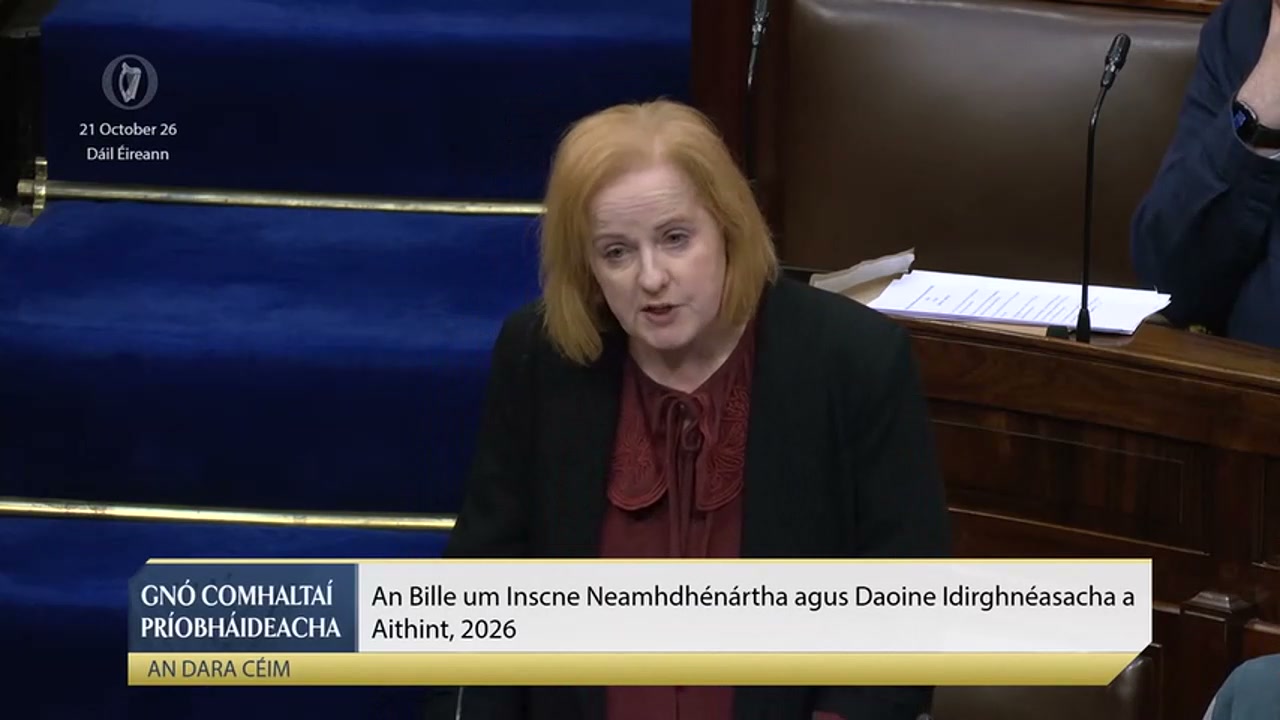
Coppinger said the Bill would add an X or other option to gender recognition certificates and allow a parent or qualified informant to record an X on the birth certificate of a child born with intersex characteristics. It would also provide equality before the law and protection from discrimination on these grounds. She said the absence of legal recognition affects non-binary people in healthcare, official documents and dealings with the State.
She argued that progress had stalled since the Gender Recognition Act was introduced in 2015, despite a government review recommending recognition for non-binary people. She also referred to Ireland’s October 2025 commitment to a Council of Europe directive on intersex equality, including action on unwanted and dangerous medical interventions on babies.
We publish thousands of recordings to make Irish politics transparent and resistant to manipulation. Spotted an error? Report it — together we are building a reliable archive of Irish politics.
Other speeches
Tego samego dnia All speeches from this day →
Paul Murphy
Paul Murphy presses Taoiseach on AI chatbot safety
Paul Murphy
Paul Murphy challenges Taoiseach on the triple lock
Paul Murphy
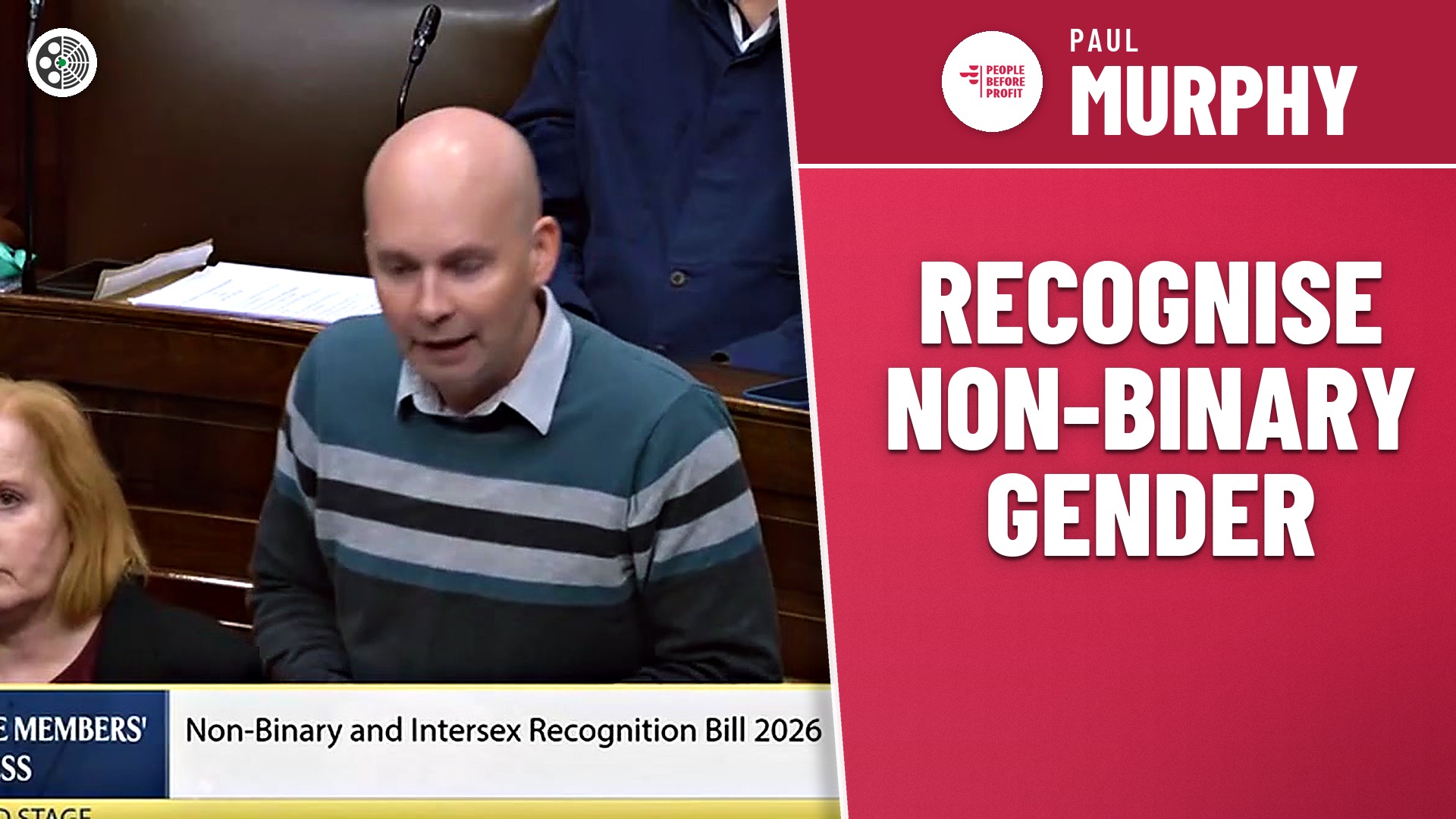
Paul Murphy: Ireland Must Recognise Non-Binary Gender
Billy Kelleher
Billy Kelleher: EU must cut red tape for SMEs
Regina Doherty
Regina Doherty warns on EU spending errors and debt
Martin Daly
Martin Daly backs stronger regulation of paramedics
Transcript
Before I introduce the Bill, I'd like to welcome to the gallery here today a huge number of
people who are representing various groups in the LGBTQI community.
So to welcome Tenny, Belong To, Intersex Ireland, Trans Healthcare Action, Shout Out, Trans
Pride and apologies if I've left Annie out, I can come back to at the end, but Minister
it gives you an idea of how desperate that people in the LGBT community are for reform
and for change and for you to live up to the promises that your party and Fine Gael and
others gave to this community.
So my Bill today proposes to give legal rights and recognition to non-binary and intersex
people in Ireland, a small minority, but who face extreme invisibility, marginalisation,
violence and discrimination in this world.
The Bill essentially does, it introduces the option of a third option on the gender
recognition certificate in addition to MNF, so the option of X or other.
Without legal recognition, a non-binary person is systematically discriminated against in
accessing healthcare, legal documents and their interactions with the state and society
in general.
For a person born with intersex characteristics, it allows a parent or a qualified informant
to put an X on a birth certificate, meaning that parents wouldn't be forced to immediately
choose between male and female.
And then it thirdly gives equality before the law and prevents discrimination on these
grounds.
Now, to be clear, in 2015 Ireland did, you know, broke new ground in allowing self-determination
in terms of gender, but progress has completely and utterly stalled since then.
And here we are now, 11 years later, with nothing done.
The review that was set up by the government at the time recommended, let's be clear, that
non-binary people would also be allowed to be recognised on the gender recognition certificate.
And to give you an idea of what it means to be non-binary in this society, it refers to
any person who identifies outside the binary of male and female.
This includes non-binary people, but also genderqueer people, anyone who sees themselves
as being outside the male and female binary.
And from talking to people, like even something as simple as, you know, booking a train ticket,
you're actually immediately asked to put Mr, Mrs, Ms, you know, so straight away in your
life this affects you.
And obviously your passport, your birth cert does not reflect who you are.
The census was a missed opportunity in terms of identifying how many people would be non-binary.
However, if up to 10% of people are LGBTQI and more and more people are identifying,
in surveys a third would say that they are non-binary.
Globally it's estimated that 2% of the world population identifies in this way.
Now what is intersex?
Intersex people are those born with innate variations of sex characteristics that vary
from the societal or medical understanding of typical female and male bodies.
Approximately 1 in 500 infants, for example, is born with ambiguous genitalia or other
variations of sex development.
But yet, and there are many, there are over 40 different types of intersex characteristics
which I don't have time to go into.
But I want to make it very clear, Minister, your government in October 2025 signed up
to a Council of Europe directive on intersex equality.
So I'm pretty disgusted to find out here today that you are opposing this bill.
That you're not going to agree to what was recommended in the gender recognition review.
And you're not going to agree to what you promised at the Council of Europe, which was
to recognise intersex people to cut out, in particular, the unwanted and dangerous medical
interventions that are being done on babies in the name of enforcing a rigid gender binary.
That's been banned in many countries, it hasn't been banned in Ireland, and this is also one
of the reasons we're putting this bill today, to recognise intersex people.
To say that that can't be enforced medically and pushed onto parents with such dangerous
repercussions for people throughout the rest of their lives.
The UN estimates 1.7% of the world has been born with some intersex trait.
So in terms of today's bill, we all know that there's pushback going on in society, Minister.
The programme for government is wishy-washy compared to even the one in 2020.
However, it does commit, very clearly, to inclusivity, to LGBT+, you know, recognition.
And yet, here's the first bill that's come before you almost two years into the dual term,
and you're going to oppose it.
So I'd be absolutely, hugely interested to hear why, and I think one of the reasons why
is that you're afraid.
I think the pushback by the far right, you know, by the extreme right, worldwide and in this
country as well, has made you fearful.
And I don't understand it, because this bill is very, very basic.
It's just recognition of the law, you know, to allow people on state documents and in
their interventions with the state.
Now, one of the things that was committed was that there will be an open and open state
departments, and still we don't have that.
We do have it in many other forms, like all the colleges, the universities are very, very
good on this, in that they do allow, in the main, certainly most of the big universities,
non-binary recognition.
But then, in so many other interactions with the state, the Department of Social Protection
and so on.
And you haven't opened up anything, and this bill is now putting it on your agenda to do
so.
There's also this myth that this is some new fad.
Non-binary intersex people have obviously always existed.
Ancient civilisations recognised multi-genders, many civilisations did, you know, from
Mesopotamia to Asia.
It's in art, it's everywhere.
And unfortunately, we have a situation where our state has the Gender Recognition Act,
which just allows people to transition from male to female, but not to non-binary, and
then does not recognise intersex people.
I just want to give an idea of how Ireland has been called out on the UN stage.
Now, we have this great, you know, the 2015 marriage equality referendum, which was obviously
a huge push forward, led by a grassroots mass movement pushed onto the establishment's
But Ireland has been called out on the UN stage for their lack of action on this.
And I think we are registering zero in terms of these issues.
So this bill is a chance for you to rectify that.
I just want to say how important this is for non-binary and intersex people.
An EU survey found that one in ten LGBTQI people had faced violence over the last five
years.
A report in UCD found a 13% increase in discrimination from 2024 to 2026.
So there's an era of hostility towards LGBT plus people.
One in three intersex people faced violence in Europe over the past five years.
And we know that Trump, one of the first things he did was to actually enforce this rigid
gender binary.
It's very important for the far right, for the maintenance of capitalism right now, not
to allow any deviation from the gender norms.
And we are seeing an increase in attacks on LGBT plus people worldwide.
We should be fighting back against this, and this bill is a key part of that.
Very important as well to say that we belong to, who deal particularly with young people,
and do.
We're coming into, after the midterm break next week, there's going to be stand-up week
in schools.
All of those schools are going to be, because I've been there myself when I was a teacher,
going to be talking about non-binary people.
But yet the state doesn't recognise them.
So children and young people in classrooms and teachers will be encouraged, quite rightly,
to recognise that.
But yet the state doesn't.
So there's a real, real problem here.
A belong to survey found that 61% of intersex people reported moderate to severe depression,
60% had self-harmed, and 74% had experienced suicidal thoughts.
How is that acceptable in our society, Minister?
And do you not agree that the state refusing to recognise people is a key contributor to
that?
I just, in finishing, want to comment on some of the issues that have been said in terms
of Tenny, who have made this point crystal clear.
All of the LGBT plus organisations are supporting this Bill, Minister, and it's deeply disappointing
to them for the government to be confronted with the first Bill and to just outright opposition.
Not a stop, not a commitment to work on the Bill and let it pass at this stage,
but just outright opposition.
No explanation sent, by the way, to the movers of the Bill.
So Tenny made the point that progress has stalled.
They have been calling for the expansion of the gender recognition process to non-binary
people, and they also said that this is causing huge problems, depression and anxiety for
many people.
I don't have time to give them, but there's many testimonials.
I'll leave it at that.
Thank you, Deputy Murphy.
Thank you.