



James Geoghegan backs 7% tax on derelict properties
James Geoghegan backed the proposed 7% derelict property tax during a Finance Bill debate, arguing that Revenue should collect it to encourage owners to bring neglected buildings back into use. He said the measure should work alongside grants and other incentives to address dereliction and increase the use of existing housing stock.
Geoghegan argued that Revenue’s role in collecting the tax could help address weak collection by local authorities. He challenged the Social Democrats’ position on the proposal while agreeing that local authorities should do more to identify derelict sites and keep their registers up to date.
He pointed to the vacant property refurbishment grant, saying more than 7,000 previously vacant or derelict properties had been restored to residential use. He also highlighted support for converting vacant upper floors above shops, including grants for refurbishment and expert advice, and referred to Dublin City Council’s record of homes restored under the scheme.
The Finance Bill sets out a 7% tax on the value of derelict properties, introduced in phases based on town and city populations. Geoghegan cited figures showing that more than a third of local authorities collected no derelict property levy in 2024, leaving an estimated €26 million uncollected.
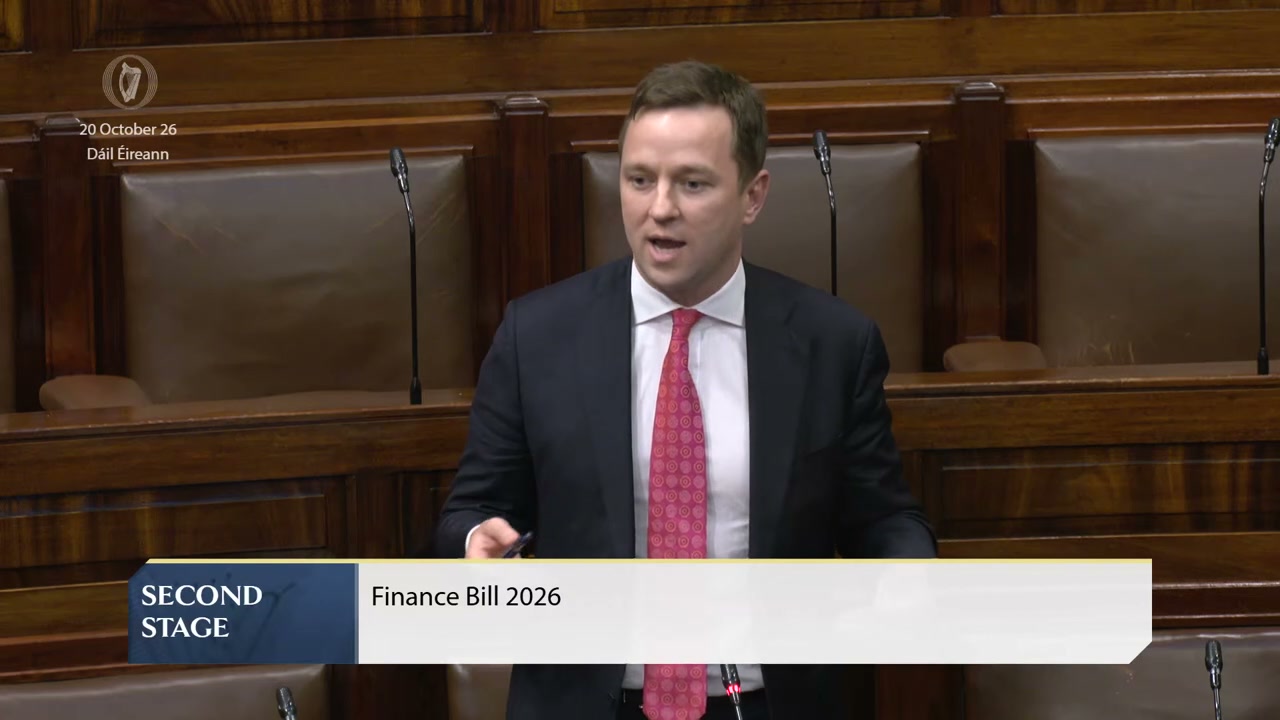
Geoghegan said the tax should encourage owners to act, rather than serve primarily as a revenue-raising measure. He argued that bringing neglected buildings back into use could support housing supply, local services and community life, while stressing that local authorities must be resourced to identify properties and apply the policy fairly. Watch the recording to hear the full contribution.
Revenue collection and local authority registers
Geoghegan argued that Revenue’s role in collecting the tax could help address weak collection by local authorities. He challenged the Social Democrats’ position on the proposal while agreeing that local authorities should do more to identify derelict sites and keep their registers up to date.
Grants to bring homes back into use
He pointed to the vacant property refurbishment grant, saying more than 7,000 previously vacant or derelict properties had been restored to residential use. He also highlighted support for converting vacant upper floors above shops, including grants for refurbishment and expert advice, and referred to Dublin City Council’s record of homes restored under the scheme.
A phased tax on derelict properties
The Finance Bill sets out a 7% tax on the value of derelict properties, introduced in phases based on town and city populations. Geoghegan cited figures showing that more than a third of local authorities collected no derelict property levy in 2024, leaving an estimated €26 million uncollected.
Housing, town centres and implementation
Geoghegan said the tax should encourage owners to act, rather than serve primarily as a revenue-raising measure. He argued that bringing neglected buildings back into use could support housing supply, local services and community life, while stressing that local authorities must be resourced to identify properties and apply the policy fairly. Watch the recording to hear the full contribution.
We publish thousands of recordings to make Irish politics transparent and resistant to manipulation. Spotted an error? Report it — together we are building a reliable archive of Irish politics.
Other speeches

Tego samego dnia All speeches from this day →
Richard Boyd Barrett
Richard Boyd Barrett Says Budget Tax Breaks Deepen Inequality
Regina Doherty
Regina Doherty calls for closer EU-UK cooperation
Richard Boyd Barrett
Richard Boyd Barrett challenges Cherrywood housing plans
Lynn Boylan
Lynn Boylan challenges EU over defence of ICC
Paul Murphy
Paul Murphy presses for Riverview school extension
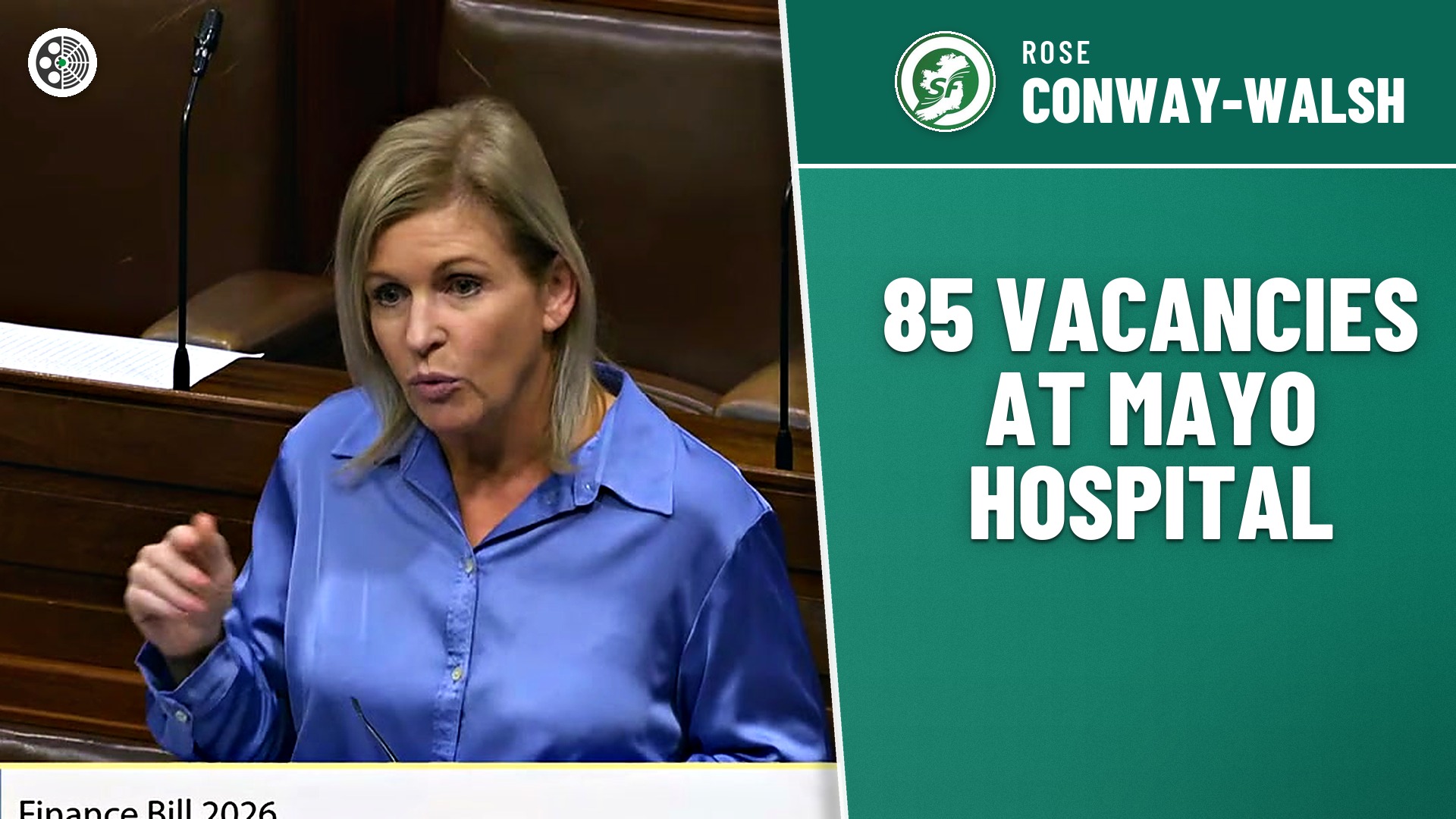
Rose Conway-Walsh
Rose Conway-Walsh: 85 vacancies at Mayo University Hospital
Transcript
Thank you Alaska and Córda. Listening to Deputy O'Hearn on the
dereliction I couldn't actually understand what his position was on the
dereliction. Like does, do the Social Democrats want revenue to collect a
dereliction site tax? He didn't actually spell that out. He spent so many
time doing sort of verbal gymnastics with himself that at one point I
felt he was arguing against himself for local authorities not doing enough to
get sites on the register and then giving out to the government for saying
actually well the revenue should be collecting the revenue that local
authorities around the country have lost to fund and to deal with the issue of
dereliction. Like what is the position? I mean personally I think this is a very
positive move that you have decided, the government has decided to give revenue
the power to collect the taxes when it comes to dereliction because we all know
and we did see this with the household charge when it was first introduced that
once revenue were given the responsibility of collecting local
property tax the initial challenges that we saw with the collection of charges
effectively evaporated overnight. We know the revenue are good at one thing and
that's collecting taxes and having the revenue doing this imposing a charge of
seven percent will do the exact thing that as I say Deputy Irons simply just
can't seem to get his mind around what the position is but it will to be not to
collect taxes. We don't want the derelict site tax to be some hugely successful
revenue raising measure for the state. We want it to be used as a stick because
the government has presented a lot of carrots. The grant, refurbishment grant,
the Living City Initiative, all of the measures that are out there and yes I'd
be the first to say and I'm sure Deputy Hearn might agree with me on this we can
probably do more we can probably be even more ambitious particularly in the city
centre with the city centre task force and I know they have great ideas of
developing over-the-shop living for cost rental housing on Middle Abbey Street on
North Frederick Street and the question of economic viability you know does the
Living City Initiative go far enough for example as an incentive could we go
further in relation to it but like let's not row about the stick here I
mean surely the Social Democrats and I presume the Labour Party and Sinn Féin
agree that it's a good idea that the revenue would collect a tax that deals
with the question of dereliction as a way of incentivizing people who own
properties in this city in our towns in our villages to activate the property
that is in ownership. Like I understand in this chamber that you have to
criticise you have to oppose but if good ideas come along like it doesn't take
much just to acknowledge that this is a good idea and yes it's addressing a
challenge that perhaps should have been addressed a lot quicker than it has to
date and that is that local authorities weren't in fact collecting the tax when
it comes to sites that were on the derelict site register to the level
that they should have been. Yes I would agree with Deputy Hearn they haven't
done enough in terms of putting enough sites on the register but to simply
throw up your hands and say I had the local authorities can't be doing that
sure what could they be doing they couldn't be putting sites on the
register I mean that's frankly ridiculous. Local councillors in every
local authority across the country should be examining how many premises
has your local authority put on the register. I know there's been a kind of
a narrow view taken in some local authorities that the investment in
personnel to go down door-to-door and to assess whether this should or should not
be on the register that that isn't a good use of resources that in fact we
should be investing our personnel resources elsewhere. But this goes to the
vitality of villages and towns across our city. It actually goes to the whole
question of social cohesion. In a situation that we are in where we are
continuing to try to drive up the amount of housing supply we have in this
country there's nothing that frustrates people more. Families walking into
villages and they're trying to look for a home and they see a boarded up
premises that has been boarded up for a number of years without the premises
being activated. Like that is a form of vandalism. It may not be graffiti or it
may not be you know smashing up windows but people who own properties, companies
that own properties in our cities, in our towns, in our villages that could
otherwise be put into active use is a form of social vandalism. And it's a
form of vandalism that becomes even more pronounced when you have a housing
challenges like we do have in this country and in this state. So I commend
the introduction of the vacant property tax as part of the Finance Bill and I
commend all of the other measures that we have introduced particularly in the
last budget and some of which have been, most of which have been extended over in
this budget to act as a carrot so that we have when the revenue comes a looking
and the owners of these properties know that we're not all about trying to tax
the hilt, we're trying to tax the owners of these properties to the hilt. We're
trying to actually encourage you if you own a property out there and that you
know that there will be a deadline in a number of months and there'll be a
deadline that the local authorities must have a newly updated register. I
suppose equally that the local authorities know that at a national level
we're setting national policy here that the government, the elected government,
the democratic government of this country has viewed as an absolute
priority the tackling of vacancy and dereliction. And I mean what we do know
is that through the carrots that we have introduced, the grants, that it has
actually borne fruit. So for example over 7,000 previously vacant and derelict
properties have been restored to residential use through the vacant
property refurbishment grant backed by over 396 million euro in grant funding.
There's been over 20,000 applications received, more than 15,000
approvals granted since the launch of the scheme in 2022 and in the
third quarter of this year the scheme maintained its strong performance
supporting the refurbishment of 809 vacant and derelict homes between July
and September. And in my own local authority of Dublin City Council it had
one of the strongest number of homes restored under the schemes, bringing
554 homes back into use so far under this grant. Upper floors of
buildings above shop premises can be an important part of the solution and as
I've already cited the example that the Dublin City Task Force are looking at
in Middle Abbey Street and North Frederick Street. Converting them into
homes can increase the number of people living in our towns, villages and city
centres and help support businesses by bringing more residents into the heart
of the community. The vacant above the shop grant which offers up to 135,000
euro to property owners willing to breathe new life into empty up floors
continues to gain traction. There was 78 applications submitted since the schemes
launched earlier this year and again this reflects an increasing interest in
town centre living and the reuse of vacant upper floor space as a means of
expanding housing supply. And I know it's not within in your domain Minister
but certainly I think we have to keep under review the successfulness of
these carrot measures in actually bringing over the shop buildings into
use and we should be as innovative and as ambitious as we possibly can
particularly in the support of the Dublin City Task Force in getting
people living in our city. Transforming older complex commercial structures into
compliant living spaces is rarely straightforward however these
conversions can be complicated. Owners may need to understand the building
condition, design, access, fire safety, planning and other requirements before
they can decide whether a project is viable. The expert advice grant is a
useful companion to that and to bridge the gap and ensure projects are viable
before major construction starts. The companion expert advice grant of up to
5,000 euro is specifically earmarked to help property owners cover the cost of
professional expert guidance on the conversion process and it is very
important the property owners out there know of these grants and that these
grants are available to them particularly as we lead up to the
introduction of revenue collecting the taxes of properties and that are placed
on this register. And the government also introduced a targeted top-up of the
vacant property refurbishment grant for entire former commercial or public
buildings that are being completely converted into multiple homes. Figures
show that there are 1,001 derelict properties across Dublin making up
around 0.2% of the overall housing stock. Collection of derelict property
levy is currently the responsibility of local authorities but more than a third
of Ireland's local authorities failed to collect a single cent of the levy in
2024 leaving an estimated 26 million euro uncollected. The introduction of
the derelicts property tax will bring more properties back into
communities across the country and the finance bill published today by the
Department of Finance has outlined the introduction of the new tax at 7% of the
property's value and this tax is being introduced on a phased basis. In the
first year of its operation the tax will apply to towns and cities which were
recorded as having populations of 4,000 or greater and in the second year of
operation the tax will expand to towns of populations of 2,000 or greater. By
placing greater responsibility on property owners to address dereliction
the new tax sends a clear message that buildings should not be left to
deteriorate indefinitely when they could be restored and returned to productive
use. Our towns, villages and city centres must be places where people can live.
Regenerating neglected buildings can help breathe new life into local streets,
protect the character of our communities and create more welcoming environments
for residents and visitors alike. This is about making the best use of places that
already have a history, identity and community around them. Reusing existing
buildings can help retain that character while adapting spaces to meet today's
needs. This regeneration must be about more than the appearance of a building.
It should help create active streets, support local services and make our
communities places where people feel they belong. We also recognise that the
successful implementation will be essential and local authorities must be
adequately supported to identify derelict properties, maintain accurate
registers and ensure that the policy is applied fairly and consistently.
Ultimately the success of this should be measured by the number of derelict
properties brought back into use, the homes made available and the lasting
improvements delivered to communities. The need for housing remains our
greatest challenge as a country and society and every effort should be made
to utilise the housing stock available. Last Ciancórla, the housing
challenge demands that we use every practical option available to us.
Building new homes is essential but so too is bringing suitable, vacant and
derelict properties back into use. We should not allow buildings to stand
businesses or help revitalise our town centres. The new levy outlined in this
finance bill will encourage owners to take action and make use of the
buildings that we already have. Thank you, Las Ciancórla.