

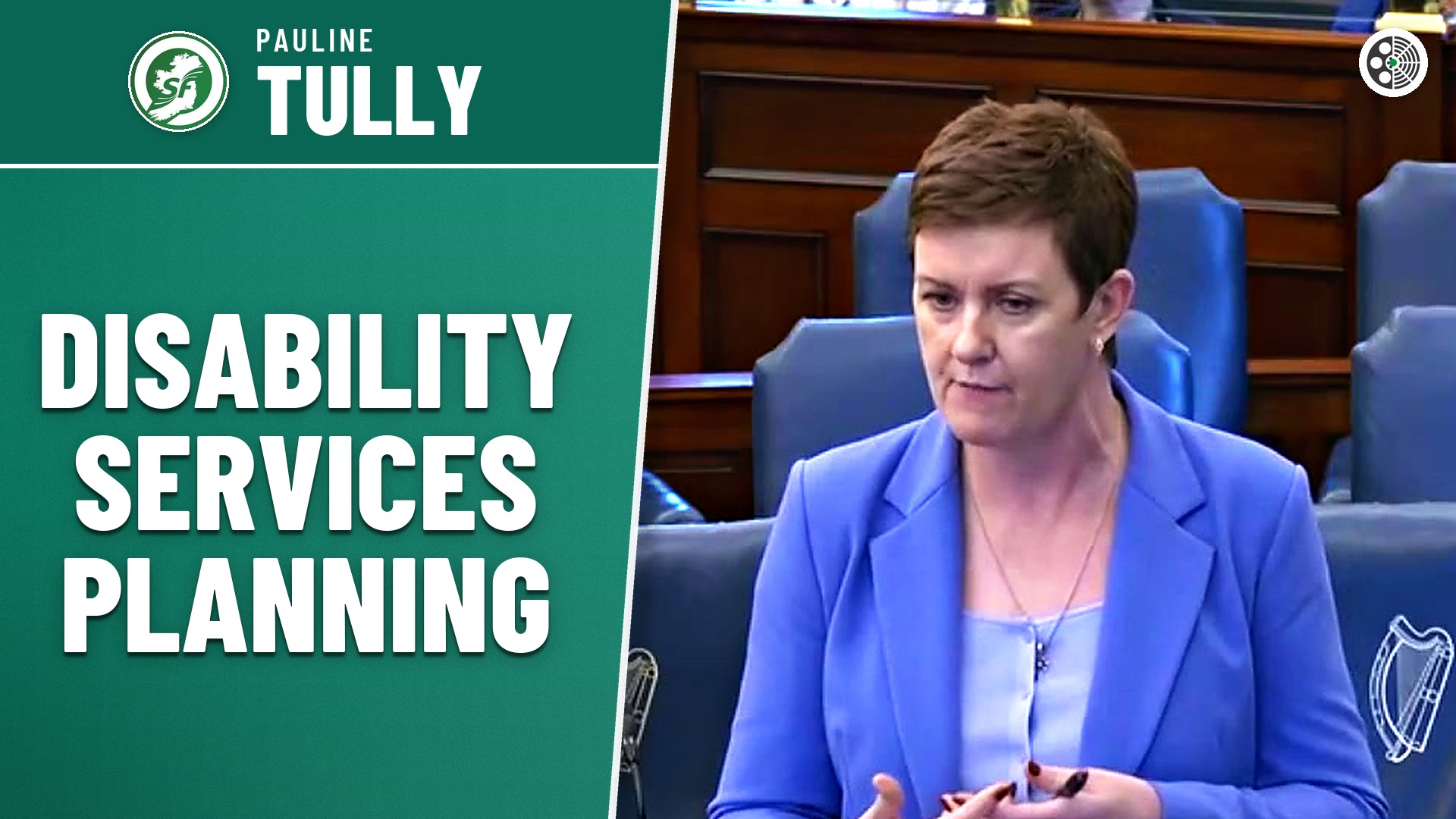


Pauline Tully: Disability services need proper planning
Pauline Tully speaks in the Dáil about gaps in disability services, including therapy waiting lists, emergency accommodation and the cost of disability payment. She calls for better planning across services and says people with disabilities must be involved in decisions that affect their lives.
Tully describes families facing long waits for speech and language therapy, psychology and autism assessments. She recounts parents paying for private assessments and therapy, and says early intervention is not reaching children who need it.
She argues that parent training, emails and phone calls should not be counted as therapy interventions. Tully says services including CDNTs, primary care and CAMHS need to work with families while providing the therapies children need.
On the Before We Die campaign, Tully says 212 new residential places were announced in the budget, with 112 for emergencies and 100 planned. She highlights the lack of centralised data on people with intellectual disabilities living with older parents, and criticises emergency-only placements and the shortage of respite.
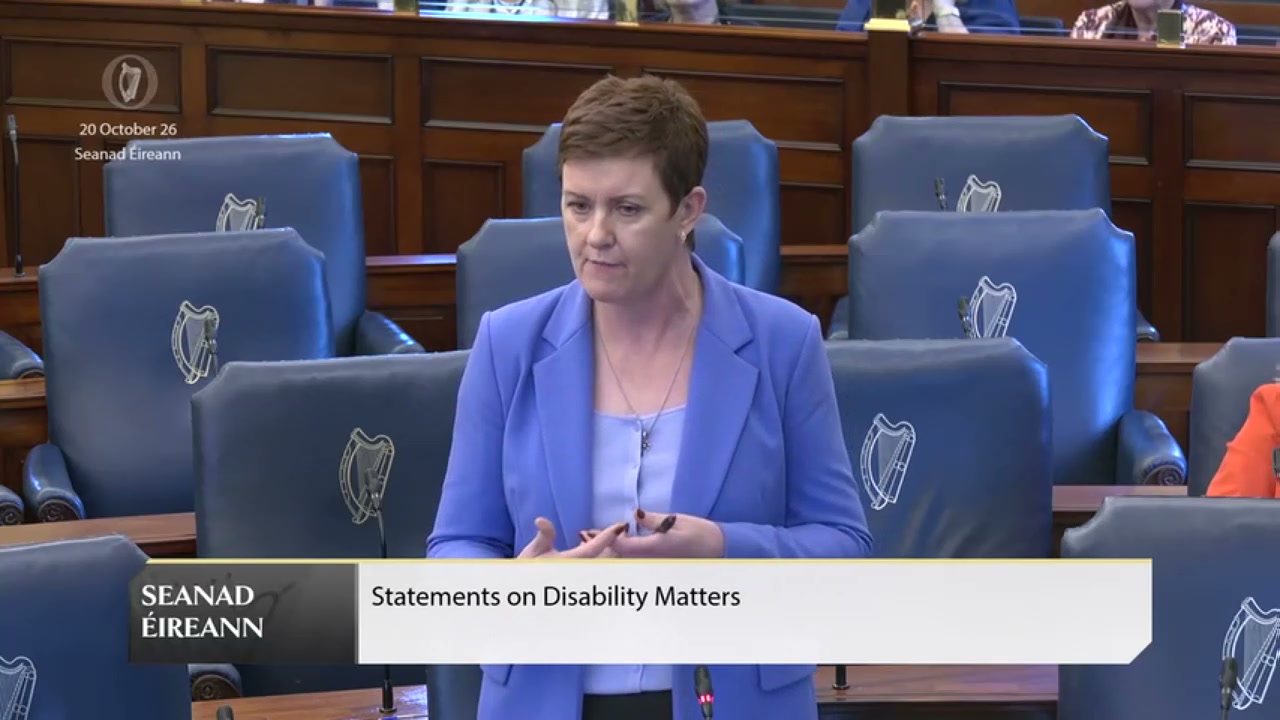
Tully questions why the cost of disability payment is limited to people on long-term disability payments, saying disabled people who work, children and older people can also face additional costs. She calls for a planned system for disabled citizens and says decisions affecting people with disabilities must include their input.
Children waiting for therapy
Tully describes families facing long waits for speech and language therapy, psychology and autism assessments. She recounts parents paying for private assessments and therapy, and says early intervention is not reaching children who need it.
Support for families
She argues that parent training, emails and phone calls should not be counted as therapy interventions. Tully says services including CDNTs, primary care and CAMHS need to work with families while providing the therapies children need.
Residential places and respite
On the Before We Die campaign, Tully says 212 new residential places were announced in the budget, with 112 for emergencies and 100 planned. She highlights the lack of centralised data on people with intellectual disabilities living with older parents, and criticises emergency-only placements and the shortage of respite.
The cost of disability
Tully questions why the cost of disability payment is limited to people on long-term disability payments, saying disabled people who work, children and older people can also face additional costs. She calls for a planned system for disabled citizens and says decisions affecting people with disabilities must include their input.
We publish thousands of recordings to make Irish politics transparent and resistant to manipulation. Spotted an error? Report it — together we are building a reliable archive of Irish politics.
Tego samego dnia All speeches from this day →
Rory Hearne
Rory Hearne: Finance Bill fails on poverty and dereliction
Paul Murphy
Paul Murphy challenges Taoiseach over lipoedema treatment delays
Rose Conway-Walsh
Rose Conway-Walsh: 85 vacancies at Mayo University Hospital
Thomas Gould
Thomas Gould: Shandon’s dereliction and vacant buildings
Carol Nolan
Carol Nolan calls for more Gardaí in Offaly
Barry Andrews
Barry Andrews urges EU action to protect ICC judges
Transcript
Minister, I engage all of the time with parents of children with disabilities and they are
at the end of their tether at this stage. Just a few weeks ago Every Child Matters campaign,
members of that campaign were outside the gates of Leinster House. It was a campaign
that started in Meath and Cavan and it has spread countrywide at this stage. Some of
them came into the room and told their stories, which they shouldn't have to do. We all love
talking about our children, but you shouldn't have to talk about your children when it's the
point of trying to highlight their disability in order that you get the supports that they
should be getting anyway. One mother told about her three beautiful sons, all who have additional
needs. Her eight and a half year old son is preferable. He's seven years on a waiting list
for speech and language therapy in the local CDNT. He didn't speak until he was five. Now,
they engaged a private speech and language therapist at considerable cost and he's
progressing really well, but he still needs support. He still hasn't got any speech and
language appointments. He's six years waiting on a psychology appointment. He was referred to CAMHS
because they suspected he had ADHD and the CAMHS kept refusing him without having even met the
child. Eventually, they did an assessment and he has ADHD, but as a result of all the delays,
and he's now on a waiting list, by the way, within CAMHS. We were told there was no waiting list in
the CAMHS section, but now, as a result, he's developed severe anxiety about issues that go
in places that he used to love to go. Her six year old son, he was with primary care. He was referred
for an autism assessment. Then they said, no, he doesn't meet the threshold. Again, they had to
source assessment for him in the private sector at considerable cost. He has DCD. He has a sensory
processing issue and he is autistic. Again, their youngest son, non-verbal. He has been diagnosed
as autistic. He has global developmental delay. They're waiting ages for a communicative device.
They finally got one. Then no training provided. They had to try and work out themselves how
best to support him. Eventually, training was provided months later and it consisted of 30
minutes in the school. That's it, 30 minutes. As Serena says, she wants to be a parent to her
children, but she's actually their advocate. She's their therapist. She's their researcher. She's their
administrator. She's fundraising. She's everything as well. She's obviously not alone. There are
many, many other parents in the same situation. Early intervention is key and yet these children
are not getting the early intervention that they need. Another mother contacted me really frustrated.
Her son finally got a letter saying he needs an appointment around speech and language therapy,
but before he could do that, she must undertake a two hour training course herself. If she
didn't, she was told this in no uncertain terms, he would be discharged from that list.
No account is taken into the fact that sometimes parents have several children with additional
needs. They already may have undertaken this training, but they have to do it again or this
child will be discharged. No account is taken of when this training is put on as well. They don't
consider that many parents are parenting alone and it could be during times when school holidays,
evening time, where they don't have childcare. We need to see whether it's CDNT or primary care or
CAMHS working with families, working together and working with families to ensure that they are
supporting them, but providing the therapies. We have things like phone calls and emails and
letters to parents being counted as interventions. They're not interventions. Parent training is not
an intervention. It's a support, all right, but it's not intervention. We want to see the children
getting the actual therapy that they deserve. In relation to the Before We Die campaign,
I believe there was 212 new residential places announced in the budget, but over half of them
are actually for emergencies, so 112 for emergencies and 100 planned. Now, we have
thousands of people. We actually don't have a definite figure because there's no centralised
data system to actually know and track people and know how many people are living, who have an
intellectual disability and are living with an elderly parent, but we know that there's at least
2,000 living with parents over 70 and maybe up to 500 of those are over 80, and 98% are housed
only as an emergency case when a parent has died, so they're trying to deal with the grief of losing
a parent. Then they are a business case. I just think this is such dehumanising language. A
business case is prepared and it's basically offered out to providers. It's like bidding,
whoever offers the best value, and then that location could be anywhere in the country. It
might be where the person has been living all their lives, where they're attending a day service,
where they have all their family, where they have community, and then next thing, as I said,
they don't cope very well with that situation, so they're medically restrained. They're doped up
to make them easy to deal with. It's a disgrace that we have no planned system for people with
intellectual disabilities in this country. We need to put one in place. This has gone on long
enough. In relation to the cost of disability payment, and I know, Minister, that's a different
department, but at the same time, you should all be working together, and you'd hope that you were,
but the cost of disability payment, as Senator Flanagan said, it's only for people on long-term
disability payments. So what about the disabled person who's working? They have considerable
extra costs, and we are trying to encourage people to go out and work. We have the worst
record in Europe for disabled people in employment, and this is a disincentive, again,
to people going and getting work. What about the families with children? What about the older
person? As I've had several older people say, oh, when I get to age 66, I lose my disability. It's
great. They're being sarcastic, of course, because suddenly it's not recognised anymore. They don't
get any supports and services. They're not entitled to the disability payment, even though
they still have additional costs of disability to address. So all of these things need to be
addressed. We need a proper system where we have services for children. We're hearing about the
increased numbers in the CDNTs, or in crime recovery, but the waiting lists are not coming
down, and the children are not getting the interventions they need. As I said, older
people are not being considered, and then adults with intellectual disabilities left living with
who are not able to look after them, and then they're put into an emergency situation.
You mentioned respite as well. I mean, respite is such a vital support, and yet many families are
not able to avail of it because they just aren't in the places available, or an emergency case
arises then, and maybe a child is put into a respite. The place cannot go home for whatever
reason, and there's no place else for them to go. That's the emergency accommodation,
so everybody else is denied respite for that length of time. Again, it's something that
needs to be addressed, and it all comes down to a lack of planning. So we need to see much
more planning done around our disabled citizens, and it goes without saying that they must be
involved in decisions that affect their lives. Decisions cannot be made without input from
people with disabilities.