

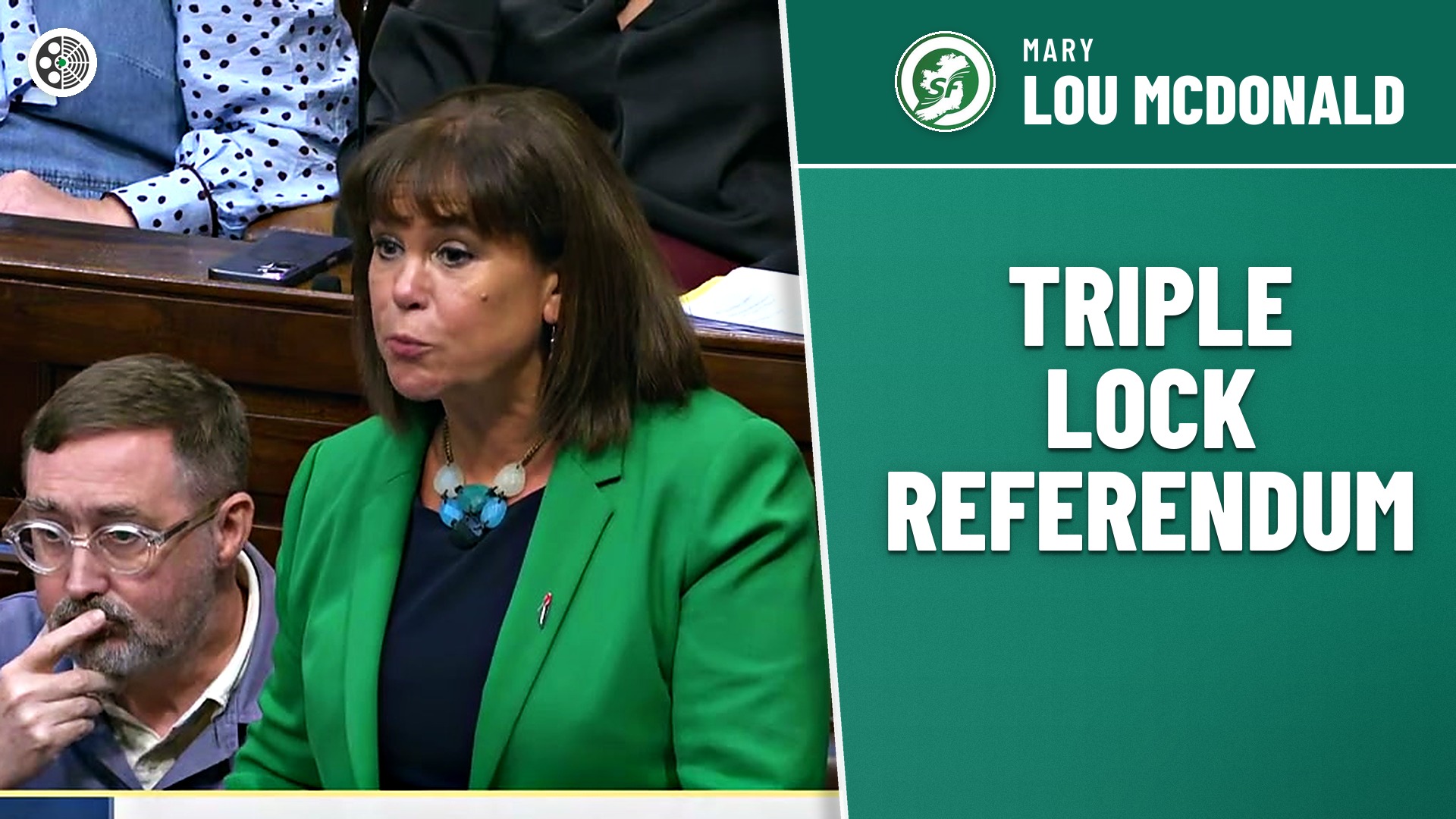


Mary Lou McDonald: Put the Triple Lock to a Referendum
In Dáil Éireann, Sinn Féin leader Mary Lou McDonald challenged the Taoiseach over the Government’s proposed legislation to abolish the triple lock on deploying Irish troops. She argued that the change would weaken Irish neutrality and called for the Irish people to decide the issue in a referendum.
Mary Lou McDonald said the triple lock, requiring a UN mandate, Government approval and Dáil approval for the deployment of Irish troops, remained central to Ireland’s neutrality. She warned that removing it could move Irish foreign policy away from peacekeeping and towards military involvement, including deeper alignment with EU military structures and NATO’s strategy.
McDonald argued that neutrality is connected to the values and identity of the Irish people, and that the Government should not abolish the triple lock without their permission. She called for a referendum, saying the decision belongs to the people rather than any government.
The Taoiseach defended the proposed legislation, arguing that it would allow Ireland to participate in peacekeeping missions, including in Lebanon, and that the change would help Ireland retain control over its decisions. McDonald responded that the Government was using a guillotine to push through legislation with long-term consequences and without sufficient debate.
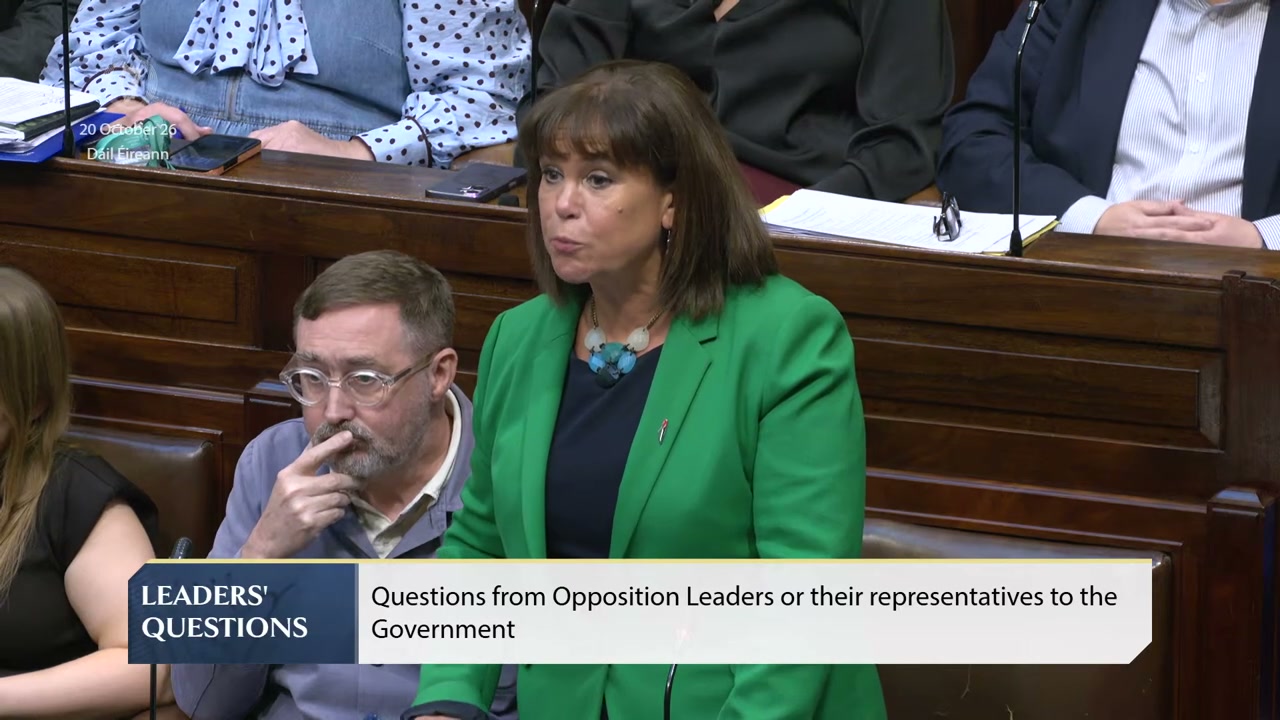
The debate also turned to the history of Irish neutrality and Sinn Féin’s record. The Taoiseach challenged McDonald over the party’s past, while McDonald maintained that the triple lock must be protected and that the Irish people should have their say.
The triple lock and Irish neutrality
Mary Lou McDonald said the triple lock, requiring a UN mandate, Government approval and Dáil approval for the deployment of Irish troops, remained central to Ireland’s neutrality. She warned that removing it could move Irish foreign policy away from peacekeeping and towards military involvement, including deeper alignment with EU military structures and NATO’s strategy.
A referendum on neutrality
McDonald argued that neutrality is connected to the values and identity of the Irish people, and that the Government should not abolish the triple lock without their permission. She called for a referendum, saying the decision belongs to the people rather than any government.
Debate over peacekeeping
The Taoiseach defended the proposed legislation, arguing that it would allow Ireland to participate in peacekeeping missions, including in Lebanon, and that the change would help Ireland retain control over its decisions. McDonald responded that the Government was using a guillotine to push through legislation with long-term consequences and without sufficient debate.
A heated exchange in the Dáil
The debate also turned to the history of Irish neutrality and Sinn Féin’s record. The Taoiseach challenged McDonald over the party’s past, while McDonald maintained that the triple lock must be protected and that the Irish people should have their say.
We publish thousands of recordings to make Irish politics transparent and resistant to manipulation. Spotted an error? Report it — together we are building a reliable archive of Irish politics.
Other speeches
Tego samego dnia All speeches from this day →
Richard Boyd Barrett
Richard Boyd Barrett challenges Cherrywood housing plans
Barry Andrews
Barry Andrews calls for closer UK ties
Seán Kelly
Seán Kelly warns wars are driving energy price crises
Pauline Tully
Pauline Tully: Disability services need proper planning
Kathleen Funchion
Kathleen Funchion says British amnesty bill must be binned
Alison Comyn
Alison Comyn calls for disability care plans and sporting discounts
Transcript
Thank you.
Fianna Fáil and Finnegal are working closely with the Irish Government to ensure that we have a fair and fair deal with the Irish people.
Listen, if you are a woman and you want to have a fair deal with your family, put the people first.
Taoiseach, in 2013, here in the Dáil, you said that the triple lock, that is the requirement to have a mandate from the UN, the Government and the Dáil for the deployment of Irish troops, you said that that was the core of our neutrality.
So why now are you pushing ahead with your plan to dismantle Irish neutrality?
Tomorrow you want to force through your bill to abolish the triple lock and you want to shut down debate here.
You want to force your bill through because you don't want proper scrutiny of this legislation and its consequences of a bill that if passed will fundamentally move Irish foreign policy away from neutrality and towards military entanglement, away from peacekeeping and towards military adventurism.
We know what's at stake here because scrapping the triple lock opens the door for Ireland to be dragged deeper into EU military structures aligned with NATO's strategy.
So the triple lock Taoiseach is core to our neutrality still.
It's the strength that has allowed Ireland to be a credible voice for peace and diplomacy for generations.
To use our experience of colonisation and oppression to always speak up for justice.
To champion a better world in a way that is unequivocally, unapologetically and powerfully Irish.
Neutrality isn't only a policy Taoiseach, it's deeply connected with the values of the Irish people, to who we are.
And that is why special neutrality protections were given for both the Nice and Lisbon treaties.
That is why we have the triple lock protection.
And now you want to walk away from those commitments and those protections.
Piece by piece, with no mandate and without honesty, your government is dismantling neutrality.
And you claim that you do this because the world has changed.
Because it's now more dangerous and more volatile.
But Taoiseach, those are precisely the reasons why defending Ireland's neutrality matters more than ever.
Adherence to international law and the requirement of a UN mandate for the deployment of Irish troops is the safeguard against military adventurism.
And dysfunction at the UN must be dealt with by reform and by strengthening the United Nations.
But it should not be used as a pretext for scrapping our neutrality.
The Irish people want no part of the military might is right agenda.
Where international law is repeatedly shredded with catastrophic consequences.
Where the European Union now pours hundreds of billions of euros into an arms race.
Our neutrality keeps Ireland outside this dangerous military race to the bottom.
It allows us to speak for freedom, human rights and justice.
To uphold the vision and possibility of a better, safer world.
And your attempt to abolish the triple lock is an enormous step.
It is literally inconceivable that any Taoiseach or government would push ahead with this without seeking first the permission of the Irish people.
Because Irish neutrality belongs to the people, not to any government.
So Taoiseach, if you are intent on abolishing the triple lock, you must have the permission of the Irish people.
You must push this question to a referendum and let the people have their say.
Thank you very much. I don't think we have time for questions.
When you look at the history of Ireland and its history from the time of Arnaill Splachas,
it is clear that perhaps the biggest theme emerging is how it dealt with in the long run in this country,
how it dealt with the situation in Ireland, and how it dealt with the situation in the whole country.
That is the biggest theme that is emerging.
A small part of the country is in Africa, and in Palestine, and I'm sorry, in Lebanon, and the rest of the world.
So it's not up to us to decide what we want to do.
And we can't do anything about it.
We don't have the power to do anything about it.
We can't do anything about it at all.
And it's up to all of us to do that in Ireland and the way you and others are doing it.
Fundamentally, peacekeeping has been one of the great manifestations of Ireland's outreach to the global world.
Not the only, but by any yardstick, one of our most significant commitments to the rule of law,
to many, many marginalized people in conflict and humanitarian crises all over the world.
The idea that we're about to abandon that is outrageously hyperbolic.
There is no balance to what you are saying, Deputy.
You use language like military adventurism, military entanglement.
Who's going to engage in military adventurism?
Do you think Doyle Airden is?
Do you think an Irish government of our?
I don't take lectures from you in terms of the conduct of foreign policy.
I've been a foreign minister on two occasions.
I invite you to go back over my record in terms of my engagement back in 2007 to then.
Frank Aitken, a member of the Fianna Fáil party, was the architect of nuclear non-proliferation treaty
and was an extraordinary minister for foreign affairs.
So Fianna Fáil takes no, and neither does Fine Gael or any other member of the government,
take any lectures from you, a party that once supported Nazism during World War II.
So you did, but you did.
Sorry, your leader, your party.
I'm sorry Taoiseach.
You can't take it.
When Eamon de Valera.
These are facts now, these are facts.
When Eamon de Valera.
Allow the Taoiseach to respond.
When Eamon.
Taoiseach, please.
I'm sorry, I'm not going to be shouted down.
Excuse me, please.
Where nobody's going to be shouted down, Deputy.
Your leader got her time.
Now allow the Taoiseach to respond.
End of.
Allow the Taoiseach to respond.
Your leader, Deputy O'Brien, your leader will respond to the Taoiseach.
It's leaders' questions.
When Eamon de Valera affirmed the policy of Irish neutrality during World War II, Sinn
Féin leaders colluded with the Hitler regime and Sean Russell was the key person and your
party leader, Deputy Mary Lou MacDonald, unveiled a statue to Sean Russell.
How dare you lecture me about Irish neutrality?
You have an inch of credibility in respect.
You and the entire lot of you.
Because for a long, long time.
Through the chair.
For a long, long time.
For a long, long time you saw any conflict that Britain was involved in as Ireland's
opportunity, right beyond World War II.
And so therefore you couldn't have given a continental about Irish neutrality for many,
many decades.
Furthermore, I would say this, and I was in the House when Russia has changed fundamentally.
Russia has changed.
Again, you don't want to hear it.
Fundamentally, what your party is now saying is that Russia, who on a daily basis are bombing
the civilians of the UK right now, should have a veto on Irish participation in peacekeeping.
And we also know that the Lebanon Unifil mission is about to end with no prospect of our participation
in it.
Because of the United States' decision to not support the continuation of peace in Lebanon.
We should be in control of our own destiny when it comes to participation in peacekeeping
missions.
Deputy MacDonald.
Well, it's true that you want Irish people to participate in peacekeeping.
That's what we want.
That's what we want today.
And the idea of abandoning our neutrality is absolutely outrageous.
You're quite correct.
And the triple lock remains at the core of our neutral position.
You were quite correct to state that in 2013.
But what we are now seeing is a very, very dangerous political sleight of hand.
You are attempting to force through by means of a guillotine legislation here that will
have the most profound consequences for the positioning of this country for generations
and generations to come.
Frank Aitken was an outstanding man.
An outstanding Irish patriot.
An outstanding South Armagh man.
And fair play to him.
He carried the torch for what is right for this country.
And for many, many decades, your party, Taoiseach, did defend neutrality.
But you have moved away from that.
And I see advancing to you the idea that a matter of this importance must be put to referendum.
And the Irish people, not you me, Hallmarkie, but the Irish people must be put to referendum.
The Irish people want us to continue to participate in peacekeeping.
They want us to participate in peacekeeping.
And the bottom line is the amended legislation that's going to...
Sorry, I didn't interrupt.
Why can you not allow people from the opposition to speak?
That is the essence of parliamentary democracy.
And the point I would make is this.
If this legislation does not go through, we will not be in a position, for example,
if we wanted to, to have some participation in Lebanon.
To be a voice, to be there as a witness to what is transpiring in Lebanon.
And in other areas as well, we will simply not.
Why? Because the party opposite, and others would prefer Russia,
to have that decision over Ireland.
Or indeed the United States, or indeed China.
And the world has changed dramatically.
And I know you don't want us to support Ukraine.
You didn't want us to allocate 90 billion for Ukraine to defend itself.
That's where you are. Fine.
You did the same when Russia invaded Crimea.
But I for one, and I think the vast majority of people, want us to keep peacekeeping.
I know our military forces want to be involved in peacekeeping.