



Cathy Bennett challenges HSE spending and hospital services
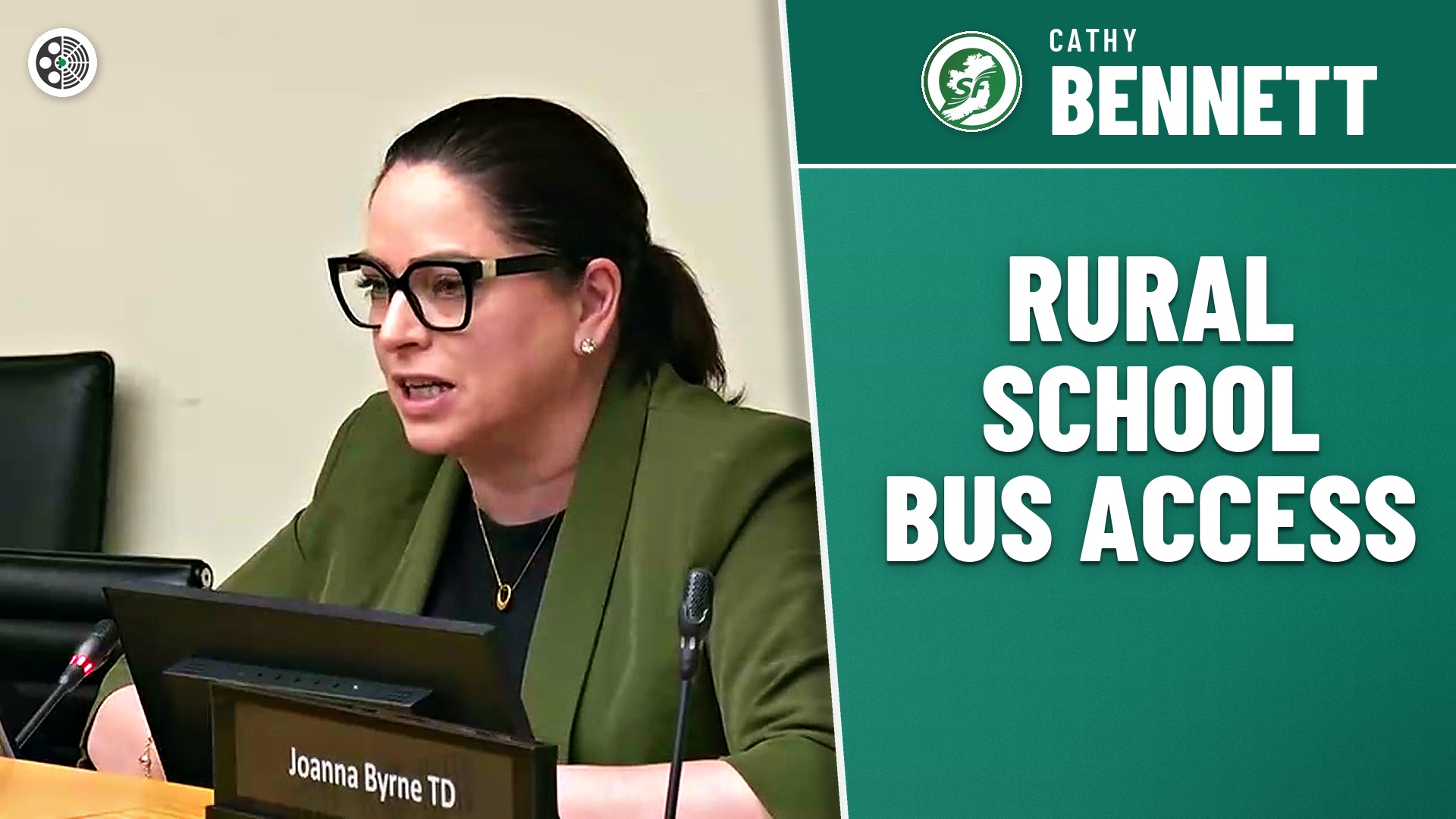
Cathy Bennett questioned HSE officials about the €252 million integrated financial management system, consultant payments and hospital services in Cavan and Monaghan during a committee exchange. She also challenged the rise in hospital car-parking income and asked about implementing a lower daily charge.
Bennett challenged HSE officials over the system’s €252 million cost, asking whether it could track consultant and staff payments and who approved a consultant payment of €910,000. She highlighted that four of the HSE’s ten highest-paid consultants were in Cavan Hospital and contrasted their salaries with the wait for an MRI machine in Monaghan.
She called for Cavan and Monaghan hospitals, 47km apart, to be treated as separate hospitals in HSE documentation. Bennett also questioned the lack of a CT scanner in Monaghan and the use of off-site and private radiology services.
Bennett said local people were dissatisfied with hospital services in Cavan and Monaghan, describing unused capacity in Monaghan alongside long waiting lists in Cavan. She asked HSE officials about the rise in car-parking income and the status of a report on hospital parking charges.
Bennett challenged HSE officials over the system’s €252 million cost, asking whether it could track consultant and staff payments and who approved a consultant payment of €910,000. She highlighted that four of the HSE’s ten highest-paid consultants were in Cavan Hospital and contrasted their salaries with the wait for an MRI machine in Monaghan.
She called for Cavan and Monaghan hospitals, 47km apart, to be treated as separate hospitals in HSE documentation. Bennett also questioned the lack of a CT scanner in Monaghan and the use of off-site and private radiology services.
Bennett said local people were dissatisfied with hospital services in Cavan and Monaghan, describing unused capacity in Monaghan alongside long waiting lists in Cavan. She asked HSE officials about the rise in car-parking income and the status of a report on hospital parking charges.
We publish thousands of recordings to make Irish politics transparent and resistant to manipulation. Spotted an error? Report it — together we are building a reliable archive of Irish politics.
Other speeches
Tego samego dnia All speeches from this day →
Joe Neville
Joe Neville calls for accountability on infrastructure projects
Roderic O'Gorman
Roderic O'Gorman challenges Budget 2027 fare hikes
Victor Boyhan
Victor Boyhan seeks more time for citizenship statements
Jennifer Carroll MacNeill
Jennifer Carroll MacNeill backs bigger role for pharmacists
Paul Murphy
Paul Murphy challenges Tánaiste over AI and privacy
Rory Hearne
Rory Hearne challenges council rent rises over mould and damp
Transcript
Thank you. Thanks very much everybody for coming in today.
Okay, I'd like to get started off. Just throughout the reports that come in from the CNAG,
I noticed that there was a huge overspends in every year and the CNAG had made reports on that every year.
In any of those years or in any of the following years, was there any
improvements in those reports from the CNAG? Maybe you'd like to answer me first,
CNAG?
As an example, the write-off on vaccines, for example, in 2024, the figure was higher.
It was much higher in 2023, so there is actually a pattern of improvement there.
That's only because of circumstances.
Well, it is, but if you're going to make year-to-year comparisons, that is what I'm showing.
But certainly with things like the three consecutive years, I've drawn attention to the very high payments
to the top earners, so there's a lot of repetition there. It may not be the same individuals,
but as well, there may be some who are repeating.
Procurement and non-compliant procurement is a systemic and persistent
problem, but I do expect to see better information about
non-compliant procurement as a result of the implementation of the IFMS.
Thank you.
So that says it all, really, doesn't it, when the CNAG says there hasn't been much of an improvement over the
last three years. So I would like to ask, then, you have now implemented a HSE
implementation of an integrated financial management and procurement system in operation. I'd like to ask, how much did that cost?
The cost of the IFMS program up to June 2026 is £252 million in total.
£252 million. So at the start of the conversation, and if you're coming in here, you said that
health matters come first within the HSE, but to me, £252 million spent on an integrated
computer system? Yeah, well, just to give context to that, that's the spend from 2017 right up to June to date, so it includes all of the
ICT capital costs, so £114 million of that is ICT capital, which is investment. £114 million is capital infrastructure.
That's investment in the backbone of the technical system.
And then we have project costs of £65 million, again, over the 10-odd years, and then our Centre of Excellence, which kind of supports that system and provides us...
An extraordinary amount of money when we are suffering in every hospital around the country, people are lying on trolleys, people are lying on floors,
and you are spending £252 million on an ICT project. That's incredible, absolutely incredible.
And I just want to say now in relation to, you have mentioned there, CNAG, about the high cost of earners.
Are there, is there wages included in this system? Can wages be monitored in this system that people, that all the hospitals, and Anne yourself,
you know right around the country how much is being spent on the consultants and on staff in every department, in every hospital right across the country.
Is that included?
Yeah, and just two things, Deputy. One is, and I appreciate it's a substantial sum of money, but I think some of the deputies mentioned earlier,
if we don't invest Ireland are bottom of the EU28 in relation to digitalisation, right across the board.
Okay, I'm asking about the consultants. Are they included in that?
The SAP system that we use for IFMS and for our HR system which is called NISRIP, it's the same system, same software.
Okay, so it's all incorporated? Everybody can see everything on the IT system?
Within rules that are there, there's clear rules for access to that information.
So who was the first to see about the consultant that got paid £700,000 was it, or £600,000 plus overtime, so he got a total of £910,000.
Who first seen that? Or how was that, who approved it?
So I think we heard earlier how at a regional level, so that is approved at a regional level in terms of the requirement for that consultant.
So does that come across your desk Ann?
In terms of, no, so that is approved.
You don't have to approve it?
No, the regional executive offers to approve it, so for example Martina in her area is OREO.
Okay, and Martina is in which area?
I'm in Dublin.
You're in Dublin, and you approve this amount Martina?
That was a different area.
That was in?
£900,000, you're referring to, I think the CEO said earlier, it was Cavan.
In Cavan, okay. That's the area I come, Cavan and Monaghan, and we are dying for services, absolutely, in Cavan and Monaghan.
The people, we can't cope. We have one hospital for Cavan and Monaghan, which are 47km between.
The HSE continue to call Cavan and Monaghan one hospital. We're 47km between the two hospitals.
And you're telling me today that you paid £910,000 for one consultant in Cavan Hospital.
You've also told me today, in the documentation here, that there was four other consultants paid such high salary close to this.
Was that also in Cavan Hospital?
So we know that four of our top ten earners are in Cavan Hospital.
So they're in Cavan Hospital. It's extraordinary.
Do you know how long we're waiting to get an MRI machine in Monaghan Hospital?
18 months. 18 months. And yous have paid four consultants. Four consultants.
It's absolutely shocking. Shocking. Shocking that this amount of money would be paid to consultants.
And we have no, we can't get staff in Monaghan Hospital.
We have a perfectly good hospital in Monaghan, and it's not being used to its full capacity.
Brilliant staff there, but people have to travel 47km to Cavan Hospital,
where four staff, which Anne, you have not monitored, and you have not seen what they have been paid,
through the system, that you paid £252 million for.
Just to say, they were the 2025 figures, but also just to say that the second MRI in Monaghan has the business case, but that has been approved.
Oh, it has been approved, but it's 18 months away before we get it. 18 months.
What about the CT scanner in Monaghan Hospital?
So I think that is not, so I don't think there's a second CT scanner going on.
Because when I've wrote about it, I've been told that it's going to be put in place in Cavan Monaghan Hospital.
This is the terminology that the HSE use. Cavan, Monaghan.
They are two separate hospitals. Two individual hospitals.
And I would ask, in any documentation that I get going forward, that they are referred to as two separate hospitals.
They are not one hospital. They are 47km apart.
I think, Deputy, in terms of the CT scanner, as I understand it, clinically it is felt that because it's a Model 2 hospital,
it is not appropriate to have a CT scanner there. That's what I'm advised, just from the clinical perspective.
Well, who's advising you, Anne? You're the director. You're the CEO.
Who is advising you?
At a regional level, there's a kind of an executive...
But you're the CEO.
Absolutely. But in terms of the clinical appropriateness of a CT scanner in a Model 2 hospital, I would be advised by clinicians on that.
Yes. So I want to ask you about your clinicians, then, in relation to radiography.
I read an article there recently, and I heard you mention it, Damien, there as well, in relation to radiography,
that you welcome the outsourcing of radiography.
Should we not have our services in-house?
I didn't say that, Deputy.
What did you say?
What I said is that the advantage of the National Imaging System is that it gives us access to all the images, be they public or private.
And the reason that's important is we don't want patients getting scanned twice, and all of our system, the public system...
So the HSE don't have to do it?
We provide an excellent radiology service in the HSE, and we continue to do so.
I'm saying the reality is some patients do go private.
We want to have all the images in one place, so that people don't have to get scanned twice.
A simple example would be if someone goes private and gets that done, they come into the public hospital...
No, you're advocating for them to go and pay privately, so they have premium.
Absolutely not. I'm just saying...
I just want to ask you, who reads the radiography? Who reads all the scans from that?
Is it like, do you read them in-house? If you perform radiography, does it happen in-house?
Yes, a radiographer will take the image, and the radiologist reports on the image. That's the way the system works.
And where are they read?
Well, actually, with the advantage of the NIMIS system, images can be read either on-site or off-site.
Off-site. So off-site, where are the scans being read?
Either on or off-site, Deputy.
Yes, off-site, where are they being read? Who's reading them off-site?
It depends on the particular situation. By off-site, I mean a radiologist can actually read it from home.
So if there's a late-night call, they're able to look at that image and get a better result quickly.
So you're not getting radiology reports or whatever, you're not getting them read abroad?
That's a different matter. I think you might be referring to probably a report that's out in the paper today in relation to images read overseas,
in relation to a consultant by a private operator. Yeah, that's through a private operator.
So, I know, but you're here advocating for private operators that you would take those scans and you would use them in-house.
But you're telling me, on the other hand, that you're not using them, but you are using them.
I'm not advocating for people to do that. I'm just saying the reality, Deputy, is we want to make sure that patients,
if they get an image, it's read once. If they do go to a private facility, that's their choice.
And we make sure people aren't scanned twice when they come into the public system.
That's our objective, to increase the connection so that all of the images in Ireland are available.
And that's the safest thing. That's the advice from our colleagues in terms of the clinical leads on radiology and around the country.
Okay. Well, I can just tell you, from the people of Cavan and Monaghan,
we are not happy with what we are being offered in Cavan and Monaghan in relation to HSE, in relation to hospitals.
We want two separate hospitals. There's huge waiting lists in Cavan Hospital.
And Monaghan is sitting with loads of rooms available that it could be used and it could be operated.
Things could be happening in it, but that is not happening at the moment.
In relation to hospital car parking fees, I would also like to ask again,
car parking fees doubled from 2021 to 2025.
It actually went up, at least doubled.
£7.39 million was taken in in 2021 and £17.76 million in 2025.
There was a report done on this, because the hospitals are ripping off sick people as it stands.
So I would ask you, where is that report? What has happened to that report?
And are you going to stop the hospitals, Anne?
Are you going to stop the hospitals charging people parking in their car parks?
Do I have to actually cover this earlier? So yes, there was a report in 2018 that has not been fully implemented.
And we know that there are different prices and different charges around different hospitals.
We have instructed that all sites work to bring back to the €10 a day charge.
There's implications clearly in doing that.
And I have asked our National Director for Strategic Infrastructure to head up a group,
which is actually going to meet next week, I think, to look at the implications.
So we have to take the 2018 report, but critically we have to drive the recommendations.
Now some things have changed in that period of time, so we have to take stock of that.
But in parallel, we have to drive the implementation of the key recommendation around the reduction in the charge.
Thanks for that, Deputy Bennett.
Thank you.