



Paul Murphy challenges water charge delays and data centre figures
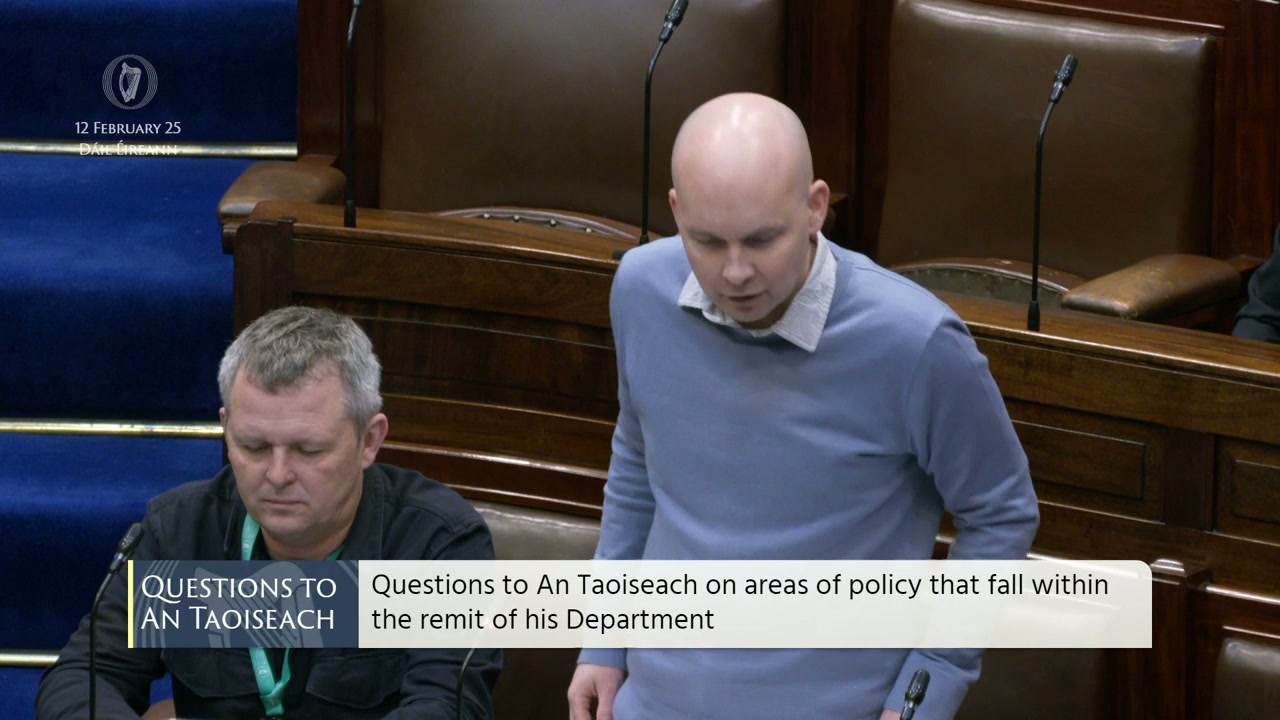
Paul Murphy questioned water service officials about excess water charges and data centre water use during a recorded exchange. He challenged the delay in implementing excess usage charges and pressed officials on conflicting figures, data transparency and past metering discrepancies.
Murphy pointed to the Water Services Act 2017 and a 2024 plan for excess usage charges, asking why the charges were not being implemented. Officials said the necessary statutory instruments and government policy were not in place, and that the charges were not in the programme for government.
Murphy asked whether data centres had been asked to conserve water during summer pressure on the water system. Officials said demand was generally steady, but acknowledged that one water-cooled data centre had increased overall data centre use. Murphy challenged the figures given, including claims that data centre use made up 0.3% of water consumption.
Murphy asked for detailed figures on data centre water use and argued that individual usage should be published, rather than only aggregated figures. Officials said the data centres connected to the public network were metered, while some facilities used their own water sources, and cited commercial sensitivity as a reason for aggregating figures.
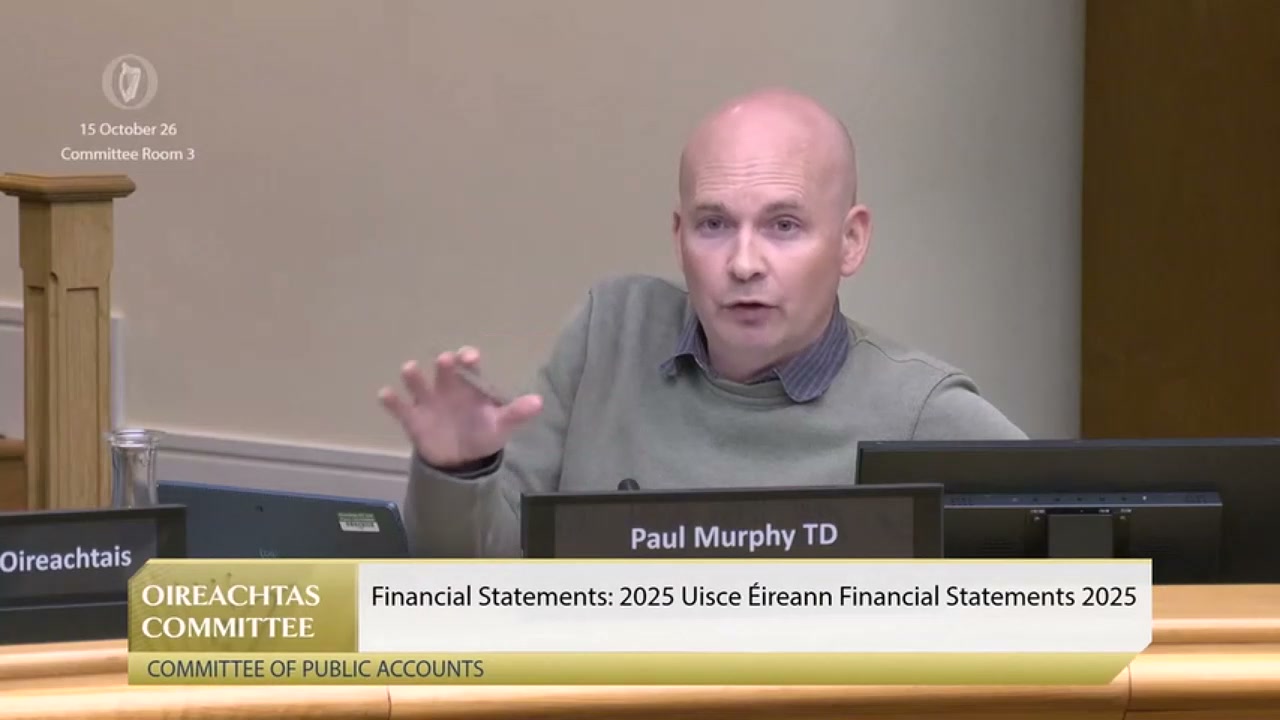
Murphy also challenged a discrepancy between Irish Water figures for 2021 and Meta’s reported use at its Clonee data centres. Officials acknowledged the earlier figures were wrong and said meters had been replaced where they were stopped or under-recording. Murphy asked whether users had been pursued for water that may not have been recorded.
Excess water charges
Murphy pointed to the Water Services Act 2017 and a 2024 plan for excess usage charges, asking why the charges were not being implemented. Officials said the necessary statutory instruments and government policy were not in place, and that the charges were not in the programme for government.
Data centres and summer demand
Murphy asked whether data centres had been asked to conserve water during summer pressure on the water system. Officials said demand was generally steady, but acknowledged that one water-cooled data centre had increased overall data centre use. Murphy challenged the figures given, including claims that data centre use made up 0.3% of water consumption.
Usage figures and public disclosure
Murphy asked for detailed figures on data centre water use and argued that individual usage should be published, rather than only aggregated figures. Officials said the data centres connected to the public network were metered, while some facilities used their own water sources, and cited commercial sensitivity as a reason for aggregating figures.
Past records and meters
Murphy also challenged a discrepancy between Irish Water figures for 2021 and Meta’s reported use at its Clonee data centres. Officials acknowledged the earlier figures were wrong and said meters had been replaced where they were stopped or under-recording. Murphy asked whether users had been pursued for water that may not have been recorded.
We publish thousands of recordings to make Irish politics transparent and resistant to manipulation. Spotted an error? Report it — together we are building a reliable archive of Irish politics.
Other speeches
Tego samego dnia All speeches from this day →

Michael Fitzmaurice
Michael Fitzmaurice challenges EU forestry regulation
Aengus Ó Snodaigh
Aengus Ó Snodaigh: Kathleen Lynn deserves hospital recognition

Joe Neville
Joe Neville presses Irish Water on profits and Kildare pipes
Richard Boyd Barrett
Richard Boyd Barrett: Workers deserve a decent pay increase
Jennifer Carroll MacNeill
Jennifer Carroll MacNeill backs Kathleen Lynn lecture theatre

Brian Stanley
Brian Stanley presses for Portlaoise Hospital bed capacity
Transcript
I just want to start with excess usage charges for domestic users of water.
Where are you at with the implementation of those charges?
They're, I guess, with the department, but they're not being implemented at the moment.
I know that.
Thanks.
I welcome that.
It just seems strange to me, and I wonder, is it strange to you that you have, for example,
a full plan from September 2024 for the implementation of these excess usage charges, I think approved
by the CRU, and yet you're not implementing these charges.
So go on.
Sorry, are you talking?
Is the Ishkar and water charges plan scheme of approved charges applicable from 1st of
That was always subject to government approval.
So that plan wasn't approved by the government.
And I mean, we have a situation, obviously, the whole public was told that water charges
in general, or excess usage charges at the very least, were required under EU law.
We have the Water Services Act of 2017, which provides for it.
We have a plan here, and yet excess usage charges aren't happening.
As the people set up to collect these charges, that obviously I'm against.
I mean, have you been asking any questions of the government about what's happening?
It's just a policy decision, so we're just waiting for that decision.
And do you have any policy from the government?
Do you have a policy saying not to do it, or a policy, you just don't have any policies
from the government?
It's with the Patron, do you have any latest update on that?
No, no, essentially, we can't carry out something that there's not a policy for, so we've no
plans to implement it at this present time.
Mark, is there a representative here from the department?
Oh, sorry, yes.
The department can tell me, thank you.
There's a legislation requirement, there's two statutory instruments that need to be
implemented in terms of additional allowances for additional people within households, and
for a medical need.
Currently, it's not in the programme for government, and it doesn't foresee implementing the charges.
It's peculiar, isn't it, that we have a law that's passed that says charges are to be
implemented, and yet the department isn't implementing the statute you implement.
Yeah, well, it's not in the programme for government, so it's not part of the policy
at the moment.
And this document back from the one that referred to 2024 to 2025 refers to a legal framework
needing to be in place.
Did that legal framework ever come into place, or is that precisely what we're talking about
here?
It's coming to that, yeah.
Okay, okay, that's the legal framework that is missing, is effectively a couple of statutory
instruments.
Okay.
Okay, I want to move on, thanks a lot, to you speaking earlier about the kind of stress
on the water system over the summer, that we were fortunate that the winter was relatively
wet, fortunate in this sense at least, and that meant we didn't tip over the edge, combined
with householders responding positively, responsibly to the call to conserve water.
Was there any similar call and ask made of data centres to conserve water at that time
of high stress on our water system?
I mean, the latest data centres are not big consumers of water, and there's no fluctuation
between colder weather and warmer weather, or drier weather and wetter weather.
So there isn't, we don't, you know, we can see from the general public that they can
respond and they can make behaviour adjustments.
For industry and commercial industries, it's much more difficult.
I don't know, Sean, if you want to talk about the latest data on data centres?
So look, despite, we know for a fact that the spike in demand during the summer, during
the drought, at the start of the drought was domestic in nature, and that generally non-domestic
or industrial users are fairly constant in what they require.
Essentially across the country...
Can I just put it, put one of you, I mean, these figures come from Irish Water, that
data centre water use has doubled during the summer months.
You're saying that's inaccurate?
On very, very warm days, they would actually demand a bit more, but the most they ever
demanded was about six megalitres.
That's mostly in the Dublin area.
The journal that I have a report here saying data centre water use almost doubled during
Ireland's long hot summer months, and there's a graph which says the source is Aisgeirin,
and it says that the water usage went from 100 million litres presumably per day up to
over 200.
That was in April, up to over 200 million litres in July.
Most that the data centres used was six million litres of water per day.
Okay, so this might, maybe this must be per month, but sorry, is the usage constant or
did it double over the summer?
It went up substantially in one particular data centre because they are predominantly
water cooled and that data centre was in place before Aisgeirin was in place.
Once we came online, we actually said to incoming data centres that we would no longer supply
water for cooling, we would only supply water for domestic purposes.
But the impact of this one data centre then was to double the overall use.
So why a minute ago did you tell me that this use is constant?
It's pretty constant across all of them except for that one, yeah.
So we just don't count the one that actually uses all the water?
No, no, no, I'm sorry, you just told me a minute ago that data centre usage is constant
and now you're telling me that it doubled.
So I mean that's, and you got to this conclusion because you excluded the one that actually
uses all the water.
It doubled.
Yeah, so it went from five to six.
What I'm saying is it's not significant in the context of other consumption.
Five to six isn't doubling, sorry.
No.
Did it double or did it not double?
No, no, overall data centre consumption went from five megalitres to six megalitres because
one particular...
But these figures suggesting a doubling of monthly usage from what must be 100 million
to 200 million per month.
No, we didn't see that.
So it's not accurate to say water use doubled during summer months of data centres as a
whole, including the one that uses all the water?
That's not my understanding, so I think we'd have to check your figures and compare them
against ours.
They're not adding up to what we are understanding.
Yeah, we can check that, absolutely.
But in the overall context of Dublin, the data centres are not a burden.
And there was no ask on them to reduce their usage?
No.
No.
And in the future could there be an ask on them or say other like big industry, pharmaceuticals
in particular, which use a lot of water?
There might be.
I mean some pharmaceutical companies and some other large biotech and technical companies
have come to us and were in active discussions about the reuse of water.
So instead of actually putting it down the drain, they've actually put in a recycling
system.
Just the article says close to 17 million litres of water per day were used by data
centres connected to the public water supply during May, June and July of this year, compared
to 9 million litres of water used by the same data centres during the first four months
of this year.
You're saying that's inaccurate?
Most we saw on any given day was 6 megalitres.
Okay.
How much?
You might come back to me with the details of that.
If you can look at this article, it does say it's based on Ishka Arun results.
Do you have the figures of data centre water usage?
Can you tell me a list of, here's all the data centres and this is how much they're
using per month, per day, per year?
They are all metered, yes, and we have that data.
And I've seen it reported that only something like 54 data centres are connected to Ishka
Arun.
Is that accurate?
No, there's more than that.
I think it's somewhere in the mid-80s.
So one question is, what accounts for the discrepancy between the mid-80s and the at
least 123 data centres we have in the country?
I understand that lots of them would not be using, they might have closed loop systems
or there might be air cooling.
So they may not be using it for cooling, but you're saying most of, even the 80 aren't
using it for cooling in any case.
So how come 40 aren't connected at all?
I mean, do they not have any bottled water?
They would have their own water sources.
They would have their own wells.
And would use that for potable water as well in terms of a canteen or whatever?
Yeah, okay.
And obviously that whole issue of abstraction is not you, that's the EPA.
Do you publish these figures in terms of the data centre usage?
We publish aggregated figures.
Why don't you publish individual figures, which I think, not that you're required to,
but we, Ireland, is required to have these publicly under European directives.
I would imagine the reason why we aggregate everything is because if we publish individual
figures of the top five or ten large users, that it might be confidentially sensitive
to their operations.
Yeah, I mean, I would ask you to publish not just the top five or ten, but publish them
all.
And I think that is required.
I don't think it's fully implemented in Irish law.
We haven't transposed the directives.
But it's going to be coming.
Okay.
Well, can we look at that?
If the directive comes in, certainly, and we're obliged to publish, we'll publish.
We're not, but we're just, you know, this is billing information.
So it's commercially sensitive.
And have you been contacted, communicated with, lobbied by tech companies on this issue
of disclosing their usage of water?
No.
No.
This is an internal decision.
No communication.
As deputy, the key thing when we looked at this here is because the consumption for new
data centres is so small, it's just non-consequential to us in terms of what we are doing.
And so, for example, the figure was given during the summer of they use 0.3% of all
your water.
You would still say that's the accurate figure?
And even at that stage, it was saying 57 data centres connected to public water supply.
Even though you've gone up now to 80-something, you're still sticking with the 0.3%?
The ones I would imagine that are above that are very, very small users.
Yeah.
They only use it for canteens and flushing toilets.
And then you're telling me there is only one which is using a kind of open loop system
in terms of cooling, which is the big user?
Correct.
And could you, just in terms of your figures, right, in 2021, you publicly were saying that
only 0.13% of drinking water supply was being used by data centres, 810 megalitres.
But the Dublin Enquirer reported last year that in 2021, Meta reported that just their
data centres in ClonE used 928 megalitres.
So there was one data centre saying we're using more than what you were saying, all
the data centres were using together.
How do you explain that discrepancy?
So what we've done in Nishgairden is we've actually set up an individual independent
water network management directorate, essentially, under myself.
And we did a very, very thorough survey and investigation of all the data centres that
are connected to our network.
And in some cases, meters were under-recording or they were stopped.
So we had to replace those meters.
And the data that we have now in 2026, we're quite confident it's very accurate.
So just for one second, I mean, you're saying basically that they, Meta, underpaid then
for the water they were using?
Did you ever chase them up for the money they didn't pay if the meter was stopped?
It was very hard.
If a meter is stopped or a meter is under-recording, it's very hard to prove what they used before
you fixed the meter.
Did you ask them to make any contribution?
No.
So they used some water that they didn't pay for?
If a meter is broken or under-recording, we make an allowance based on, essentially, what
we thought they were using, and they're charged on that basis.
But ultimately, if a meter is under-recording or it's broken, it's up to us to fix it.
How long was the meter, first, was it stopped?
Was it just not recording anything or was it under-recorded?
I can't comment on Meta because I'm not certain that theirs was broken or under-recording.
I suspect it wasn't because it's such a large user that we would always have them taped.
But then that doesn't, if it isn't Meta, then it doesn't explain the discrepancy.
You said publicly 810, Meta reported 928, just by one.
Yes, that's in 2021.
Yes.
Yeah.
So, as I said, I mean, ultimately, there are other large users.
Now, Meta is half of what's used, but there are other large users in the area.
Sorry, but your figures were wrong then in 2021.
You're accepting that they're wrong?
Yes, absolutely.
But you're confident that the figures you're giving me today are right, even though they're
different than what's reported and what is based on figures you've provided previously?
Well, what's in the journal is incorrect.
We never saw 9 or 18 on any given day.
We saw 6.
Okay.
Thanks a lot.