



Michael Fitzmaurice Questions Farmers’ Duties Under EU Regulation
Michael Fitzmaurice questioned officials about the EU deforestation regulation at a committee hearing, focusing on its application in Ireland and its implications for farmers. He sought clarity on whether Irish representatives could change the rules, how forestry is defined and what cattle farmers must declare.
Fitzmaurice pressed officials on whether the committee could reject or stop the regulation, which they said applies across the EU. He challenged what that means for Irish decision-making and raised concern that later changes could affect how the rules operate.
He questioned whether naturally growing trees on rough or boggy ground could lead land to be classified as forest, potentially affecting farmers who clear it to return it to grazing. An official said the definition in the regulation would determine whether land qualifies and agreed to look into the example Fitzmaurice raised.
The discussion also covered the regulation’s requirements for timber and cattle. Officials said small and micro businesses would use a simplified, one-off declaration, with a system being developed to submit declarations for farmers.
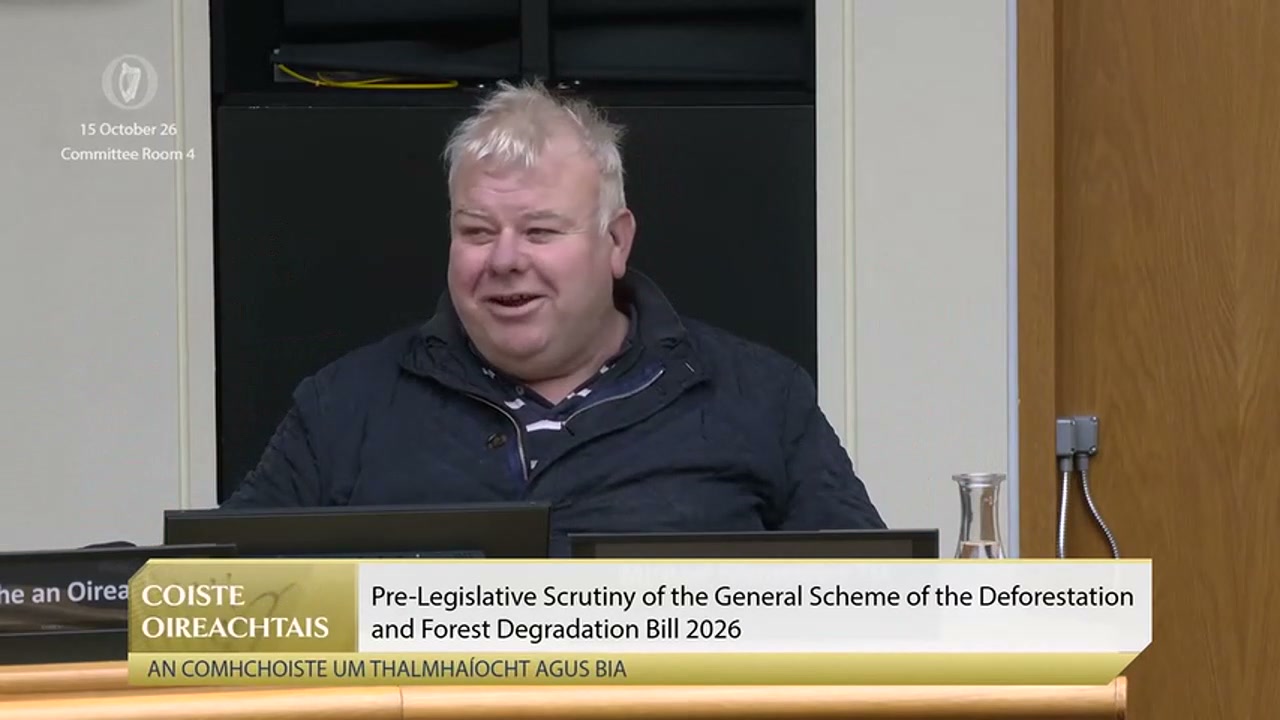
Fitzmaurice asked whether a cattle declaration could affect farming on peatland or be tied to future rewetting. Officials said the regulation discussed at the hearing relates to forestry and deforestation, not wetlands, peatlands or rewetting. Fitzmaurice said he was concerned about farmers signing a declaration without clarity on its implications. Watch the recording to hear the full exchange.
EU regulation and Ireland’s role
Fitzmaurice pressed officials on whether the committee could reject or stop the regulation, which they said applies across the EU. He challenged what that means for Irish decision-making and raised concern that later changes could affect how the rules operate.
Forestry definitions and rough land
He questioned whether naturally growing trees on rough or boggy ground could lead land to be classified as forest, potentially affecting farmers who clear it to return it to grazing. An official said the definition in the regulation would determine whether land qualifies and agreed to look into the example Fitzmaurice raised.
Declarations and cattle traceability
The discussion also covered the regulation’s requirements for timber and cattle. Officials said small and micro businesses would use a simplified, one-off declaration, with a system being developed to submit declarations for farmers.
Peatland concerns
Fitzmaurice asked whether a cattle declaration could affect farming on peatland or be tied to future rewetting. Officials said the regulation discussed at the hearing relates to forestry and deforestation, not wetlands, peatlands or rewetting. Fitzmaurice said he was concerned about farmers signing a declaration without clarity on its implications. Watch the recording to hear the full exchange.
We publish thousands of recordings to make Irish politics transparent and resistant to manipulation. Spotted an error? Report it — together we are building a reliable archive of Irish politics.
Other speeches

Tego samego dnia All speeches from this day →
Victor Boyhan
Victor Boyhan flags complexity in EU deforestation rules
Albert Dolan
Albert Dolan Questions Commission Power Under CSA2
Brian Stanley
Brian Stanley asks for leave protections for Civil Defence volunteers
Albert Dolan
Albert Dolan questions Uisce Éireann on spending and delays
David Cullinane
David Cullinane pays tribute to Waterford first responders
Rose Conway-Walsh
Rose Conway-Walsh calls for action to avert public sector strike
Transcript
I was listening to you earlier on on the phone here.
If we went against this as a committee, can we stop this?
So the EU regulation applies in it?
I'm asking a straight question.
If this committee went against it, can it stop it?
Well, Ireland has to implement this regulation,
and it has to have the powers.
So we cannot stop it.
So basically, what we are is a tick and box exercise
for this regulation, are we?
No, I wouldn't say.
No, no, no.
We can't stop it.
If we felt here that we didn't agree with it,
we cannot stop it, is what you're saying.
So the regulation, the EU regulation,
is directly applicable in Ireland.
So what you're saying is, I just want to be clear.
I'm not titting a bomb question.
I'm asking, if this commission decided
that we didn't agree with this piece of legislation,
can we stop it?
Yes or no?
Straight answer.
So we can't stop the EU regulation applying in the EU.
That's what I want to know.
But in terms of how we're implementing
or the provisions we've provided for.
If I asked you, and you probably have a house,
and if me and you went into a bank manager in the morning
and we signed our mortgage, and the bank had written on it
that down the road, that they can change on peatlands,
and I'd like you to elaborate on what they can do,
or other things, down the road, without the member state,
that the member state would have to bring in the legislation,
didn't need primary legislation here.
If a bank said, we can change the terms and conditions
and we can do whatever we want with the house,
would you sign your mortgage?
No more than this piece of legislation
is asking us to sign up to something that is stating,
and I was listening to you earlier on with Deputy Kinney,
that it's stated that if the EU changes the goalposts,
and I want to hear from you on the peatland side of it,
because when you brought up, or other areas,
that the member state basically doesn't have to put in
primary legislation, that the minister's hands are tied,
to put it simply, isn't that correct?
Well, EU legislation, you know, there's treaties
and there's legislation that govern
how EU legislation applies.
No, but the question was asked in fairness
by the other members.
Does it come back to us that we get a say in it or anything?
And the answer is no.
So what we're signing up to now
is that this piece of legislation
can move left or right or up or down.
It can go on to some other area.
The EU has the competence on it, and we have no say.
Is that fair to say?
Subject to the EU process and the legislative process.
So we have no say here, as public reps.
Well, I'm not going to...
Well, I'm saying it, OK?
Could you elaborate on the peace side of it,
where they can move out to, or what they can do?
Where is the goalposts?
How fair can these goalposts move out?
So in terms of forestry and...
The forestry licensing, felling license process
is a whole process, and that provides the conditions
of when trees can be cleared or cut down or change of use.
As it stands at the moment, that's...
They're looked at on a case-by-case basis.
If there's environmental reasons or if there...
You know, there can be case-by-case basis
for when replanting obligations can be different
or can be changed as part of a felling license process.
But the definition...
And I come back to a previous speaker.
The definition, and I heard it being brought up
of, like, sedge or farmers in acres, for example.
Five years, a riparian zone might be closed off.
They mightn't top it. They don't have to top it.
They can top it, but they don't have to top it.
If suckers and what we call suckers of small tree
and starts growing on it, and if forests start growing...
And because I was listening to you carefully,
that you said it doesn't have to be specifically forest.
And if it became a sort of a...
What we'd call a roof area that, after five years,
you go in with the digger and you whip it out
and you have cattle within it again.
Going by what you're saying, their classification of that,
I would worry about it.
That's where I'm coming from in this.
Would you agree with me on that,
that that can be classified then,
that it's once that the sucker tree is growing,
once that there is forest growing,
it's not a planted forest,
but it's become what we'd call a sedgey area,
a rough bit of ground.
You're in trouble under that legislation.
So, again, it depends on the case in question.
I mean, it depends on what...
Is that an established forest? Does it qualify as a forest?
You talk that it didn't have to be an established forest,
that it could be...
If forests start growing and if...
Look, we all know that with wind and everything,
you'll see spruce and shoot across the seeds
and they'll start growing.
You'll have suckers that are not planted.
And you'll see odd bits of birch and stuff in bed ground.
I'm talking about boggy bed ground.
And you'll see an area after four or five years,
we'd call it gone wild, to put it simple.
Are you caught in on this legislation
if you don't keep your land constantly managed?
Because this is the worry I have for the acres farmers.
So, other wooded land is not covered by the EUDR.
So it's only forests,
as in the definition of a forest in the regulation.
What you're describing to me there,
you know, I'd have to look into detail of, you know,
what... Does it qualify?
Could you come back to me on that?
I can, yeah.
That would be a worry for a lot of farmers,
especially in the West of Ireland or Southwest
and a lot of parts.
And the other thing that I'm watching this under,
basically traceability of timber.
Am I correct in saying that under the traceability of timber,
that you down the road forest,
people that own forests will have to have a consultant
or someone that will be able to basically back up
that their timber came from my village or whatever,
to show that it wasn't in an area that cut down
or that was in an area that went into agriculture
from forest, like the rain forest.
And what sort of a cost will be involved
for the ordinary person in that?
So the regulation has different people in the supply chain
that have to do different things.
So it's the person first placing the product
on the EU market.
So the first transaction, that's where the heavy lifting,
if you're not a small micro person,
that's where the heavy lifting is done.
And if you're a small micro?
You're a small micro, you have a single declaration.
So if you're a small,
if you're an Irish forest owner or an Irish cattle owner,
you have a one-off simplified declaration
and that generates a number.
You mentioned cattle there.
Has a farmer to say that their cattle didn't come from,
are you saying that to me,
that farmer has to say that their cattle didn't come
from where there was a forest cut down?
That's what this regulation provides for, yes.
So every farmer will have to do this?
Well, they won't, because we've come up
with a simplified approach, as I said.
So it's a one-off declaration
because these are all small micro businesses.
We're looking at developing a system
to actually do that for the farmers
and submit those to the EU system.
We're using the AIM system.
We have the traceability.
And if a farmer has peat land
that they developed or shored and all of that, right?
And what we would call a farmer a sheep
that's there on the mountain.
But if a farmer is on a cattle on peat land
and the EU decides under the nature restoration law
that that peat land would be better put in for re-wetting.
If a farmer producing an animal and signs this declaration,
are they signing something that the EU
could actually block them from farming peat land
where they want restoration?
No, this only relates to forestry and deforestation.
So this doesn't relate to other,
the other, you know, what you talk about wetlands
down there or peat lands or re-wetting.
This only relates to forestry
and that the land hasn't been deforested previously
or hasn't been turned into agricultural use
when it was a forest.
So a farmer selling cattle from now on, when this is in,
to make it clear, because I think people need to know,
it's relating to forestry that the cattle they're selling,
sign a declaration that the cattle they're selling
didn't come from where there was forestry one time
or cut down forestry on primary forestry.
The land wasn't converted to use for agriculture.
I'd worry about it because I hate signing a blank cheque.
Could hop in your face.