

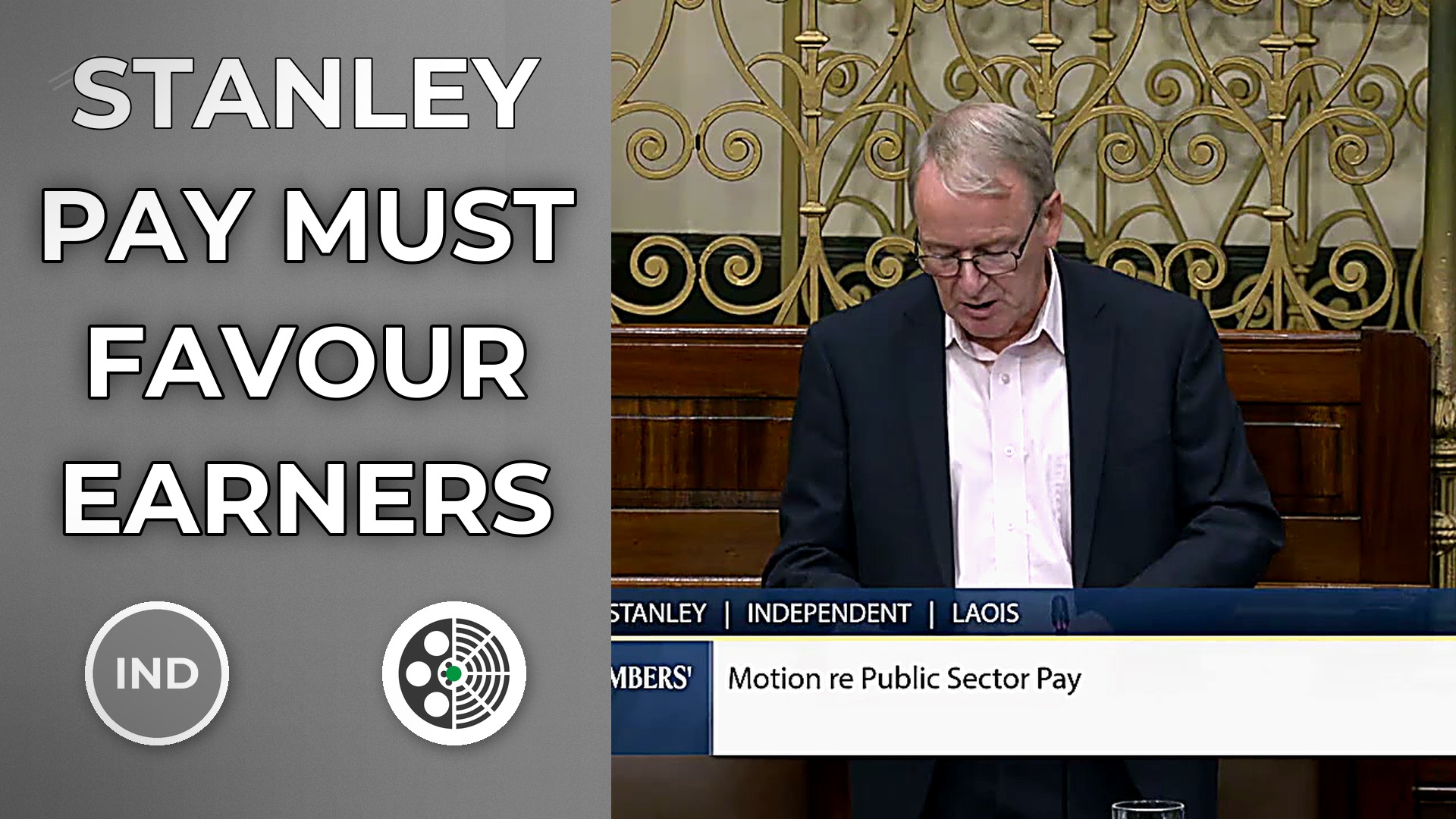


Brian Stanley says public sector pay must favour lower earners
Brian Stanley addresses the public sector strike and pay dispute, arguing that any new agreement must prioritise low- and middle-income workers. He also calls for legislation to protect collective bargaining and trade union recognition across the private sector.
Stanley says public sector workers in County Laois took strike action after frustration over the implementation of previous pay agreements, delays to substantive talks and the rising cost of living. He says the Government should have engaged before the previous agreement expired in June.
He argues that the budget did not adequately support workers, citing Social Justice Ireland’s analysis and the impact of essential costs such as housing, energy, insurance and transport. Stanley says the €1.2 billion allocated for public sector pay will not be enough to keep workers ahead of rising prices, and calls for higher percentage increases for lower- and middle-income workers.
Stanley says 82% of private sector workers are not in a trade union and argues that the Government should legislate for collective bargaining and union recognition. He criticises the programme for government’s commitment to research and an action plan, describing it as a policy for inaction.
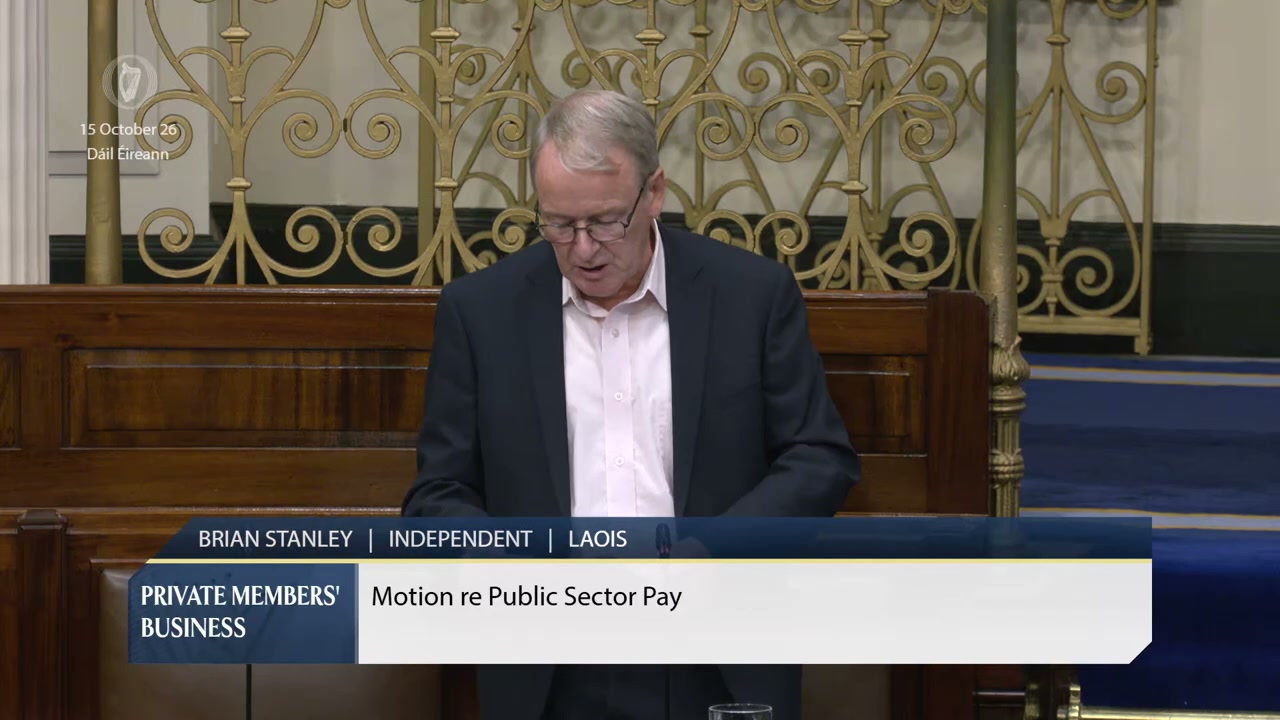
He calls for a substantial pay offer with no preconditions, aimed at keeping workers ahead of inflation, alongside legislation giving all workers the right to be represented by a trade union. Watch the recording to hear the full contribution.
Public sector pay and the strike
Stanley says public sector workers in County Laois took strike action after frustration over the implementation of previous pay agreements, delays to substantive talks and the rising cost of living. He says the Government should have engaged before the previous agreement expired in June.
Budget and cost of living
He argues that the budget did not adequately support workers, citing Social Justice Ireland’s analysis and the impact of essential costs such as housing, energy, insurance and transport. Stanley says the €1.2 billion allocated for public sector pay will not be enough to keep workers ahead of rising prices, and calls for higher percentage increases for lower- and middle-income workers.
Collective bargaining in the private sector
Stanley says 82% of private sector workers are not in a trade union and argues that the Government should legislate for collective bargaining and union recognition. He criticises the programme for government’s commitment to research and an action plan, describing it as a policy for inaction.
What Stanley says should happen next
He calls for a substantial pay offer with no preconditions, aimed at keeping workers ahead of inflation, alongside legislation giving all workers the right to be represented by a trade union. Watch the recording to hear the full contribution.
We publish thousands of recordings to make Irish politics transparent and resistant to manipulation. Spotted an error? Report it — together we are building a reliable archive of Irish politics.
Other speeches
Tego samego dnia All speeches from this day →
Michael Fitzmaurice
Michael Fitzmaurice Questions Farmers’ Duties Under EU Regulation
Jack Chambers
Jack Chambers says public service pay talks should begin without delay
Rose Conway-Walsh
Rose Conway-Walsh calls for action to avert public sector strike
Michael Fitzmaurice
Michael Fitzmaurice challenges EU forestry regulation
Joe Neville
Joe Neville presses Irish Water on profits and Kildare pipes
Cathy Bennett
Cathy Bennett challenges Irish Water on spending and pay
Transcript
Yesterday, the public sector unions took the only course of action that was open to them.
Thousands of them went on strike. And in County Leash, there wasn't just pickets, there was
crowds on the picket lines. From the council, to hospitals, to prison, to government departments.
I was proud to stand, particularly with the health workers, three health unions. Workers
expressed their total frustration at the government's failure to fully implement their previous
pay agreements. They also were frustrated by the delay in government getting substantive
talks and getting pay front and centre. And the failure of government to recognise the
cost of living pressures they're under. Why didn't the government get into talks prior
to June when the previous pay agreement ran out? And why no meaningful engagement or realistic
proposal over the past four months? Then we had a budget tabled by government, it's supposed
to be a budget for workers, but it wasn't. It was a sprinkle in the middle of a cost
of living crisis. Middle and low income households got crumbs according to Social Justice Ireland's
analysis and workers on £30,000 or below actually lost money. Any new agreement has
to favour low and middle income workers in the public sector and percentages should be
higher for those workers who are on middle and low income in terms of percentage points
than those at the very top. And regarding public sector pay, £1.2 billion was earmarked
in the budget. That will not be enough to keep workers up with the rising cost of living.
And this is all because of the cost of essential outgoings such as rent, mortgages, insurance,
electricity, gas, oil, transport and motor fuel etc. And the day after the strike, what
did we learn? Niall Gleeson, the CEO of Aoisge Aran, gets a pay rise of £118,000, so he's
in the public sector are reasonably well organised and rightly so and have some bargaining
power. Unfortunately in the private sector they don't. 82% of workers in the private
sector are not even in a trade union and government have a responsibility to legislate for collective
bargaining and union recognition by all employers. But Fianna Fáil and Fianna Gael have refused
to do this over the years and in the current programme for government there's a watery
commitment to publish an action plan and the plan is even more watery than that and it
says you will conduct comprehensive research on the coverage and impact of collective bargaining
and collaborate with academic and policy researchers. My god almighty, that's a policy for inaction
and a plan for inaction. But governments have commitments under EU directives and workers need
the right to combine in a trade union and have to be represented by them and this is very much
the case in the private sector. Unfortunately when someone tried to join a trade union,
they're pressurised out of the job by their bosses or sacked. The solution to the public
sector pay dispute is straightforward. Government need to make clear there's no preconditions that
there will be substantial offer on the table in relation to pay that favours middle and low
income workers. To make it clear that increases will be in line and keep workers ahead in terms
of the cost of inflation and rising prices. And Minister, would you please, will you catch up with
the rest of Europe and legislate for collective bargaining and the right of all workers to be represented by a trade union.