



Richard O'Donoghue Calls for Film Industry Rules on Workers' Rights
Richard O'Donoghue argued that film industry employment rules should recognise workers’ continuing service across successive production companies. Drawing on his experience as a building contractor and employer, he said regulation should protect workers’ rights when film companies are set up and dissolved between productions.
O'Donoghue said the film industry’s production-company structure creates a gap between successive contracts: workers may work on multiple films, but each production can involve a separate company. He argued that the rules should account for this continuity rather than treating each contract as entirely separate.
As a building contractor, O'Donoghue contrasted employees, whose employment carries over between contracts, with subcontractors, who may work briefly and manage their own tax affairs. He said the same approach to regulation may not suit industries with very different working arrangements.
O'Donoghue questioned whether repeated contracts with companies linked to the same main producer should count towards long-term employment. He said policy should balance protection for production companies with workers’ rights across successive film projects.
The discussion also addressed fixed-term contracts, employment law and the film industry’s regulatory framework. O'Donoghue asked whether responsibility for workers’ rights could be recognised at producer-company level, noting the committee’s 2023 recommendation on the producer company.
Different rules for film work
O'Donoghue said the film industry’s production-company structure creates a gap between successive contracts: workers may work on multiple films, but each production can involve a separate company. He argued that the rules should account for this continuity rather than treating each contract as entirely separate.
Comparing film and construction
As a building contractor, O'Donoghue contrasted employees, whose employment carries over between contracts, with subcontractors, who may work briefly and manage their own tax affairs. He said the same approach to regulation may not suit industries with very different working arrangements.
Recognising the producer company
O'Donoghue questioned whether repeated contracts with companies linked to the same main producer should count towards long-term employment. He said policy should balance protection for production companies with workers’ rights across successive film projects.
Employment rights and film regulation
The discussion also addressed fixed-term contracts, employment law and the film industry’s regulatory framework. O'Donoghue asked whether responsibility for workers’ rights could be recognised at producer-company level, noting the committee’s 2023 recommendation on the producer company.
We publish thousands of recordings to make Irish politics transparent and resistant to manipulation. Spotted an error? Report it — together we are building a reliable archive of Irish politics.
Other speeches


Tego samego dnia All speeches from this day →
Ged Nash
Ged Nash: Families need targeted energy credits this winter
Jim O'Callaghan
Jim O'Callaghan: Bill to protect public participation advances
Richard Boyd Barrett
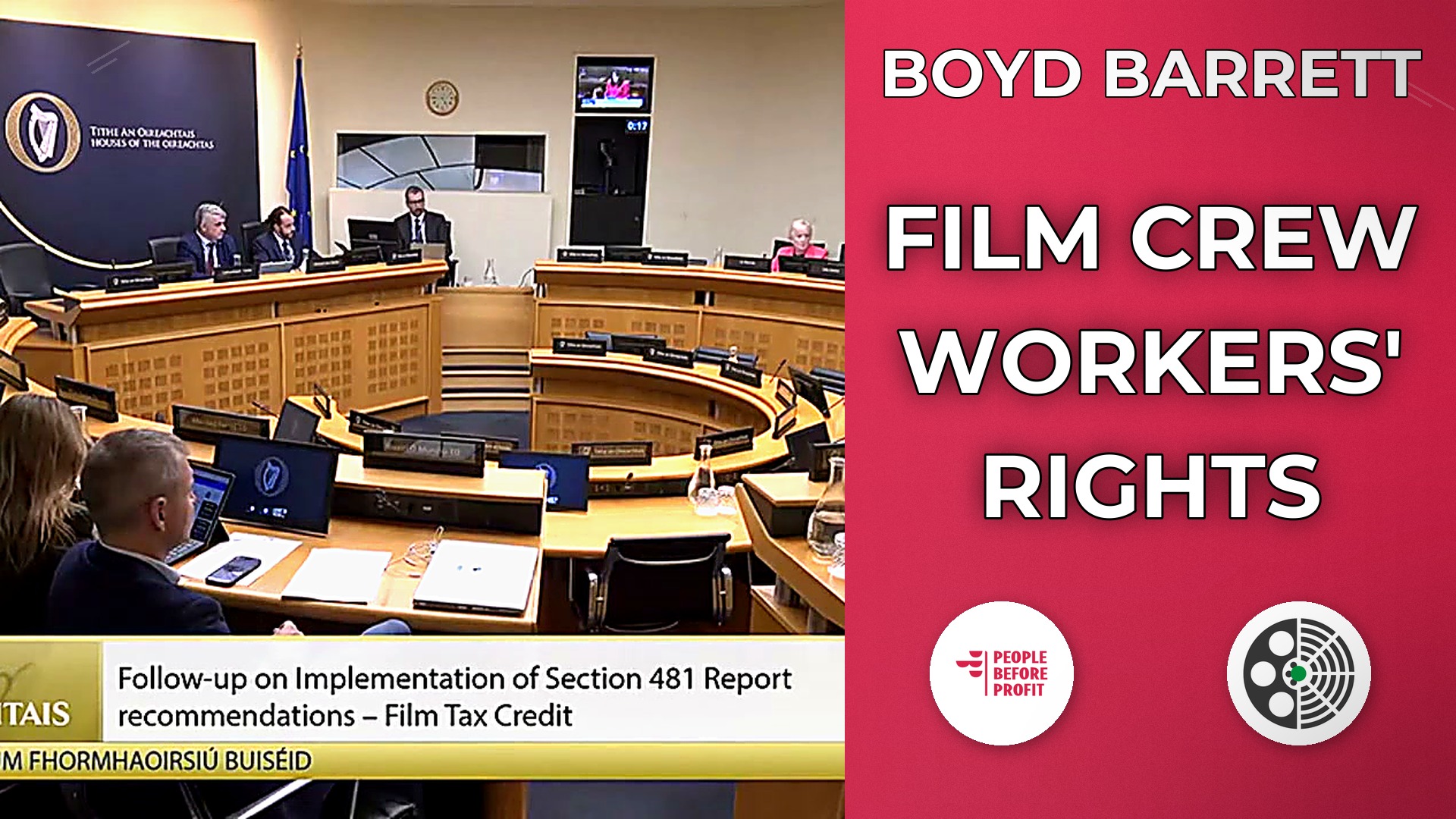
Richard Boyd Barrett Challenges Film Industry Worker Practices
Louise O'Reilly
Louise O'Reilly says people should be able to heat their homes
Rose Conway-Walsh
Rose Conway-Walsh says heating oil support falls far short
Seán Canney
Seán Canney welcomes first-cousin DNA testing at Tuam
Transcript
I said at the outset of the meeting that I'm actually in construction myself, and I am an employer myself.
And the more I'm listening to
the evidence that has been given,
this won't change under the current legislation and the laws around film industry itself.
I believe there needs to be a different regulation around the film industry because of the process. So
I'm a building contractor.
I'm a limited company.
I employ employees, but I also employ subcontractors.
The subcontractors that work with me, they might be here for a couple of weeks and are gone.
They get a premium cost for being subcontractors, so they look after their own tax affairs and everything else.
But if they're there with me over a long term, they can be then deemed as employees
at a certain amount, no, at a certain time.
But all my employees, when I go from one contract to another contract, everything carries over because they're employees.
Nothing carries over for a subcontractor. And I'm listening to everything that you're saying, that you signed 30 multiple contracts.
But I've also listened to what you've actually been saying about
the film industry itself, the producing of the company, the main company as I would call it from the film industry.
Every time they start a production or a film, they set up another company.
That company then,
at the end of its
film,
at the end of the tax year, that is dissolved within, and then they open up another company.
And I presume they're doing that for the protection of the main company because they might have 10 or 12 or 15 films going on at the one time.
And if something happens over here, it could impact on the main company itself.
But I understand all that.
But from the, the only way you're going to change this, and you'll be back here again,
the only way of changing this is there has to be a certain
policy and regulation around the film industry because of its,
I wouldn't be allowed to set up a new company and then go, because you go on a register, send it to so many companies,
it takes so long to set up a company and then by the time you dissolve a company and the directors and everything going forward,
it takes so long.
So, I think the only way forward from this that I'm hearing myself, from my own
experience that I have, and I'm no legal expert, is
the companies that they're using,
and as I said, it's a 12-month cycle or whatever the cycle is,
they dissolve that, then that takes away all the different rights then that you have.
Because you can't take it from one company to another company that set up for another film because it's a separate identity, separate.
But from, and a separate probably tax number and everything from the whole compliance, everything has been set up differently.
So what the government could intervene in, is what I'm trying to look at, is that in that purpose alone,
there has to be a right of contract carried over, so you said you've done 30 contracts with the same company on different film sets.
To me personally,
that then is a carryover from the point of view of long-term employment under the same
mother company, but you're 30 contracts with 30 different companies
under their eyes.
And that's where the problem lies, is that if it's the same
main company, and they have all these sub companies or self companies that they open up and close up,
this is where the regulation, myself personally, needs to be tightened up.
Yes, they have to protect the main company,
but yes, they also have to protect the workers' rights within, that are working in a film industry that carries over from one to the other.
That's where the regulation should change, and that's where the,
to me, policy should change. So to me, looking at everything I said, there should be a different policy for around film industry,
based on, because what you're saying for you wouldn't work for me,
under my industry, and there's other industries that wouldn't work for as well.
So if you're using the same regulation and laws for one sector that's completely different to mine,
99% of them will probably work under mine, but there's a percentage of them that won't work under yours, so...
There is a separate regulation for the film industry,
Statutory Instrument 119 of 2019. It's always operated under its own standalone film regulations,
there was Statutory Instrument 357, because I always remember the magnum, 357,
but, you know, and then before that, and it's going back a considerable number of years, but up until 20, up until
2019, when, or, sorry,
2016, 15 or 16, it was changed from an investor industry to a production-based industry, and
from that time, that's when the difficulties arose.
Before that, you know, I mean, for instance, my colleague John, he shouldn't have had
contracts. When he started in the film industry in 1999, he should have been on an open-ended contract.
I mean, the Protection of Employees Fixed-Term Work Act came in, in
1999, but, and it would have direct effect, but it wasn't transposed here until
2003, but it would have had direct effect from
1999. So, he should have been considered an open-ended worker.
He wasn't. They started issuing fixed-term contracts, and, and they just went on and on. After two...
On a fixed-term contract, and again, I go back to the construction industry, which I'm most familiar with,
they set a premium for their fixed-price contract, if they're coming in as a, as a contractor, as a specialized
contractor, regardless what sector they come from, but they charge a premium for that contract,
but from the point of view of what John is, is...
Did a contract come under a basic pay scale, then?
Oh, no, it's not that type. It's not a contract.
It's a fixed-term contract under the Protection of Employees Fixed-Term Work Act.
So, after two contracts and four years, you're entitled to a contract of indefinite duration, and because they're saying, well,
hold on a second, that wasn't me, Your Honour. It was, it was me, but I was, I was, I was...
At a sub-company.
At a sub-company, and, and so, so it doesn't, but in the, in the, in the undertaking, the Minister for Finance made it clear,
the Department of Finance made it clear in that undertaking, which was added in 2018,
that the Protection of Employees Fixed-Term Work Act, all other EU employment law, or EU law, all other directives,
all social law, all employment law, must apply to the film industry.
Now, the film industry will come in here and tell you, but we do, but it's for the period that you're on the gig.
But the other things, like the framework directive, the new directive on, on, on sure and transparent work,
none of those can apply, because you, you don't have the service.
So, getting to the crux of this, then, is, so, if, if the main film industry that is applying, and they have their sub-companies,
those sub-companies are, are listed to the, the same, the main, sorry, for one second, please.
They are listed to the same main company.
So, if they're sub-companies of a main company, under the workers' rights, it's what you're looking for,
is that, that's recognised, if they're sub-companies, even if they're disabled, they should be sub-companies, for the employment rights.
Yes, well, as the, as the committee recommended in their, in the report in 2023, the producer company.
To be responsible, because they're the, they're the people who get the money.
Okay, I understand what you're, that one. I have to let Deputy Mark Cook come in.