

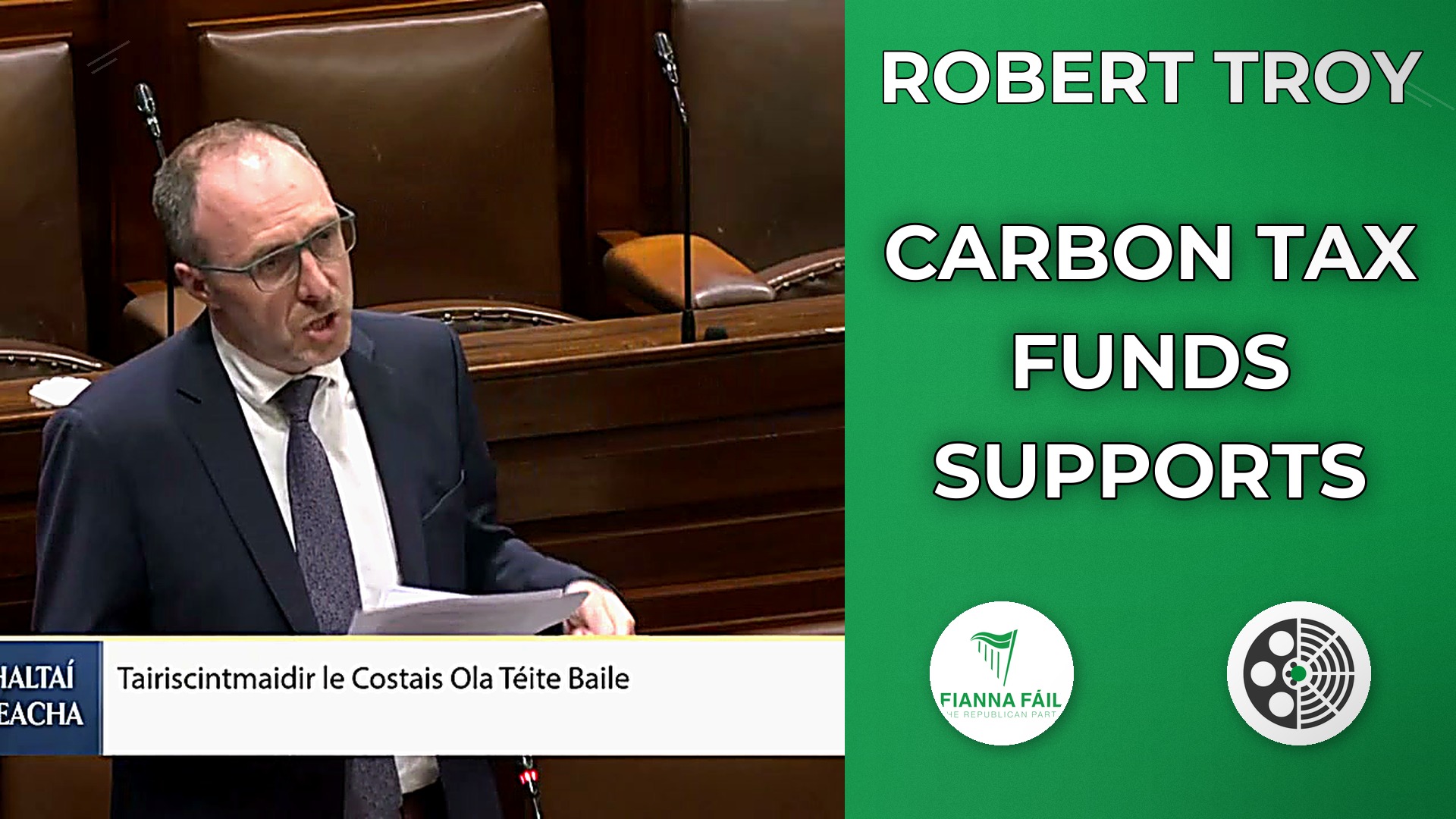


Robert Troy defends carbon tax and cost-of-living measures
Robert Troy defended the Government’s cost-of-living measures and carbon tax during a debate on a Government counter-motion. He argued that Budget 2027 provides targeted relief while preserving funding for longer-term energy supports and future crises.
Troy acknowledged that the cost of living is the main issue affecting people across the country, and said he hears about the pressure on families at his weekly constituency clinics. He pointed to international energy market disruption, including the impact of the conflict in the Middle East and shipping disruption through the Strait of Hormuz.
He said Budget 2027 includes a 13% increase in the fuel allowance to €43 a week, extending eligibility to around 50,000 more households, and keeping the 9% VAT rate on gas and electricity until 2030. He also cited continued fuel excise reductions and other social protection measures, saying the interventions are intended to offer relief while leaving capacity to respond to future pressures.
Troy challenged Sinn Féin’s position on carbon tax, arguing that the party supports schemes funded by the tax while opposing the revenue that pays for them. He said carbon tax revenue supports the fuel allowance, SEAI retrofitting grants, agricultural schemes, greenways, electric vehicle supports and the Just Transition Fund for the Midlands.
He highlighted fully funded deep retrofit grants for 39,500 households, saying home improvements can reduce exposure to volatile energy prices. Troy said the Government had reduced carbon tax on home heating oil to 2023 levels and argued that immediate relief must be balanced with longer-term support. Watch the recording to hear the full contribution.
Cost-of-living pressures
Troy acknowledged that the cost of living is the main issue affecting people across the country, and said he hears about the pressure on families at his weekly constituency clinics. He pointed to international energy market disruption, including the impact of the conflict in the Middle East and shipping disruption through the Strait of Hormuz.
Budget 2027 supports
He said Budget 2027 includes a 13% increase in the fuel allowance to €43 a week, extending eligibility to around 50,000 more households, and keeping the 9% VAT rate on gas and electricity until 2030. He also cited continued fuel excise reductions and other social protection measures, saying the interventions are intended to offer relief while leaving capacity to respond to future pressures.
Carbon tax funding
Troy challenged Sinn Féin’s position on carbon tax, arguing that the party supports schemes funded by the tax while opposing the revenue that pays for them. He said carbon tax revenue supports the fuel allowance, SEAI retrofitting grants, agricultural schemes, greenways, electric vehicle supports and the Just Transition Fund for the Midlands.
Long-term household energy costs
He highlighted fully funded deep retrofit grants for 39,500 households, saying home improvements can reduce exposure to volatile energy prices. Troy said the Government had reduced carbon tax on home heating oil to 2023 levels and argued that immediate relief must be balanced with longer-term support. Watch the recording to hear the full contribution.
We publish thousands of recordings to make Irish politics transparent and resistant to manipulation. Spotted an error? Report it — together we are building a reliable archive of Irish politics.
Other speeches
Tego samego dnia All speeches from this day →
Martin Kenny
Martin Kenny says carbon tax should be removed to ease fuel costs
Pearse Doherty
Pearse Doherty says €43 oil relief falls short
Alan Dillon
Alan Dillon Defends Government’s Fuel-Cost Supports
Ged Nash
Ged Nash: Families need targeted energy credits this winter
Sharon Keogan
Sharon Keogan says ESB should cut winter power margins
Peadar Tóibín
Peadar Tóibín challenges Taoiseach over strikes and cost of living
Transcript
Thank you, and I wish to move the government's counter motion.
Like many of my colleagues both across this chamber and in government, I hold weekly clinics
in my constituency.
I engage with family, friends and supporters and every week we sit down with people from
across communities.
We listen to their concerns, the challenges they face and the issues impacting their daily
lives.
Like my colleagues across government, I do everything I can to help them.
I think any insulation otherwise is completely false.
One of my colleagues opposite gave an example of people who are working overtime.
Because of budgetary changes that were introduced last week, because you're working overtime,
it's now you'll earn more before you go into the higher tax bracket.
That was a change that was made last week, putting more money back into individuals'
I don't know who pulls strings in the party opposite us in terms of running that party,
but there's no one pulling strings in terms of who's running the government.
The democratically elected government that went before the will of the people a number
of years ago.
And I do acknowledge that the cost of living is the number one issue affecting people across
the country.
I hear it, my colleagues hear it, and we do understand the pressure families are facing.
These pressures are being driven by circumstances far beyond the government's control, with
households across Europe and beyond facing similar challenges.
Something that wasn't really acknowledged in the last 20 minutes, maybe once or twice.
The most effective way to bring about an end to current pressures on fuel prices is through
a de-escalation of the conflict in the Middle East.
The disruption to the shipping through the Strait of Hormuz, through which approximately
20% of the world's oil supply normally passes, has profound consequences for international
energy markets.
Ireland continues to use its diplomatic influence wherever possible, but we must recognise our
influence alone cannot resolve this crisis.
However, that does not mean that the government cannot or will not respond.
We have responded and we will continue to do so.
I've said it before and I say it again, this government will respond to those most in need
when they need it most.
We have a strong record of doing so, whether it was during Brexit, COVID, inflationary
pressures following Russia's invasion of Ukraine, or the challenges we face today.
But supporting people does not mean that we can afford to be reckless.
We have responsibility not only to those who need help today, but also to those who may
need help tomorrow.
That is why the balance we sought to strike in Budget 2027, responding to the challenges
of today, while protecting our ability to respond to the crisis of tomorrow.
And it's because of the prudent management of our economy over the last number of years
that we have full employment, that we are running budget surpluses, and we were in a
position to announce a number of interventions last week.
Look at some of the other European countries where they stand at the moment.
Look at what's going on in France, where the government is proposing tax increases.
Look at what's going on in Spain, where the government fell because of their inability
to introduce the measures that they needed to introduce in relation to taxation.
So what we have done is, because of the prudent management of our economy, we have been able
to make interventions.
And Budget 2027 introduced targeted measures to provide relief to households and businesses
facing rising costs.
They included increasing the fuel allowance by 13% to €43 per week, and expanding eligibility
criteria by approximately 50,000 additional households, bringing the total coverage to
more than 465,000 households nationwide.
So that's 465,000 households getting over €1,200 a year towards their fuel costs.
Extending the 9% VAT rate on gas and electricity until 2030.
Continuing temporary reductions in fuel excise duties, with the overall cost of these interventions
expected to exceed €1 billion.
Enhancing social protection supports, and extending the €400 income tax disregard
for households involved in micro-generation until the end of 2028.
These measures will not eliminate every pressure households face, and we have never suggested
otherwise.
But they will provide some relief, particularly those in most need.
Importantly, they have been designed to provide that support in a sustainable way, ensuring
we retain the capacity to intervene again if necessary.
Of course, the opposition will argue that we should have spent more, done more and taxed
more.
But the decisions we make today have a direct impact on our ability to respond tomorrow.
And as a government, we don't have the luxury of ignoring that.
We must consider both.
Can I call out, what confuses me about Sinn Féin's position is its fundamental contradiction.
Sinn Féin supports many of the measures funded by carbon tax.
They regularly raise concerns about waiting lists for schemes supported by that revenue.
Yet they oppose the very tax that helped fund them.
The reality is that these schemes are popular because they provide meaningful, long-term
supports to households, to help families reduce their energy bills, improve energy
efficiency of their homes, and become less dependent on volatile international energy
markets.
Every cent of carbon tax revenue is allocated towards measures supporting households, communities
and our transition to a more sustainable economy.
These include fuel allowance, SEAI retrofitting grants, agriculture environmental schemes
such as acres, peatland rehabilitation, greenways, electric vehicle supports and the Just Transition
Fund for the Midlands.
Between 2020 and 2026, £4.2 billion in carbon tax revenue was made available for these purposes.
In 2026 alone, £566 million for retrofitting, just transition and climate measures, £350
million for targeted social protection supports including fuel allowance, £173 million for
sustainable agriculture, principally schemes such as acreage, and £20 million for transport
measures including greenways and electric vehicle infrastructure.
As of October 2026, 287,000 households qualified for home energy approval since 2019.
And we'll talk about those who were most vulnerable, people who were dependent on the fuel allowance.
39,500 households were fully funded for deep retrofit grants.
That's households who had their windows replaced.
That's households who had their walls pumped with insulation.
That's households who had new energy efficient heating grids installed.
That's households who are not going to be left to the volatility of the energy markets
in terms of keeping their energy prices at a sustainable level in the future.
That is making a permanent difference to the households that benefit.
And we want to do more in that regard.
We want to continue to support families make the change, make the improvements.
Fully funded for people in receipt of fuel allowance, you ask about it quite frequently
in relation when you look at their PQs in terms of when people can access these schemes.
But today you're talking about taking away part of the funding that would help fund these
schemes which would mean a longer waiting list for people to assess these schemes.
Research using ESRI's switch model has demonstrated that lower income households particularly
benefit from social protection measures funded by carbon tax.
These are not simply once-off interventions.
They are investments that help address the underlying causes of high energy costs.
So I put a simple question to Sinn Féin.
How do you propose to continue funding these measures if you abolish the very tax that
helps pay for them?
You cannot support the expenditure while ignoring the revenue that makes it possible.
You cannot have it both ways.
Ken Corlin, we must be honest about what is possible, both in providing immediate relief
and protecting households over the longer term.
Any changes must be carefully collaborated.
That is precisely what this government has sought to do.
We have listened and we have responded.
The carbon tax on home heating oil has been reduced to 2023 levels, delivering savings
to households.
Furthermore, by maintaining this reduced rate for the lifetime of this government, those
savings will continue into the longer term.
No government can fully shield every household from the consequences of international crisis.
But this government has consistently demonstrated its willingness to intervene, provide supports
and protect those who need it the most.
We will continue to do so while ensuring that the decisions we make today do not compromise
our ability to respond to tomorrow.
I wish to say again that the government proposes to adopt the counter motion that we have tabled.