



Richard Boyd Barrett challenges RTÉ funding for film producers
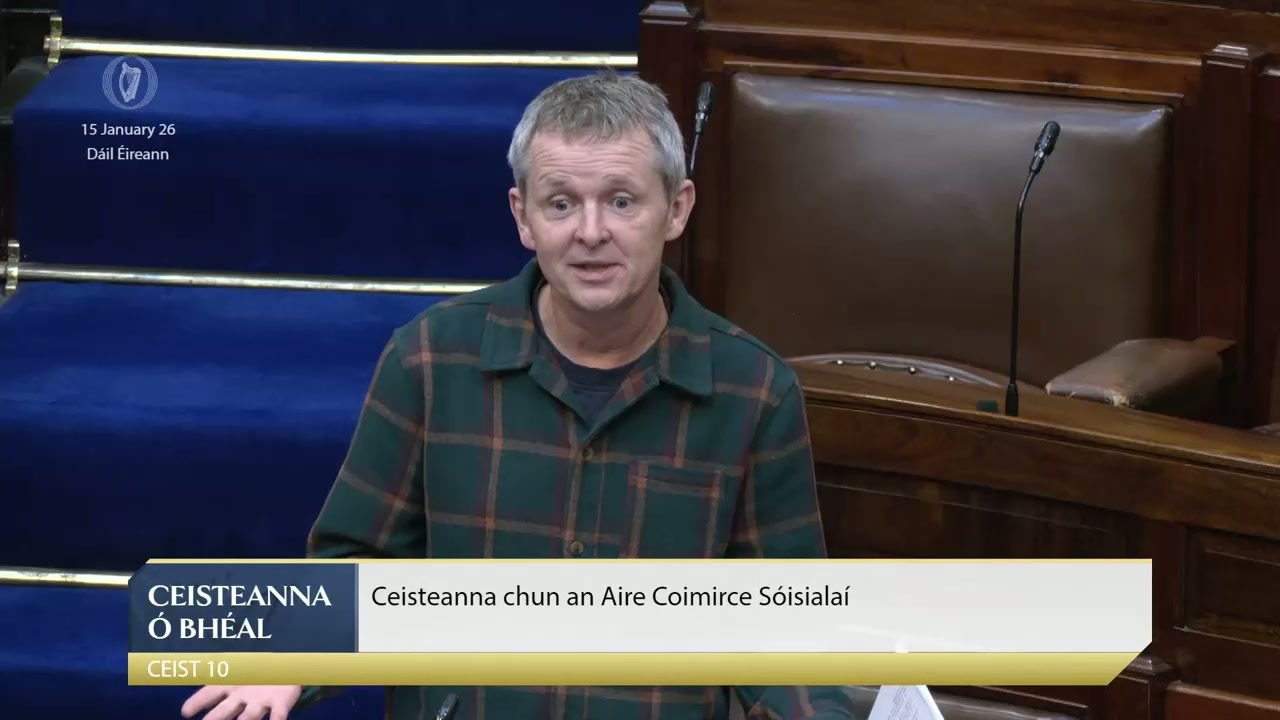
Richard Boyd Barrett spoke during a debate on proposed changes to RTÉ’s independent programmes account, arguing that increased public funding for independent producers must come with protections for workers. He called for his amendment to remove the proposed changes, citing concerns about employment conditions, actors’ residuals and enforcement of Section 481 rules.
Boyd Barrett said the Bill would increase the share of RTÉ funding directed to the independent sector. His amendment would remove the proposed changes to the independent programmes account and the requirement for TG4 to publish an annual report on commissioning from the sector.
He said actors and performers are pressured to sign away future residual payments, while film crew can be repeatedly engaged without their employment relationship being recognised. Boyd Barrett argued that workers should not have to accept these conditions to secure work.
Boyd Barrett said public money should not subsidise what he described as the abuse of workers’ rights. He also criticised what he said was a lack of oversight and enforcement, pointing to trade union representatives’ evidence about Section 481 measures.
In response, the debate turned to Section 116 of the Broadcasting Act 2009, which provides for a fixed, indexed payment by RTÉ into the independent programmes account. The sum for 2026 was stated as €49.1 million. Watch the recording to hear the full exchange.
RTÉ funding and the amendment
Boyd Barrett said the Bill would increase the share of RTÉ funding directed to the independent sector. His amendment would remove the proposed changes to the independent programmes account and the requirement for TG4 to publish an annual report on commissioning from the sector.
Workers’ rights in film and television
He said actors and performers are pressured to sign away future residual payments, while film crew can be repeatedly engaged without their employment relationship being recognised. Boyd Barrett argued that workers should not have to accept these conditions to secure work.
Public funding and accountability
Boyd Barrett said public money should not subsidise what he described as the abuse of workers’ rights. He also criticised what he said was a lack of oversight and enforcement, pointing to trade union representatives’ evidence about Section 481 measures.
The existing account
In response, the debate turned to Section 116 of the Broadcasting Act 2009, which provides for a fixed, indexed payment by RTÉ into the independent programmes account. The sum for 2026 was stated as €49.1 million. Watch the recording to hear the full exchange.
We publish thousands of recordings to make Irish politics transparent and resistant to manipulation. Spotted an error? Report it — together we are building a reliable archive of Irish politics.
Other speeches
Tego samego dnia All speeches from this day →
Paul Nicholas Gogarty
Paul Nicholas Gogarty calls for EU-funded grid upgrade
Rose Conway-Walsh
Rose Conway-Walsh says heating oil support falls far short
Keira Keogh
Keira Keogh backs pay gap data and Tuam identification changes
Joe O'Reilly
Joe O'Reilly says councillors need real tax-raising powers
Sharon Keogan
Sharon Keogan: Local Councillors Need Power and Proper Resources
Albert Dolan
Albert Dolan backs pay gap reporting and DNA search change
Transcript
Yeah, well it just follows on directly from the last point, I'm just going to elaborate.
But you must move the amendment.
I move, I move.
Thank you.
Okay, so this is deleting the section which the government have inserted.
Currently in the Broadcasting Act, there's a figure, I think it's 40 million of revenues have to go to the independent account.
But now it's gone up to 40% as far as I understand, right?
So we're hardwiring into public funding for RTE that 25% has to go to the independent sector.
So a quarter of all the money goes to RTE, it doesn't actually go to RTE, it goes to the independent sector to outsource into private companies.
And those producers who are also, and this is referred to in the government's amendment, also refers to section 481.
Just to repeat, that's 177 million and rising.
Went from 122 million in 2024 to 177 million last year, right?
And it's going, rising all the time.
Now don't get me wrong, I'm for funding the Irish film industry, but it is conditional on quality employment and training.
But there is no quality employment and training.
The actors and performers are having their royalties, what used to be known as residuals, effectively stolen from them.
There's no other way to describe it.
They are forced to sign contracts where they sign away their rights to future residuals for 10 years.
Most of the residuals, normally actors and performers would have got a little small check every time something was played again.
Now they don't get them because they have to sign them away.
And if you don't sign them away, you don't get on the movie.
That's the way it works.
And we've just had testimony again for the umpteenth time in our committee saying that is the case.
Similarly, we have film crew who've worked for the same producer companies that you now want to give an even higher percentage of RTE money to,
who refuse to acknowledge an employment relationship with people that they've employed again and again and again over periods of 20, 30 and 40 years.
So the clock goes back to zero for people who've worked.
Imagine every single day the workers came in here and said, well you're only employed for a day.
And if you say anything, you won't be employed tomorrow.
That's how it is in the film industry.
Now we wouldn't accept it anywhere else.
Why do we accept it in the film industry?
We are insisting the 40% of RTE money.
So what we're doing is we're replacing proper jobs in RTE with no jobs.
And giving the money to film producers who deny their relationship with the employees,
and who rob the actors and performers of their rights to residuals, their future rights to residuals.
I don't believe we should do that.
And there's no oversight mechanisms included anywhere in this to prevent that from happening.
There's been no serious enforcement.
Despite the Budget Scrutiny Committee producing a report on Section 481, recommending a whole series of things,
we had representatives of the trade unions come in today and said,
all the bits that suit the producers have been activated.
All the bits that would help the workers have not.
That's what's happening.
So workers, as usual, lose out.
But public money is subsidising an abuse of workers' rights.
And I don't think public money should be used to subsidise the abuse of workers' rights.
Amendment 9, Deputy Boyd Barrett, from yourself, as you outlined,
would remove all of the proposed changes to the RTE independent programmes account set out in the Bill.
And in addition as well, would remove the proposed requirement on TG Cahart to publish an annual report
on their commissioning of productions from the independent sector.
I know you'll be aware that Section 116 of the Broadcasting Act 2009
currently provides that RTE shall pay a fixed indexed link sum into the independent programmes,
which for 2026, the sum was €49.1 million.
And that independent programmes account was first introduced through...