

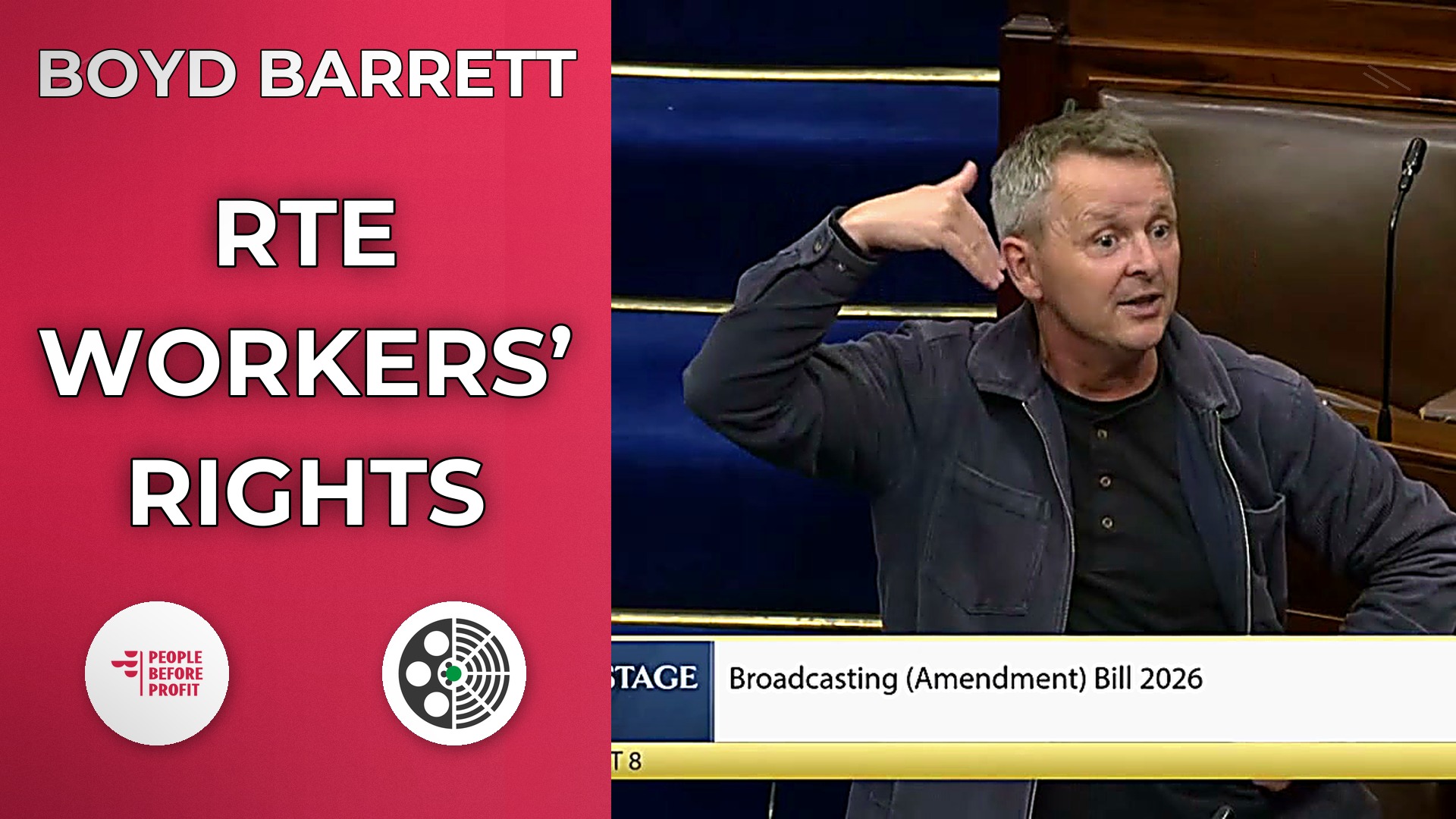


Richard Boyd Barrett warns of RTE outsourcing and workers’ rights
Richard Boyd Barrett criticised the proposed requirement for 40% of RTE’s revenue to go to independent producers during a Dáil debate on the RTE Bill. He argued that public funding should come with protections for actors, performers and film crew, including safeguards against buyout contracts and blacklisting.
Boyd Barrett said the Bill would direct a substantial share of RTE’s revenue to private companies without equivalent scrutiny. He backed conditions on that funding and said his own amendment went further by opposing the outsourcing requirement.
Citing concerns raised by representatives of Equity, CIP2 and film crew at a Budget Scrutiny Committee, he described alleged pressure on workers to accept contracts that surrender future royalty rights. He also raised concerns about crew members’ employment histories being disregarded through production companies structured as separate DACs, and said workers who assert their rights risk being blacklisted.
Boyd Barrett argued that productions can generate revenue after filming, while performers may be asked to sign away rights to that future income. He said public funding for independent productions should not come without protections for the people working on them.
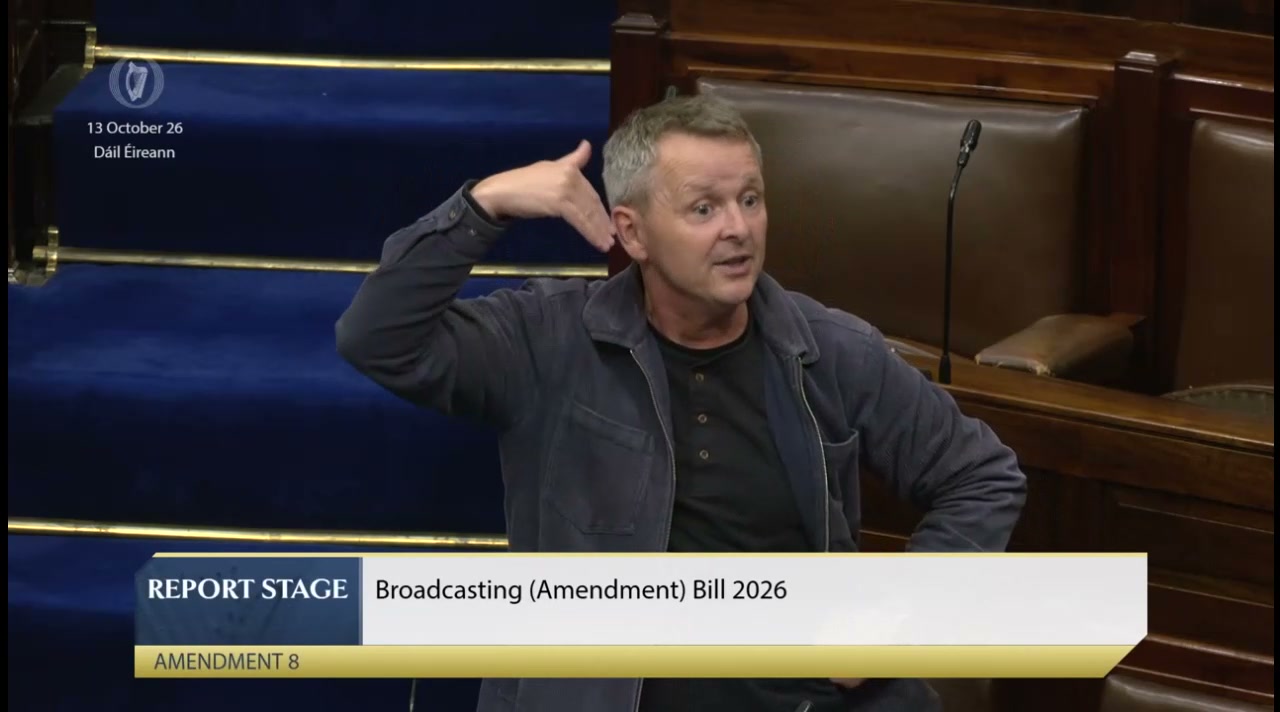
The Minister said public bodies are expected to comply with employment, copyright and other applicable laws, and pointed to existing guidance on employment status. On artificial intelligence, the Minister referred to EU transparency rules and said a proposed restriction on funding AI-generated content would be premature. The Minister said the amendment could not be accepted.
Outsourcing and scrutiny
Boyd Barrett said the Bill would direct a substantial share of RTE’s revenue to private companies without equivalent scrutiny. He backed conditions on that funding and said his own amendment went further by opposing the outsourcing requirement.
Workers’ rights in film and television
Citing concerns raised by representatives of Equity, CIP2 and film crew at a Budget Scrutiny Committee, he described alleged pressure on workers to accept contracts that surrender future royalty rights. He also raised concerns about crew members’ employment histories being disregarded through production companies structured as separate DACs, and said workers who assert their rights risk being blacklisted.
The case against buyout contracts
Boyd Barrett argued that productions can generate revenue after filming, while performers may be asked to sign away rights to that future income. He said public funding for independent productions should not come without protections for the people working on them.
Minister’s response
The Minister said public bodies are expected to comply with employment, copyright and other applicable laws, and pointed to existing guidance on employment status. On artificial intelligence, the Minister referred to EU transparency rules and said a proposed restriction on funding AI-generated content would be premature. The Minister said the amendment could not be accepted.
We publish thousands of recordings to make Irish politics transparent and resistant to manipulation. Spotted an error? Report it — together we are building a reliable archive of Irish politics.
Other speeches
Tego samego dnia All speeches from this day →
Michael Cahill
Michael Cahill urges action on home heating oil costs
Ged Nash
Ged Nash: Families need targeted energy credits this winter
Eoin Hayes
Eoin Hayes says government lacks energy crisis leadership
Robert Troy
Robert Troy defends carbon tax and cost-of-living measures
Donnchadh Ó Laoghaire
Donnchadh Ó Laoghaire: Budget leaves households short-changed
Sharon Keogan
Sharon Keogan: Local Councillors Need Power and Proper Resources
Transcript
I strongly support this amendment and it relates indeed to an amendment I have after it which
is about deleting the section requiring that 40% of all the revenues that go to RTE should
be outsourced to the independent sector.
Because what this is requiring is that basically employment rights, workers' rights are properly
upheld, that we avoid the use of buyout contracts for actors and performers, that public money
shouldn't be used for that.
Now I don't know what assurances the government are giving but I don't credit them and I'll
tell you why I don't credit them because I've just come from the Budget Scrutiny Committee
where we had representatives of equity, CIP2 and film crew who were pointing out, as they
have been for about a decade, that if you try to assert your rights in the Irish film
sector which we're now going to insist 40% of Irish, of revenue going to RTE is to be
outsourced to this sector and it's explicitly mentioned in the Bill, Section 481, so people
in receipt of what is now £177 million in money in tax relief are also now going to
receive 40% of RTE's revenues and the people who work in that sector, funded by Section
481, are in this building as we speak this afternoon saying that their rights are being
trampled on and they've been saying it for a decade.
Because you see this Bill is about governance of RTE, excessive salaries, all that stuff,
true, right?
And we want the Controller Audit in General to look at it.
But do you know who nobody's scrutinising is the private companies that RTE money is
now going to go to.
In fact there's going to be a requirement in this Bill that 40% of all of the money
that goes to RTE is given to private companies over whom there's no scrutiny at all.
So this well thought out motion by Sinn Féin is saying at least there should be conditions
on it.
Personally mine goes further and says we shouldn't be doing it.
Because this is essentially a mandatory requirement to hollow out RTE and to outsource productions
to the private sector over which there's no scrutiny.
Now why in response to the governance scandals and excessive salaries in RTE would we outsource
and saying we have to have more oversight, would we insist that most of it is now outsourced
to a sector where there's no oversight?
Right, I mean it's bonkers.
So they can do what they like and what the actors and performers were saying is in this
sector you are blacklisted, they said it in the House again today, if you say I'm not
accepting a buyout contract where your right which you have under EU law to royalties on
the future exploitation of your work in a film or whatever, if you don't accept a contract
which buys you out of those entitlements and rights you don't get the job, you're blacklisted
and you won't work again.
Similarly if you're a film crew and you say I insist that you recognise my service to
this industry if for example as a member of crew I've been working in this industry for
20 years for the same producer who's getting all this public money that my service to the
industry has cost but they refuse to recognise it and they hide behind DACs which are set
up in all these independent productions and say oh yes I did employ you in that DAC but
that DAC doesn't exist now and now there's a new DAC and I have no responsibility to
you whatsoever so therefore I don't have an employment relationship with you and if you
dare assert your rights you won't be working again, you won't and in fact there was people
in there today who said since they came into this house and brought this issue to the attention
of an Oireachtas committee people who worked in the industry for 20, 30 and 40 years have
never worked again.
So blacklisting is rampant in this sector which we are now insisting with this bill
is going to get 40% of all RTE's revenues.
Now I think that's absolutely unacceptable, unacceptable but at least this amendment is
trying to put some conditions on it and to say these revenues that have to be conditions
there can be no use of buyout contracts.
Every single contract that is given to actors and performers in this country is requiring
the actors to give away, to sign buyout contracts and give away their rights to future revenues
and most of the revenue that's generated from these productions comes from the revenues
downstream because a film production or a drama doesn't make revenue while you're producing
it, it makes revenue further down the line but the people who are in it are being asked
to sign that away and the government is doing nothing about it.
In fact they're now going to give carte blanche to those companies to have even more public
money but not guarantee the rights of actors not to have to work under these contracts
and by the way that's sharp contrast with every other jurisdiction.
In Britain they don't have to sign buyout contracts, in the United States even they
don't have to sign buyout contracts, in many of the countries in Europe they don't have
to sign buyout contracts and similarly for crew, people below the line workers as they
rather insultingly call them, their service is recognised but in the Irish film industry
your service isn't recognised.
So I'm against that, I think at least the Sinn Féin motion is trying to say there should
be some conditionality on this money going to this sector but in reality we shouldn't
be insisting on what is essentially the backdoor privatisation of RTE to the benefit of producers
who then will trample on the rights of actors, performers and film crew.
Thank you Deputy.
No further members.
Minister would you like to respond?
Thanks Deputy.
Deputy Boyd Barrett and first of all I'd like to reiterate what Minister O'Donovan said
at committee stage in terms of our clear expectation that state bodies comply fully with all applicable
law whether it be employment, copyright, social protection, tax law or any relevant case law.
This includes the principle of equal pay for equal work as is set out in the Employment
Equality Act and the protections for rights holders set out in the Copyright and Related
Rights Act 2000.
We also expect state bodies to comply with all relevant guidance including the Code of
Practice on determining employment status published by Revenue Commissioners, Department
of Social Protection and Workplace Relations Commission.
The Code of Practice for the governance of state bodies and any other guidelines issued
by regulatory bodies such as Commission on Demand and likewise for every other independent
body as well Deputy Boyd Barrett who equally are subject to the law in the same way.
In the context of the Deputy's amendment it is important to note that the most recent
iteration of the Code of Practice on determining employment status contains a five-step framework
included in the Kershian judgment which provides a decision-making model to determine the employment
status of workers.
I'm conscious that artificial intelligence is a new area presenting both challenges and
opportunities for the media and creative sectors.
In this context I want to acknowledge the work done by Deputy O'Snuddy, Deputy Borne
as well in highlighting the massive challenge AI can present to our creative sectors.
From an AI transparency perspective we have introduced regulation at EU level which I
would expect RT and TG CAHR to fully comply with.
Article 50 of the AI Act came into force from August of this year setting clear transparency
requirements and this includes a requirement on a provider such as RT or TG CAHR to disclose
if an AI system has been used to generate or manipulate text which is published with
the purpose of informing the public on matters of public interest.
The supervisory responsibilities in this area as it relates to the media sector have been
assigned to Commissioner Naaman as the independent regulator.
The deputies have proposed that no revenue should be used by RT or TG CAHR to fund the
production of content by artificial intelligence.
I recognise that this builds on the Dáil motion on the impact of AI on creative workers
proposed by Deputy O'Snuddy which was passed this summer.
This would be quite a wide ranging provision to include an Irish law at this stage of the
development and deployment of AI particularly in the absence of accompanying guidance and
consideration of the degree to which AI could be used to assist in creative or journalistic
work funded or undertaken by RT and TG CAHR.
Given where we are in terms of policy development on artificial intelligence I think it would
be premature to introduce a measure of this nature though I do understand the intention
and the concern that deputies have for the rights and position of creative artists in
this context.
As Minister O'Donovan set out at committee stage ultimately this amendment cannot be
accepted not only for the uncertainty regarding AI but also because it replicates many of
the legal requirements that apply to RT, TG CAHR and other public bodies.