

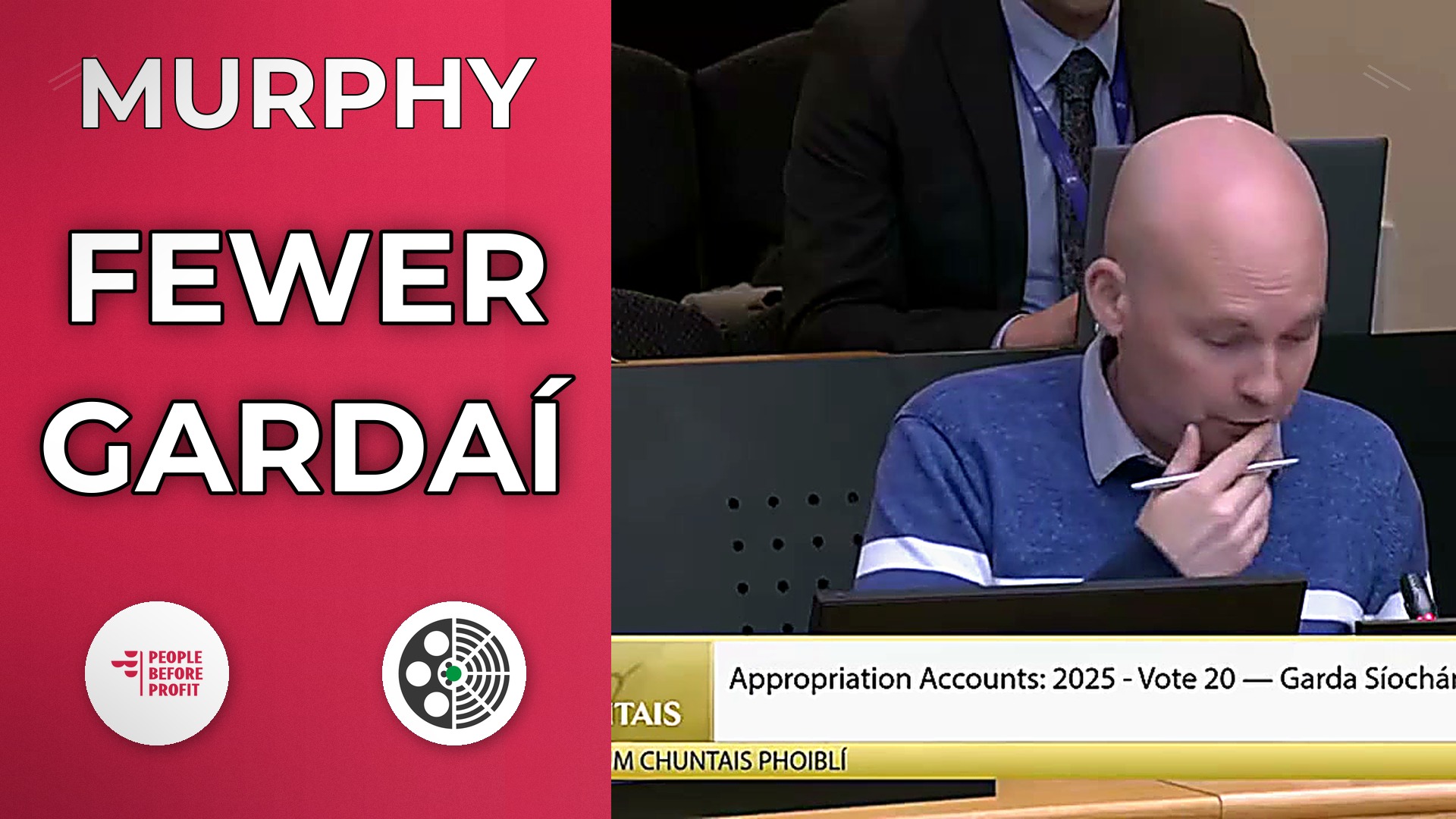


Paul Murphy presses Gardaí on roads policing numbers
Paul Murphy questioned Garda representatives about roads policing and rising road deaths during a parliamentary exchange. He challenged the lack of firm commitments to increase Gardaí in roads policing and asked how staffing, deployment and enforcement are being addressed.
Murphy pointed to road deaths rising year on year since 2021 and cited figures indicating that Gardaí allocated to roads policing had fallen substantially since 2009. A Garda representative said 660 people worked in the area and described it as the organisation’s largest specialist unit.
Murphy asked whether roads policing had too few Gardaí and pressed for details on a previous commitment to add 150 officers. The Garda representative said numbers would increase incrementally, including an uplift in the north-western region, but could not give a total for the end of 2027.
The exchange covered daily road-policing duties for Gardaí, tracking those duties, and the use of technology. Murphy also asked whether roads policing officers could be assigned to events such as football matches; the Garda representative said that would not be the norm.
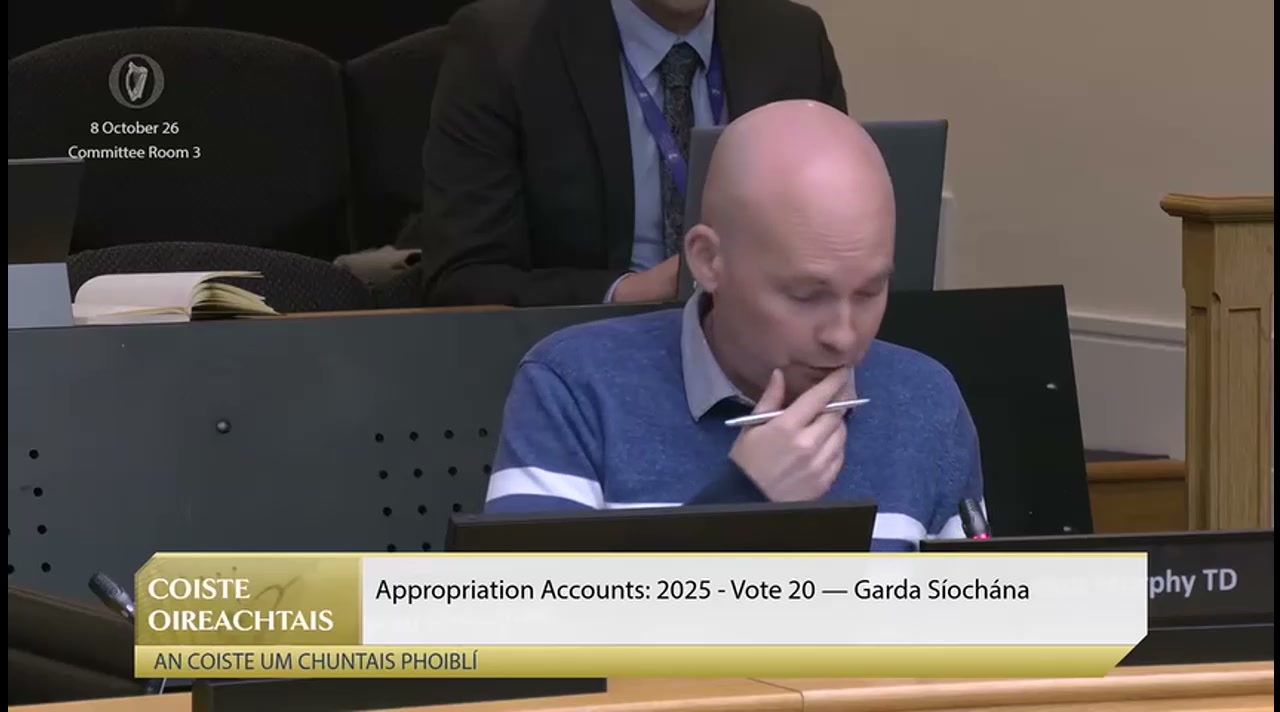
Murphy raised findings from the Crowe Review on officer productivity and ANPR equipment. The Garda representative said most recommendations had been implemented or were being addressed. The exchange also touched on the overall Garda allocation for EU Presidency-related policing and the absence of a cost breakdown for individual events. Watch the recording to hear the full exchange.
Road deaths and Garda numbers
Murphy pointed to road deaths rising year on year since 2021 and cited figures indicating that Gardaí allocated to roads policing had fallen substantially since 2009. A Garda representative said 660 people worked in the area and described it as the organisation’s largest specialist unit.
No firm total for planned increases
Murphy asked whether roads policing had too few Gardaí and pressed for details on a previous commitment to add 150 officers. The Garda representative said numbers would increase incrementally, including an uplift in the north-western region, but could not give a total for the end of 2027.
Deployment and enforcement
The exchange covered daily road-policing duties for Gardaí, tracking those duties, and the use of technology. Murphy also asked whether roads policing officers could be assigned to events such as football matches; the Garda representative said that would not be the norm.
Crowe Review and EU Presidency costs
Murphy raised findings from the Crowe Review on officer productivity and ANPR equipment. The Garda representative said most recommendations had been implemented or were being addressed. The exchange also touched on the overall Garda allocation for EU Presidency-related policing and the absence of a cost breakdown for individual events. Watch the recording to hear the full exchange.
We publish thousands of recordings to make Irish politics transparent and resistant to manipulation. Spotted an error? Report it — together we are building a reliable archive of Irish politics.
Other speeches

Tego samego dnia All speeches from this day →
Pearse Doherty
Pearse Doherty challenges Government over public service pay
James Lawless
James Lawless sets out college fee cuts and skills investment
Martin Daly
Martin Daly says department’s funding case needs scrutiny
Michael Fitzmaurice
Michael Fitzmaurice challenges lack of care for families
Albert Dolan
Albert Dolan presses Gardaí on towing invoices and pursuit training
Pearse Doherty
Pearse Doherty says €43 oil relief is an insult
Transcript
Thanks a lot. I want to focus mostly on the issue of roads policing. Obviously we're seeing
a very worrying trend of road deaths increasing basically year on year since 2021. Unfortunately,
this year looks set to be no exception. That goes against the grain of what's happening
in most European countries and what obviously stands in stark relief to that increase of
fatalities is the significant decrease in terms of the number of Gardaí allocated to
roads policing units. Compared to 2009, we're down about 45%. You might correct me if that's
changed, but the most recent figures I saw, we were about 645 Gardaí allocated compared
to about 1,050 in 2009. Why are we so far down and why do the Gardaí seem to have such
difficulty getting that number back up again? Thank you, Deputy. As you rightly say, the
fatalities are tragically up this year. We've had 134 fatalities, an increase on 13 from
2025 and they occurred in a total of 123 different collisions. Obviously, I think it would be
remiss of me not to say it, obviously every one of those is an absolute terrible tragedy
and my condolences to all the families involved in those incidents. To go to your question
around the numbers, we have 660 people in total working in roads policing. This is the
biggest area of any one specialist area in our whole organisation. There's more in roads
policing than there is in organised crime than there is, for example, in our sexual
crime units. It's the biggest one block of people, bigger than immigration. I think it's
important to note that. The other thing is actually the vast majority of our detections
are detected by roads policing units, they're actually detected by frontline. The majority
of ours say are drunk driving arrests, they're by frontline. One of the things that I certainly
want to do is the people that we have in roads policing, we want to make sure that we're
getting the most work out of them, they're being productive, they're being efficient.
We've made a number of changes around the structures of roads policing. Catriona actually
in her previous role, she was assistant commissioner in charge of roads policing. She took a review
around the structures, the management, we've put more management in place. I think the
numbers are quite instructive in that area. For example, drunk driving incidents, 27%
increase on last year. Our checkpoints are roughly in line with last year, so there's
not a drop on any of those. Many of our lifesaver offences detections are all up.
It wouldn't just be by roads policing as well, that's what you're saying?
No, absolutely definitely. While our deaths on our roads are tragically up, we compare
favourably across Europe around the numbers. I think that's another thing to note.
Just to clarify, are you saying that the low numbers in allocated roads policing isn't
really a problem?
No, I think it's one factor. It's one factor. But the reality, and of course every single
one of these fatalities, I read the report on it, every single one of them, and I look
at them. So there are some of them, and unfortunately and again, really tragically, there's some
of them that it wouldn't even matter if there were guards there, that action was going to
happen. And I'll just give one example. There are a segment of those, and they're people
who have health issues. For example, someone could have a heart attack and they crash their
car and they die. So it's not all about policing. Some of this is around...
Sure. But just, I mean, you do accept that we have too few guards allocated to roads
policing. Do you accept that?
So, no.
No, you don't. Okay, no, I'm going to keep asking questions if it's okay. I mean, Commissioner
Harris made a commitment back in 2024 to the Transport Committee that there would be
an extra 75 in 2024, an extra 75 in 2025. That didn't transpire. You're not making any
such commitment in terms of, are we going to see an increase in the number of guards?
You certainly will, Deputy. You certainly will.
Can you give me numbers?
Yeah, well, I can give you some numbers. So how it actually works is when we have new
guards going out from the college, that gives us the ability to move other guards around.
So say our next outtake is in October, and at that October uptake, what I'm doing is
I'm bolstering up roads policing in one of our regions that is particularly low. So that's
the northwestern region of the country. Obviously, Donegal is an area where we've seen a number
of fatalities. So we will have an uplift in there.
Can you tell me a total number? Are we going to get to...
Do we know the number? It could be 20 to 30 now. I don't know.
So the 150 promise is gone?
There has to be an incremental approach to this. I mean, like I say...
We were promised previously. I know it wasn't you. It was your predecessor. But we were
promised 150, and now you're not even promising the 150.
I think it's really important to just talk about what the 150 was predicated on. And
it was predicated, he was very clear that it would be based on incremental increases
in the overall number of Gardaí, which is what the Commissioner is explaining in terms
of what we will get to in time. So I just think it's important that that was... It was
this number based on the overall number going up, and that is something that we're working
toward. But I think the overall figure keeps getting quoted out of context.
But you won't give me a figure now of how many extra Gardaí and roads policing we're
going to have, say, by the end of 2027?
No, I'm not in a position to do that, Deputy, but what I can certainly say is in the coming
months and years, you will see more people going into roads policing. So, for example,
in October, that north-western region will see a significant uplift in their numbers.
And obviously how we looked at that, we looked at all the regions, we looked at the numbers,
we looked at the statistics, and we've chosen to give a significant uplift into that area.
Thanks. In April 2024, former Commissioner Harris directed every Gardaí to do 30 minutes
road policing a day. Was that ever implemented?
Yes, it certainly was.
Is it still being implemented?
Yeah, and I can ask maybe Deputy Constable...
So every Gardaí is doing 30 minutes road policing a day?
Yes, they're directed to do so and we track it, so we have a tracking system in place.
We're in the process of putting together a mobile app as well, which would help us with
more robust tracking of that. That's been in train for a long time. I mention that because
the other thing that I think is important to talk about with respect to numbers and
roads policing is the use of technology, just in terms of our enforcement numbers are up
and it's because of a whole organisation approach around it.
Okay, and let's say these numbers, I think you said 660 or something at the moment in
terms of roads policing units. These are people who are full-time on roads policing, they're
not drawn into other activities?
No, but I mean roads policing has quite a wide area of responsibility. They do lots
of different things, so it's not just, for example, I think people think roads policing
are just doing speeding or whatever. There's lots of different things that they do, all
obviously focused on the roads.
I mean, would they ever be requisitioned into going to a football match or a concert or
something like that?
No, but what they certainly would do, Deputy, is they would do sometimes escort duties.
So, again, you will see whatever that is, an ambulance has to be rushed to hospital,
a guard a bike, they're all traffic people that would do that.
But you're telling me guards from the road policing unit would never be requisitioned
to a football match?
I would be loathe to say never, but, I mean, that's not their sole focus. Their sole focus
is on roads policing, so I would not say never, but it would be, in my view, it would be quite
unlikely that that would happen. It would be the same as...
I understand that it has happened in terms of, for example, a match on the 27th of February
this year, Bows against Rovers, six members of the roads policing unit were sent to do
it, it was last year at the day of the budget, they were requisitioned, but presumably they,
when we get the figure, it's about 660, that doesn't say 660, but minus at this time, they're
still marked as doing roads policing.
But, again, I'd need to see the context on that. They could have been there on overtime,
for example, so they could be there on overtime, which is extra duty to what they were doing.
And another thing they could be doing, they could be, well, they could be requisitioned
to work at the budget, they could be doing roads policing at the budget, as in managing
traffic, you know, so it's hard to comment on that without seeing the full context around
it, but it would not be the norm, Deputy, that roads policing officers are doing front
line policing, that's not the norm.
Just in relation to the Crow review, which is obviously, some of it was pretty shocking,
obviously it found a lot of Gardaí were doing good work in terms of roads policing and so
on, but it found, quote, a significant cohort of officers who were disinterested, have a
poor work ethic, deliberately ignored offences, and whose productivity is comparatively low.
So, it illustrated, you know, a significant cultural issue amongst a minority of officers.
Are you confident that those issues have been addressed?
Yes, so we've done a lot of work around that, and one of the key areas is around the supervision
and the management, and as I said earlier, Assistant Commissioner Katrina Gunn has led
out on this for me, and one of the things that we've done, we have put in extra layers
of management there, and supervisors, and again, and I thank you for saying that, Deputy,
it must be acknowledged it's a small minority of people in roads policing, so I think the
majority of our people in roads policing do a really good job for us, and again, I have
to also say, of course, relatively recently we lost a colleague, Gardaí Kevin Flatley,
who was killed on roads policing duty, so like the vast, vast majority of people for
us do really, really good work on roads policing, but I do agree with you, some of what was
reported in that was absolutely shocking.
There were particular points around the ANPR equipment, which seemed to be unreliable,
seemed to be not working, and a small cohort effectively kind of didn't care that they
weren't working. Are those issues in terms of equipment?
Yes, so we obviously have the Crowe Report, there's a whole series of recommendations
in it, and we've implemented most of them, we've put together a team to do that, so I'm
of the problems unearthed with the Crowe Report, they've either been resolved or are in the
process of being resolved.
Just finally, the Minister for Justice told Deputy Mark Ward that in Gardaí Síocháin
has been allocated £125 million for EU Presidency related costs, is that, that's about what
you consider the total cost of policing all EU Presidency related events will be?
Yes.
Do you have a particular cost for how much the AI Summit, which is on next Wednesday,
will cost or an estimate?
I don't have them broken down per event, I just check with my colleagues, no I don't
have them broken down by event, but yeah.
Thanks a lot.