



Ged Nash challenges Government over wages and public sector pay
Labour TD Ged Nash challenged the Government over the living wage and public sector pay during a Dáil debate on Budget 2027. He called for good-faith pay talks with public sector trade unions and asked that future pay increases protect workers against inflation, as the Government defended its approach to wages and negotiations.
Nash criticised the decision to abandon the 2029 living-wage target and argued that low-paid workers were being left behind. He also contrasted the Government’s approach to wages with tax measures benefiting wealthier people and said the budget had missed an opportunity to address the cost of living.
Nash said the expiry of the previous public service pay deal without a successor was reckless while inflation and household bills were rising. He asked the Minister to drop preconditions and commit to negotiating in good faith with public sector trade unions, with pay increases that at least protect wages against inflation.
Nash said the Labour Party would not cross picket lines at Leinster House the following Wednesday and called on other colleagues to show solidarity with workers. He argued that the budget had failed to avert planned industrial action and that workers had made their assessment of the Government’s choices.
The Minister defended the 5.6% increase in the national minimum wage and cited other worker protections, including the ban on zero-hour work, tips legislation and auto-enrolment. On public service pay, the Minister said €1.2 billion had been put forward to begin negotiations and urged trade union leaders to take their seats at the negotiating table. Watch the recording to hear the full exchange.
Living wage and minimum wage
Nash criticised the decision to abandon the 2029 living-wage target and argued that low-paid workers were being left behind. He also contrasted the Government’s approach to wages with tax measures benefiting wealthier people and said the budget had missed an opportunity to address the cost of living.
Public sector pay talks
Nash said the expiry of the previous public service pay deal without a successor was reckless while inflation and household bills were rising. He asked the Minister to drop preconditions and commit to negotiating in good faith with public sector trade unions, with pay increases that at least protect wages against inflation.
Labour and strike action
Nash said the Labour Party would not cross picket lines at Leinster House the following Wednesday and called on other colleagues to show solidarity with workers. He argued that the budget had failed to avert planned industrial action and that workers had made their assessment of the Government’s choices.
Government response
The Minister defended the 5.6% increase in the national minimum wage and cited other worker protections, including the ban on zero-hour work, tips legislation and auto-enrolment. On public service pay, the Minister said €1.2 billion had been put forward to begin negotiations and urged trade union leaders to take their seats at the negotiating table. Watch the recording to hear the full exchange.
We publish thousands of recordings to make Irish politics transparent and resistant to manipulation. Spotted an error? Report it — together we are building a reliable archive of Irish politics.
Other speeches
Tego samego dnia All speeches from this day →
Emer Currie
Emer Currie warns of risks in Ireland’s tax base
Peter Roche
Peter Roche calls for clear mental health crisis pathways
Sharon Keogan
Sharon Keogan calls for probe into Muslim Brotherhood
Conor D McGuinness
Conor D McGuinness presses for Tallow primary care centre
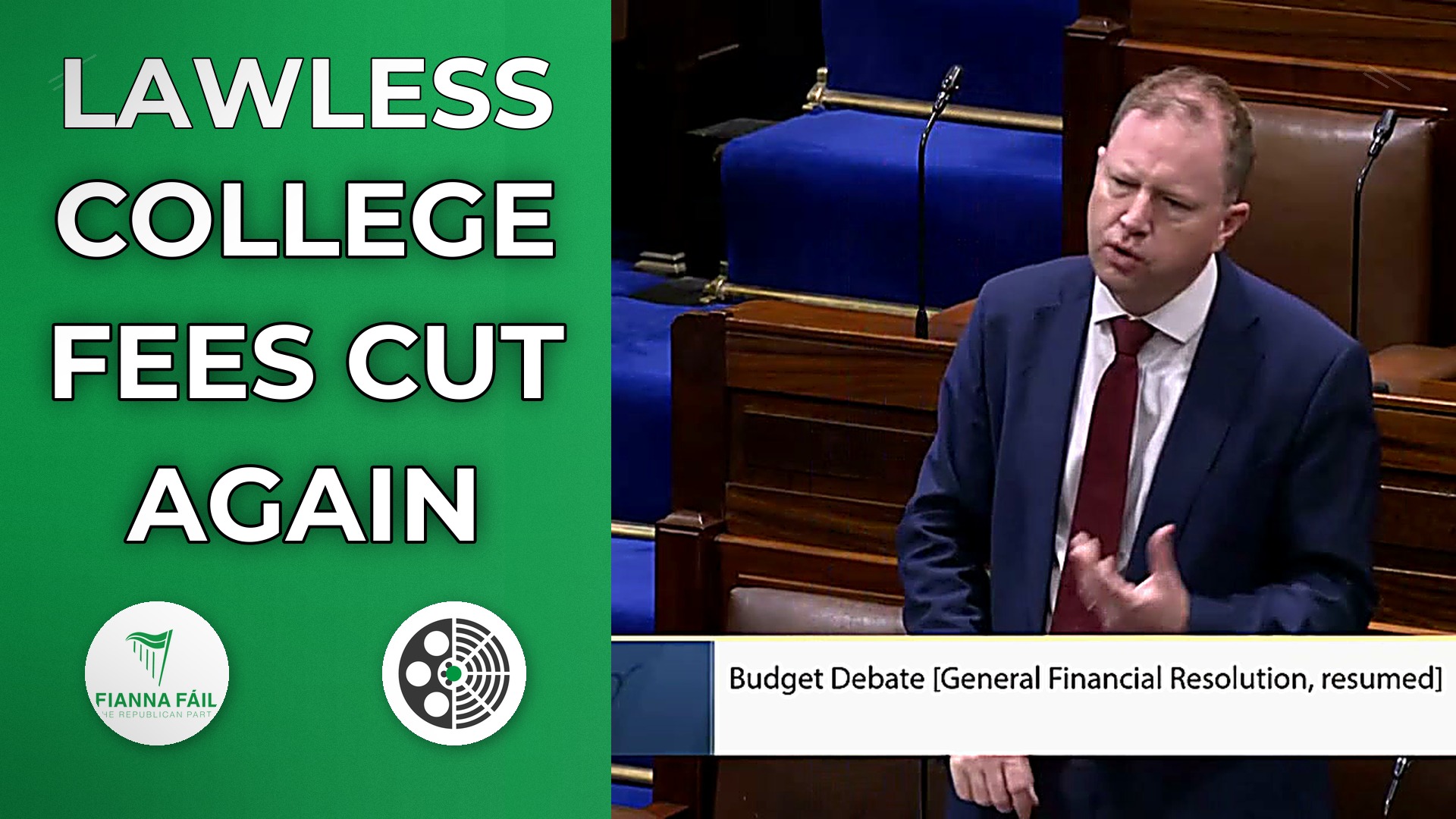
James Lawless
James Lawless sets out college fee cuts and skills investment
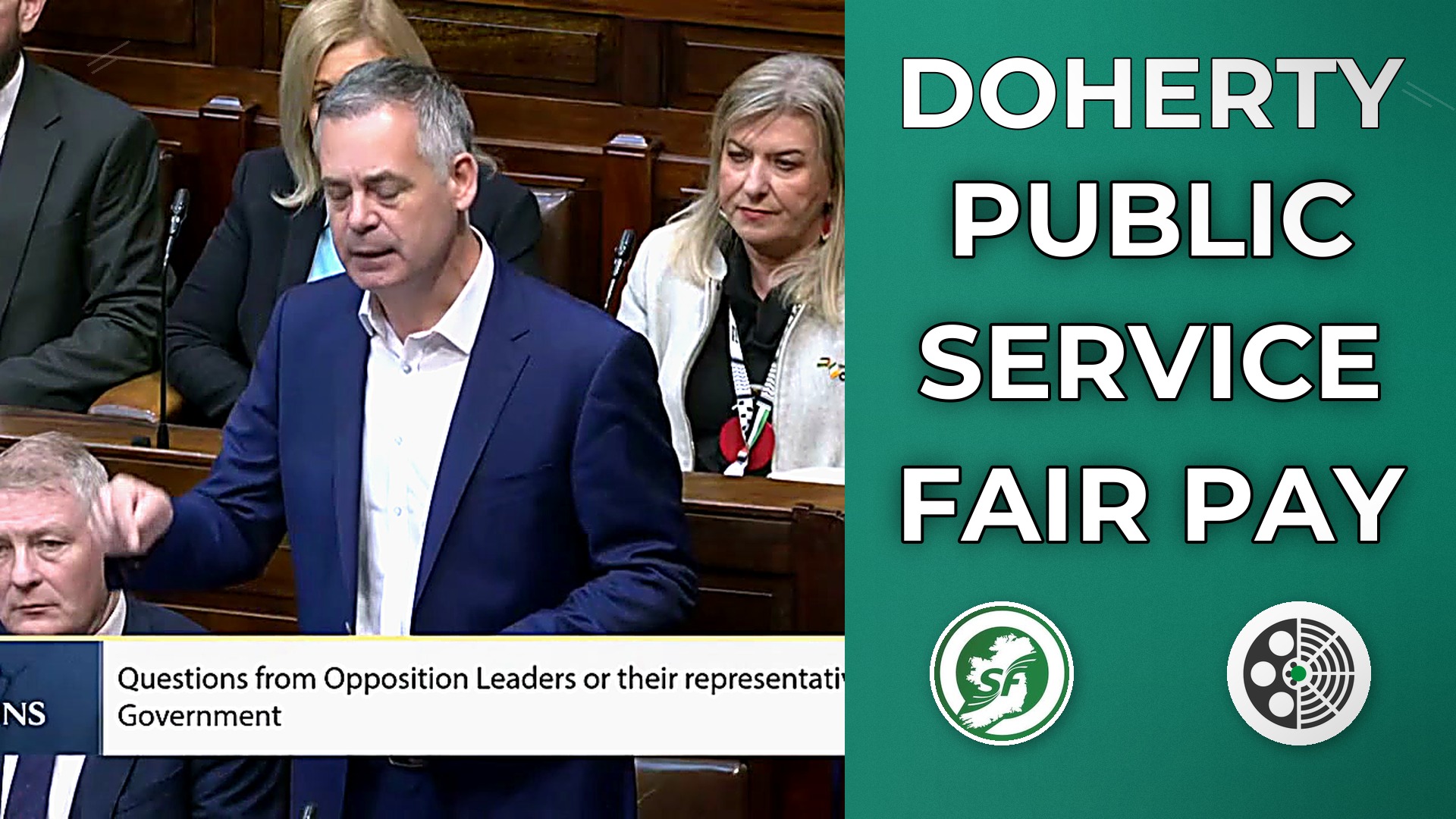
Pearse Doherty
Pearse Doherty challenges Government over public service pay
Transcript
Yesterday was a good day to bury bad news. As the hapless Culture Minister cuts
funding for RTE to save face after the culture chaos, it emerged that there
would be no living wage in one of the richest countries in the world.
Now you deigned to allow the 79 cent an hour increase go ahead on the minimum
wage but once again this government has been shaken down by the hospitality
sector and other sectors addicted to low pay. The lobbyists have earned their
crust again. Abandoning the government goal of a living wage by 2029 will be a
massive stain on your party minister and on Fianna Fáil. Now this directly hits
one in ten workers, the lowest paid people in the country directly in the
pocket and while you spend over 200 million euros to cut capital gains tax
for the wealthiest in our society this week there is no end to this
government's gaslighting of working people, insults laid on top of injury
days away from the first nationwide strike in a generation. So Minister what
are you going to do about this in the next few days? Because workers are
paying attention. They don't forget and they won't forget and they know what you
did last year. They live every single day with the consequences. Instead of
providing indexation of wages and allowing inflation you took the guts of a
billion from them and stealthed tax increases and you gave that to the
burger barons of the big builders in the form of VAT cuts. Workers paid for the
profits enjoyed by developers and diners and they are wise to you and the
income tax moves this year Minister still leaves them behind where they
should have been. They also know what you did when fuel protesters brought the
country to a standstill. Another sector got a special deal. Good for them but it
lays down a marker. It sets a precedent. Now your message is clear. Threaten the
authority of the state. Get what you want. Play by the rules and not only will we
ignore you but Jack and Micheal will patronise and disrespect you too. And now
since Budget Day we have the Minister and the Taoiseach taunting public sector
workers. They say there's no basis for a strike they say but the record says
differently. Public sector workers know that you've been foot-dragging on
existing sexual bargaining awards. They know from the exploratory talks earlier
this year that the government isn't and wasn't serious about addressing the
rising cost of living and the budget has confirmed that. They know inflation is
now at nearly four percent and rising. They know that their bills are out of
control. They know as well that it's economically and fiscally reckless in
the current uncertain global environment for the government to allow the last pay
deal to elapse without a successor. But you did it anyway. Absolutely on brand
for Fine Gael and Fianna Fáil. And I will say this too. The Labour Party will not be
passing any pickets here in Leinster House next Wednesday. And I will call on
other colleagues to join us in doing the same in solidarity with the workers here.
So Minister will you drop the arbitrary preconditions and commit to engaging in
good faith with public sector trade unions on pay? And will you confirm the
future pay increases for public sector workers will at a very minimum protect
their wages against inflation?
Thank you Deputy Nash for his very important question and
critically in relation to first of all I'll address lower paid workers in the
economy which we came forward with a 5.6 percent increase in the national
minimum wage which is right now growing significantly ahead of inflation.
Obviously wage growth in our economy for next year is projected to be at 4.1
percent which means that lower paid workers are getting increases which are
ahead of inflation. And that's been the case over the last number of years where
we see about 67 percent of an increase in minimum wage workers pay over the
last four years. Again running significantly ahead of inflation. And I
would point out that this government has been at the very forefront of
introducing additional protections for the lower pay. We banned zero-hour
work. We've brought forward tips legislation to protect the most
vulnerable. We brought forward for first time with Minister Derek O'Leary auto
enrolment to protect the future of workers. And as we embark upon an era
where people are living longer and you'll have a million people over the
age of 65 by 2030. That's protecting their future. We also brought forward a
number of areas supporting remote working. Again supporting a more agile
approach to working. We brought in a sick leave scheme as well where now there is
a safety net whereby someone can go directly on to illness benefit. Again
supporting workers in our economy. And that's the key thing that we have to do.
But also I have to ensure that employment keeps strong. I have a dual
obligation in that regard. And looking at the increased cost that businesses have
faced. I have set out and I said out in this house here yesterday I never hide
from anyone. I put it on the record of the Dáil here yesterday in relation to
the living wage. That I was annulling the 2029 deadline. But also saying that
we're going to track prevailing conditions. And I want to be very clear
to lower paid workers. I always want to see lower paid workers getting an
increase in line with wage growth. One which supports them and keeps them ahead
of inflation. And that's what this government has been about. And in relation
to public service pay deal. I have made it abundantly clear. The invitations are
out there. We want the unions to come and take their seats at the negotiation
table. That's how you get a sustainable agreement that first of all delivers
fair pay for the years ahead for those workers. Who hold up the valuable public
services are in our economy. That this government really really appreciates. For
our teachers, our nurses, our frontline workers, our council workers, our outdoor
staff. Every single day doing huge work in our economy. We are asking their
leaders to step up. Come to the negotiation table and work a
sustainable agreement for the taxpayer. And also to give them fair pay. Like its
predecessors did. And I pointed out to Deputy Doherty. Increases over the last
number of years ahead of inflation. And critically protecting the lowest paid in
our economy. And that's what Budget 2027 was about. Giving increases beyond that
of inflation. And the wider public service. Helping people in the most
vulnerable. With disabilities and our older people with additional increases.
Let's be honest. If Finnegan and Fianna Fáil had their way. There is absolutely no way
without the bulwark that we introduced against low pay. The Low Pay Commission.
There's no way without the Low Pay Commission that the minimum wage would
have increased year on year in recent years. And the Minister and others have
shown their true colours in that regard before. We know that working people are
not a priority. And this week's budget was actually an opportunity to help to
move the dial. And a last-chance effort could be made in the budget to avert
next week's action. But that chance was blown. Workers. Public sector workers.
Workers across the country have made their assessment on the budget. You had
the chutzpah to say that this was a workers budget. At the same time that you
cut well taxes for the wealthiest across this country. The cognitive dissonance is
absolutely extraordinary. It is breathtaking. And the arrogance of the
Minister Chambers with the comments they've made this week are quite
extraordinary. And they are only serving to inflame the situation. So
Minister, I'll ask you again. The clue is in the title. They're pay talks. Do you
not think it is reasonable of trade unions to expect that pay would be
prioritised at the outset of pay talks? The clue is in the title.
Thank you, Lass Kean-Cora. And that's why the government has put together a figure to
commence negotiations. They've put together 1.2 billion euro on the table to commence
negotiations and ask our union leaders to come and negotiate and work a
sustainable agreement. And I'm very clear it has to protect those who deliver our
public services and give them increases that support their families, of which we
appreciate the work that they do, which is most important. I also pointed out
that you have mentioned about a budget not rewarding work and rewarding
higher paid workers. If you talk about the guard, talk about the nurse getting
1,386 euro back a year. Those are the people that keep our economy going. So
many middle-income earners that don't qualify for benefits in our society but
are doing everything they can to support their families and work so hard. We've
supported the lower paid workers with an increase of 5.6%. We've increased
indexation of tax credits by 6.25%. We've increased the top rate
of entry point for tax by 5.6%. Again, ensuring that we are rewarding work, that
those who are working hard in our economy get the rewards and create the
resources to protect the most vulnerable, to look after those with disabilities, to
protect our pensioners with increases and ensure that we can run efficient
public services. And that's what we want to do in the context of public sector
pay deals. The negotiation table is open. Please take your seats.